
Explain 10 heart disease with ecg report to understand the disease and what we should point out
Reading File
Now let me search the medical library for ECG findings across the major heart diseases in parallel.
Finding Sources
Finding Sources
Finding Sources
Finding Sources
Finding Sources
Finding Sources
Finding Sources
Finding Sources
Finding Sources
Good, I have enough context to work from Braunwald's and other sources. Let me read the key ECG sections from Braunwald's and Tintinalli's simultaneously.
Reading File
Reading File
Finding Sources
Finding Sources
Finding Sources
Finding Sources
Finding Sources
Finding Sources
Finding Sources
Reading File
Reading File
Finding Sources
I now have enough textbook-sourced material to write a thorough, well-organized answer. Let me fetch a couple of the key ECG images to include visually.
Loading Image
Finding Sources
Finding Sources
I now have comprehensive material from multiple authoritative textbooks (Braunwald's, Harrison's, Tintinalli's, Goldman-Cecil, Fuster & Hurst's, Rosen's). Let me compose the full answer.
10 Heart Diseases: ECG Findings and Key Points
The ECG is one of the most powerful first-line tools in cardiology. Here is a thorough guide to 10 major cardiac conditions, what the ECG shows, and exactly what you need to look for on the tracing.
1. ST-Elevation Myocardial Infarction (STEMI)
What is it? Complete occlusion of a coronary artery causing full-thickness (transmural) myocardial necrosis.
ECG Findings:
| Feature | Detail |
|---|---|
| ST elevation | Convex ("tombstone") upward bowing ≥1 mm in ≥2 contiguous limb leads, or ≥2 mm in precordial leads |
| Hyperacute T waves | Tall, broad, symmetrical T waves - earliest sign, within minutes of occlusion |
| Pathological Q waves | Width ≥0.04 sec (1 small square), depth ≥25% of R wave height - appear within hours |
| Reciprocal ST depression | ST depression in leads "opposite" to the infarct territory |
| R-wave loss | Progressive loss of R-wave amplitude over infarcted territory |
| T-wave inversion | Follows ST elevation as ischemia persists |
Territory localization:
- Inferior (II, III, aVF) = RCA occlusion
- Anterior (V1-V4) = LAD occlusion
- Lateral (I, aVL, V5-V6) = LCx occlusion
- Posterior = tall R and ST depression in V1-V2 (mirror image)
What to point out: Look for ST elevation first, then check for reciprocal changes in opposite leads. A new LBBB in the right clinical context is treated as a STEMI equivalent. Serial ECGs every 15-30 minutes are essential if the first is non-diagnostic. - Rosen's Emergency Medicine; Harrison's 22E
2. Non-ST-Elevation Myocardial Infarction (NSTEMI) / Unstable Angina
What is it? Partial coronary occlusion causing subendocardial ischemia without full-thickness necrosis (NSTEMI has elevated troponin; unstable angina does not).
ECG Findings:
| Feature | Detail |
|---|---|
| ST depression | Horizontal or downsloping ≥0.5-1 mm in ≥2 contiguous leads |
| T-wave inversion | Symmetric, deep (especially in V1-V4 for LAD territory) |
| No pathological Q waves | Key distinguishing point from STEMI |
| Normal ECG | Present in up to 30-40% of NSTEMI cases |
What to point out: ST depression is subendocardial ischemia until proven otherwise. Deeply inverted, symmetric T-waves in V1-V4 (Wellens syndrome) are a warning sign of critical LAD stenosis - these patients often have no pain and are at high risk for anterior STEMI. A normal ECG does not rule out NSTEMI - troponins are the definitive test. - Goldman-Cecil Medicine; Tintinalli's
3. Atrial Fibrillation (AF)
What is it? Chaotic, disorganized atrial electrical activity from multiple re-entrant wavelets, replacing normal sinus rhythm.
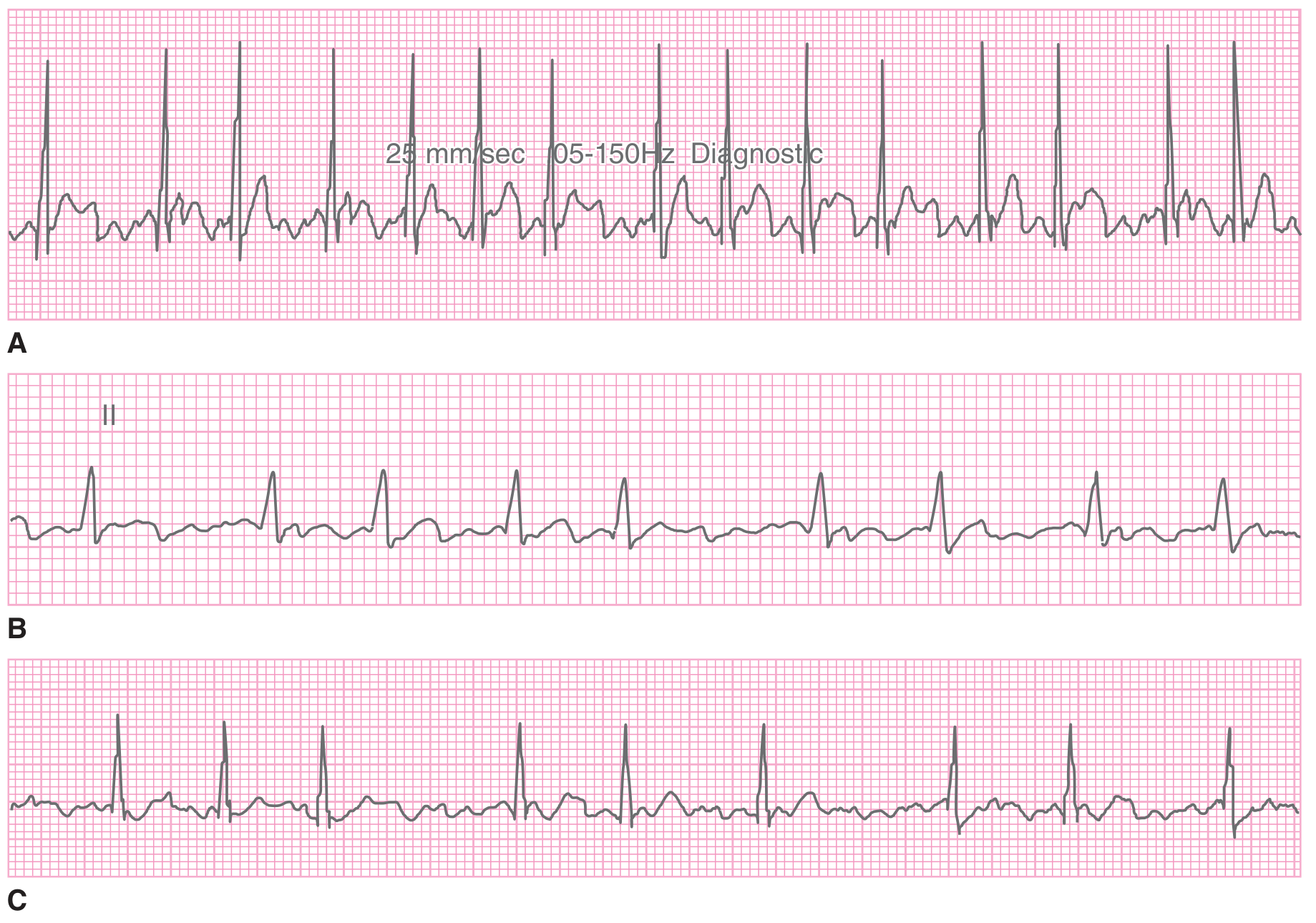
ECG Findings:
| Feature | Detail |
|---|---|
| No P waves | Replaced by chaotic fibrillatory baseline (best seen in V1) |
| Irregularly irregular R-R intervals | The hallmark - no predictable pattern whatsoever |
| Atrial rate | 350-600 beats/min (not all conducted) |
| Ventricular rate | Variable, typically 100-170 bpm with intact AV node |
| Narrow QRS | Unless pre-existing bundle branch block or accessory pathway |
What to point out: The phrase "irregularly irregular" is the key description. If QRS complexes are wide AND irregularly irregular, suspect AF with aberrant conduction or WPW - this is dangerous and adenosine/AV nodal blockers are contraindicated in WPW-AF. Atrial rate >200 bpm with wide QRS = WPW until proven otherwise. - Tintinalli's; Fuster & Hurst's The Heart 15E
4. Atrial Flutter
What is it? A macro-reentrant circuit in the right atrium, producing rapid but organized atrial activity.
ECG Findings:
| Feature | Detail |
|---|---|
| Flutter (F) waves | Sawtooth pattern at ~300 bpm, best seen in leads II, III, aVF and V1 |
| No isoelectric baseline | The sawtooth waves are continuous |
| Regular ventricular rate | Typically 2:1 block = ~150 bpm (a rate of exactly 150 should always raise suspicion) |
| Narrow QRS | Unless pre-existing aberrancy |
What to point out: At 2:1 AV block the flutter waves can hide within the QRS complex. Press the calipers to the T-waves - you will often find flutter waves buried there. The rate of exactly 150 bpm is the classic "red flag." Variable AV block produces an irregular ventricular response that mimics AF. - Tintinalli's Emergency Medicine
5. Complete (Third-Degree) AV Heart Block
What is it? Complete failure of conduction between the atria and ventricles. The atria and ventricles beat independently (AV dissociation).
ECG Findings:
| Feature | Detail |
|---|---|
| AV dissociation | P waves and QRS complexes march independently, with NO relationship between them |
| Atrial rate > ventricular rate | e.g., P waves at 75 bpm, QRS at 35-40 bpm |
| Escape rhythm QRS | Narrow if junctional escape (above bundle of His); wide and bizarre if ventricular escape (below His) |
| Regular P-P and R-R intervals | Each is internally regular, just not linked to each other |
Comparison - AV Block ladder:
- 1st degree: PR >200 ms, every P conducts
- 2nd degree Mobitz I (Wenckebach): PR progressively lengthens until a QRS drops
- 2nd degree Mobitz II: Fixed PR, then sudden dropped QRS - more dangerous, can progress to complete block
- 3rd degree: Complete dissociation
What to point out: Always calculate atrial rate AND ventricular rate separately. Map out the P waves - they are often hidden in T waves or QRS. The key diagnostic criterion is that P-R intervals vary continuously (there is no consistent PR relationship). A wide, slow escape rhythm means a low ventricular escape focus - these patients need urgent pacing. - Goldman-Cecil Medicine
6. Ventricular Tachycardia (VT)
What is it? Three or more consecutive ventricular beats at ≥100 bpm, originating below the bundle of His.
ECG Findings:
| Feature | Detail |
|---|---|
| Wide QRS | ≥120 ms (≥3 small squares) |
| Rate | 100-250 bpm |
| AV dissociation | P waves independent of QRS - pathognomonic of VT when seen |
| Fusion beats | A sinus P wave partially depolarizes the ventricle simultaneously with the VT beat - "hybrid" QRS |
| Capture beats | Narrow QRS amid wide ones when a sinus P wave fully captures the ventricle |
| Concordance | All precordial leads (V1-V6) point the same direction (all positive or all negative) |
| QRS axis | Extreme axis deviation (northwest axis, -90° to ±180°) |
What to point out: Any wide-complex tachycardia in a patient with structural heart disease is VT until proven otherwise - never assume SVT with aberrancy. AV dissociation, fusion beats, and capture beats are the "smoking gun" findings. The Brugada criteria or Vereckei algorithm can help differentiate VT from SVT with aberrancy. A QRS width >0.14 s in RBBB morphology or >0.16 s in LBBB morphology strongly favors VT. - Braunwald's Heart Disease; Rosen's Emergency Medicine
7. Acute Pericarditis
What is it? Inflammation of the pericardial sac, causing pleuritic chest pain, fever, and characteristic ECG changes in four evolving stages.
ECG Findings (4 stages):
| Stage | Finding |
|---|---|
| Stage I (hours-days) | Diffuse ST elevation (concave/saddle-shaped) in most leads except aVR and V1; PR depression in II, III, aVF, V4-V6; PR elevation in aVR |
| Stage II (days) | ST normalizes; T waves flatten |
| Stage III (1-3 weeks) | T-wave inversion (diffuse) |
| Stage IV (weeks-months) | ECG returns to normal |
Key differentiator from STEMI:
| Feature | Pericarditis | STEMI |
|---|---|---|
| ST distribution | Diffuse (most leads) | Localized (territory) |
| ST shape | Concave (saddle) | Convex (tombstone) |
| Reciprocal changes | Absent (except aVR) | Present |
| PR depression | Present | Absent |
| Q waves | No | Yes (eventually) |
What to point out: The PR depression is the most specific ECG finding for pericarditis and is often missed. Check lead aVR - it should show ST depression with PR elevation (the "reciprocal" pericarditis pattern). Spodick's sign = downsloping TP segment in lead II. - Fuster & Hurst's The Heart 15E; Braunwald's Heart Disease
8. Pulmonary Embolism (PE)
What is it? Obstruction of pulmonary vasculature causing acute right heart strain and increased right-sided pressures.
ECG Findings:
| Feature | Detail |
|---|---|
| Sinus tachycardia | Most common finding (>40% of cases) |
| S1Q3T3 pattern | S wave in lead I + Q wave and T-wave inversion in lead III (only ~20% of cases) |
| New RBBB | Right bundle branch block (complete or incomplete) from right ventricular strain |
| Right axis deviation | Sudden rightward shift |
| T-wave inversions V1-V4 | Right ventricular "strain" pattern |
| P pulmonale | Tall, peaked P wave >2.5 mm in lead II (right atrial enlargement) |
| AF/flutter | Can be precipitated by PE |
What to point out: The ECG is neither sensitive nor specific for PE - a normal ECG does not exclude it. The most important finding is sinus tachycardia with right heart strain signs in a patient with dyspnea and risk factors. The S1Q3T3 pattern is widely taught but only present in ~20% of cases. Serial ECGs showing progressive right-sided changes in a deteriorating patient with dyspnea should prompt urgent investigation. - Rosen's Emergency Medicine; Creasy & Resnik's Maternal-Fetal Medicine
9. Hypertrophic Cardiomyopathy (HCM) / Left Ventricular Hypertrophy (LVH)
What is it? HCM is a genetic (sarcomere mutation) cardiomyopathy with asymmetric septal hypertrophy; LVH may also result from hypertension or aortic stenosis.
ECG Findings:
| Feature | Detail |
|---|---|
| High QRS voltage | Sokolow-Lyon: S in V1 + R in V5 or V6 ≥35 mm; Cornell: R in aVL + S in V3 ≥20 mm (women) or ≥28 mm (men) |
| Left axis deviation | QRS axis between -30° and -90° |
| Strain pattern | Asymmetric ST depression + T-wave inversion in lateral leads (V4-V6, I, aVL) - indicates pressure overload |
| Deep narrow Q waves | In lateral/inferior leads - from septal hypertrophy ("septal Q waves") |
| Giant T-wave inversion | Massive inversion in V3-V5 in apical HCM variant |
| LAE | Left atrial enlargement - broad notched P wave in lead II (P mitrale), or deep negative P component in V1 |
What to point out: The strain pattern (ST depression in V4-V6 with asymmetric T-wave inversion) is a marker of significant pressure or volume overload and is present in ~75% of patients with LVH by voltage. Deep narrow "dagger-like" Q waves in I, aVL, V5-V6 without prior infarction should raise suspicion for HCM. - Rosen's Emergency Medicine (LVH with repolarization abnormality figure); Fuster & Hurst's 15E
10. Wolff-Parkinson-White (WPW) Syndrome
What is it? A pre-excitation syndrome with an accessory conduction pathway (bundle of Kent) bypassing the AV node, causing early ventricular activation and tachyarrhythmias.
ECG Findings (in sinus rhythm):
| Feature | Detail |
|---|---|
| Short PR interval | <120 ms (bypass of AV node delay) |
| Delta wave | Slurred, upward "notch" at the start of the QRS complex - the hallmark |
| Widened QRS | Due to delta wave; total QRS often ≥120 ms |
| Secondary ST-T changes | Discordant to the QRS direction |
During tachycardia (AVRT):
- Orthodromic AVRT (most common): Narrow QRS tachycardia - impulse goes down AV node, back up the accessory pathway
- Antidromic AVRT: Wide QRS tachycardia - impulse goes down accessory pathway, back up AV node (mimics VT)
- AF with WPW: Wide, bizarre, very rapid (>200 bpm), irregularly irregular - DANGEROUS. AV nodal blockers (adenosine, beta blockers, verapamil) are contraindicated as they can accelerate conduction down the accessory pathway
What to point out: Scan the PR interval and beginning of QRS in all 12 leads - the delta wave may be subtle in some leads. In WPW with AF, the irregular, wide, very fast rhythm can be mistaken for VF. The delta wave polarity across leads can localize the accessory pathway location. - Textbook of Family Medicine; Symptom to Diagnosis 4E; Tintinalli's Emergency Medicine
Quick ECG Reference Summary
| Condition | Rate | Rhythm | P Wave | PR | QRS | ST/T |
|---|---|---|---|---|---|---|
| STEMI | Variable | Regular | Normal | Normal | ±wide (LBBB) | ST elevation + reciprocal depression |
| NSTEMI/UA | Variable | Regular | Normal | Normal | Narrow | ST depression, T inversion |
| Atrial Fibrillation | 100-170 | Irregularly irregular | Absent (fibrillatory) | None | Narrow | Variable |
| Atrial Flutter | ~150 (2:1) | Regular | Sawtooth ~300 bpm | 2:1, 3:1, etc. | Narrow | Normal |
| 3rd Degree Block | Atria: 60-100; Ventricles: 20-40 | Dissociated | Normal, more frequent than QRS | None (dissociated) | Wide (escape) | None |
| VT | 100-250 | Regular | Dissociated | None | Wide ≥120 ms | Discordant |
| Pericarditis | Variable | Regular | Normal | PR depression | Normal | Diffuse saddle ST elevation |
| PE | >100 (tachy) | Usually regular | P pulmonale | Normal | ±RBBB | S1Q3T3, RV strain |
| LVH/HCM | Normal | Regular | ±LAE (P mitrale) | Normal | High voltage | Strain pattern, T inversion |
| WPW | Normal (or SVT) | Regular or irregular | Normal | Short (<120 ms) | Wide + delta wave | Discordant |
Sources: Braunwald's Heart Disease (10E); Tintinalli's Emergency Medicine; Goldman-Cecil Medicine; Harrison's Principles of Internal Medicine 22E; Fuster & Hurst's The Heart 15E; Rosen's Emergency Medicine; Symptom to Diagnosis 4E
This is a shared conversation. Sign in to Orris to start your own chat.