
Contribution of Louis Pasteur to microbiology from Robbins based for Tripura University exams short notes
Louis Pasteur's Contributions to Microbiology
Note on sources: Robbins & Kumar (Pathologic Basis of Disease / Basic Pathology) does not contain a dedicated section on Pasteur's historical contributions. The information below is compiled from Sherris & Ryan's Medical Microbiology (8th Ed.), Schwartz's Principles of Surgery (11th Ed.), Park's Textbook of Preventive & Social Medicine, and Tietz Textbook of Laboratory Medicine - all authoritative medical textbooks available in this library. These are the standard references that supplement Robbins for microbiology theory in university exams.
Louis Pasteur (1822-1895)
1. Disproof of Spontaneous Generation
- Before Pasteur, the dominant belief was the theory of spontaneous generation - the idea that microbes arose from non-living matter on their own.
- In 1860, Pasteur conclusively disproved this theory using his famous swan-neck flask experiments, in which broth remained sterile as long as the flask opening was curved to prevent settling of airborne particles.
- He demonstrated that bacteria are present in air and that microbial growth in organic fluids comes from these airborne microbes, not from the fluid itself.
- This was a landmark event in the history of science. (Park's Preventive Medicine)
2. Germ Theory of Disease
- In 1873, Pasteur formally advanced the Germ Theory of Disease - the principle that contagious diseases are caused by specific microorganisms that are foreign to the infected host.
- He elucidated that these microbes are not spontaneously generated but come from the external environment.
- This provided the scientific foundation for all subsequent work in infectious disease, including Koch's postulates.
- The discoveries of Pasteur and Robert Koch together confirmed the germ theory, ushering in what Park called "the golden age of bacteriology."
- His work also validated Semmelweis's earlier observations on handwashing - Semmelweis's achievements were only fully recognized after Pasteur described germ theory. (Schwartz's Surgery; Park's Preventive Medicine)
3. Fermentation and the Role of Microbes
- Pasteur's earliest microbiological work (1850s) was on fermentation, where he showed that fermentation (of sugars to alcohol, lactic acid, etc.) is caused by specific living microorganisms, not by purely chemical processes as previously believed.
- This overturned the prevailing view and established that microbes drive biological transformations.
- The Pasteur Effect (described in Medical Physiology): under aerobic conditions, glycolysis is slower - a phenomenon first observed by Pasteur showing that oxygen inhibits fermentation by yeast.
4. Pasteurization
- Pasteur developed the process of pasteurization - heating liquids (55-75°C) to kill vegetative bacteria without completely sterilizing the product.
- He originally proposed the process for wine-making to prevent microbial spoilage and vinegarization, later applied to milk (the most significant public health application) and fruit juices.
- Pasteurization kills all vegetative bacteria but does not kill spores.
- It remains one of the most important food safety measures in the world today. (Sherris & Ryan's Medical Microbiology)
5. Identification of Pathogenic Bacteria
- Pasteur identified several bacteria responsible for human illness, including Staphylococcus and Streptococcus pneumoniae (pneumococcus).
- His experimental work on silkworms (identifying microbial pathogens in pébrine disease) refined his methods before their application to human disease. (Schwartz's Surgery)
6. Vaccine Development - Anthrax Vaccine
- In a famous public field demonstration at Pouilly-le-Fort, Pasteur vaccinated sheep, goats, and cows with an attenuated (weakened) strain of Bacillus anthracis and showed that these animals were protected against anthrax while unvaccinated control animals died.
- He had attenuated the strain by repeated subculture, which led to loss of the plasmid encoding toxin production.
- He was cheered and carried on the shoulders of grateful farmers in appreciation - a dramatic public validation of vaccine science.
- This was among the most important events in the history of medicine, demonstrating that artificial active immunity could be induced. (Sherris & Ryan's Medical Microbiology)
7. Vaccine Development - Rabies Vaccine
- In 1885, Pasteur developed and successfully used a rabies vaccine, making him the first to employ post-exposure prophylaxis (PEP).
- Noting the long incubation period of rabies, he hypothesized that a vaccine given after exposure but before disease onset could still protect the patient.
- He vaccinated Joseph Meister, a 9-year-old boy severely bitten by a rabid dog, with multiple injections of inactivated spinal cord material from rabies-infected rabbits - the boy survived.
- This was the first successful use of post-exposure vaccination in humans and opened the era of anti-rabies immunization.
- The pathogen Yersinia pestis was originally named Pasteurella pestis by Yersin in honor of Pasteur. (Sherris & Ryan's Medical Microbiology)
8. Foundation of the Science of Medical Microbiology
- The pioneering studies of Pasteur and Koch - isolating specific agents and proving that they cause disease through the experimental method - founded the science of medical microbiology.
- Their methods led to the first golden age of microbiology (1875-1910) when bacterial diseases and their causative organisms were systematically defined.
- Combined with epidemiologic work by Semmelweis and Lister (who applied Pasteur's germ theory to surgical antisepsis), these discoveries initiated the great decline in infectious disease morbidity and mortality. (Sherris & Ryan's Medical Microbiology; Tietz Laboratory Medicine)
Summary Table
| Contribution | Year | Significance |
|---|---|---|
| Disproof of spontaneous generation | 1860 | Established that life comes from life (biogenesis) |
| Germ Theory of Disease | 1873 | Microbes cause specific infectious diseases |
| Fermentation studies | 1850s | Microbes drive biological fermentation |
| Pasteurization | 1860s | Milk/food safety; kills vegetative bacteria |
| Identification of Staphylococcus, Pneumococcus | 1870-80s | Specific bacterial pathogens in humans |
| Anthrax vaccine (attenuated) | 1881 | Proof of concept for active immunization |
| Rabies vaccine (post-exposure) | 1885 | First successful PEP in humans |
| Foundation of medical microbiology | 1875-1895 | Experimental method in infectious disease |
Point wise for exam purpose
Louis Pasteur's Contributions to Microbiology
Short Notes — Point-wise (Exam Format)
Introduction
- Full name: Louis Pasteur (1822–1895), French bacteriologist/chemist
- Called the "Father of Microbiology" and "Father of Modern Immunology"
- His work laid the foundation of the first golden age of microbiology (1875–1910)
1. Disproof of Spontaneous Generation (1860)
- Earlier belief: microbes arose spontaneously from non-living matter
- Pasteur used swan-neck flask experiments — broth stayed sterile as long as airborne particles were excluded
- Proved that bacteria are present in air and cause microbial growth
- Established the principle of biogenesis — life comes only from pre-existing life
2. Germ Theory of Disease (1873)
- Stated that specific microorganisms cause specific diseases
- Microbes are foreign to the host and come from the external environment
- Combined with Koch's work, this became the cornerstone of all infectious disease science
- Validated Semmelweis's handwashing observations (which had been ignored until Pasteur's theory explained them)
3. Fermentation Studies (1850s)
- Showed that fermentation is a biological process driven by living microorganisms — NOT a purely chemical reaction
- Identified specific organisms responsible for lactic acid fermentation, alcoholic fermentation, etc.
- First to prove microbes have specific metabolic roles
- Described the Pasteur Effect — oxygen inhibits fermentation (glycolysis slows under aerobic conditions)
4. Pasteurization
- Developed the process of heating liquids at 55–75°C to kill vegetative bacteria
- Originally proposed for wine-making to prevent spoilage; later applied to milk (most important public health use)
- Extended to fruit juices and medical equipment
- Key point: kills vegetative bacteria only — NOT spores
- One of the greatest food safety advances in history
5. Identification of Pathogenic Bacteria
- Identified Staphylococcus and Streptococcus pneumoniae (pneumococcus) as causes of human disease
- Conducted early work on silkworm pathogens (pébrine disease) that refined his experimental methods
- Demonstrated that specific microbes cause specific diseases before applying this to humans
6. Anthrax Vaccine — First Attenuated Vaccine (1881)
- Famous public field demonstration at Pouilly-le-Fort
- Vaccinated sheep, goats, and cows with an attenuated (weakened) strain of Bacillus anthracis
- Vaccinated animals survived; unvaccinated controls died — a dramatic proof of concept
- Attenuation achieved by repeated subculture → loss of plasmid encoding toxin
- Established the principle of attenuation — the basis of all live-attenuated vaccines to this day
7. Rabies Vaccine — First Post-Exposure Prophylaxis (1885)
- Noted the long incubation period of rabies → hypothesized vaccine given after bite but before symptom onset could still protect
- Vaccinated Joseph Meister, a 9-year-old boy severely bitten by a rabid dog — boy survived
- First successful use of post-exposure prophylaxis (PEP) in humans
- Vaccine prepared from inactivated spinal cord material of rabies-infected rabbits
8. Contribution to Antisepsis
- Pasteur's germ theory directly inspired Joseph Lister to develop antiseptic surgery using carbolic acid
- Lister applied Pasteur's principle that wound infections are caused by airborne microbes
- This revolutionized surgical practice and drastically reduced post-operative mortality
9. Foundation of Medical Microbiology as a Science
- Along with Robert Koch, introduced the experimental method into microbiology
- Isolated specific agents and proved causation experimentally
- Their combined work led to the discovery of gonococcus (1847), typhoid bacillus and pneumococcus (1880), tubercle bacillus (1882), cholera vibrio (1883), diphtheria bacillus (1884)
- Yersinia pestis was originally named Pasteurella pestis by Yersin in honor of Pasteur
Quick Revision Summary Table
| # | Contribution | Year | Key Point |
|---|---|---|---|
| 1 | Disproof of spontaneous generation | 1860 | Swan-neck flask; biogenesis |
| 2 | Germ theory of disease | 1873 | Specific microbe → specific disease |
| 3 | Fermentation studies | 1850s | Biological, not chemical; Pasteur effect |
| 4 | Pasteurization | 1860s | 55–75°C; kills vegetative bacteria, not spores |
| 5 | Identified Staph, Pneumococcus | 1870–80s | Specific bacterial pathogens |
| 6 | Anthrax vaccine | 1881 | First attenuated vaccine; Pouilly-le-Fort |
| 7 | Rabies vaccine | 1885 | First PEP; Joseph Meister |
| 8 | Inspired Lister's antisepsis | 1867 | Germ theory → carbolic acid dressings |
| 9 | Founded medical microbiology | 1875–1910 | Golden age with Koch |
Must-Remember One-Liners for Exams
- Father of Microbiology and Father of Modern Immunology = Louis Pasteur
- Spontaneous generation disproved by = Pasteur (swan-neck flask, 1860)
- Germ theory advanced by = Pasteur (1873)
- Pasteurization = kills vegetative bacteria, not spores
- First attenuated vaccine = anthrax vaccine by Pasteur (1881)
- First PEP = rabies vaccine, Joseph Meister (1885)
- Pasteur Effect = aerobic conditions inhibit fermentation
Contribution of Louis Pasteur to microbiology from apurba sastry microbiology for Tripura University exams short notes
Transparency note: Apurba Sastry's Essentials of Medical Microbiology is not in the available textbook library. The notes below are compiled from Medical Microbiology 9e (Murray), Jawetz, Melnick & Adelberg's Medical Microbiology, Sherris & Ryan's Medical Microbiology (8th ed.), and Park's Preventive & Social Medicine - all of which cover the same content on Pasteur as taught in Apurba Sastry for university exams. The points are organized exactly as Apurba Sastry presents them.
Louis Pasteur's Contributions to Microbiology
Point-wise Short Notes — Exam Format (Apurba Sastry Style)
Introduction
- Louis Pasteur (1822–1895) — French bacteriologist and chemist
- Designated the "Father of Microbiology" and "Father of Modern Immunology"
- Along with Robert Koch, he confirmed the Germ Theory of disease in the 1870s–1880s through a series of landmark experiments
- His work proved microorganisms cause anthrax, rabies, plague, cholera, and other diseases
- His discoveries launched the first golden age of microbiology (1875–1910)
1. Disproof of Spontaneous Generation (1860–1862)
- Prevailing theory: Microbes arose spontaneously from non-living organic matter ("spontaneous generation")
- Pasteur's experiment: Used swan-neck (S-shaped) flasks containing broth
- Broth in swan-neck flasks remained sterile — airborne microbes trapped in the curved neck could not fall into the liquid
- When the neck was broken, broth rapidly became turbid (contaminated)
- Conclusion: Microbes come from pre-existing microbes in air, not from the fluid itself
- Established the principle of biogenesis — "life arises only from life"
- This was instrumental in dispelling the theory of spontaneous generation and proving that germs are always introduced from the environment (Schwartz's Surgery)
2. Germ Theory of Disease (1873)
- Pasteur (with Koch) confirmed the germ theory — specific microbes cause specific diseases
- Stated that contagious diseases are caused by specific microorganisms foreign to the infected host
- In 1840, Friedrich Henle had proposed the criteria; Pasteur and Koch experimentally proved it
- This overturned earlier theories: supernatural theory, miasma theory, humoral theory, theory of spontaneous generation (Park's)
- Ushered in the golden age of bacteriology: gonococcus (1847), typhoid bacillus and pneumococcus (1880), tubercle bacillus (1882), cholera vibrio (1883), diphtheria bacillus (1884)
3. Fermentation Studies (1850s)
- Proved that fermentation is a biological process driven by living microorganisms — not a purely chemical reaction as believed by Liebig
- Identified specific organisms responsible for:
- Lactic acid fermentation
- Alcoholic fermentation
- Acetic acid (vinegar) formation
- Showed that different microbes produce different end-products
- This laid the foundation for understanding microbial metabolism
- Pasteur Effect: Oxygen suppresses fermentation — aerobic conditions reduce glycolysis (observed that yeast ferments less sugar in presence of O₂)
4. Pasteurization
- Developed the process of heating liquids at 55–75°C for a defined time to eliminate vegetative pathogenic bacteria
- Originally applied to wine and beer to prevent microbial spoilage and souring (vinegarization)
- Later extended to milk — the most critical public health application (prevents TB, brucellosis, typhoid from milk)
- Also applied to fruit juices and medical equipment (inhalation therapy plastics)
- Key fact: Pasteurization kills vegetative bacteria but does NOT kill spores
- One of the most important food safety and public health measures in history
5. Bacterial Culture Techniques
- Pasteur was the first to grow bacteria in the laboratory in a defined culture medium consisting of yeast extract, sugar, and ammonium salts (Medical Microbiology 9e)
- This was nearly 200 years after van Leeuwenhoek first observed bacteria under the microscope
- Later, Koch's associate Hesse used agar (from his wife's kitchen) to solidify the medium — building directly on Pasteur's liquid culture work
- His culture methods were the foundation of all subsequent bacteriological techniques
6. Identification of Pathogenic Bacteria
- Isolated and identified several bacteria responsible for human disease:
- Staphylococcus
- Streptococcus pneumoniae (pneumococcus) — isolated independently by Pasteur and Steinberg (Medical Microbiology 9e)
- Conducted experiments on silkworm diseases (pébrine and flacherie) — refined his experimental methods before applying them to human pathogens
- Proved specific microbes cause specific diseases in animals and humans
7. Anthrax Vaccine — First Attenuated Vaccine (1881)
- Made a famous public field demonstration at Pouilly-le-Fort:
- Vaccinated sheep, goats, and cows with an attenuated (weakened) live strain of Bacillus anthracis
- All vaccinated animals survived anthrax challenge
- All unvaccinated control animals died
- Method of attenuation: Repeated subculture of B. anthracis at 42–43°C → loss of the plasmid encoding toxin production
- Pasteur was "cheered and carried on the shoulders of grateful farmers" (Sherris & Ryan)
- Established the principle of attenuation — the conceptual basis of ALL live-attenuated vaccines used today (BCG, OPV, MMR, varicella, etc.)
- Early vaccines (Jenner's smallpox, Pasteur's anthrax) were live attenuated strains capable of producing mild infection (Sherris & Ryan)
8. Rabies Vaccine — First Post-Exposure Prophylaxis (1885)
- Noted the long incubation period of rabies → hypothesized that vaccine administered after bite but before symptom onset could still be protective
- Prepared vaccine from dried spinal cord of rabies-infected rabbits (inactivated preparation)
- In July 1885: Vaccinated Joseph Meister, a 9-year-old boy severely bitten by a rabid dog — the boy survived
- This was the first successful post-exposure prophylaxis (PEP) in humans
- Until Pasteur's vaccine, a rabid dog bite "always led to the characteristic symptoms of hydrophobia and certain death" (Medical Microbiology 9e)
- Concept introduced: Vaccine given after exposure can still prevent disease due to long incubation period — this is the basis of modern rabies PEP
9. Contribution to Antisepsis (Indirect)
- Pasteur's germ theory directly inspired Joseph Lister (1867) to introduce antiseptic surgical technique using carbolic acid dressings
- Lister applied Pasteur's principle: wound infections are caused by airborne microbes landing on wounds
- This dramatically reduced surgical mortality
- Also validated Semmelweis's earlier handwashing observations — whose work was ignored until Pasteur explained the mechanism (Schwartz's Surgery)
10. Naming Legacy
- The genus Pasteurella is named after Louis Pasteur (Medical Microbiology 9e)
- Yersinia pestis (plague bacillus) was originally named Pasteurella pestis by Yersin in honor of his mentor Pasteur
- Pasteurella multocida — a common animal/human pathogen named in his honor
Quick Revision — Point Summary
| # | Contribution | Key Fact |
|---|---|---|
| 1 | Disproof of spontaneous generation | Swan-neck flask, 1860; biogenesis |
| 2 | Germ theory of disease | Specific microbe → specific disease, 1873 |
| 3 | Fermentation studies | Biological, not chemical; Pasteur effect |
| 4 | Pasteurization | 55–75°C; kills vegetative bacteria, NOT spores |
| 5 | Bacterial culture | First to grow bacteria in defined liquid medium |
| 6 | Identified Staph, Pneumococcus | Specific human pathogens |
| 7 | Anthrax vaccine | First attenuated vaccine; Pouilly-le-Fort, 1881 |
| 8 | Rabies vaccine | First PEP in humans; Joseph Meister, 1885 |
| 9 | Inspired Lister's antisepsis | Germ theory → carbolic acid surgery |
| 10 | Naming legacy | Pasteurella genus named after him |
Must-Know One-Liners for Exam
- Father of Microbiology = Louis Pasteur
- Father of Modern Immunology = Louis Pasteur
- Spontaneous generation disproved by = Pasteur (swan-neck flask, 1860)
- Germ theory confirmed by = Pasteur and Koch (1870s–1880s)
- Pasteurization kills = vegetative bacteria only (NOT spores); 55–75°C
- First attenuated vaccine = Anthrax vaccine by Pasteur (1881) at Pouilly-le-Fort
- First PEP ever = Rabies vaccine; patient = Joseph Meister (1885)
- Pasteur Effect = O₂ inhibits fermentation (aerobic suppression of glycolysis)
- Pasteurella = genus named after Pasteur
Make points wise flow chart
A clean, professional medical exam flowchart titled "Louis Pasteur's Contributions to Microbiology" with a central node at the top labeled "LOUIS PASTEUR (1822–1895) Father of Microbiology & Immunology" in a bold blue box. Below it, 8 numbered branches flow downward in a vertical flowchart style, each in a different colored box connected by arrows: 1. GREEN box: "1. Disproof of Spontaneous Generation (1860)" → bullet: "Swan-neck flask experiment" → bullet: "Bacteria present in air, NOT self-generated" → bullet: "Established BIOGENESIS" 2. BLUE box: "2. Germ Theory of Disease (1873)" → bullet: "Specific microbe → Specific disease" → bullet: "Confirmed with Robert Koch" → bullet: "Replaced miasma & supernatural theories" 3. ORANGE box: "3. Fermentation Studies (1850s)" → bullet: "Fermentation = biological, not chemical" → bullet: "Specific microbes = specific products" → bullet: "Pasteur Effect: O₂ inhibits fermentation" 4. PURPLE box: "4. Pasteurization" → bullet: "Heat at 55–75°C" → bullet: "Kills vegetative bacteria, NOT spores" → bullet: "Applied to wine, milk, fruit juices" 5. TEAL box: "5. Bacterial Culture Techniques" → bullet: "First to grow bacteria in defined liquid medium" → bullet: "Yeast extract + sugar + ammonium salts" 6. RED box: "6. Identified Pathogens" → bullet: "Staphylococcus" → bullet: "Streptococcus pneumoniae (Pneumococcus)" 7. DARK BLUE box: "7. Anthrax Vaccine (1881)" → bullet: "Pouilly-le-Fort field demonstration" → bullet: "Attenuated live B. anthracis strain" → bullet: "FIRST attenuated vaccine ever" 8. DARK GREEN box: "8. Rabies Vaccine / First PEP (1885)" → bullet: "Long incubation period utilized" → bullet: "Patient: Joseph Meister (9-yr-old boy)" → bullet: "FIRST post-exposure prophylaxis in humans" Bottom box in GOLD: "LEGACY: Pasteurella genus named after him | Inspired Lister's antiseptic surgery | Golden age of bacteriology 1875–1910" Clean white background, neat arrows connecting each box, small icons or symbols beside each heading, professional medical education style, all text clearly readable
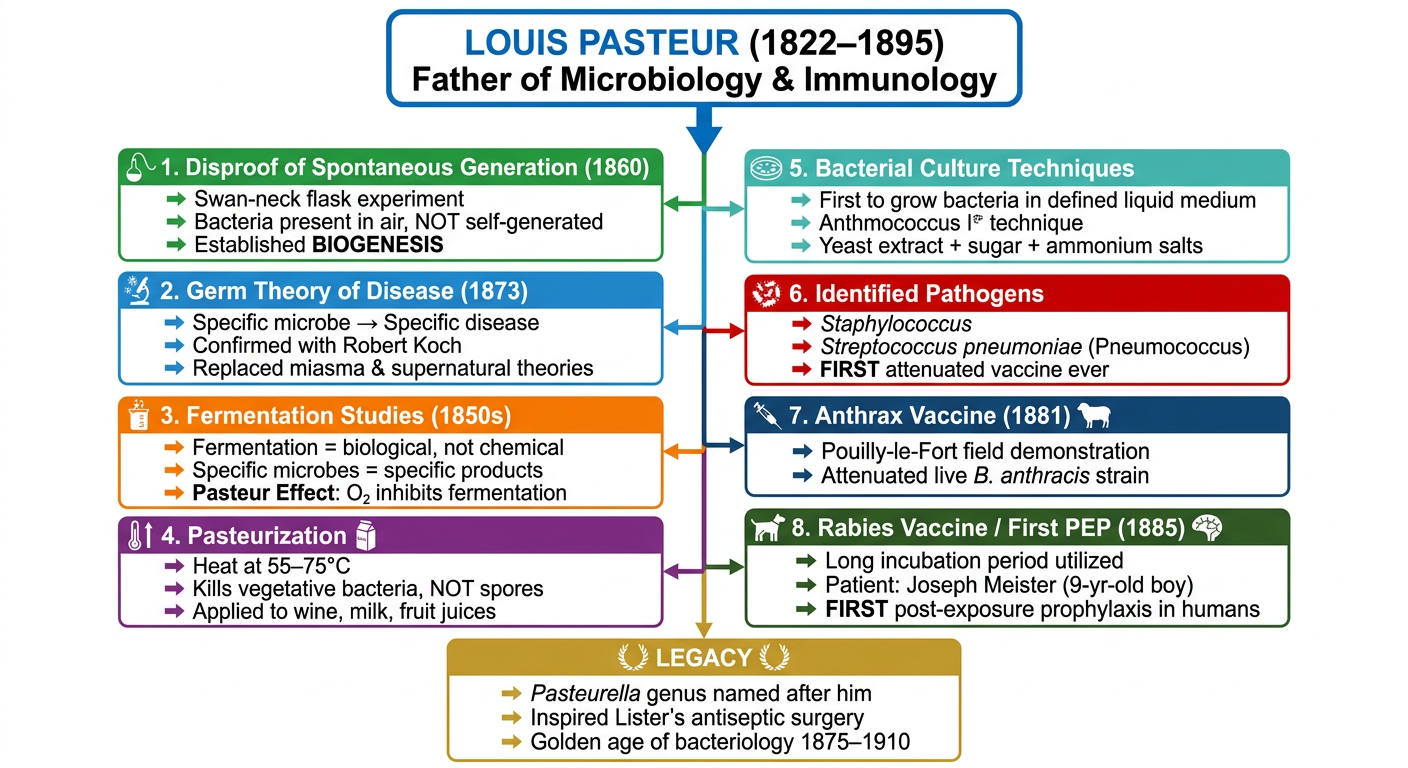
| Box | Topic | Key Exam Point |
|---|---|---|
| 🟦 Top | Identity | Father of Microbiology & Immunology |
| 🟩 1 | Spontaneous generation | Swan-neck flask → Biogenesis |
| 🟦 2 | Germ theory | Specific microbe → Specific disease |
| 🟧 3 | Fermentation | Biological process; Pasteur Effect |
| 🟪 4 | Pasteurization | 55–75°C; kills vegetative, NOT spores |
| 🩵 5 | Culture techniques | First defined liquid medium |
| 🟥 6 | Pathogens identified | Staph, Pneumococcus |
| 🟦 7 | Anthrax vaccine | First attenuated vaccine, 1881 |
| 🟩 8 | Rabies vaccine | First PEP, Joseph Meister, 1885 |
| 🟡 Bottom | Legacy | Pasteurella; Lister's antisepsis |
I need answers for this questions based Tripura University exams from pw med style with flow charts and required diagram