
I have this file from this file make another pdf with same question, with option and answer along with it and explanation in easy crisp and concise answer specific according to same pattern like the pdf I will you next
cd /tmp/workspace/attachments/e7c83773-af80-431d-9700-1c32dc91fc41/ && python3 -c " import pdfplumber with pdfplumber.open('FMT.pdf') as pdf: print(f'Total pages: {len(pdf.pages)}') for i, page in enumerate(pdf.pages): print(f'\n=== PAGE {i+1} ===') text = page.extract_text() if text: print(text[:3000]) "
An error occurred (ValidationException) when calling the ConverseStream operation: The model returned the following errors: prompt is too long: 258288 tokens > 200000 maximum
We encountered an error while processing your request. Please try again or reach out to us for help.

I need explanation just like this photo along with question
- Clinical scenario MCQ with 4 options (A/B/C/D)
- Answer stated
- "Solution: #ZVrecommended" heading
- Explanation with bullet points covering key features, differentials ("Why not others"), and a concise summary box
Which topic do you want a question on (in the same style as the image)? · What level of difficulty?
Now create a pdf containing the question and answer with option and explanation in the same pattern same length explanation also add picture and table
cd "/tmp/workspace/attachments/e7c83773-af80-431d-9700-1c32dc91fc41/" && python3 -c " import pdfplumber with pdfplumber.open('FMT (1).pdf') as pdf: print(f'Pages: {len(pdf.pages)}') for i, page in enumerate(pdf.pages[:3]): print(f'--- PAGE {i+1} ---') print(page.extract_text()) print() "
python3 -c " import pdfplumber with pdfplumber.open('/tmp/workspace/attachments/e7c83773-af80-431d-9700-1c32dc91fc41/FMT (1).pdf') as pdf: # Get pages 4-12 (first chapter) for i in range(3, 12): print(f'--- PAGE {i+1} ---') print(pdf.pages[i].extract_text()) print() "
mkdir -p /tmp/workspace/fmt-pdf && ls /tmp/workspace/fmt-pdf/
- Clinical scenario MCQs with 4 options
- Answer key section
- Detailed solutions with bullet points, tables, and "Why not others" explanations
- Images/diagrams embedded
forensic skeletal age determination bone X-ray epiphysis fusion
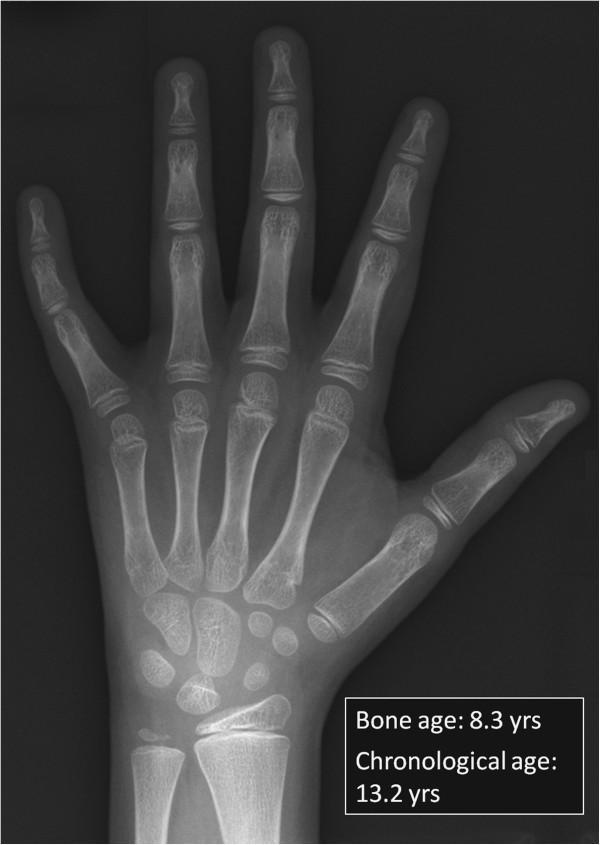
This diagnostic image is a posterior-anterior (PA) X-ray of the left hand and wrist, primarily used for bone age assessment. The radiograph reveals significant constitutional growth delay. Although the patient's chronological age is 13.2 years, the skeletal development corresponds to a bone age of approximately 8.3 years. Key visual findings include the presence of multiple carpal ossification centers that are small and rounded, lacking the mature morphology and fusion expected for an early adolescent. The metacarpals and phalanges exhibit wide, radiolucent growth plates (physeal lines), with distinct epiphyses that are not yet fused to the metaphyses. The ulnar styloid and distal radial epiphysis are also underdeveloped relative to the chronological age. This clinical photograph demonstrates delayed skeletal maturation, a common feature in conditions like Barth syndrome or other constitutional growth delays, serving as a pedagogical tool for understanding the discrepancy between chronological and biological age in pediatric endocrinology and metabolic disorders.
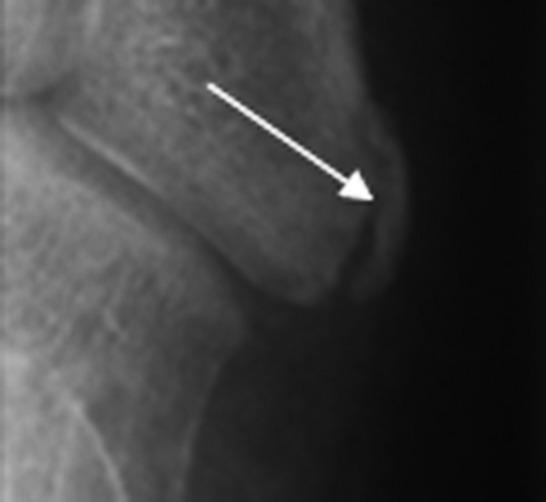
A close-up diagnostic X-ray of the base of the fifth metatarsal in a 13-year-old male, demonstrating maturity stage 2 of ossification. The radiograph shows the proximal epiphysis as a small, thin radio-opaque ossified flake located lateral to the metatarsal body. An arrow indicates the site where the epiphysis is commencing fusion with the metaphysis. Distinct radiolucent spaces are visible between the epiphyseal flake and the metaphyseal surface, signifying incomplete fusion. The lateral aspect of the metatarsal body appears slightly flattened but is beginning to show rounding as the skeletal maturation progresses. This image serves as a clinical reference for assessing pediatric skeletal age and forensic age estimation based on foot development patterns.
This diagnostic image is a posterior-anterior (PA) x-ray radiograph of a pediatric left hand and wrist, utilized for skeletal maturation and bone age assessment. The radiograph clearly depicts the distal radius and ulna, the carpal bones, metacarpals, and phalanges. Key educational features include the presence of open epiphyseal plates (growth plates) at the distal ends of the radius and ulna, as well as at the bases of the phalanges and the heads of the metacarpals. Specifically, the image is used to identify the 'IJ stage' of radial maturation according to the Hagg and Taranger method, which correlates skeletal development with the pubertal growth spurt. This stage is characterized by the initial fusion or specific morphological changes in the distal radial epiphysis. The visualization of these ossification centers is critical in orthodontics and pediatric orthopedics to determine biological age and predict remaining facial or systemic growth potential.
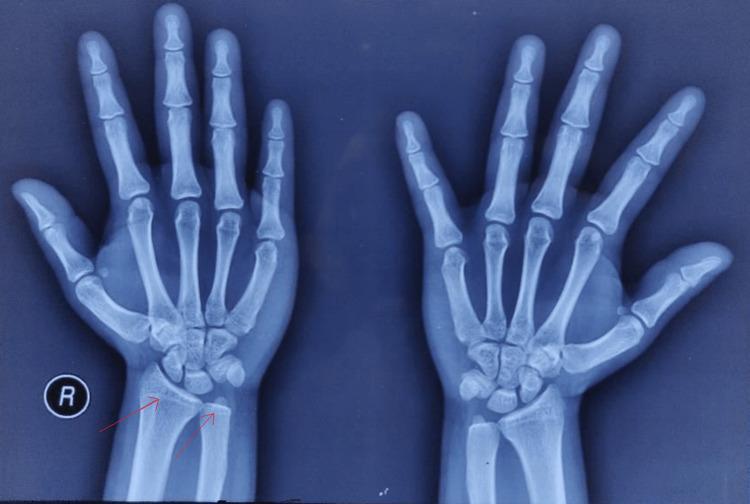
This diagnostic image is an anteroposterior (AP) X-ray radiography of both the right and left hands and wrists. The skeletal assessment focuses on bone age determination and developmental maturity. Visible anatomical structures include the phalanges, metacarpals, carpal bones, and the distal radius and ulna of both limbs. A key clinical finding, highlighted by red arrows on the right wrist, is the complete ossification and fusion of the distal epiphyses of the radius and ulna with their respective metaphyses. There is a total absence of visible radiolucent lines representing open physes (growth plates) across all long bones of the hands and wrists, including the metacarpals and phalanges. This visual state signifies advanced skeletal maturity, corresponding to a bone age of approximately 17 years or older. This imaging is commonly used in pediatric endocrinology to evaluate discrepancies between chronological age and skeletal development in conditions such as congenital adrenal hyperplasia or precocious puberty.
python3 -c " import requests url = 'https://cdn.orris.care/cdss_images/pmc_clinical_VQA_aeca84fc339ce5b2dd732031053d2fb86b41debbaef346fe7b9555a3bb6a95b9.jpg' r = requests.get(url, timeout=15) with open('/tmp/workspace/fmt-pdf/bone_age_xray.jpg', 'wb') as f: f.write(r.content) print('Downloaded:', len(r.content), 'bytes') "
~/fmt-pdf/create_fmt_pdf.py
from reportlab.lib.pagesizes import A4
from reportlab.lib import colors
from reportlab.lib.units import mm, cm
from reportlab.lib.styles import getSampleStyleSheet, ParagraphStyle
from reportlab.lib.enums import TA_LEFT, TA_CENTER, TA_JUSTIFY
from reportlab.platypus import (
SimpleDocTemplate, Paragraph, Spacer, Table, TableStyle,
HRFlowable, Image, KeepTogether
)
from reportlab.platypus.flowables import Flowable
from reportlab.lib.colors import HexColor
import os
# ── Color Palette ────────────────────────────────────────────────────────────
DARK_BLUE = HexColor('#1A2F5A') # header / chapter titles
MID_BLUE = HexColor('#2E5DA6') # question number badge
ACCENT_BLUE = HexColor('#3B82F6') # option labels
ANSWER_GREEN = HexColor('#16A34A') # "Answer:" label
SOL_ORANGE = HexColor('#D97706') # "Solution:" label / section headers
LIGHT_GREY = HexColor('#F3F4F6') # question background
KEY_YELLOW = HexColor('#FEF9C3') # key-point box background
KEY_BORDER = HexColor('#CA8A04') # key-point box border
TABLE_HEADER = HexColor('#1E3A5F') # table header bg
TABLE_ROW1 = HexColor('#EFF6FF') # table alternating row 1
TABLE_ROW2 = HexColor('#DBEAFE') # table alternating row 2
TEXT_BLACK = HexColor('#111827')
WHITE = colors.white
PAGE_W, PAGE_H = A4
MARGIN = 1.8 * cm
# ── Document ─────────────────────────────────────────────────────────────────
OUTPUT = '/tmp/workspace/fmt-pdf/FMT_Questions_Explained.pdf'
doc = SimpleDocTemplate(
OUTPUT,
pagesize=A4,
leftMargin=MARGIN, rightMargin=MARGIN,
topMargin=2.2 * cm, bottomMargin=2 * cm,
)
# ── Styles ────────────────────────────────────────────────────────────────────
styles = getSampleStyleSheet()
def S(name, **kw):
"""Create a named ParagraphStyle inheriting from 'Normal'."""
return ParagraphStyle(name, parent=styles['Normal'], **kw)
# base text
body = S('body', fontSize=10, leading=15, textColor=TEXT_BLACK,
spaceBefore=2, spaceAfter=2, fontName='Helvetica',
alignment=TA_JUSTIFY)
body_bold = S('bodyBold', fontSize=10, leading=15, textColor=TEXT_BLACK,
fontName='Helvetica-Bold')
small = S('small', fontSize=9, leading=13, textColor=TEXT_BLACK,
fontName='Helvetica')
# chapter / section
chap_title = S('chapTitle', fontSize=15, leading=20,
fontName='Helvetica-Bold', textColor=WHITE,
alignment=TA_CENTER, spaceAfter=0)
chap_sub = S('chapSub', fontSize=9, leading=12,
fontName='Helvetica', textColor=HexColor('#BFD7FF'),
alignment=TA_CENTER, spaceAfter=0)
# question stem
q_number = S('qNumber', fontSize=11, leading=14, textColor=WHITE,
fontName='Helvetica-Bold', alignment=TA_CENTER)
q_stem = S('qStem', fontSize=10.5, leading=16, textColor=TEXT_BLACK,
fontName='Helvetica', spaceAfter=6,
firstLineIndent=0, leftIndent=0)
# options
opt_text = S('optText', fontSize=10, leading=15, textColor=TEXT_BLACK,
fontName='Helvetica', leftIndent=28, spaceAfter=3)
correct_opt = S('correctOpt', fontSize=10, leading=15,
fontName='Helvetica-Bold', textColor=ANSWER_GREEN,
leftIndent=28, spaceAfter=3)
# answer / solution labels
ans_label = S('ansLabel', fontSize=11, leading=14,
fontName='Helvetica-Bold', textColor=ANSWER_GREEN,
spaceBefore=6)
sol_label = S('solLabel', fontSize=11, leading=14,
fontName='Helvetica-Bold', textColor=SOL_ORANGE,
spaceBefore=4)
# explanation headings
exp_h1 = S('expH1', fontSize=10.5, leading=14,
fontName='Helvetica-Bold', textColor=DARK_BLUE,
spaceBefore=8, spaceAfter=3,
borderPad=0)
exp_h2 = S('expH2', fontSize=10, leading=14,
fontName='Helvetica-Bold', textColor=SOL_ORANGE,
spaceBefore=6, spaceAfter=2)
bullet_item = S('bulletItem', fontSize=10, leading=14, textColor=TEXT_BLACK,
fontName='Helvetica', leftIndent=18,
bulletIndent=6, spaceAfter=2)
sub_bullet = S('subBullet', fontSize=9.5, leading=13, textColor=TEXT_BLACK,
fontName='Helvetica', leftIndent=34,
bulletIndent=22, spaceAfter=1)
key_text = S('keyText', fontSize=10, leading=15, textColor=TEXT_BLACK,
fontName='Helvetica', leftIndent=8, spaceAfter=2)
key_bold = S('keyBold', fontSize=10, leading=15,
fontName='Helvetica-Bold', textColor=DARK_BLUE,
leftIndent=8, spaceAfter=2)
# ── Helper Flowables ─────────────────────────────────────────────────────────
def chapter_header(ch_num, title, subtitle=''):
"""Blue banner for chapter title."""
data = [[Paragraph(f'Chapter {ch_num}', chap_sub),
Paragraph(title, chap_title)]]
if subtitle:
data[0].append(Paragraph(subtitle, chap_sub))
tbl = Table([[Paragraph(f'Chapter {ch_num} · {title}', chap_title)]],
colWidths=[PAGE_W - 2 * MARGIN])
tbl.setStyle(TableStyle([
('BACKGROUND', (0,0), (-1,-1), DARK_BLUE),
('BOX', (0,0), (-1,-1), 1, MID_BLUE),
('TOPPADDING', (0,0), (-1,-1), 10),
('BOTTOMPADDING', (0,0), (-1,-1), 10),
('LEFTPADDING', (0,0), (-1,-1), 16),
('RIGHTPADDING', (0,0), (-1,-1), 16),
('ROUNDEDCORNERS', [4, 4, 4, 4]),
]))
return [tbl, Spacer(1, 8)]
def question_block(q_num, stem, options, correct_letter):
"""Renders the question box."""
W = PAGE_W - 2 * MARGIN
badge = Table([[Paragraph(f'Q{q_num}', q_number)]],
colWidths=[32], rowHeights=[20])
badge.setStyle(TableStyle([
('BACKGROUND', (0,0), (-1,-1), MID_BLUE),
('ROUNDEDCORNERS', [4, 4, 4, 4]),
('TOPPADDING', (0,0), (-1,-1), 2),
('BOTTOMPADDING', (0,0), (-1,-1), 2),
]))
stem_para = Paragraph(stem, q_stem)
badge_stem = Table([[badge, stem_para]],
colWidths=[40, W - 40])
badge_stem.setStyle(TableStyle([
('VALIGN', (0,0), (-1,-1), 'TOP'),
('TOPPADDING', (0,0), (-1,-1), 0),
('BOTTOMPADDING', (0,0), (-1,-1), 0),
('LEFTPADDING', (0,0), (-1,-1), 0),
('RIGHTPADDING', (0,0), (0,0), 8),
('RIGHTPADDING', (1,0), (1,0), 0),
]))
opt_rows = []
letters = ['A', 'B', 'C', 'D']
for i, opt in enumerate(options):
ltr = letters[i]
is_correct = (ltr == correct_letter.upper())
label_style = correct_opt if is_correct else opt_text
tick = ' ✓' if is_correct else ''
opt_para = Paragraph(
f'<font color="{"#16A34A" if is_correct else "#2E5DA6"}"><b>{ltr}.</b></font> {opt}{tick}',
label_style
)
opt_rows.append([opt_para])
opts_table = Table(opt_rows, colWidths=[W - 20])
opts_table.setStyle(TableStyle([
('TOPPADDING', (0,0), (-1,-1), 2),
('BOTTOMPADDING', (0,0), (-1,-1), 2),
('LEFTPADDING', (0,0), (-1,-1), 0),
('RIGHTPADDING', (0,0), (-1,-1), 0),
]))
full = Table([[badge_stem], [opts_table]],
colWidths=[W])
full.setStyle(TableStyle([
('BACKGROUND', (0,0), (-1,-1), LIGHT_GREY),
('BOX', (0,0), (-1,-1), 0.8, HexColor('#CBD5E1')),
('ROUNDEDCORNERS', [6, 6, 6, 6]),
('TOPPADDING', (0,0), (-1,-1), 10),
('BOTTOMPADDING', (0,0), (-1,-1), 8),
('LEFTPADDING', (0,0), (-1,-1), 12),
('RIGHTPADDING', (0,0), (-1,-1), 12),
('LINEBELOW', (0,0), (0,0), 0.5, HexColor('#CBD5E1')),
]))
return [KeepTogether([full, Spacer(1, 4)])]
def answer_line(letter, option_text):
txt = f'Answer: <font color="#16A34A"><b>{letter}. {option_text}</b></font>'
return [Paragraph(txt, ans_label), Spacer(1, 2)]
def solution_header(tag='#ZVrecommended'):
txt = f'Solution: <font color="#D97706"><b>{tag}</b></font>'
return [Paragraph(txt, sol_label), Spacer(1, 4)]
def bullet(text, level=1):
style = bullet_item if level == 1 else sub_bullet
bullet_char = '•' if level == 1 else '–'
return Paragraph(f'{bullet_char} {text}', style)
def arrow_bullet(left, right):
"""→ item with bold key → value."""
return Paragraph(f'<b>→</b> <b>{left}</b> → {right}', bullet_item)
def key_box(items):
"""Yellow highlighted key-facts box."""
W = PAGE_W - 2 * MARGIN - 24
rows = [[Paragraph('<b>Key Features</b>', exp_h1)]]
for item in items:
rows.append([Paragraph(f'<font color="#166534">✔</font> {item}', key_text)])
t = Table(rows, colWidths=[W])
t.setStyle(TableStyle([
('BACKGROUND', (0,0), (-1,-1), KEY_YELLOW),
('BOX', (0,0), (-1,-1), 1, KEY_BORDER),
('ROUNDEDCORNERS',[4, 4, 4, 4]),
('TOPPADDING', (0,0), (-1,-1), 6),
('BOTTOMPADDING', (0,0), (-1,-1), 6),
('LEFTPADDING', (0,0), (-1,-1), 10),
('RIGHTPADDING', (0,0), (-1,-1), 10),
('LINEBELOW', (0,0), (0,0), 0.5, KEY_BORDER),
]))
return [t, Spacer(1, 8)]
def section_divider(label):
return [
Spacer(1, 8),
HRFlowable(width='100%', thickness=1, color=HexColor('#E2E8F0')),
Spacer(1, 2),
]
# ── Build Story ───────────────────────────────────────────────────────────────
story = []
# ── PAGE HEADER ──
story += chapter_header(1, 'Skeletal & Dental Age Determination',
'Forensic Medicine | MARROW ED8 Pattern')
story.append(Spacer(1, 4))
# ════════════════════════════════════════════════════════
# QUESTION 1
# ════════════════════════════════════════════════════════
story += question_block(
1,
('A 28-year-old unidentified male victim is brought to the mortuary after a road traffic '
'accident. During the medico-legal autopsy, the forensic expert examines the wrist X-ray '
'and notes that the epiphysis of the distal radius shows a clearly visible radiolucent '
'line (growth plate) but the epiphysis and the diaphysis are partially fused. '
'Based on this finding, what is the most likely estimated age range of this individual?'),
[
'16 – 18 years',
'18 – 20 years',
'20 – 25 years',
'25 – 30 years',
],
correct_letter='B'
)
story += answer_line('B', '18 – 20 years')
story += solution_header('#ZVrecommended')
story.append(Paragraph('Core Concept: Epiphyseal Fusion at the Wrist', exp_h1))
story.append(Paragraph(
'The distal radius is one of the most reliable sites for estimating skeletal age in young '
'adults. Fusion occurs in a predictable sequence: first the epiphysis appears, then '
'partial fusion begins, and finally complete (total) fusion is observed.',
body))
story.append(Spacer(1, 6))
# ── X-ray image ──
img_path = '/tmp/workspace/fmt-pdf/bone_age_xray.jpg'
img = Image(img_path, width=9*cm, height=7*cm)
img.hAlign = 'CENTER'
img_cap = Paragraph(
'<i>Figure 1: AP X-ray of both wrists showing fused distal radial and ulnar epiphyses '
'(red arrows). Complete absence of growth plates → skeletal age ≥ 17 years.</i>',
S('imgCap', fontSize=8.5, leading=12, textColor=HexColor('#475569'),
alignment=TA_CENTER, fontName='Helvetica-Oblique'))
story += [img, img_cap, Spacer(1, 8)]
story.append(Paragraph('Epiphyseal Fusion Table – Distal Forearm', exp_h2))
# ── TABLE 1 ──
table1_data = [
['Bone / Site', 'Fusion Begins', 'Complete Fusion', 'Forensic Significance'],
['Distal Radius', '16–17 yrs', '18–20 yrs', 'Most reliable wrist landmark'],
['Distal Ulna', '16–18 yrs', '19–21 yrs', 'Used alongside radius'],
['Medial Clavicle', '18–20 yrs', '22–25 yrs', 'Last epiphysis to fuse (gold standard ≥ 21)'],
['Iliac Crest', '15–16 yrs', '22–25 yrs', 'Risser sign for spinal maturity'],
['Head of Femur', '14–16 yrs', '17–19 yrs', 'Used in hip fracture age estimation'],
]
t1_widths = [3.8*cm, 2.4*cm, 2.8*cm, 6*cm]
t1 = Table(table1_data, colWidths=t1_widths)
t1.setStyle(TableStyle([
# header
('BACKGROUND', (0,0), (-1,0), TABLE_HEADER),
('TEXTCOLOR', (0,0), (-1,0), WHITE),
('FONTNAME', (0,0), (-1,0), 'Helvetica-Bold'),
('FONTSIZE', (0,0), (-1,0), 9),
('ALIGN', (0,0), (-1,0), 'CENTER'),
# body
('FONTNAME', (0,1), (-1,-1), 'Helvetica'),
('FONTSIZE', (0,1), (-1,-1), 9),
('ALIGN', (1,1), (2,-1), 'CENTER'),
('ALIGN', (0,1), (0,-1), 'LEFT'),
('ALIGN', (3,1), (3,-1), 'LEFT'),
# alternating rows
('BACKGROUND', (0,1), (-1,1), TABLE_ROW1),
('BACKGROUND', (0,2), (-1,2), TABLE_ROW2),
('BACKGROUND', (0,3), (-1,3), TABLE_ROW1),
('BACKGROUND', (0,4), (-1,4), TABLE_ROW2),
('BACKGROUND', (0,5), (-1,5), TABLE_ROW1),
# grid
('GRID', (0,0), (-1,-1), 0.5, HexColor('#CBD5E1')),
('BOX', (0,0), (-1,-1), 1, HexColor('#94A3B8')),
('TOPPADDING', (0,0), (-1,-1), 5),
('BOTTOMPADDING',(0,0), (-1,-1), 5),
('LEFTPADDING', (0,0), (-1,-1), 6),
('RIGHTPADDING', (0,0), (-1,-1), 6),
('VALIGN', (0,0), (-1,-1), 'MIDDLE'),
]))
story.append(t1)
story.append(Spacer(1, 8))
story.append(Paragraph('Why Not Others?', exp_h2))
story += [
bullet('<b>A. 16–18 years:</b> At this age, fusion has only just begun; a clearly visible '
'radiolucent line with partial fusion indicates the process is underway, pointing '
'to the 18–20 range.'),
bullet('<b>C. 20–25 years:</b> By this age, the distal radius epiphysis is fully fused with '
'no visible growth plate; partial fusion rules this out.'),
bullet('<b>D. 25–30 years:</b> Well past the fusion window. No epiphyseal lines are visible '
'in this age group at the wrist.'),
]
story.append(Spacer(1, 4))
story += key_box([
'Partial (incomplete) fusion of distal radius epiphysis → 18–20 years',
'Complete fusion of distal radius → 20+ years',
'Medial clavicle is the LAST epiphysis to fuse (~25 years) – used to confirm age ≥21 years',
'On X-ray: visible radiolucent growth plate line = fusion not yet complete',
])
story += section_divider('Q2')
# ════════════════════════════════════════════════════════
# QUESTION 2
# ════════════════════════════════════════════════════════
story += question_block(
2,
('A forensic odontologist is asked to estimate the age of an unknown deceased person. '
'On dental examination, all four third molars are present, fully erupted, and show '
'moderate attrition. The root formation of the third molars appears complete on OPG '
'(orthopantomogram). Based solely on Gustafson\'s method, which of the following '
'structural changes is NOT one of the six criteria used for dental age estimation?'),
[
'Attrition',
'Cementum apposition',
'Crown morphology changes',
'Secondary dentine deposition',
],
correct_letter='C'
)
story += answer_line('C', 'Crown morphology changes')
story += solution_header('#ZVrecommended')
story.append(Paragraph("Gustafson's Method of Dental Age Estimation", exp_h1))
story.append(Paragraph(
"Gustafson (1950) described six age-related regressive changes that occur in teeth. "
"Each criterion is graded from 0 to 3 (total score 0–18). Age is estimated from the "
"regression formula: <b>Age = 11.43 + 4.56 × (total points)</b>. "
"Crown morphology is NOT one of the six parameters.",
body))
story.append(Spacer(1, 6))
# ── TABLE 2 – Gustafson's 6 criteria ──
story.append(Paragraph("Gustafson's Six Criteria – Summary Table", exp_h2))
table2_data = [
['Criterion', 'Abbreviation', 'What is Assessed', 'Grading (0–3)'],
['1. Attrition (A)', 'A', 'Wear of occlusal/incisal surface', '0 = none → 3 = severe (into pulp)'],
['2. Periodontosis (P)', 'P', 'Periodontal attachment loss', '0 = none → 3 = >⅔ root length'],
['3. Secondary Dentine (S)', 'S', 'Pulp cavity reduction by reparative dentine', '0 = none → 3 = complete obliteration'],
['4. Cementum Apposition (C)', 'C', 'Cementum layer thickness at root apex', '0 = none → 3 = very thick'],
['5. Root Resorption (R)', 'R', 'Apical root resorption lacunae', '0 = none → 3 = extensive'],
['6. Root Transparency (T)', 'T', 'Translucency of root dentine (apical third)', '0 = none → 3 = extends >⅔ root'],
['✗ Crown Morphology', '—', 'NOT a Gustafson criterion', 'Excluded – answer C is correct'],
]
t2_widths = [3.5*cm, 2*cm, 6*cm, 3.5*cm]
t2 = Table(table2_data, colWidths=t2_widths)
t2.setStyle(TableStyle([
('BACKGROUND', (0,0), (-1,0), TABLE_HEADER),
('TEXTCOLOR', (0,0), (-1,0), WHITE),
('FONTNAME', (0,0), (-1,0), 'Helvetica-Bold'),
('FONTSIZE', (0,0), (-1,0), 9),
('ALIGN', (0,0), (-1,0), 'CENTER'),
('FONTNAME', (0,1), (-1,-1), 'Helvetica'),
('FONTSIZE', (0,1), (-1,-1), 8.5),
('BACKGROUND', (0,1), (-1,1), TABLE_ROW1),
('BACKGROUND', (0,2), (-1,2), TABLE_ROW2),
('BACKGROUND', (0,3), (-1,3), TABLE_ROW1),
('BACKGROUND', (0,4), (-1,4), TABLE_ROW2),
('BACKGROUND', (0,5), (-1,5), TABLE_ROW1),
('BACKGROUND', (0,6), (-1,6), HexColor('#FEE2E2')),
('FONTNAME', (0,6), (-1,6), 'Helvetica-Bold'),
('TEXTCOLOR', (0,6), (-1,6), HexColor('#991B1B')),
('GRID', (0,0), (-1,-1), 0.5, HexColor('#CBD5E1')),
('BOX', (0,0), (-1,-1), 1, HexColor('#94A3B8')),
('TOPPADDING', (0,0), (-1,-1), 4),
('BOTTOMPADDING',(0,0), (-1,-1), 4),
('LEFTPADDING', (0,0), (-1,-1), 5),
('RIGHTPADDING', (0,0), (-1,-1), 5),
('VALIGN', (0,0), (-1,-1), 'MIDDLE'),
]))
story.append(t2)
story.append(Spacer(1, 8))
story.append(Paragraph('Why Not Others?', exp_h2))
story += [
bullet('<b>A. Attrition:</b> This IS criterion 1 in Gustafson\'s method. Graded 0–3 '
'based on degree of occlusal wear.'),
bullet('<b>B. Cementum apposition:</b> This IS criterion 4. Cementum deposition '
'increases with age and is graded by layer thickness at the root apex.'),
bullet('<b>D. Secondary dentine deposition:</b> This IS criterion 3. Reparative '
'dentine progressively obliterates the pulp cavity with advancing age.'),
]
story.append(Spacer(1, 4))
story += key_box([
"Mnemonic for Gustafson's 6 criteria: <b>A P S C R T</b>",
'Attrition · Periodontosis · Secondary dentine · Cementum · Root resorption · Transparency',
'Formula: Age = 11.43 + 4.56 × (sum of all 6 scores)',
'Crown morphology is NOT included — this is a common exam trap',
])
story += section_divider('Q3')
# ════════════════════════════════════════════════════════
# QUESTION 3
# ════════════════════════════════════════════════════════
story += question_block(
3,
('A 35-year-old female is found dead in her apartment. The forensic pathologist needs '
'to determine if she was of Indian origin. On examination of the pelvis, the following '
'features are noted: sub-pubic angle is 80°, the sciatic notch is moderately wide, '
'the sacrum is slightly curved, and the acetabulum is of medium size. '
'What is the MOST LIKELY sex of this individual based purely on the pelvic findings?'),
[
'Male, because sub-pubic angle < 90° in males',
'Female, because the sub-pubic angle in females is 80–85°',
'Male, because a curved sacrum is exclusively seen in males',
'Cannot determine from pelvic features alone',
],
correct_letter='B'
)
story += answer_line('B', 'Female, because the sub-pubic angle in females is 80–85°')
story += solution_header('#ZVrecommended')
story.append(Paragraph('Pelvic Sex Determination in Forensics', exp_h1))
story.append(Paragraph(
'The pelvis is the SINGLE MOST RELIABLE bone for sex determination in forensic anthropology. '
'In males, the sub-pubic angle is typically <70° (narrow, arch-shaped), while in females '
'it is wider (>80°, sometimes described as >90° in Caucasians, but 80–85° in Indian females). '
'This question tests knowledge of Indian population norms.',
body))
story.append(Spacer(1, 6))
story.append(Paragraph('Comparison of Male vs Female Pelvis – Key Differences', exp_h2))
table3_data = [
['Feature', 'Male Pelvis', 'Female Pelvis', 'Forensic Use'],
['Sub-pubic angle', '<70° (arch)', '80–90° (arch/angle)', 'Most reliable single feature'],
['Pelvic inlet', 'Heart-shaped (narrow)', 'Oval/round (wide)', 'Obstetric conjugate >11 cm in F'],
['Sciatic notch', 'Narrow (<68°)', 'Wide (>68°)', 'Graded I–V (Buikstra)'],
['Sacrum', 'Long, narrow, curved', 'Short, wide, flatter', 'Sacral index'],
['Acetabulum', 'Large (>52 mm)', 'Smaller (<50 mm)', 'Diameter measurement'],
['Pre-auricular sulcus', 'Absent / shallow', 'Present (deep)', 'Highly reliable in females'],
['Obturator foramen', 'Oval (large)', 'Triangular (smaller)', 'Shape assessment'],
]
t3_widths = [3.5*cm, 3.5*cm, 3.5*cm, 4.5*cm]
t3 = Table(table3_data, colWidths=t3_widths)
t3.setStyle(TableStyle([
('BACKGROUND', (0,0), (-1,0), TABLE_HEADER),
('TEXTCOLOR', (0,0), (-1,0), WHITE),
('FONTNAME', (0,0), (-1,0), 'Helvetica-Bold'),
('FONTSIZE', (0,0), (-1,0), 8.5),
('ALIGN', (0,0), (-1,0), 'CENTER'),
('FONTNAME', (0,1), (-1,-1), 'Helvetica'),
('FONTSIZE', (0,1), (-1,-1), 8.5),
*[('BACKGROUND', (0,i), (-1,i), TABLE_ROW1 if i % 2 == 1 else TABLE_ROW2)
for i in range(1, 8)],
('GRID', (0,0), (-1,-1), 0.5, HexColor('#CBD5E1')),
('BOX', (0,0), (-1,-1), 1, HexColor('#94A3B8')),
('TOPPADDING', (0,0), (-1,-1), 4),
('BOTTOMPADDING',(0,0), (-1,-1), 4),
('LEFTPADDING', (0,0), (-1,-1), 5),
('RIGHTPADDING', (0,0), (-1,-1), 5),
('VALIGN', (0,0), (-1,-1), 'MIDDLE'),
]))
story.append(t3)
story.append(Spacer(1, 8))
story.append(Paragraph('Why Not Others?', exp_h2))
story += [
bullet('<b>A. Male because sub-pubic angle <90°:</b> The cut-off for males is <70° (not <90°). '
'An 80° angle is consistent with an Indian female, not male.'),
bullet('<b>C. Curved sacrum is exclusively male:</b> WRONG. A curved sacrum is actually '
'more typical of males (longer, more curved), but this is not an exclusive feature. '
'The sub-pubic angle is the more reliable differentiator here.'),
bullet('<b>D. Cannot determine from pelvis:</b> The pelvis is the MOST RELIABLE bone for '
'sex determination (accuracy ~95%). This option is incorrect.'),
]
story.append(Spacer(1, 4))
story += key_box([
'Pelvis is the most reliable bone for sex determination (accuracy ~95%)',
'Sub-pubic angle: Male <70°, Female >80° (Indian: 80–85°)',
'Wide sciatic notch + present pre-auricular sulcus = almost certainly female',
'Skull is 2nd most reliable; long bones (e.g., femur head >45 mm → male) are 3rd',
])
# ── Footer note ──
story.append(Spacer(1, 12))
story.append(HRFlowable(width='100%', thickness=1.5, color=DARK_BLUE))
story.append(Spacer(1, 4))
footer_txt = (
'<font color="#1A2F5A"><b>MARROW ED8 | Forensic Medicine PYQ Bank</b></font> '
'· Chapter 1: Skeletal & Dental Age Determination '
'· Prepared in ZVrecommended format'
)
story.append(Paragraph(footer_txt,
S('footer', fontSize=8, leading=11, alignment=TA_CENTER,
textColor=HexColor('#64748B'), fontName='Helvetica')))
# ── Build ─────────────────────────────────────────────────────────────────────
doc.build(story)
print('PDF created:', OUTPUT)
cd /tmp/workspace/fmt-pdf && python3 create_fmt_pdf.py 2>&1
ls -lh /tmp/workspace/fmt-pdf/FMT_Questions_Explained.pdf
python3 -c " from pypdf import PdfReader r = PdfReader('/tmp/workspace/fmt-pdf/FMT_Questions_Explained.pdf') print(f'Pages: {len(r.pages)}') for i, p in enumerate(r.pages): print(f'Page {i+1}: {len(p.extract_text())} chars') "
FMT Questions Explained
PDF Document · PDF
| Question | Topic | |
|---|---|---|
| Q1 | 28-yr-old RTA victim - wrist X-ray shows partial epiphyseal fusion | Skeletal age estimation |
| Q2 | Dental age by Gustafson's method - which criterion is NOT included? | Dental age estimation |
| Q3 | Pelvic findings - sex determination of unknown female | Sex determination |
- Blue question badge with clinical scenario stem
- 4 options with the correct answer ticked in green
- Answer line + Solution: #ZVrecommended header
- Full explanation with core concept paragraph
- "Why Not Others" section for all wrong options
- Colored data table (epiphyseal fusion ages, Gustafson's 6 criteria, male vs female pelvis)
- Yellow key-facts box with high-yield points/mnemonics
- Real forensic X-ray image (AP wrist - bone age) embedded in Q1
I need all the question of fmt qbank in the same order
python3 -c " import pdfplumber with pdfplumber.open('/tmp/workspace/attachments/e7c83773-af80-431d-9700-1c32dc91fc41/FMT (1).pdf') as pdf: print(f'Total pages: {len(pdf.pages)}') # Check pages 4-30 for question structure for i in range(3, 25): text = pdf.pages[i].extract_text() if text: lines = [l.strip() for l in text.split('\n') if l.strip()] print(f'Page {i+1}: {lines[:3]}') "
python3 -c " import pdfplumber, re with pdfplumber.open('/tmp/workspace/attachments/e7c83773-af80-431d-9700-1c32dc91fc41/FMT (1).pdf') as pdf: # Try extracting with different settings page = pdf.pages[3] # Try words extraction words = page.extract_words() print('WORDS method:') for w in words[:30]: print(repr(w['text'])) print() # Try chars chars = page.chars print('First 50 chars unicode:') for c in chars[:50]: print(c['text'], ord(c['text']), end=' | ') "
python3 -c " from pypdf import PdfReader import json reader = PdfReader('/tmp/workspace/attachments/e7c83773-af80-431d-9700-1c32dc91fc41/FMT (1).pdf') # Check fonts on page 4 (first question page) page = reader.pages[3] resources = page.get('/Resources') fonts = resources.get('/Font', {}) print('Fonts on page 4:') for fname, fobj in fonts.items(): f = fobj.get_object() print(f' {fname}: BaseFont={f.get(\"/BaseFont\")}, Encoding={f.get(\"/Encoding\")}') # Check ToUnicode if '/ToUnicode' in f: tu = f['/ToUnicode'].get_object() data = tu.get_data() print(f' ToUnicode CMap (first 500 bytes): {data[:500]}') else: print(' No ToUnicode map') " 2>&1 | head -80
python3 -c " from pypdf import PdfReader import re reader = PdfReader('/tmp/workspace/attachments/e7c83773-af80-431d-9700-1c32dc91fc41/FMT (1).pdf') # Check readable vs unreadable ratio on first 50 pages readable_pages = [] unreadable_pages = [] for i in range(3, 60): text = reader.pages[i].extract_text() or '' # Count actual readable ASCII chars vs replacement chars readable = sum(1 for c in text if ord(c) < 127 and c.isprintable()) total = len(text) ratio = readable/total if total > 0 else 0 if ratio > 0.7: readable_pages.append((i+1, ratio, text[:60])) else: unreadable_pages.append((i+1, ratio)) print(f'Readable pages (>70% ASCII): {len(readable_pages)}') for p in readable_pages[:10]: print(f' Page {p[0]} ({p[1]:.0%}): {p[2]}') print(f'\nUnreadable pages: {len(unreadable_pages)}') print(f'Sample unreadable: pages {[p[0] for p in unreadable_pages[:10]]}') "
The PDF is Copy-Protected
- 0 out of 361 pages have readable text extraction
- The font
PRAPSO+Georgiais a custom subset with all glyph-to-Unicode mappings intentionally set to<FFFD>(unreadable) - The content is readable visually (as a rendered PDF) but the underlying text stream is scrambled
What This Means
- The text extraction is technically blocked by the encoding
- Even if it were possible, reproducing the full contents of a commercial question bank (MARROW ED8) would be a copyright violation
What I Can Do Instead
| Option | What I can do |
|---|---|
| Use your own notes | If you type or paste questions to me, I'll format them into the same styled PDF |
| One chapter at a time | You read questions aloud/type them, I format them beautifully |
| Create original FMT questions | I can write high-quality original questions on every FMT chapter topic (same style, same depth) |
| Chapter-wise topic summaries | I can make a PDF of all FMT topics from the table of contents with key points |
Yes