
Femoral triangle content
Reading File
Searching sources...
Finding Sources
Searching the Web
femoral triangle contents anatomy
Reading File
Reading File
Reading File
Loading Image
Loading Image
Loading Image
Finding Sources
Here is a complete overview of the femoral triangle contents, sourced from Gray's Anatomy for Students and the THIEME Atlas of Anatomy.
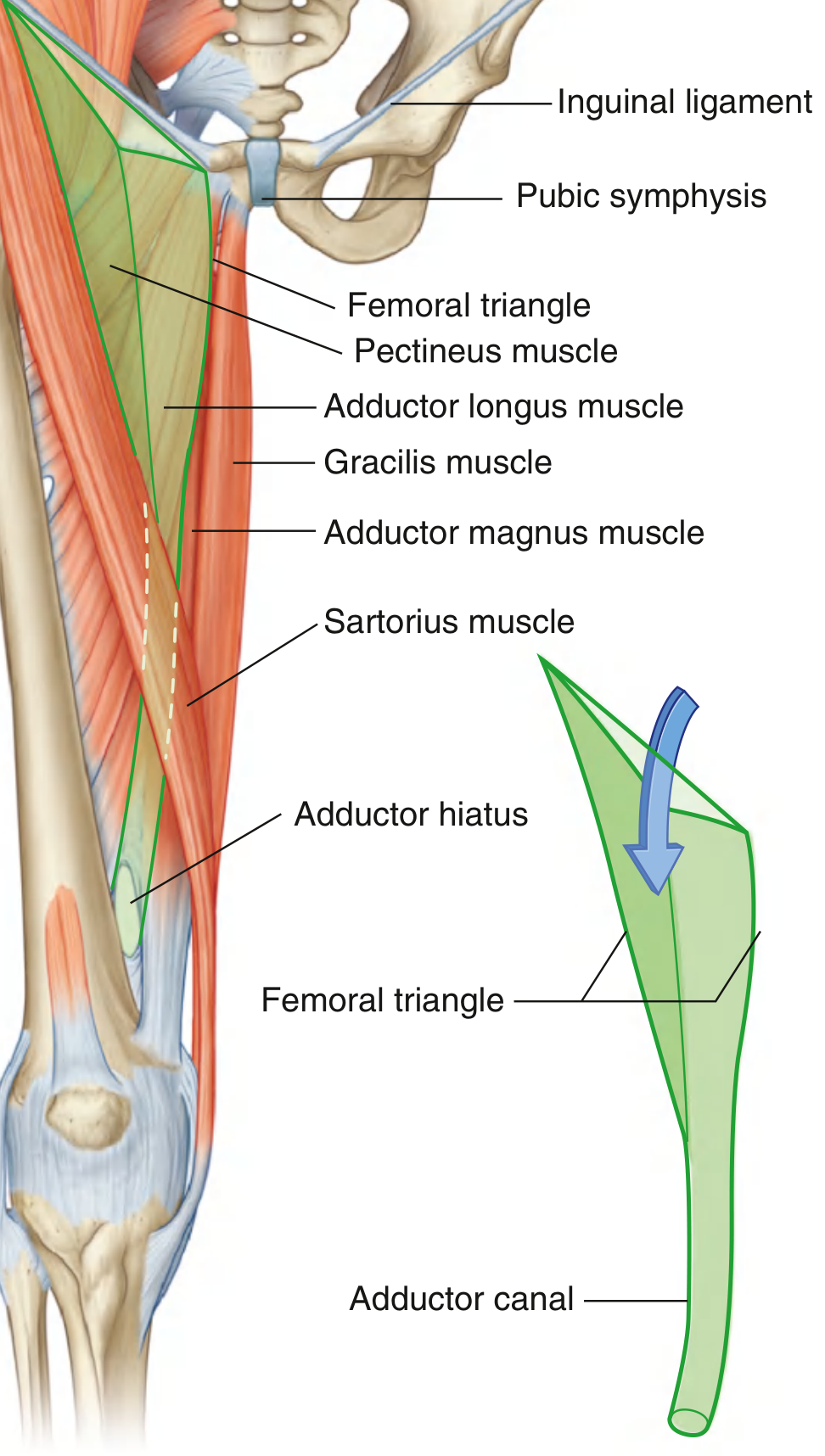
Femoral Triangle
Overview
The femoral triangle is a wedge-shaped depression in the superomedial anterior thigh, at the junction of the anterior abdominal wall and the lower limb. It serves as the main passageway for neurovascular structures between the abdomen/pelvis and the lower extremity.
Boundaries
| Boundary | Structure |
|---|---|
| Base (superior) | Inguinal ligament |
| Lateral border | Medial margin of sartorius muscle |
| Medial border | Medial margin of adductor longus muscle |
| Apex | Where sartorius crosses adductor longus (pointing inferiorly); continues as the adductor canal |
| Floor | Laterally: iliopsoas; medially: pectineus + adductor longus |
| Roof | Fascia lata (with the saphenous opening/hiatus for the great saphenous vein) |
Contents (Lateral to Medial: NAVY mnemonic)
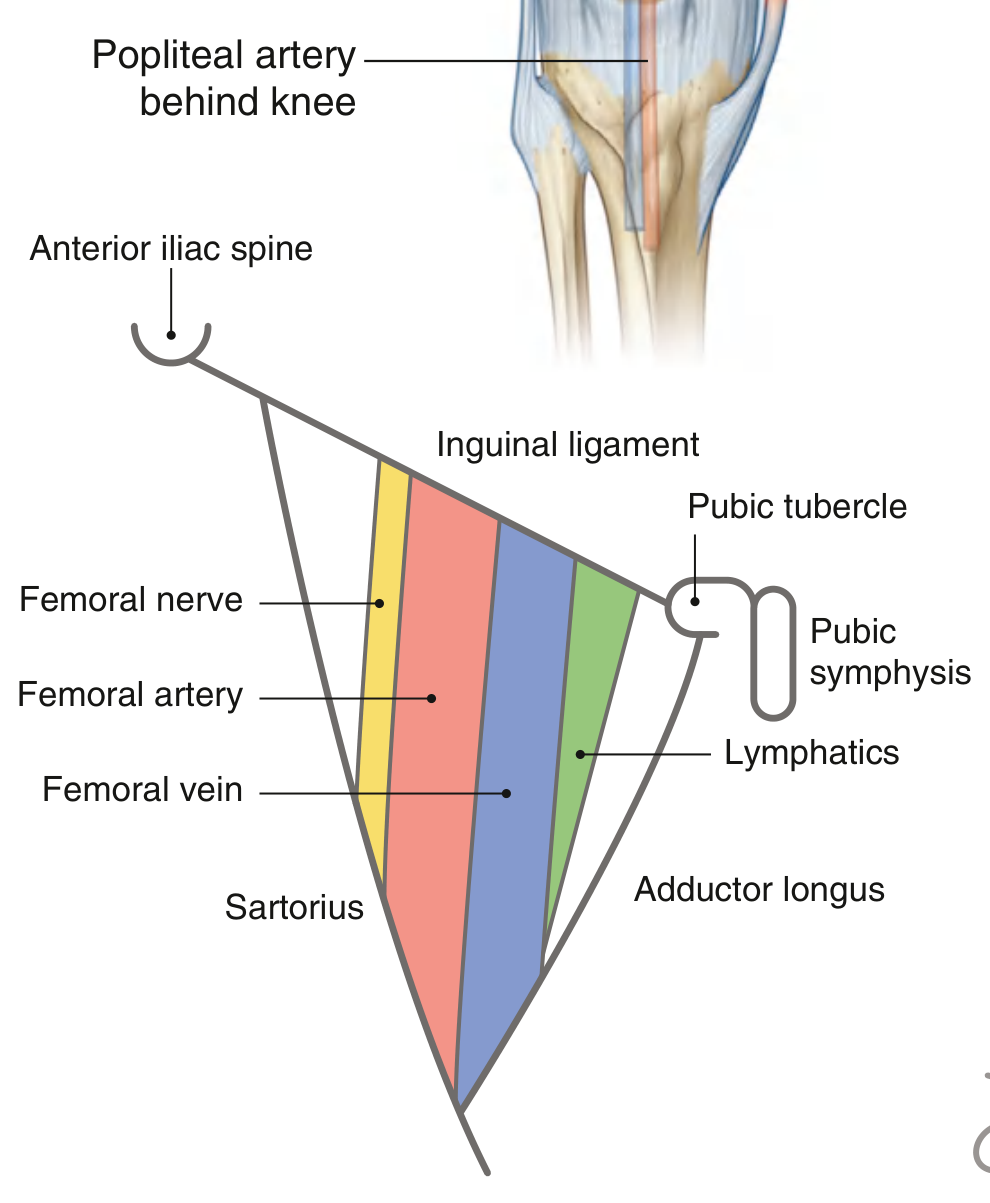
From lateral to medial the contents are:
N - A - V - L (Nerve, Artery, Vein, Lymphatics)
| Structure | Position | Notes |
|---|---|---|
| Femoral Nerve | Most lateral | Outside the femoral sheath; divides into anterior and posterior divisions almost immediately |
| Femoral Artery | Between nerve and vein | Continuation of external iliac artery; palpable midway between ASIS and pubic symphysis |
| Femoral Vein | Medial to artery | Becomes the external iliac vein above the inguinal ligament |
| Lymphatics / Deep inguinal nodes | Most medial (femoral canal) | Drain deep structures of the lower limb |
The Femoral Sheath
The femoral artery, vein, and lymphatics are enclosed in a funnel-shaped fascial sleeve called the femoral sheath. Key points:
- Continuous superiorly with transversalis fascia (anteriorly) and iliac fascia (posteriorly)
- Divided into three compartments:
- Lateral - femoral artery (+ femoral branch of genitofemoral nerve)
- Intermediate - femoral vein
- Medial (femoral canal) - lymphatics and deep inguinal lymph nodes
- The femoral nerve is NOT inside the sheath - it lies lateral to it
Femoral Canal
- The most medial compartment of the femoral sheath
- Superior opening = femoral ring (covered by femoral septum, often contains the node of Cloquet/Rosenmuller)
- The femoral ring is a potential weak point and is the site of femoral hernias
Detailed View (THIEME Atlas)
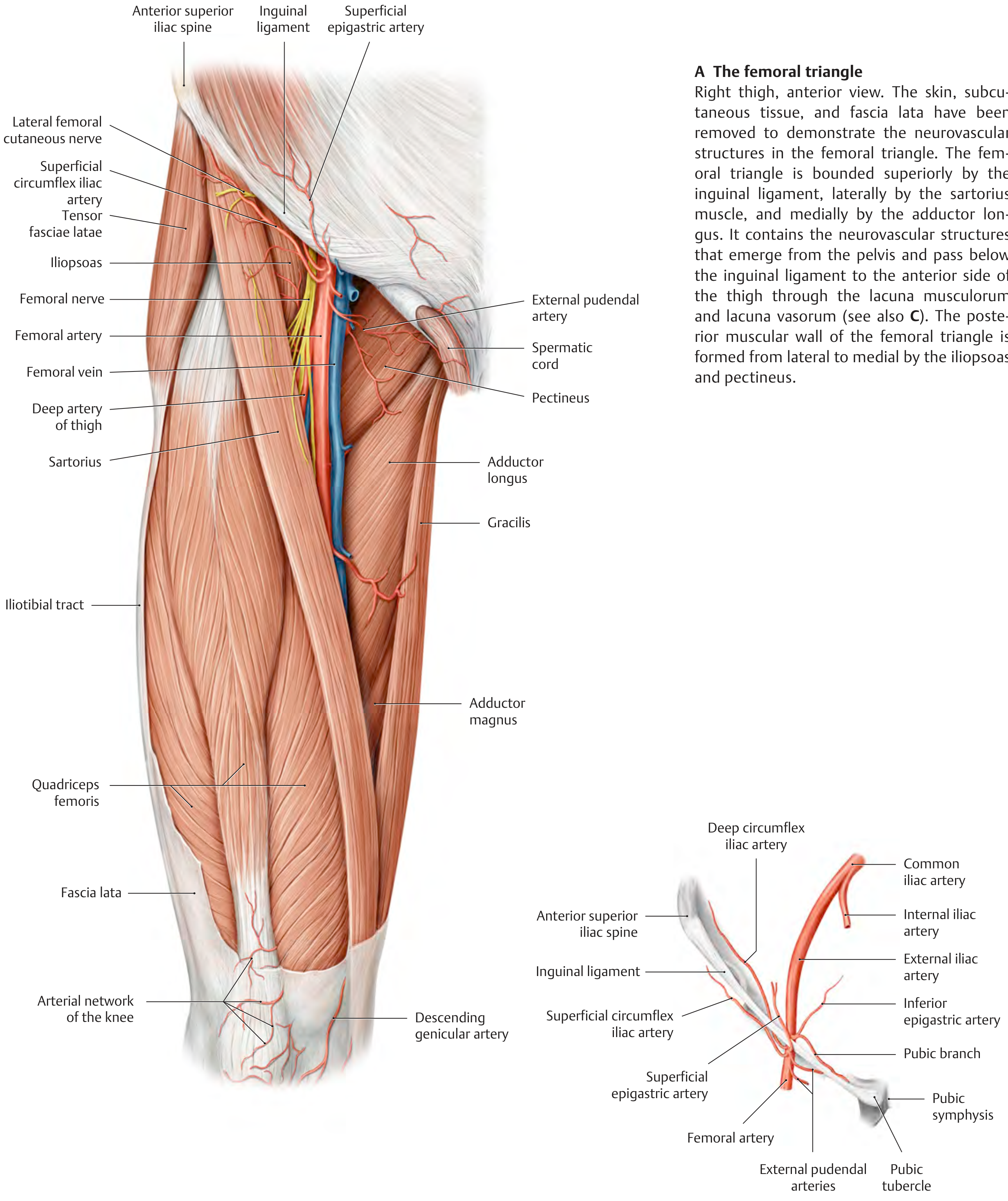
The iliopectineal arch (a thickened fascial band) divides the space below the inguinal ligament into:
- Vascular compartment (medial) - femoral artery, femoral vein, deep inguinal lymphatics, femoral branch of genitofemoral nerve
- Muscular compartment (lateral) - iliopsoas, femoral nerve, lateral femoral cutaneous nerve
Key Branches of the Femoral Artery in the Triangle
| Branch | Distribution |
|---|---|
| Profunda femoris (deep artery of thigh) | Main branch; arises ~4 cm below inguinal ligament |
| Medial circumflex femoral artery | Usually from profunda; supplies femoral head |
| Lateral circumflex femoral artery | Usually from profunda; divides into ascending, transverse, descending branches |
| Superficial epigastric artery | Skin of lower abdomen |
| Superficial circumflex iliac artery | Skin near ASIS |
| External pudendal arteries | External genitalia |
Femoral Nerve Divisions
The femoral nerve enters the triangle lateral to the femoral artery (outside the femoral sheath) and quickly divides:
- Anterior cutaneous branches - skin of anterior and medial thigh
- Muscular branches - sartorius, quadriceps femoris, pectineus
- Saphenous nerve (longest terminal branch) - descends through the adductor canal to supply medial leg and foot
Continuation - Adductor Canal
The apex of the femoral triangle is continuous with the adductor canal (subsartorial/Hunter's canal), through which the femoral artery and vein (and the saphenous nerve) pass, eventually exiting through the adductor hiatus in adductor magnus to become the popliteal vessels behind the knee.
Clinical Relevance
- Femoral pulse - palpated just below the inguinal ligament at the midpoint between ASIS and pubic symphysis (mid-inguinal point)
- Femoral vascular access - for cardiac catheterization, coronary angiography, access to pulmonary circulation, renal veins, etc.
- Femoral hernia - protrudes through the femoral ring into the femoral canal, medial to the femoral vein; more common in women
- Femoral nerve block - used for analgesia of the anterior thigh (e.g., femoral neck fracture)
Sources: Gray's Anatomy for Students (ISBN 9780323934237), p. 675-676; THIEME Atlas of General Anatomy and Musculoskeletal System (ISBN 9781626237186), p. 573
This is a shared conversation. Sign in to Orris to start your own chat.