
Medical negligence in fmt bhms 2nd year 5mark
Reading File
Searching sources...
Finding Sources
Finding Sources
Reading File
Reading File
Reading File
Reading File
Reading File
Reading File
Reading File
I now have all the content needed for a comprehensive 5-mark answer on Medical Negligence for BHMS 2nd Year FMT. Here is the complete answer:
Medical Negligence (Malpractice) - FMT | BHMS 2nd Year | 5 Marks
Definition
Professional Negligence is defined as "want of reasonable care and skill, or willful negligence on the part of the medical practitioner while treating a patient, resulting in bodily injury, ill-health or death."
- Negligence (Justice Baron Alderson, 1856): "The omission to do something which a reasonable man could do, or doing something which a prudent and reasonable man could not do."
- Medical negligence is a part of the Law of Torts - a civil wrong for which the sufferer can seek compensation.
Essential Elements (4 Ds - Lord Wright, 1934)
| Element | Meaning |
|---|---|
| Duty | Existence of a duty of care owed by the doctor to the patient |
| Dereliction (Breach) | Failure to conform to the standard of care - either by omission (not doing what should be done) or commission (doing what should not be done) |
| Direct causation | A direct and causal connection between the negligent act/omission and the resulting injury (proximate cause) |
| Damage | Actual damage/injury must result; of a type foreseeable by a reasonable physician |
The patient must prove all four elements by a preponderance of evidence (more likely than not).
Types of Medical Negligence
1. Civil Negligence
Arises when:
- A patient sues the doctor in a civil court for compensation for injury suffered due to negligence.
- A doctor sues the patient for fees, and the patient alleges negligence as a defense.
2. Criminal Negligence
- When the patient wants the doctor to be punished (not just compensated).
- Requires a higher degree of negligence - gross, reckless, or wanton disregard for patient safety.
- Punishable under Section 106 BNS (previously Section 304A IPC).
3. Corporate Negligence
- Negligence on the part of a hospital/institution rather than an individual doctor.
- Hospital is vicariously liable for the acts of its employees.
4. Contributory Negligence
- The patient himself contributes to the harm by his own negligence, e.g., not following medical advice, concealing history, or not taking prescribed medicines.
- Reduces or eliminates the doctor's liability.
Doctrine of Res Ipsa Loquitur ("The thing speaks for itself")
A rule of evidence in law of torts. The patient need NOT prove negligence by expert medical evidence where this doctrine applies.
Conditions to be satisfied:
- In the absence of negligence, the injury would not have occurred ordinarily.
- The doctor had exclusive control over the injury-producing instrument or treatment.
- The patient was not guilty of contributory negligence.
Examples:
- Prescribing an overdose causing ill-effects
- Giving poisonous medicine by mistake
- Leaving a surgical instrument/sponge inside the body
- Operating on the wrong limb
Vicarious Liability
A senior doctor or hospital is held responsible for the negligent acts of junior staff, nurses, or employees acting under their supervision (principle: respondeat superior - "let the master answer").
Defenses Against Medical Negligence
- No duty owed to the plaintiff
- Duty discharged according to prevailing standards (Bolam test)
- Misadventure - unforeseeable, unavoidable accident
- Error of judgment - genuine error without negligence
- Contributory negligence by the patient
- Res judicata - matter already decided by a court (appeal only)
- Limitation - suit must be filed within 2 years (3 years for breach of contract)
Instances of Medical Negligence (Examples)
- Refusal to admit patients requiring urgent hospitalization
- Failure to obtain informed consent
- Failure to examine the patient personally
- Failure to take proper history
- Wrong diagnosis leading to wrong treatment
- Failure to refer when specialist care is required
- Prescribing a drug the patient is known to be allergic to
- Abandonment of a patient without proper notice
Prevention of Medical Negligence (5 Rs)
| "R" | Principle |
|---|---|
| Rapport | Maintain healthy communication with patient, family, and team |
| Rationale | Use all available data (history, examination, investigations) to diagnose and treat; document it |
| Records | Keep complete, accurate, legible, timely records - "A bad result with bad records = liability" |
| Remarks | Never reprimand patients or criticize colleagues in front of patients |
| Recipe | Prescribe only with appropriate indication; warn about side-effects and contraindications |
Key Landmark Cases
- Bolam vs Friern Hospital Management Committee (1957): Doctor is not negligent if he acts in accordance with a practice accepted by a responsible body of medical opinion ("Bolam test").
- Roe vs Ministry of Health: Percolation of Nupercaine - held as misadventure (risk unknown at that time), not negligence.
- Hatcher vs Black (1954): Lord Denning - "Negligence is like a dagger that wounds a doctor's professional reputation."
Sources: The Essentials of Forensic Medicine and Toxicology, 36th ed. (2026); P.C. Dikshit Textbook of Forensic Medicine and Toxicology
In human language
Medical Negligence - Simple Language Version
What is Medical Negligence?
Simply put - when a doctor makes a mistake that a careful, skilled doctor would NOT have made, and the patient gets harmed because of it.
It is NOT every mistake. It is a mistake that happens due to carelessness, lack of skill, or not following basic standards.
The 4 Things That MUST Be Proven (4 Ds)
Think of it like a checklist. ALL 4 must be present:
- Duty - The doctor had a responsibility to treat that patient (doctor-patient relationship existed)
- Dereliction - The doctor did NOT do his job properly (skipped something or did something wrong)
- Direct Cause - That mistake is what caused the harm (not something else)
- Damage - The patient actually got hurt (injury, disability, death, prolonged illness)
If even ONE of these 4 is missing, there is NO negligence legally.
Types of Negligence
Civil - Patient wants money as compensation → goes to civil court
Criminal - Patient wants the doctor to be punished/jailed → goes to criminal court (needs GROSS carelessness, not just a small mistake)
Corporate - The hospital is at fault, not just one doctor
Contributory - The patient himself was also careless (e.g., hid his allergy history) → reduces doctor's blame
Res Ipsa Loquitur - "The Fact Speaks For Itself"
Some mistakes are SO obvious that the patient doesn't even need to prove negligence with medical expert evidence.
Classic examples:
- Doctor left a scissor/sponge inside the patient's abdomen after surgery
- Operated on the wrong leg
- Gave a 10x overdose of medicine
These things simply do not happen unless someone was careless.
Vicarious Liability
If a junior doctor or nurse under your supervision makes a mistake, the senior doctor or hospital is also responsible.
"If your team member causes harm while working under you, you share the blame."
Defenses - How Doctors Protect Themselves
- "I followed standard practice" - Bolam test: if a recognized group of doctors would have done the same thing, the doctor is safe
- "It was a misadventure" - an unforeseeable accident, not carelessness
- "Error of judgment" - genuine honest mistake, not recklessness
- "Patient was also at fault" - contributory negligence
- Time limit passed - patient must file case within 2 years
How to PREVENT Negligence (5 Rs - Easy to Remember)
| R | What it means in plain language |
|---|---|
| Rapport | Talk to your patient. Explain everything. Build trust. |
| Rationale | Always examine properly. Order necessary tests. Don't guess. |
| Records | Write everything down. Your notes are your proof in court. |
| Remarks | Never bad-mouth other doctors or nurses in front of patients. |
| Recipe | Prescribe only what is needed. Know side effects. Warn the patient. |
Common Examples of Negligence in Real Life
- Not asking about allergies before giving a drug
- Not taking informed consent before surgery
- Discharging a patient too early
- Failing to refer a serious case to a specialist
- Not examining the patient personally and prescribing blindly
What is NOT Negligence
- A patient dies despite the best possible care
- A rare, unpredictable drug reaction occurs
- Honest diagnostic error when the case was genuinely difficult
- A complication that is a known risk of a procedure (if patient was informed)
Bottom line for your exam: Negligence = Careless doctor + Patient harmed + That carelessness caused the harm. Not every bad outcome is negligence. The law asks - "What would a reasonably skilled doctor have done?"
Corpus delcdi
Corpus Delicti - Latin for "body of the crime." In forensic medicine, it means proving that a crime actually occurred before anyone can be convicted. Let me search the textbooks for the full FMT answer.
Searching sources...
Finding Sources
Finding Sources
Reading File
Reading File
Got everything needed. Here is the full answer in simple, human language:
Corpus Delicti - FMT | BHMS 2nd Year
What Does It Mean?
Corpus Delicti is a Latin phrase that literally means "Body of the Crime."
In plain language: Before you can charge or convict someone of a crime, you must first PROVE that the crime actually happened.
It is NOT just about the dead body - it means all the evidence that proves a crime occurred.
Simple Example
Imagine someone says, "I killed him."
The court cannot convict that person ONLY on their confession.
The prosecution must also show proof that a crime actually happened - a body, injuries, weapon, etc.
This rule exists because confessions can be false - people sometimes confess under pressure, torture, or coercion.
What Does Corpus Delicti Include?
It is NOT limited to just the physical body. It includes:
| Evidence | Examples |
|---|---|
| The victim's body | Dead body showing signs of crime |
| Weapon evidence | Bullet, knife blade, or broken weapon found in/near the body |
| Clothing | Clothes with weapon marks, blood stains, tear marks |
| Photographs & drawings | Images showing fatal injuries |
| Other physical evidence | Anything proving foul play occurred |
The Key Legal Rule
- Prosecution must have enough corroborating evidence that the essential parts of a crime occurred - BEFORE charging anyone.
- If corpus delicti is NOT established, the case cannot proceed in court.
- A person cannot be convicted based on confession alone - there must be supporting evidence.
- However - the court CAN pass a death sentence even if the body is not recovered, provided there is strong eyewitness or other corroborative evidence.
Why Is It Important in Forensic Medicine?
In medico-legal cases, the doctor's role is to help establish corpus delicti by:
- Identifying the dead body - proving it is indeed a human being and identifying who it is
- Establishing cause of death - natural, accidental, suicidal, or homicidal
- Documenting injuries - type, nature, weapon used
- Collecting forensic evidence from the body
Methods Used to Establish Identity (as part of Corpus Delicti)
For a dead person:
- Age, Sex, Religion, Complexion
- Stature and body development
- Fingerprints, footprints
- Teeth and dental patterns
- DNA fingerprinting
- Superimposition
- Personal belongings
For a living person (additionally):
- Speech and voice
- Handwriting
- Gait (style of walking)
- Habits, memory, education
Positive (Undeniable) Identification Methods
These are the GOLD STANDARD methods courts accept:
- Fingerprints / Footprints / Lip prints
- Dental patterns
- DNA analysis
- Frontal sinus pattern (unique like fingerprints on X-ray)
- Bone comparisons
One-Line Summary for Exam
Corpus Delicti = Proof that a crime actually occurred. It includes the body of the victim + all physical evidence of foul play. No one can be convicted without first proving that a crime happened.
Sources: The Essentials of Forensic Medicine and Toxicology, 36th ed. (2026); P.C. Dikshit Textbook of Forensic Medicine and Toxicology
Data for identification
Searching sources...
Finding Sources
Finding Sources
Reading File
Reading File
I have all the needed content. Here is the complete answer in simple human language:
Data for Identification - FMT | BHMS 2nd Year
What is Identification?
Identification means determining who a person is - whether living or dead - based on their physical and biological features.
Since no single feature is reliable alone, a combination of features is always used. Sex, Age, and Stature are the three PRIMARY characteristics of identification.
The 14 Types of Identification Data
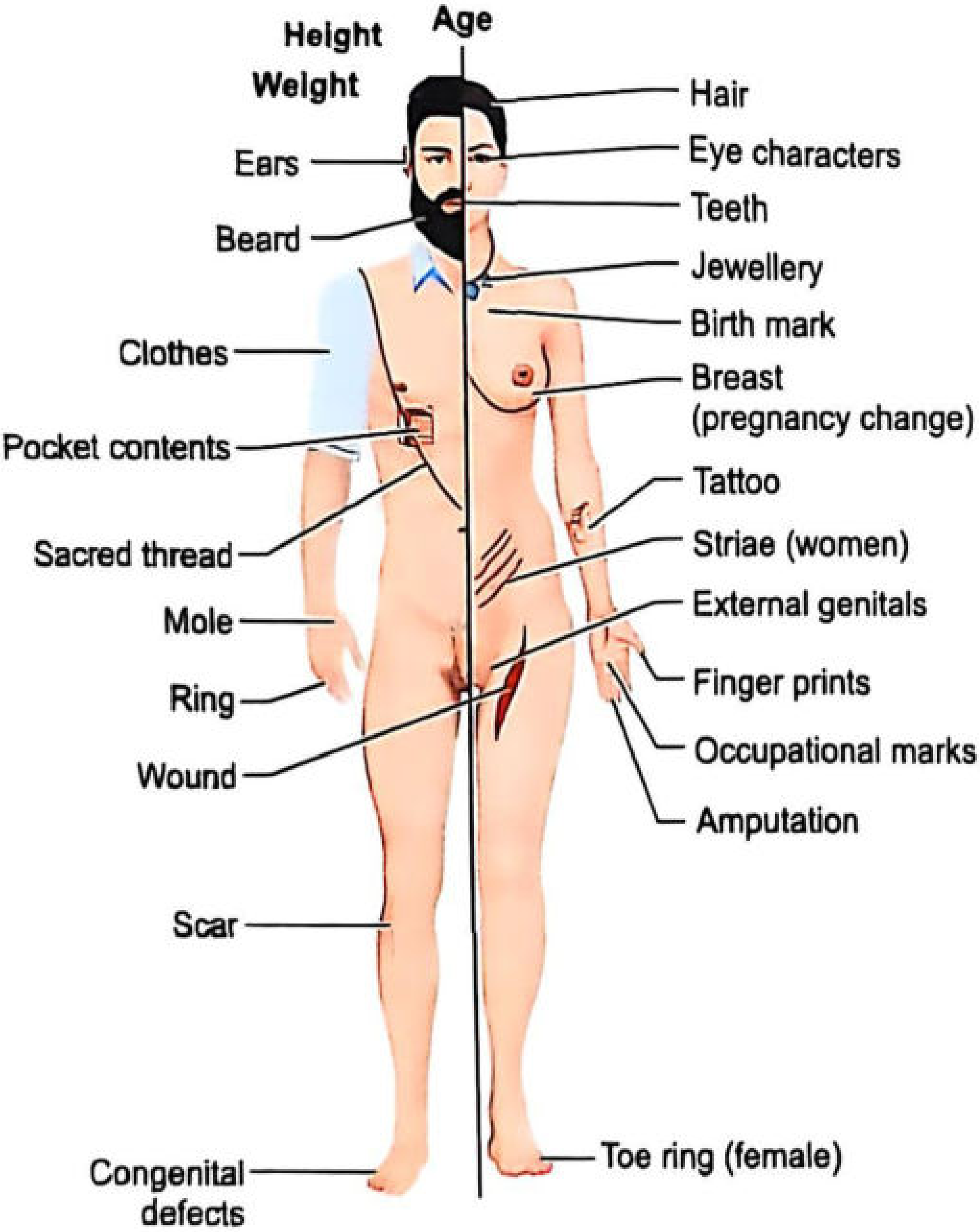
1. Race and Religion
Race is determined by:
- Complexion - Indians = brown, Europeans = fair, Negroes = black (limited value as it changes with decomposition/burning)
- Hair - straight (Caucasians/Mongolians), woolly/curly (Negroes)
- Skull characteristics:
| Race | Skull | Orbits | Nasal aperture | Limbs |
|---|---|---|---|---|
| Caucasian (Indians, Europeans) | Rounded, high | Triangular | Elongated, sharp sill | Normal |
| Mongoloid (Chinese, Japanese) | Square, flat face | Rounded | Rounded | Smaller |
| Negroid (Africans) | Narrow, elongated, prognathic | Square | Broad, guttered | Longer |
Religion clues:
- Hindu males - not circumcised, sacred thread, tuft of hair, pierced ears, caste marks on forehead
- Hindu females - vermilion on forehead/scalp parting, silver toe ornaments, tattoo marks, nose ring in left nostril
- Muslim males - circumcised, corns/callosities on knees and feet (from prayer posture)
- Muslim females - nose ring in nasal septum, multiple ear piercings, generally NO tattoo marks
2. Sex
Used in - marriage, divorce, rape, heirship, nullity of marriage, unidentified bodies.
External features (living):
| Feature | Male | Female |
|---|---|---|
| Height | Taller | Shorter |
| Shoulders | Broader | Narrower |
| Hips | Narrower | Broader |
| Body hair | More | Less |
| Genitalia | Male organs | Female organs |
| Breasts | Absent | Present |
| Pubic hair | Diamond-shaped | Triangular |
Skeleton clues (dead body/bones):
- Pelvis - most reliable bone for sex determination
- Female pelvis: wider, rounder, greater sciatic notch angle (>90°)
- Male pelvis: narrower, heart-shaped inlet, smaller sciatic notch (<90°)
- Skull - males: prominent brow ridges, mastoid process, chin; females: smoother, more rounded
- Long bones - males have longer, thicker, heavier bones
3. Age
Estimated by:
- Physical features - skin, hair (grey/white), wrinkles, posture
- Teeth eruption - most reliable in children (milk teeth → permanent teeth)
- Ossification of bones - appearance and fusion of bone centres (used in medico-legal age estimation)
- X-rays - for bone age
4. General Development and Stature (Height)
- Stature can be estimated from long bones (especially femur and tibia) using regression formulae
- Nutritional status, muscle build, and weight give additional clues
5. Complexion and Features
- Skin color, facial structure, eye color, nose shape
- Limited value in decomposed or burned bodies
6. External Peculiarities ⭐ (Very Important)
These are unique individual marks:
- Moles and birthmarks
- Scars (surgical, injury, vaccination)
- Tattoo marks - give clues about community, profession, prison history
- Occupation marks - e.g., callosities on hands of laborers
- Malformations - extra fingers (polydactyly), fused toes, etc.
- Wounds - old healed injuries
7. Anthropometric Measurements (Bertillon System)
Measurements of body parts that remain constant after age 21:
- Height, arm span, length of head, width of head
- Length of right ear, left foot, left middle finger, left little finger
- Width of cheeks
(Largely replaced by fingerprinting today)
8. Fingerprints and Footprints ⭐ (GOLD STANDARD)
- Most reliable method of identification
- Fingerprint pattern is formed by the 4th month of fetal life and never changes throughout life
- Even identical twins have different fingerprints
- Types of patterns: Loop (most common ~65%), Whorl (~30%), Arch (~5%)
9. Teeth (Dental Identification) ⭐
- Teeth survive fire, decomposition, and trauma better than other tissues
- Dental formula helps estimate age
- Dental records, fillings, crowns, and missing teeth are used for comparison
- Gustafson's method - estimates age from tooth wear, root resorption, etc.
10. Personal Effects
- Clothes, jewelry, ID cards, wallet contents, pocket items
- Can give quick presumptive identification (but not conclusive)
11. Handwriting
- Unique to each person; used to identify living individuals
- Analyzed by a forensic document examiner
12. Speech and Voice
- Tone, accent, language, speech defects
- Voice spectrography (voiceprint) used in modern forensics
13. Gait, Tricks of Manner and Habit
- The way a person walks, stands, gestures
- Recognized by people who know them well
- Useful in CCTV footage analysis
14. Memory and Education
- Knowledge, skills, language ability
- Useful when all other features fail (e.g., amnesia cases)
Special Identification Methods (Positive/Undeniable)
These are accepted in court as conclusive proof:
- Fingerprints / Footprints / Lip prints
- Dental patterns
- DNA fingerprinting - most modern, most accurate
- Frontal sinus X-ray pattern - unique like fingerprints
- Skull suture patterns
- Bone comparison (normal and abnormal)
Quick Summary Table
| Data | Best Used For |
|---|---|
| Sex + Age + Stature | Primary ID - always first |
| Fingerprints | Conclusive ID - gold standard |
| DNA | Best modern method |
| Teeth | Burnt/decomposed bodies |
| Pelvis | Sex from skeleton |
| Tattoo/Scars | Personal history clues |
| Religion marks | Community identification |
Exam tip: Always remember - "No single feature is reliable. A combination of features is used for identification." Sex, Age, and Stature are the PRIMARY characteristics.
Source: The Essentials of Forensic Medicine and Toxicology, 36th ed. (2026)
This is a shared conversation. Sign in to Orris to start your own chat.