
Explain the mechanism of acute respiratory distress syndrome
Reading File
Finding Sources
Searching PubMed
"acute respiratory distress syndrome" AND pathophysiology
Good results. The most comprehensive sources are Murray & Nadel's (block29, block32), Goldman-Cecil (block12), and Sabiston (block11). Let me read these in parallel.
Reading File
Reading File
Reading File
Good start. Let me now read the dedicated ARDS mechanism sections from Murray & Nadel's block32 and also search specifically for pathophysiology/mechanism content.
Reading File
Finding Sources
The block32 content is about NIV/HFNC, not the mechanism itself. Let me search specifically for the pathogenesis/mechanism sections from the dedicated ARDS chapter in Murray & Nadel.
Finding Sources
Finding Sources
Found the key section: "ETIOLOGY AND PATHOGENESIS OF ARDS" in Murray & Nadel's block31. Let me read that along with the Diffuse Alveolar Damage sections.
Reading File
Reading File
This is a table of contents. I need to read further into block31 to get the actual pathogenesis content. Let me read more of it.
Reading File
Excellent — this is incredibly rich content covering the full pathophysiology. I have detailed mechanistic content on neutrophils, alveolar-capillary membrane, cytokines, surfactant dysfunction, coagulation, Na/water transport, and more. I also got ARDS imaging and a diagram. Now I have enough to write a comprehensive answer. Let me also quickly search for an ARDS mechanism image.
Searching Images
ARDS acute respiratory distress syndrome pathophysiology mechanism alveolar damage
I have rich content from the textbooks and excellent images. I can now write a comprehensive, well-structured answer on the mechanism of ARDS.
Acute Respiratory Distress Syndrome (ARDS) — Mechanism
ARDS is a syndrome of noncardiogenic pulmonary edema driven by severe lung inflammation, characterised by bilateral infiltrates, hypoxemia (PaO₂/FiO₂ < 300 on ≥5 cmH₂O PEEP), and decreased lung compliance, developing within 7 days of a known insult. The Berlin definition (2012) stratifies severity: mild (P/F 200–300), moderate (100–200), and severe (<100).
1. Initiating Insults
ARDS arises from either direct (pulmonary) or indirect (extrapulmonary) lung injury:
| Direct (pulmonary) | Indirect (systemic) |
|---|---|
| Pneumonia (bacterial, viral) | Sepsis (most common overall cause) |
| Aspiration of gastric contents | Severe trauma / shock |
| Toxic inhalation / near drowning | Pancreatitis |
| Pulmonary contusion | Massive transfusion (TRALI) |
2. The Alveolar-Capillary Membrane Breakdown
The central event in ARDS is disruption of the alveolar-capillary barrier, which consists of:
- The capillary endothelium
- The basement membrane
- The alveolar epithelium (type I and type II pneumocytes)
Under normal conditions this barrier prevents movement of proteins and fluid into the alveolar space. In ARDS, injury to either surface — or both — leads to a high-permeability pulmonary edema, fundamentally distinct from the hydrostatic (cardiogenic) edema of heart failure.
The epithelial surface is particularly important. Type I alveolar epithelial cells cover ~95% of the alveolar surface and are highly vulnerable to injury. Type II pneumocytes, which produce surfactant and can regenerate type I cells, are more resistant but are also impaired.
3. Neutrophil Recruitment and Activation — The Core Driver
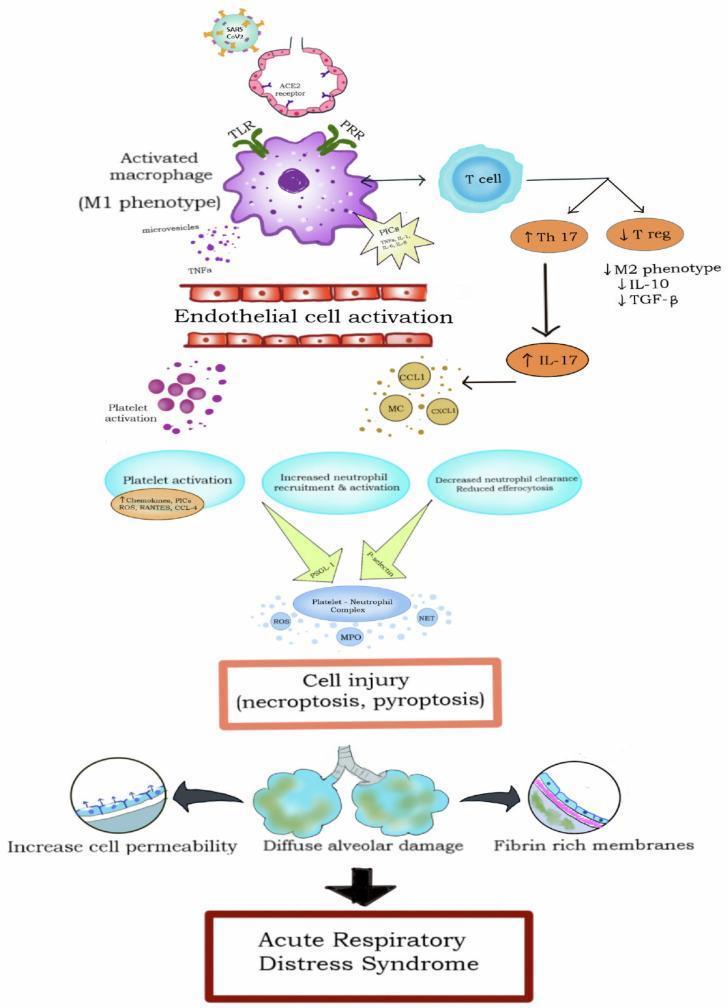
Neutrophils are the primary effector cells of ARDS lung injury. The sequence:
- Systemic activation: The initiating insult activates the innate immune system — pattern-recognition receptors (TLRs, PRRs) on macrophages detect DAMPs (damage-associated molecular patterns) or PAMPs (pathogen-associated patterns).
- Cytokine storm: Activated alveolar macrophages release pro-inflammatory cytokines — TNF-α, IL-1β, IL-6, IL-8 — into the alveolar space and systemic circulation.
- Neutrophil margination and sequestration: IL-8 and other chemokines recruit neutrophils into the pulmonary capillaries. Neutrophils become stiff, sequester in capillary beds, and adhere to activated endothelium via upregulated adhesion molecules (ICAM-1, selectins).
- Transendothelial and transepithelial migration: Neutrophils migrate into the interstitium and alveolar space.
- Toxic mediator release: Activated neutrophils release:
- Reactive oxygen species (ROS) — oxidative damage to lipid membranes
- Proteases (elastase, matrix metalloproteinases, cathepsins) — degrade the extracellular matrix and tight junctions
- Neutrophil extracellular traps (NETs) — webs of chromatin and enzymes that amplify injury
- Myeloperoxidase (MPO) — generates hypochlorous acid
- Barrier destruction: Together these mediators destroy tight junction proteins (occludin, claudins, ZO-1) of both endothelium and epithelium, producing the high-permeability leak.
Key finding: BAL fluid from ARDS patients contains a high neutrophil count (often >80% PMNs), whereas normal BAL has <5%.
4. Surfactant Dysfunction
Type II pneumocytes are injured, reducing surfactant synthesis. Surfactant already present is:
- Diluted by protein-rich edema fluid
- Inactivated by phospholipase A2 (released from activated neutrophils and pancreatic/systemic sources) — phospholipase A2 enzymatically degrades surfactant phospholipids
- Oxidised by ROS
The result is markedly elevated alveolar surface tension, leading to widespread alveolar collapse (atelectasis) and further reduction in lung compliance. This explains the characteristic "baby lung" phenomenon — only a small fraction of alveoli remain recruitable.
5. Phases of Histopathological Injury: Diffuse Alveolar Damage (DAD)
The pathological correlate of ARDS is Diffuse Alveolar Damage (DAD), which evolves in phases:
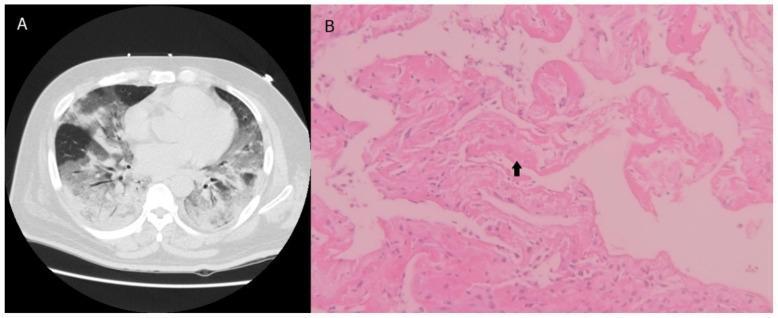
Exudative phase (0–7 days)
- Protein-rich, fibrin-containing alveolar edema
- Sloughing of type I pneumocytes — the alveolar basement membrane is denuded
- Formation of hyaline membranes — eosinophilic deposits of fibrin, necrotic cell debris, and protein lining the alveolar walls (pathognomonic of DAD)
- Neutrophilic infiltration of the interstitium and alveolar space
- Capillary microthrombi formation
Proliferative phase (7–21 days)
- Type II pneumocyte hyperplasia — attempt to repopulate denuded epithelium
- Fibroblast proliferation and early fibrosis begins
- Macrophage-mediated clearance of debris
- Restoration of surfactant production if recovery proceeds
Fibrotic phase (>21 days, in some patients)
- Permanent fibrotic remodelling of alveoli
- Loss of lung architecture, reduced compliance
- Not all patients progress to this phase — good recovery is possible
6. Coagulation and Microvascular Thrombosis
ARDS generates a procoagulant state in the alveolar microenvironment:
- Damaged endothelium exposes tissue factor → activates the extrinsic coagulation cascade
- Fibrin deposited within capillaries and alveolar spaces
- Plasminogen activator inhibitor-1 (PAI-1) is elevated → suppresses fibrinolysis
- Capillary microthrombi worsen ventilation-perfusion (V/Q) mismatch and contribute to pulmonary hypertension
7. Impaired Alveolar Fluid Clearance
Under normal conditions, Na⁺-K⁺-ATPase pumps on type II and type I pneumocytes actively reabsorb sodium (and osmotically water) from the alveolar space. In ARDS:
- Injury to type I and II cells impairs active Na⁺ transport
- Protein-rich edema accumulates and cannot be cleared
- Catecholamines, which normally upregulate Na⁺ transport, lose their effect in the injured epithelium
The rate of alveolar fluid clearance is an independent predictor of outcome: faster clearance correlates with lower mortality.
8. Angiopoietins and Vascular Dysregulation
The angiopoietin-Tie2 axis regulates endothelial barrier function:
- Angiopoietin-1 (Ang-1): stabilises endothelial junctions — protective
- Angiopoietin-2 (Ang-2): released from Weibel-Palade bodies during endothelial activation → destabilises junctions, promotes vascular leak and upregulates inflammatory adhesion molecules
Elevated plasma Ang-2 levels are associated with increased ARDS severity and mortality.
9. Physiological Consequences
| Mechanism | Consequence |
|---|---|
| Alveolar flooding + collapse | Intrapulmonary shunt → refractory hypoxemia |
| Surfactant loss + edema | Reduced compliance (stiff lungs) |
| Capillary microthrombi + hypoxic vasoconstriction | V/Q mismatch, pulmonary hypertension |
| Inflammatory cytokine spill-over | Multi-organ dysfunction |
| Mechanical ventilation (high volumes/pressures) | Ventilator-induced lung injury (VILI) — biotrauma amplifies inflammation |
10. Two Biological Phenotypes
Large ARDS trial data (latent class analysis) has identified at least two phenotypes:
- Hyperinflammatory (phenotype 2): high IL-6, IL-8, Ang-2, low protein C; higher mortality (~40%), may respond to higher PEEP and statin therapy
- Hypoinflammatory (phenotype 1): milder biomarker elevation, lower mortality (~20%)
This heterogeneity partly explains why no single pharmacological therapy has shown consistent mortality benefit.
Summary Pathway
Systemic insult (sepsis, trauma, aspiration…)
        ↓
Innate immune activation → macrophage cytokine release (TNF-α, IL-1β, IL-8)
        ↓
Neutrophil sequestration in pulmonary capillaries
        ↓
ROS, proteases, NETs → Alveolar-capillary barrier destruction
        ↓
High-permeability edema floods alveoli
        ↓
Surfactant inactivation → alveolar collapse
Impaired Na⁺ transport → edema accumulation
Procoagulant state → microvascular thrombosis
        ↓
DAD: hyaline membranes, type I cell sloughing, type II hyperplasia
        ↓
Severe hypoxemia (refractory to O₂), decreased compliance, pulmonary HTN
        ↓
Respiratory failure → mechanical ventilation required
Sources:
- Murray & Nadel's Textbook of Respiratory Medicine — Chapter 134 (Etiology and Pathogenesis of ARDS)
- Murray & Nadel's Textbook of Respiratory Medicine — Chapter 94 (Diffuse Alveolar Damage)
- Goldman-Cecil Medicine — Chapter 91 (ARDS)
- Sabiston Textbook of Surgery — Critical Care chapter
This is a shared conversation. Sign in to Orris to start your own chat.