
Base of brain
Reading File
Finding Sources
Finding Sources
Finding Sources
Reading File
Finding Sources
Finding Sources
Finding Sources
Finding Sources
Reading File
Finding Sources
Reading File
Reading File
Reading File
Loading Image
Loading Image
Reading File
I now have excellent images and detailed content from Gray's Anatomy for Students and Neuroanatomy through Clinical Cases. Let me compile a thorough answer.
Base of the Brain (Inferior Surface)
The base of the brain is viewed from below (inferior/basal aspect) and reveals the undersurfaces of the frontal, temporal, and occipital lobes, the brainstem, cerebellum, all 12 cranial nerves, and the major arterial supply including the Circle of Willis.
Anatomy Overview
Fig. 8.57 - Cranial Nerves on the Base of the Brain
(Gray's Anatomy for Students)
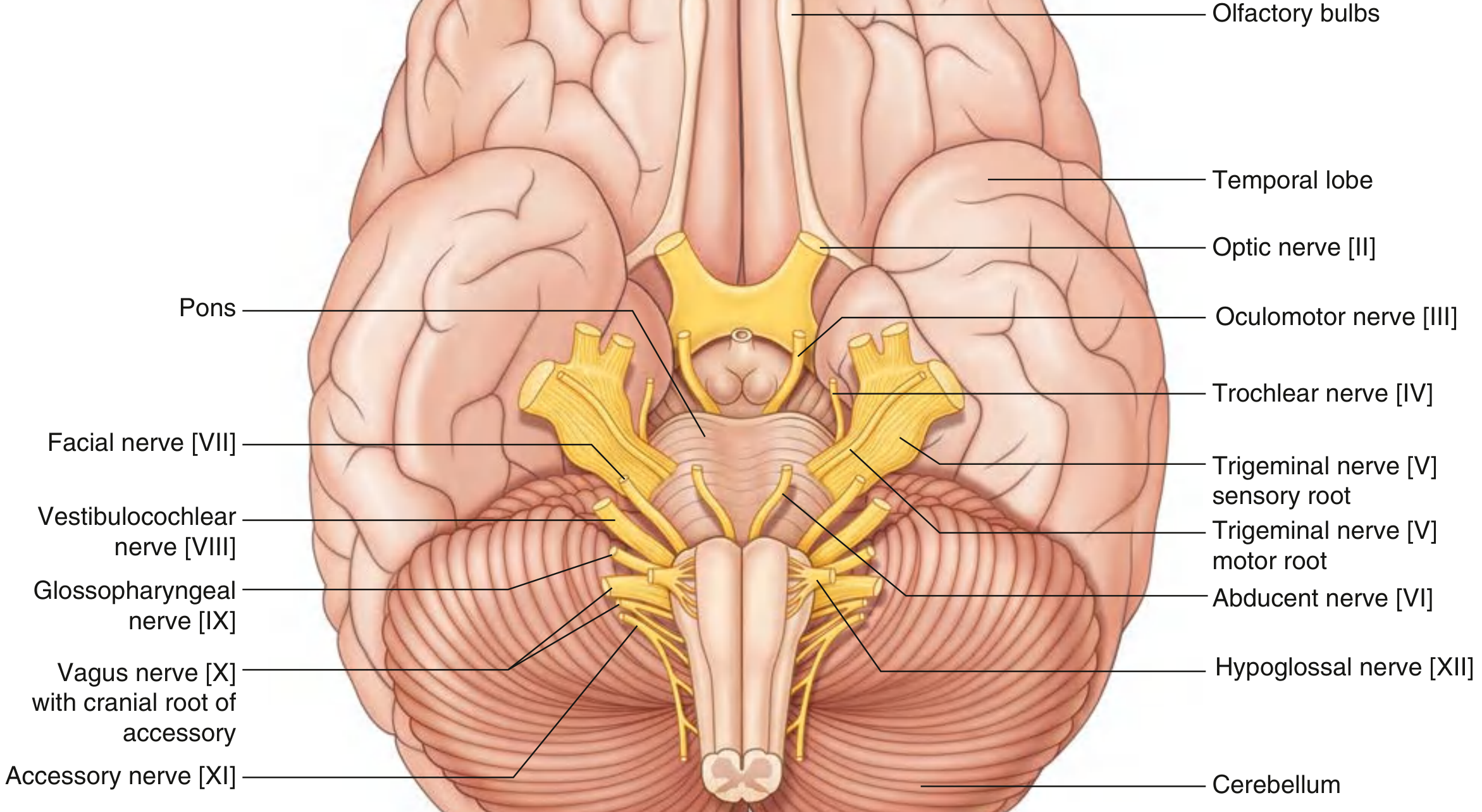
Structures Visible at the Base of the Brain
1. Cerebral Lobes (Inferior Surface)
- Frontal lobe - the orbital (inferior) surface rests on the floor of the anterior cranial fossa. The olfactory bulbs and tracts lie in the olfactory sulci.
- Temporal lobe - the inferior surface is visible lateral to the brainstem on each side.
- Occipital lobe - the most posterior, merging with the tentorial surface.
2. Olfactory System (CN I)
The olfactory bulbs sit on the cribriform plate of the ethmoid, just above. Olfactory filaments (fila olfactoria) pass through the cribriform plate from the nasal mucosa. The olfactory tracts run posteriorly and divide into medial and lateral olfactory striae at the anterior perforated substance.
3. Brainstem - Inferior View
From rostral to caudal:
- Midbrain - the interpeduncular fossa is visible between the two cerebral peduncles. CN III emerges here.
- Pons - a prominent bulge; CN V (trigeminal) exits from its anterolateral surface; CN VI (abducent) emerges at the pontomedullary junction.
- Medulla oblongata - pyramids (corticospinal fibers), olives, and the pyramid decussation are visible; CN VII, VIII, IX, X, XI, and XII emerge from or near the medulla.
- Cerebellum - visible posteriorly, flanking the medulla and pons.
Cranial Nerves at the Base - Attachment Points and Exits
| CN | Name | Attachment / Exit |
|---|---|---|
| I | Olfactory | Olfactory bulbs on cribriform plate (not from brainstem) |
| II | Optic | Optic chiasm (base of diencephalon); exits via optic canal |
| III | Oculomotor | Interpeduncular fossa (midbrain); exits superior orbital fissure |
| IV | Trochlear | Only CN to exit the posterior surface of the brainstem (dorsal midbrain); wraps around to base |
| V | Trigeminal | Anterolateral pons (large sensory root + small motor root) |
| VI | Abducent | Pontomedullary junction (medial); exits superior orbital fissure |
| VII | Facial | Cerebellopontine angle (lateral pontomedullary junction); exits internal acoustic meatus |
| VIII | Vestibulocochlear | Cerebellopontine angle (lateral to VII); exits internal acoustic meatus |
| IX | Glossopharyngeal | Lateral medulla (post-olivary sulcus); exits jugular foramen |
| X | Vagus | Lateral medulla (post-olivary sulcus, multiple rootlets); exits jugular foramen |
| XI | Accessory | Lateral medulla + upper cervical spinal cord; exits jugular foramen |
| XII | Hypoglossal | Medulla (pre-olivary sulcus, between pyramid and olive); exits hypoglossal canal |
- Gray's Anatomy for Students, p. 1034-1037
Vascular Supply at the Base - Circle of Willis
Circle of Willis and Its Main Branches
(Neuroanatomy through Clinical Cases, 3rd Edition)
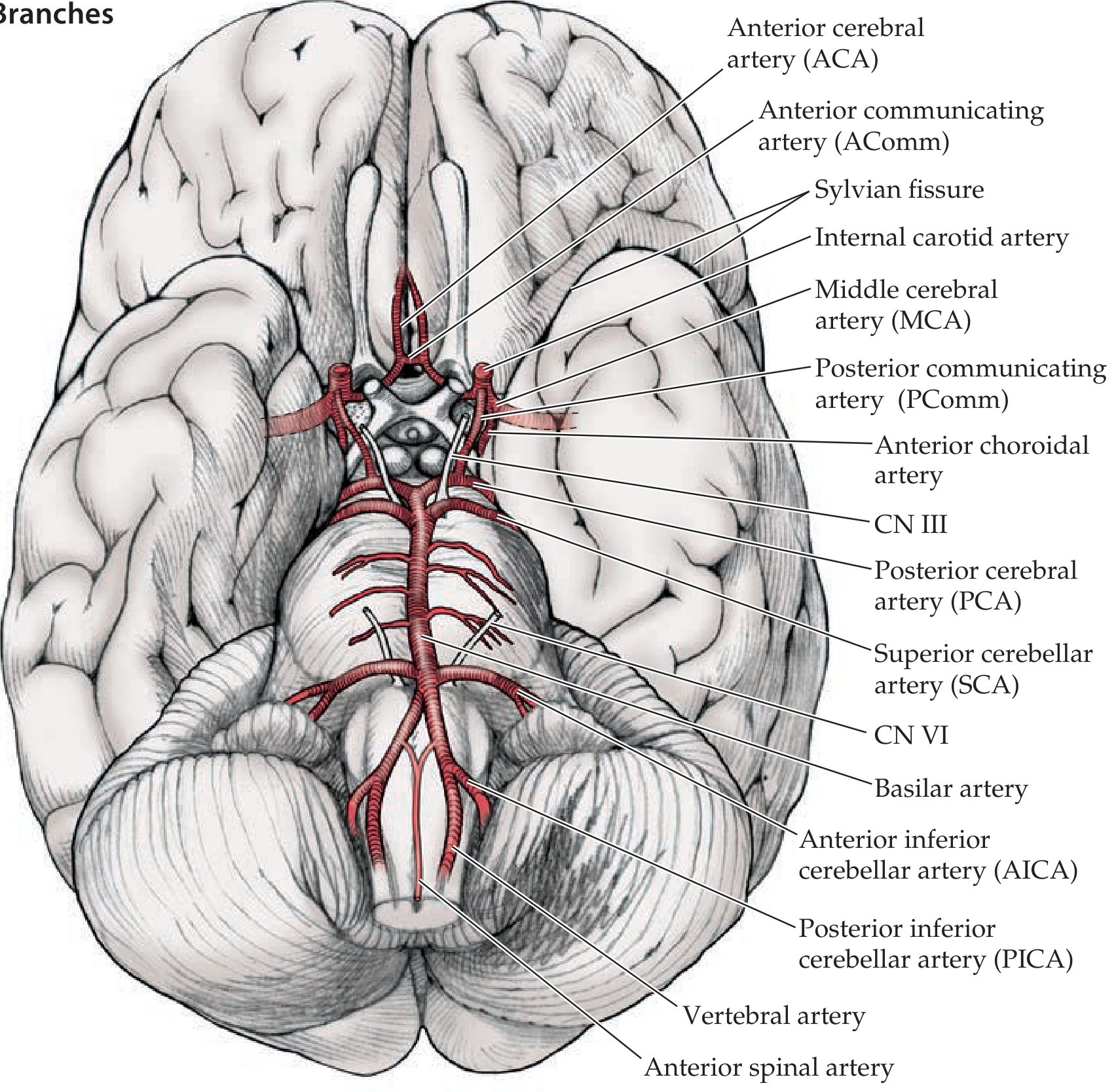
The Circle of Willis is the anastomotic ring at the base of the brain formed by:
Anterior Circulation (from internal carotid arteries):
- Internal carotid artery (ICA) - enters cranium via carotid canal
- Middle cerebral artery (MCA) - lateral territory (Sylvian fissure)
- Anterior cerebral artery (ACA) - medial frontal/parietal cortex
- Anterior communicating artery (AComm) - connects the two ACAs
- Anterior choroidal artery - supplies internal capsule, choroid plexus
Posterior Circulation (from vertebral/basilar arteries):
- Vertebral arteries - ascend through foramina transversaria, enter foramen magnum
- Basilar artery - formed by fusion of two vertebral arteries at pontomedullary junction; runs along ventral pons
- Posterior inferior cerebellar artery (PICA) - from vertebral arteries
- Anterior inferior cerebellar artery (AICA) - from basilar
- Superior cerebellar artery (SCA) - from basilar just before bifurcation
- Posterior cerebral artery (PCA) - terminal branches of basilar
Communicating vessels:
- Posterior communicating artery (PComm) - links ICA to PCA, joining anterior and posterior circulations
A complete Circle of Willis (all vessels full-caliber) is present in only ~34% of individuals - anatomical variants are common. - Neuroanatomy through Clinical Cases, 3rd Ed.
Key Structures in the Interpeduncular Region
- Optic chiasm - partial decussation of optic fibers; sits just anterior to the pituitary stalk (infundibulum) at the base of the diencephalon
- Mammillary bodies - paired rounded eminences posterior to the pituitary stalk; part of the limbic hypothalamus
- Pituitary stalk (infundibulum) - connects the hypothalamus to the pituitary gland (sits in the sella turcica, below the base)
- Anterior perforated substance - on each side between olfactory striae and optic tract; penetrated by lateral striate and lenticulostriate arteries
- Posterior perforated substance - in the interpeduncular fossa; penetrated by posterior thalamoperforating branches of PCA/PComm
Clinical Relevance
| Condition | Basal Involvement |
|---|---|
| Subarachnoid hemorrhage | Blood floods basal cisterns (interpeduncular, chiasmatic, pontine cisterns); aneurysms most common at Circle of Willis junctions |
| Bacterial meningitis | Purulent exudate collects at base of brain, encasing cranial nerves and causing CN palsies |
| Neurosarcoidosis | Predilection for base of brain; cranial neuropathies, especially CN VII |
| Pituitary tumors | Compress optic chiasm from below → bitemporal hemianopia |
| Posterior communicating artery aneurysm | Compresses CN III as it passes in the interpeduncular cistern → painful third nerve palsy with pupil involvement |
| Basilar artery occlusion | Devastating - bilateral pontine/midbrain infarction; may produce locked-in syndrome |
Basal Cisterns
The subarachnoid space at the base is expanded into named cisterns:
- Interpeduncular cistern - between cerebral peduncles; contains CN III, basilar tip, PCA origins
- Chiasmatic cistern - around optic chiasm and pituitary stalk
- Pontine cistern - ventral to pons; contains basilar artery and CN VI
- Cerebellopontine angle cistern - contains CN VII and VIII (clinical target in acoustic neuroma)
- Cisterna magna (cerebellomedullary cistern) - largest; between cerebellum and medulla; often sampled by cisternal puncture
Sources: Gray's Anatomy for Students (p. 1034-1037), Neuroanatomy through Clinical Cases 3rd Ed. (p. 391-417), Color Atlas of Human Anatomy, Adams and Victor's Principles of Neurology
This is a shared conversation. Sign in to Orris to start your own chat.