
analyse_media
Reading File
The question is: A 25-year-old lady with acute abdominal pain, 4 months of amenorrhea, vomiting, PR 125 bpm, BP 90/60 mmHg. Give differential diagnosis and management.
This is a classic obstetric/gynecological emergency. The most likely diagnosis is ruptured ectopic pregnancy given the triad of amenorrhea + acute abdominal pain + hemodynamic instability (tachycardia + hypotension = shock). Let me search the textbooks for a detailed answer.
Searching sources...
Finding Sources
Finding Sources
Reading File
Reading File
Reading File
Finding Sources
Reading File
Reading File
Finding Sources
I now have enough information from the textbooks to give a comprehensive, well-structured answer. Let me also fetch the diagnostic algorithm image.
Loading Image
I now have all the information needed for a complete, structured answer. Here it is:
Clinical Case Analysis
Patient: 25-year-old female
Complaints: Acute abdominal pain, 4 months amenorrhea, vomiting
Vitals: PR 125 bpm (tachycardia), BP 90/60 mmHg (hypotension = shock)
Most Likely Diagnosis: Ruptured Ectopic Pregnancy
This is the #1 diagnosis until proven otherwise. The classic triad of ectopic pregnancy - abdominal pain, amenorrhea, and vaginal bleeding - is present. Combined with hemodynamic instability (tachycardia + hypotension indicating hemorrhagic shock), this points to a ruptured tubal ectopic pregnancy with intra-abdominal hemorrhage. As noted in Berek & Novak's Gynecology, "with rupture and intra-abdominal hemorrhage, the patient develops tachycardia followed by hypotension," exactly what this patient shows.
Differential Diagnosis
1. Ruptured Ectopic Pregnancy (Most Likely)
- Fallopian tube is the most common site (>95% of ectopics)
- 4 months amenorrhea fits a pregnancy of ~16 weeks by dates, but ectopic tubal rupture most commonly occurs at 6-10 weeks - the 4 months may indicate a missed/delayed presentation or a non-tubal ectopic (cornual, ovarian, abdominal)
- Key features: acute onset pain, shock, positive pregnancy test, empty uterus on ultrasound
2. Abruptio Placentae / Uterine Rupture
- Less likely at 4 months (16 weeks) unless pre-existing uterine scar, though the uterus at this stage is still relatively small
3. Ovarian Cyst - Torsion or Rupture (Twisted/Ruptured Ovarian Cyst)
- A large ovarian cyst or corpus luteum cyst can rupture and cause hemoperitoneum
- Can cause acute abdominal pain, vomiting, tachycardia
- Pregnancy test may be positive if corpus luteum cyst accompanies an IUP
4. Appendicitis
- Can present with acute abdominal pain, vomiting, tachycardia, low BP (if perforated)
- Usually right iliac fossa pain with fever; less likely to cause this degree of shock without perforation
5. Acute Pelvic Inflammatory Disease (PID) with Tubo-ovarian Abscess (TOA) Rupture
- Can cause peritonitis and shock
- Usually associated with fever, vaginal discharge, bilateral adnexal tenderness
6. Septic Abortion / Incomplete Abortion
- If pregnancy is intrauterine and non-viable; heavy bleeding + sepsis can cause shock
- Associated with PV bleeding and dilated cervical os
7. Heterotopic Pregnancy
- Coexisting intrauterine and ectopic pregnancy
- Rare (~1 in 30,000 naturally; more common with ART)
8. Degeneration of Uterine Fibroid (Red Degeneration)
- In pregnancy, fibroids can undergo red degeneration causing acute pain
- Less likely to cause hemodynamic shock
Management
This patient is hemodynamically unstable - this is an EMERGENCY. The management of a ruptured ectopic pregnancy is directed at the primary goal of achieving hemostasis (Berek & Novak's Gynecology, p. 1757).
IMMEDIATE (Resuscitation - First 30 Minutes)
| Step | Action |
|---|---|
| 1 | ABC - Airway, Breathing, Circulation |
| 2 | Two large-bore IV access (14-16G), start aggressive IV fluids (crystalloids - Normal Saline / Ringer's Lactate) |
| 3 | Cross-match blood - arrange 2-4 units packed red blood cells (PRBCs) |
| 4 | Oxygen - high flow via face mask |
| 5 | Urinary catheter - monitor urine output |
| 6 | Investigations simultaneously: Urine/serum beta-hCG, CBC, BT/CT, blood group & Rh, RFTs, serum electrolytes, bedside FAST ultrasound |
| 7 | Inform senior obstetrician & anesthesia - prepare for emergency surgery |
| 8 | Consent for emergency surgery |
DEFINITIVE TREATMENT: Surgical
Since the patient is hemodynamically unstable with signs of ruptured ectopic, immediate surgical intervention is mandatory - do NOT delay for investigations.
- Emergency Laparotomy (preferred in hemodynamically unstable patients, not laparoscopy)
- Achieve hemostasis first
- Salpingectomy (removal of the affected fallopian tube) - procedure of choice in ruptured ectopic
- Salpingostomy (tube-conserving) is an option only in unruptured ectopic with intact tube and desire for future fertility
- Laparoscopy - preferred in stable patients; associated with less blood loss, shorter operating time, and faster recovery vs. laparotomy (Berek & Novak's Gynecology, p. 1766)
MEDICAL TREATMENT (Methotrexate)
- NOT appropriate here - reserved only for hemodynamically stable patients with unruptured ectopic
- Absolute contraindications to MTX include: ruptured ectopic, hemodynamic instability, beta-hCG >5,000 mIU/mL (relative), or presence of fetal cardiac activity
POST-OPERATIVE CARE
- Monitor vitals, urine output, Hb post-op
- Anti-D immunoglobulin if patient is Rh negative (300 mcg IM)
- Thromboprophylaxis
- Counseling regarding future fertility and recurrence risk (15% chance of recurrence)
- Follow-up beta-hCG to confirm resolution
Diagnostic Algorithm
This flowchart from Berek & Novak's Gynecology summarizes the approach when a positive pregnancy test is present:
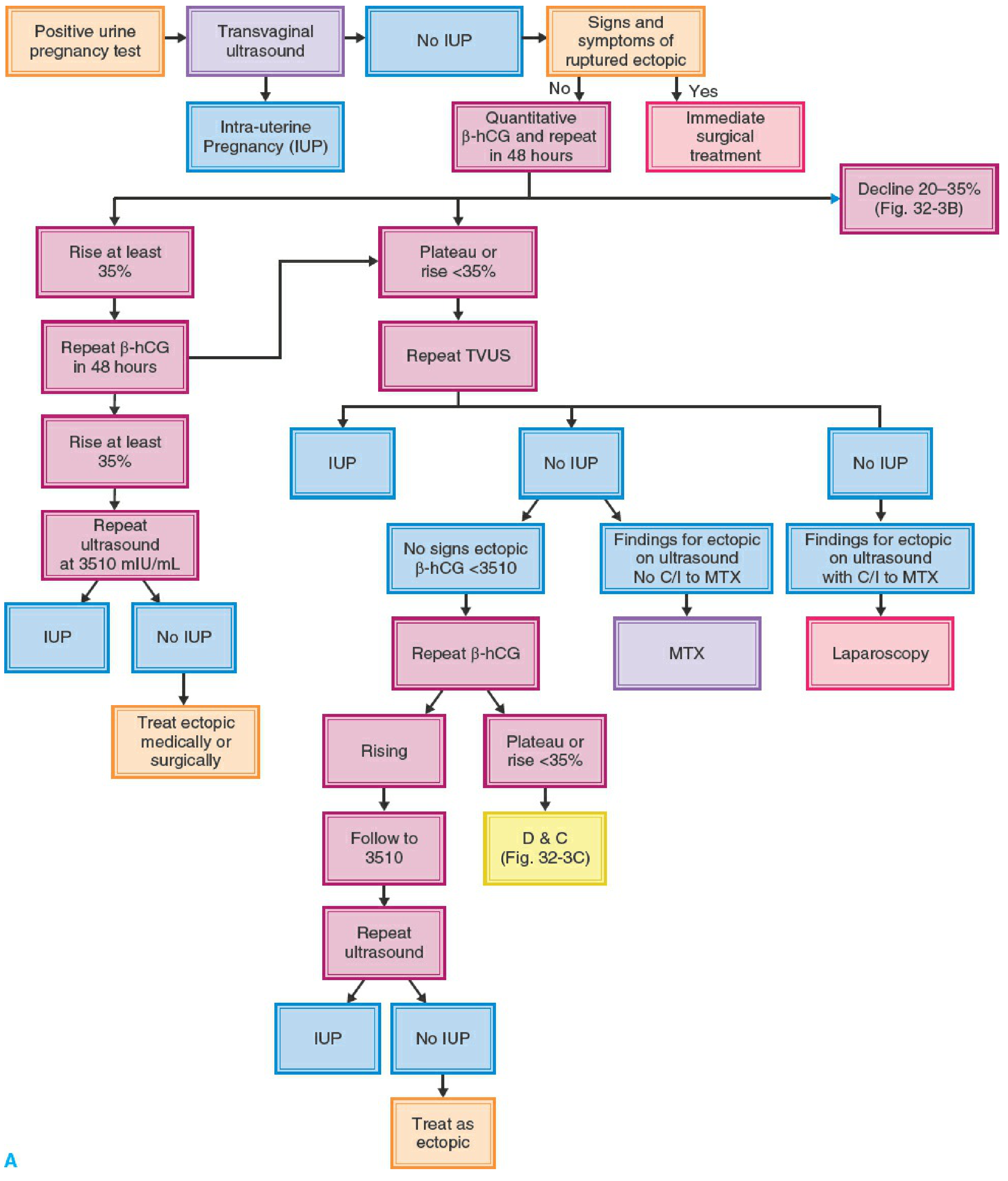
Note: In this patient, she already has signs and symptoms of ruptured ectopic (shock, peritonism) - so the algorithm directs straight to "Immediate Surgical Treatment" (top-right branch).
Summary Table
| Feature | This Patient | Significance |
|---|---|---|
| 25F, amenorrhea 4 months | Pregnancy of unknown location | High suspicion for ectopic |
| Acute abdominal pain + vomiting | Peritoneal irritation | Suggests rupture/hemoperitoneum |
| PR 125 bpm | Tachycardia | Compensatory - blood loss |
| BP 90/60 mmHg | Hypotension | Class III-IV hemorrhagic shock |
| Combined | Ruptured ectopic with shock | Surgical emergency |
Key teaching point: In any woman of reproductive age with the "Three A's" - Abdominal pain, Amenorrhea, Adnexal tenderness - ectopic pregnancy must be excluded as a matter of urgency. Hemodynamic instability mandates immediate surgical management without waiting for investigations to confirm the diagnosis.
Sources: Berek & Novak's Gynecology (Chapter 32, pp. 1757-1768); Swanson's Family Medicine Review
First give me differential as per Gyne and obs point if view
From a pure Gynecology & Obstetrics standpoint, the key features to organize differentials around are: 25-year-old woman + 4 months amenorrhea + acute abdominal pain + vomiting + shock (PR 125, BP 90/60).
Searching sources...
Finding Sources
Finding Sources
Finding Sources
Finding Sources
Reading File
Finding Sources
Reading File
Reading File
I have the full Berek & Novak classification. Now let me compile the complete, focused Gyne & Obs differential.
Differential Diagnosis: Gynecology & Obstetrics Perspective
Clinical Context: 25F | Amenorrhea 4 months | Acute abdominal pain | Vomiting | PR 125 bpm | BP 90/60 mmHg (hemodynamic shock)
The two key axes here are: (1) She is pregnant (amenorrhea of 4 months = ~16 weeks) and (2) She is in shock. Every differential must be viewed through this lens.
GROUP A: OBSTETRIC CAUSES (Pregnancy-Related) ← PRIMARY FOCUS
These must be ruled in/out first since she has 4 months of amenorrhea.
1. Ruptured Ectopic Pregnancy ⭐ MOST LIKELY
| Feature | In this patient |
|---|---|
| Amenorrhea | ✅ 4 months |
| Acute abdominal pain | ✅ Present |
| Hemodynamic shock | ✅ PR 125, BP 90/60 |
| Vomiting (peritoneal irritation) | ✅ Present |
- The classic triad is: abdominal pain + amenorrhea + vaginal bleeding (present in ~50% of ruptured cases)
- Tubal rupture causes intraperitoneal hemorrhage → irritation of the diaphragm → shoulder tip pain (may be present)
- Most common site: Ampullary portion of fallopian tube
- At 4 months amenorrhea, consider interstitial (cornual), ovarian, cervical, or abdominal ectopic - these rupture later and bleed more catastrophically than tubal ectopics
- On exam: Cervical excitation tenderness, adnexal tenderness, empty uterus, uterus slightly enlarged
"With rupture and intra-abdominal hemorrhage, the patient develops tachycardia followed by hypotension. The abdomen is distended with marked tenderness and rebound tenderness." - Berek & Novak's Gynecology, p. 1757
2. Abortion with Complications
(a) Incomplete Abortion with Hemorrhagic Shock
- Products of conception partially expelled → continued uterine bleeding → hypovolemic shock
- Dilated cervical os, visible POC at os
- More likely to have PV bleeding as the dominant feature
- At 16 weeks (4 months), blood loss from an incomplete abortion can be substantial
(b) Septic Abortion
- Infected retained products → endometritis → septic shock (sepsis-induced hypotension)
- Features: fever, foul-smelling PV discharge, uterine tenderness, history of unsafe instrumentation
- BP drop and tachycardia here are from septic shock (warm shock early, cold shock late)
- Distinguished from ectopic by: positive POC on exam, dilated os, fever
(c) Inevitable Abortion / Complete Abortion with Shock
- Less common to cause shock unless massive hemorrhage
3. Placental Abruption (Abruptio Placentae)
- At 16 weeks, the placenta is present but abruption at this early gestation is uncommon
- Premature separation of normally implanted placenta → concealed or revealed hemorrhage → shock
- Features: acute abdominal pain (board-like rigidity), PV bleeding (may be concealed), uterus tender and tense
- More characteristic after 20 weeks but can occur earlier in trauma, hypertension, cocaine use
4. Uterine Rupture
- Rare at 16 weeks unless prior uterine surgery (previous CS scar, myomectomy), obstructed labor, or trauma
- Sudden tearing pain → acute peritonism → fetal parts palpable outside uterus → fetal heart lost → shock
- Cessation of uterine contractions, bleeding
5. Red Degeneration of Fibroid (Carneous Degeneration)
- Occurs during pregnancy (typically 14-22 weeks) when a fibroid outgrows its blood supply
- Acute severe localized pain over the fibroid, low-grade fever, vomiting
- Does NOT typically cause hemodynamic shock unless very large bleed into fibroid
- Uterus tender locally; no peritonism
GROUP B: GYNECOLOGIC CAUSES (Non-Obstetric, but she could have a coexisting IUP)
These are less likely as the primary diagnosis given the hemodynamic instability, but must be considered:
6. Ruptured Hemorrhagic Ovarian Cyst (Corpus Luteum Cyst)
- Corpus luteum cyst is the most common ovarian cyst to rupture → hemoperitoneum
- The corpus luteum is present and enlarged in early pregnancy - it can rupture and bleed significantly
- Features: sudden onset unilateral lower abdominal pain → diffuse peritonism, vomiting
- Can cause significant hemorrhage and shock (particularly right-sided corpus luteum)
- Pregnancy test positive (due to ongoing IUP or ectopic)
- Key distinguishing point: transvaginal ultrasound shows IUP + adnexal free fluid/cyst
"A corpus luteum cyst is the most common cyst to rupture and leads to hemoperitoneum. Symptoms of a ruptured corpus luteum..." - Berek & Novak's Gynecology
7. Adnexal Torsion (Ovarian/Fallopian Tube Torsion)
- Twisting of ovary ± tube on its vascular pedicle → ischemia → infarction
- Features: sudden onset severe colicky unilateral pain, vomiting (prominent), low-grade fever
- In pregnancy, enlarging ovarian cysts (corpus luteum, theca lutein) predispose to torsion
- Shock is uncommon unless associated hemorrhage
- Vomiting is a hallmark symptom of torsion
8. Tubo-Ovarian Abscess (TOA) Rupture
- Rupture of a TOA causes acute peritonitis → septic shock
- Features: fever, bilateral lower abdominal pain, cervical excitation, vaginal discharge
- Less likely in a pregnant patient but possible in early pregnancy
- Distinguished by: high fever, elevated WBC, purulent discharge
SUMMARY TABLE: Gyne & Obs Differentials Ranked by Likelihood
| Priority | Diagnosis | Shock Type | Key Distinguishing Feature |
|---|---|---|---|
| 1st | Ruptured Ectopic Pregnancy | Hemorrhagic | Empty uterus on USG, +βhCG, adnexal mass |
| 2nd | Incomplete/Septic Abortion | Hemorrhagic / Septic | Dilated os, POC visible, ± fever |
| 3rd | Ruptured Corpus Luteum Cyst | Hemorrhagic | IUP on USG + free fluid, adnexal cyst |
| 4th | Placental Abruption | Hemorrhagic | Tense, tender uterus ± PV bleed, IUP present |
| 5th | Adnexal Torsion | Neuro-vagal | Vomiting dominant, no/minimal shock |
| 6th | Red Degeneration of Fibroid | None/minimal | Localised uterine tenderness, low-grade fever |
| 7th | Uterine Rupture | Hemorrhagic | Prior scar, fetal parts palpable, loss of FHS |
| 8th | Ruptured TOA | Septic | High fever, pus on culdocentesis |
| 9th | Heterotopic Pregnancy | Hemorrhagic | IUP seen + separate ectopic (rare) |
One-Line Diagnostic Mantra
In any woman of reproductive age with amenorrhea + acute abdomen + shock, ruptured ectopic pregnancy is the diagnosis until proven otherwise. Rule it out before everything else.
Source: Berek & Novak's Gynecology (Table 12-1 - Differential Diagnosis of Acute Pelvic Pain, Chapter 12 & Chapter 32)
This is a shared conversation. Sign in to Orris to start your own chat.