
SERM mechanism flow chart
Reading File
SERMs (Selective Estrogen Receptor Modulators) act as tissue-selective estrogen agonists or antagonists depending on co-regulator proteins present. Let me pull textbook content on this mechanism now.
Searching sources...
Finding Sources
Finding Sources
Reading File
Reading File
I have the key content and two diagram images. Let me fetch both images and get the rest of the Lippincott SERM section.
Loading Image
Loading Image
Reading File
Reading File
I now have all the content needed. Here is the complete SERM mechanism flow chart and explanation:
SERM Mechanism - Flow Chart
How Normal Estrogen Signaling Works (the baseline)
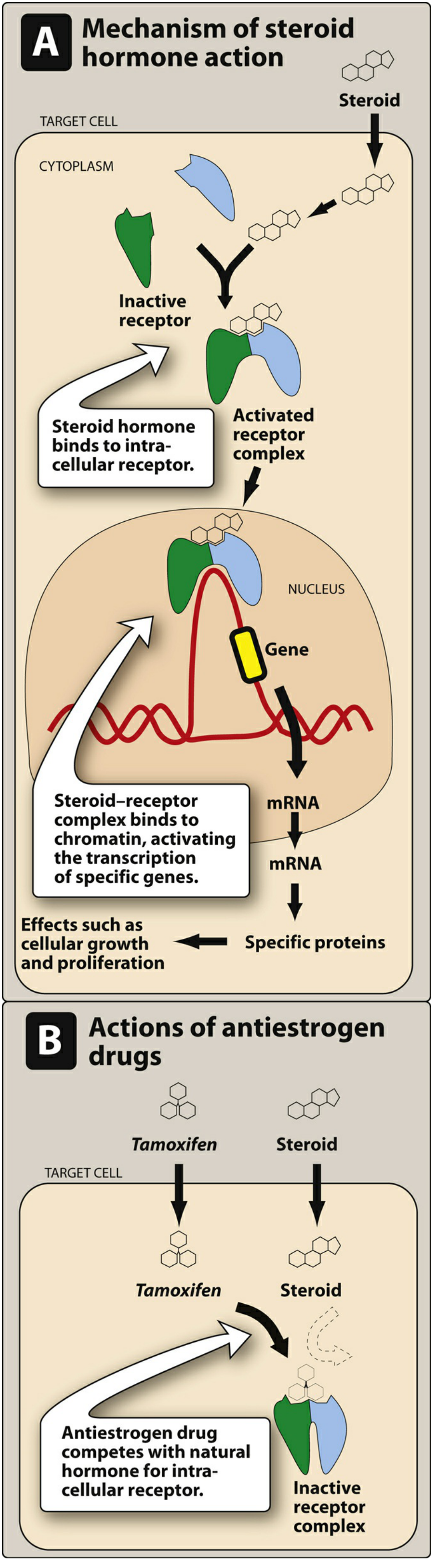
ESTRADIOL (endogenous estrogen)
        │
        ▼
Enters target cell (lipophilic, diffuses freely)
        │
        ▼
Binds intracellular ESTROGEN RECEPTOR (ER)
  [ERα homodimer | ERβ homodimer | ERα-ERβ heterodimer]
        │
        ▼
Conformational change → Receptor ACTIVATION
        │
        ▼
Recruits COACTIVATORS (co-regulatory proteins)
        │
        ▼
ER-ligand complex translocates to NUCLEUS
        │
        ▼
Binds ESTROGEN RESPONSE ELEMENT (ERE) on DNA
        │
        ▼
Gene transcription → mRNA → Specific proteins
        │
        ▼
Tissue effects: cell growth, proliferation, bone
maintenance, uterine/breast development
How SERMs Alter This Pathway
The critical concept: SERMs bind the same ER but induce a DIFFERENT receptor conformation compared to estradiol. This different shape recruits different coregulators (coactivators vs. corepressors) depending on the tissue.
SERM (e.g., Tamoxifen, Raloxifene, Clomiphene)
        │
        ▼
Competes with estradiol for ESTROGEN RECEPTOR binding
  (competitive partial agonist/antagonist)
        │
        ▼
Binds ER → ALTERED conformational change
  ┌─────────────────────────────────────────────┐
  │  Different shape than estradiol-bound ER    │
  │  → Different coregulator recruitment        │
  └─────────────────────────────────────────────┘
        │
        ├──────────────────────────────────────────────────────────┐
        ▼                                                          ▼
  BREAST TISSUE                                           BONE / UTERUS / LIVER
  ─────────────                                           ─────────────────────
  Corepressors recruited                                  Coactivators recruited
        │                                                          │
        ▼                                                          ▼
  ANTAGONIST effect                                         AGONIST effect
  ─ Blocks ERE binding                                    ─ Activates ERE
  ─ No gene transcription                                 ─ Gene transcription occurs
  ─ No cell proliferation                                 ─ Bone: ↓ resorption
  ─ THERAPEUTIC: treats/                                  ─ Uterus (tamoxifen only):
    prevents breast cancer                                   ↑ endometrial proliferation
                                                          ─ Liver: ↓ LDL cholesterol
SERM Effects by Drug and Tissue
| Tissue | Tamoxifen | Raloxifene | Clomiphene |
|---|---|---|---|
| Breast | Antagonist (blocks proliferation) | Antagonist | Antagonist |
| Bone | Agonist (preserves density) | Agonist (prevents resorption) | - |
| Endometrium | Partial agonist (risk of endometrial cancer) | Neutral/antagonist (no cancer risk) | - |
| Hypothalamus/Pituitary | - | - | Antagonist → blocks negative feedback → ↑ FSH/LH → ovulation |
| Lipids | ↓ LDL | ↓ LDL | - |
Full Hormonal Axis Context (Where SERMs Fit)
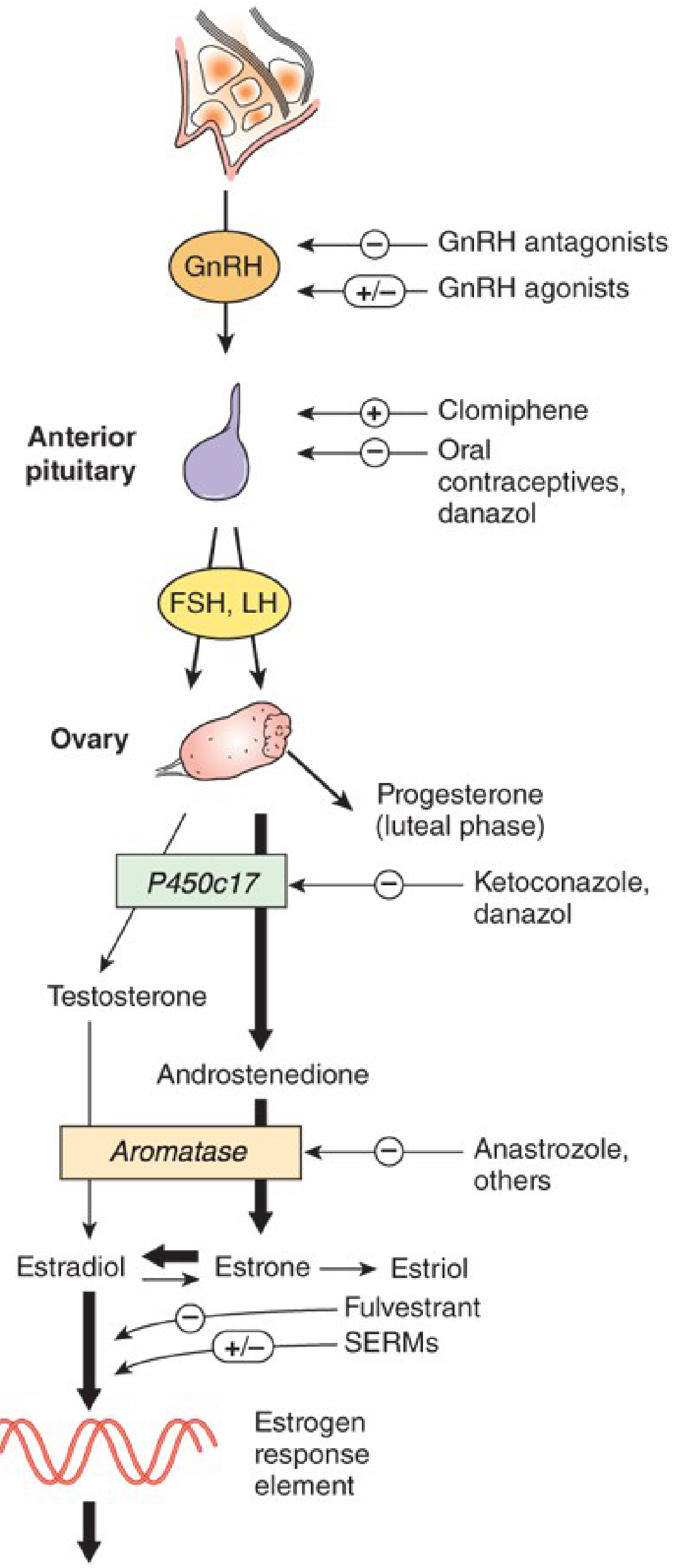
Molecular Mechanism Summary (3-Step Core)
Step 1 – BINDING
  SERM competes with estradiol at ER ligand-binding domain
  (nonsteroidal structure but fits same binding pocket)
        │
        ▼
Step 2 – CONFORMATIONAL CHANGE
  SERM-bound ER adopts a shape DIFFERENT from estradiol-bound ER
  The helix-12 (AF-2) of the ER is repositioned
  → alters surface for coregulator interaction
        │
        ▼
Step 3 – TISSUE-SPECIFIC COREGULATOR RECRUITMENT
  Breast → corepressors (NCoR, SMRT) recruited → silencing
  Bone/Uterus → coactivators (SRC-1, etc.) recruited → activation

  *** This is why the same drug is antagonist in one tissue
      but agonist in another ***
Mechanism Behind CYP2D6 Interaction (Tamoxifen-specific)
Tamoxifen (prodrug, moderate SERM activity)
        │
        ▼ CYP2D6 metabolism
        │
        ▼
4-hydroxytamoxifen / Endoxifen
  (active metabolite - far more potent SERM)
        │
⚠ Strong CYP2D6 inhibitors (e.g., fluoxetine, paroxetine)
  → reduce endoxifen levels → reduced efficacy
Clinical Applications Mapped to Mechanism
| Indication | Drug | Mechanism Used |
|---|---|---|
| ER+ breast cancer treatment | Tamoxifen | Breast antagonism |
| Breast cancer chemoprevention | Tamoxifen, Raloxifene | Breast antagonism |
| Postmenopausal osteoporosis | Raloxifene | Bone agonism |
| Infertility (ovulation induction) | Clomiphene | Hypothalamic antagonism → ↑ GnRH/FSH/LH |
| Hypogonadism in men | Clomiphene | Pituitary antagonism → ↑ LH/testosterone |
Key Takeaway: SERMs are not simply "estrogen blockers." They are tissue-selective because the ER conformation they induce - and therefore the coregulators they recruit - differs by tissue. The agonist vs. antagonist outcome is determined by which coregulatory proteins are available in each tissue, not by the drug alone.
Sources: Lippincott Illustrated Reviews Pharmacology, Fig. 37.26; Katzung Basic & Clinical Pharmacology 16th Ed., Chapter 40, Fig. 40-5
This is a shared conversation. Sign in to Orris to start your own chat.