
Type of zinc and there role on different different body functions
Reading File
Finding Sources
Searching the Web
types of zinc supplements and their roles in body functions
Finding Sources
Reading File
Reading File
Reading File
Reading File
Finding Sources
Reading File
Finding Sources
Reading File
Loading Image
Reading File
I now have comprehensive information from multiple authoritative textbooks. Let me compile this into a thorough answer.
Zinc: Types and Roles in Body Functions
Zinc (Zn) is the second most abundant trace element in the human body after iron. The adult body contains approximately 2–2.6 g of zinc, distributed mainly in bone and skeletal muscle (>85%), with significant concentrations also in skin, liver, prostate, retina, and red blood cells.
Types / Forms of Zinc
Zinc in biology and supplementation exists in several key forms:
1. Zinc as a Metalloenzyme Component (Catalytic Zinc)
The most fundamental biological form. Zinc acts as a direct cofactor in over 300 enzymes (some sources cite over 300 metalloenzymes across all 6 enzyme categories). Key enzymes include:
- Carbonic anhydrase – CO₂/HCO₃⁻ equilibrium, acid-base balance
- Alkaline phosphatase – bone mineralization, liver function
- Alcohol dehydrogenase – ethanol metabolism
- RNA polymerases I, II, III – gene transcription
- DNA polymerase / thymidine kinase – DNA replication and repair
- Carboxypeptidases A & B – protein digestion
- Cu/Zn superoxide dismutase (SOD) – antioxidant defense (Zn provides structural stability; Cu provides catalytic activity)
2. Structural Zinc ("Zinc Finger" Proteins)
Zinc coordinates with histidine and cysteine residues in proteins to form stable folded domains called "zinc fingers." These are critical DNA-binding transcription factors that regulate:
- Gene expression broadly
- Steroid hormone receptor signaling (estrogen, testosterone, cortisol)
- Thyroid hormone receptor signaling
- Developmental biology
More than 1,000 transcription factors depend on zinc.
3. Regulatory / Signaling Zinc
Free zinc ions (Zn²⁺) act as intracellular messengers and regulators:
- Regulate metallothionein (MT) gene expression via the metal response factor MTF1
- Control expression of zinc transporter genes (ZnT and ZIP families)
- Modulate cytokine signaling (MT synthesis is induced by IL-1, IL-6, and glucocorticoids)
4. Metallothionein-Bound Zinc (Storage Zinc)
Metallothionein (MT) is a low-molecular-weight (~9,000–10,000 Da), cysteine-rich intracellular protein that reversibly binds up to 7 zinc atoms. It functions as:
- An intracellular zinc buffer/storage pool
- A zinc trafficking protein within cells
- A protector against zinc toxicity (sequesters excess Zn²⁺)
MT synthesis is upregulated by high zinc intake and by inflammatory stress, making it a dynamic regulator of zinc homeostasis.
5. Dietary / Supplemental Zinc Forms
Common supplemental forms with varying bioavailability:
| Form | Notes |
|---|---|
| Zinc gluconate | Widely used, good tolerability |
| Zinc acetate | Used in Wilson's disease management |
| Zinc sulfate | Common but more GI side effects |
| Zinc oxide | Lower bioavailability, used in topicals |
| Zinc picolinate / citrate | Enhanced absorption via amino acid chelation |
| Zinc protoporphyrin | Formed in iron deficiency states; marker of iron/zinc status |
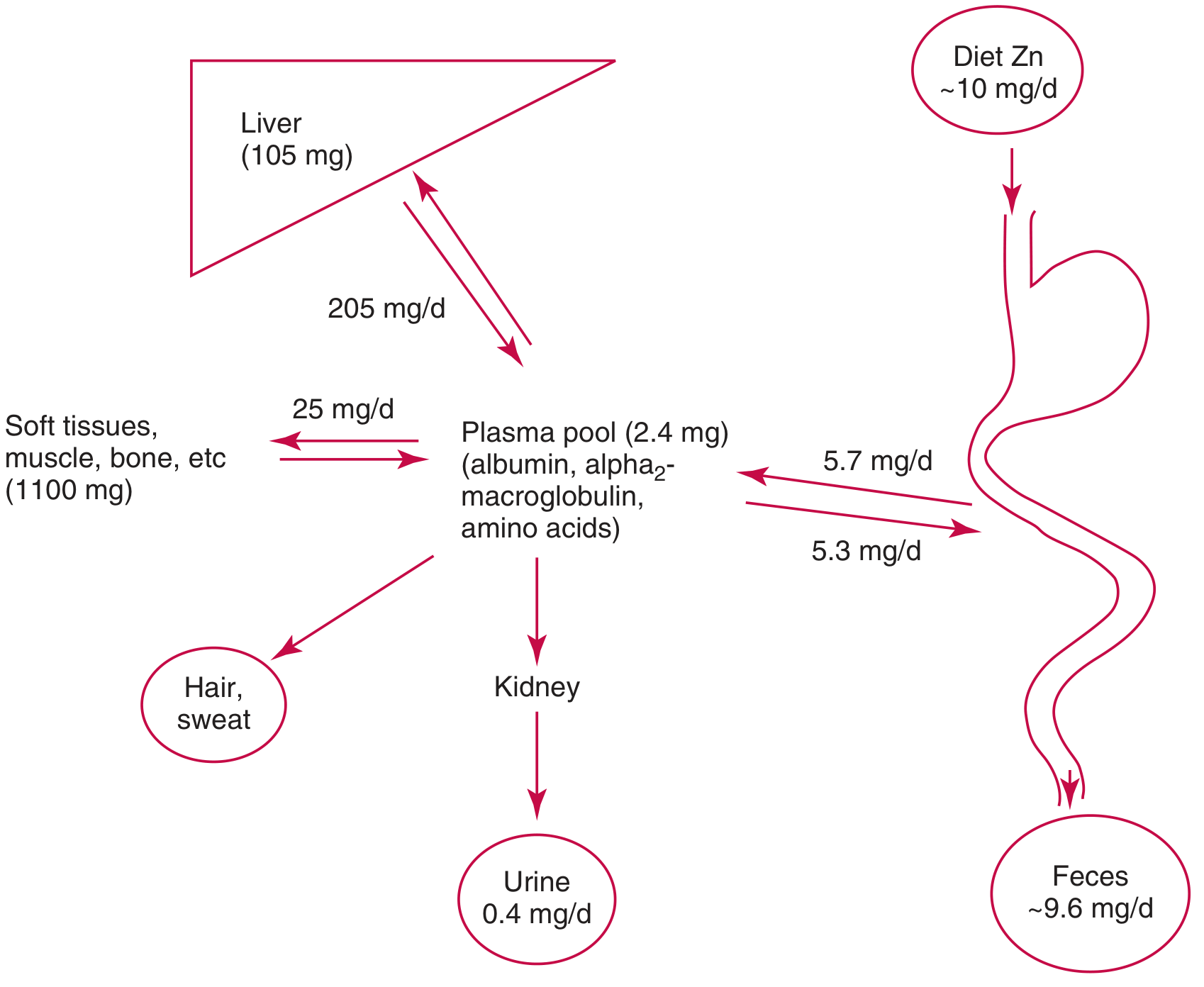
Zinc Metabolism Diagram
Roles in Body Functions
🔬 Enzymatic & Metabolic Functions
Zinc is essential as a catalyst in all six enzyme classes. It enables:
- Protein and nucleic acid synthesis — failure of growth and impaired wound healing are hallmark deficiency signs
- Carbohydrate metabolism — role in glucose tolerance (mechanism not fully elucidated)
- Energy metabolism via involvement in mitochondrial enzymes
🛡️ Immune Function
Zinc is critical for innate and adaptive immunity:
- Required for T-cell development and function — T-cell dysfunction is a specific marker of zinc deficiency
- Supports neutrophil and natural killer (NK) cell activity
- Thymulin (a thymic hormone) is zinc-dependent; low zinc → reduced thymulin → impaired T-cell maturation
- Zinc supplementation in elderly populations has reversed age-related thymic defects
🩹 Wound Healing & Skin
- Zinc is essential for collagen synthesis and cell proliferation in wound repair
- Deficiency causes skin lesions (perioral, periocular, perianal, gluteal regions), alopecia, and impaired wound healing — classic in acrodermatitis enteropathica
- Zinc oxide is widely used topically for skin barrier protection
🧠 Neurological Function
- Zn is a neurosecretory product concentrated in synaptic vesicles of "zinc-containing neurons," found almost exclusively in the forebrain (cerebral cortex and limbic system)
- Plays roles in memory, cognition, and mood — severe deficiency causes confusion, depression, and personality changes
- Zinc dyshomeostasis is implicated in synaptic deterioration and brain aging
🔴 Reproductive Function
- The prostate secretes large amounts of Zn (1–2 mmol/L in seminal plasma) — required for sperm vitality and antibacterial function
- Zn²⁺ interacts with semenogelin to regulate sperm motility
- Low seminal Zn is a risk factor for sperm abnormality and male infertility
- Zinc modulates testosterone synthesis — zinc deficiency → low testosterone
- Required for growth and sexual maturation — deficiency causes delayed puberty
🦴 Bone & Growth
- ~30% of body zinc is in bone; critical for bone mineralization (via alkaline phosphatase)
- Zinc deficiency → growth retardation in children
- Plasma IGF-1 and growth velocity increase with zinc supplementation in zinc-deficient children
👁️ Vision
- High concentrations of Zn in the retina; involved in retinol (vitamin A) mobilization from the liver
- Zinc deficiency → night blindness (via impaired vitamin A metabolism)
- Zinc supplementation is used in age-related macular degeneration (AMD)
🫁 Other Key Roles
| Body System | Role |
|---|---|
| Taste & smell | Gustin (carbonic anhydrase VI) is zinc-dependent; deficiency → dysgeusia, anosmia |
| Antioxidant defense | Structural component of Cu/Zn SOD |
| Apoptosis & proliferation | Regulates cellular apoptosis and differentiation |
| Hormones | Thyroid (free T4), IGF-1, insulin all zinc-dependent |
| Lipid peroxidation | Protective role against oxidative lipid damage |
Zinc Deficiency — Key Clinical Features
- Growth and developmental delay, delayed sexual maturation
- Skin lesions, alopecia, impaired wound healing
- Night blindness, dysgeusia (taste disturbance), anosmia
- Immune dysfunction (especially T-cell)
- Chronic diarrhea, anorexia
- Neuropsychiatric: personality changes, depression, confusion
- Acrodermatitis enteropathica: autosomal recessive defect in SLC39A4 (ZIP4 transporter) — presents with eczema, dermatitis, immunodeficiency, growth failure
Zinc Toxicity
- Doses >150–450 mg/day → nausea, vomiting, GI distress, decreased immune function
- Chronic high doses (>60 mg/day) → copper deficiency (competitive inhibition of intestinal Cu absorption)
- US tolerable upper intake level: 40 mg/day for adults
Sources:
- Tietz Textbook of Laboratory Medicine, 7th Edition
- Yamada's Textbook of Gastroenterology, 7th Edition
- Sleisenger and Fordtran's Gastrointestinal and Liver Disease
- Dermatology 2-Volume Set, 5th Edition
- Goldman-Cecil Medicine
Which type of zinc recommend in hair loss and dandruff in scalp
Finding Sources
Finding Sources
Searching PubMed
zinc supplementation alopecia hair loss
Finding Sources
Finding Sources
Reading Article
PMID: 39440586
Reading File
Reading File
Finding Sources
Reading Article
PMID: 39739356
Reading File
Reading File
You've run out of free credits. Sign up for a free account to continue using Orris.
This is a shared conversation. Sign in to Orris to start your own chat.