

42944.jpg
Details me explain Karo
I can see your image shows Unit 1: Enzymes topics from a Paper-I priority order list. I'll explain each topic in detail.
Searching sources...
Reading File
Now let me search the medical library for all the enzyme topics in parallel.
Finding Sources
Finding Sources
Finding Sources
Finding Sources
Finding Sources
Good - I can see biochemistry books. Let me search for enzyme topics in the biochemistry books specifically.
Finding Sources
Finding Sources
Excellent! I found the key sections. Let me now read the core enzyme sections from Lippincott and Basic Medical Biochemistry in parallel.
Reading File
Reading File
I have rich content from the textbooks. Let me read the enzyme inhibition and Lineweaver-Burk sections now.
Reading File
Reading File
I now have comprehensive textbook content. Let me fetch the key diagrams for visual explanation.
Loading Image
Loading Image
I now have everything needed to write a thorough explanation. Here is the complete, structured breakdown of all Unit 1 Enzyme topics from your syllabus.
Unit 1: Enzymes - Complete Notes
(Sources: Lippincott's Biochemistry 8th Ed, Basic Medical Biochemistry 6th Ed, Harper's Biochemistry 32nd Ed)
1. Enzyme Classification
Enzymes are biological catalysts (almost always proteins) that increase reaction rates by 10⁶ to 10¹⁴-fold. The International Union of Biochemistry (IUB) classifies enzymes into 6 major classes:
| Class | Reaction Catalyzed | Example |
|---|---|---|
| 1. Oxidoreductases | Oxidation-reduction (transfer of electrons/H) | Lactate dehydrogenase (LDH) |
| 2. Transferases | Transfer of a chemical group | Aminotransferases (AST, ALT) |
| 3. Hydrolases | Hydrolysis (cleavage with water) | Lipase, trypsin, pepsin |
| 4. Lyases | Addition/removal across a double bond | Aldolase, carbonic anhydrase |
| 5. Isomerases | Intramolecular rearrangement | Phosphoglucose isomerase |
| 6. Ligases | Bond formation using ATP | Acetyl-CoA carboxylase |
Key structural concepts:
- Active site: A cleft or crevice on the enzyme where substrate binds and catalysis occurs. It has a binding site (for substrate) and a catalytic site (for bond making/breaking).
- Lock-and-Key model: Substrate fits the active site like a key in a lock (rigid).
- Induced-fit model: Enzyme changes shape upon substrate binding (more accurate for most enzymes).
- Cofactors: Non-protein helpers - metal ions (Zn²⁺, Mg²⁺) or coenzymes (NAD⁺, FAD, derived from vitamins). A complete enzyme is called a holoenzyme = apoenzyme + cofactor.
- Specificity arises from the unique 3D amino acid sequence of the active site.
2. Factors Affecting Enzyme Activity
a) Substrate Concentration - Michaelis-Menten Kinetics
The Michaelis-Menten equation describes how velocity (v₀) changes with substrate [S]:
$$v_0 = \frac{V_{max}[S]}{K_m + [S]}$$
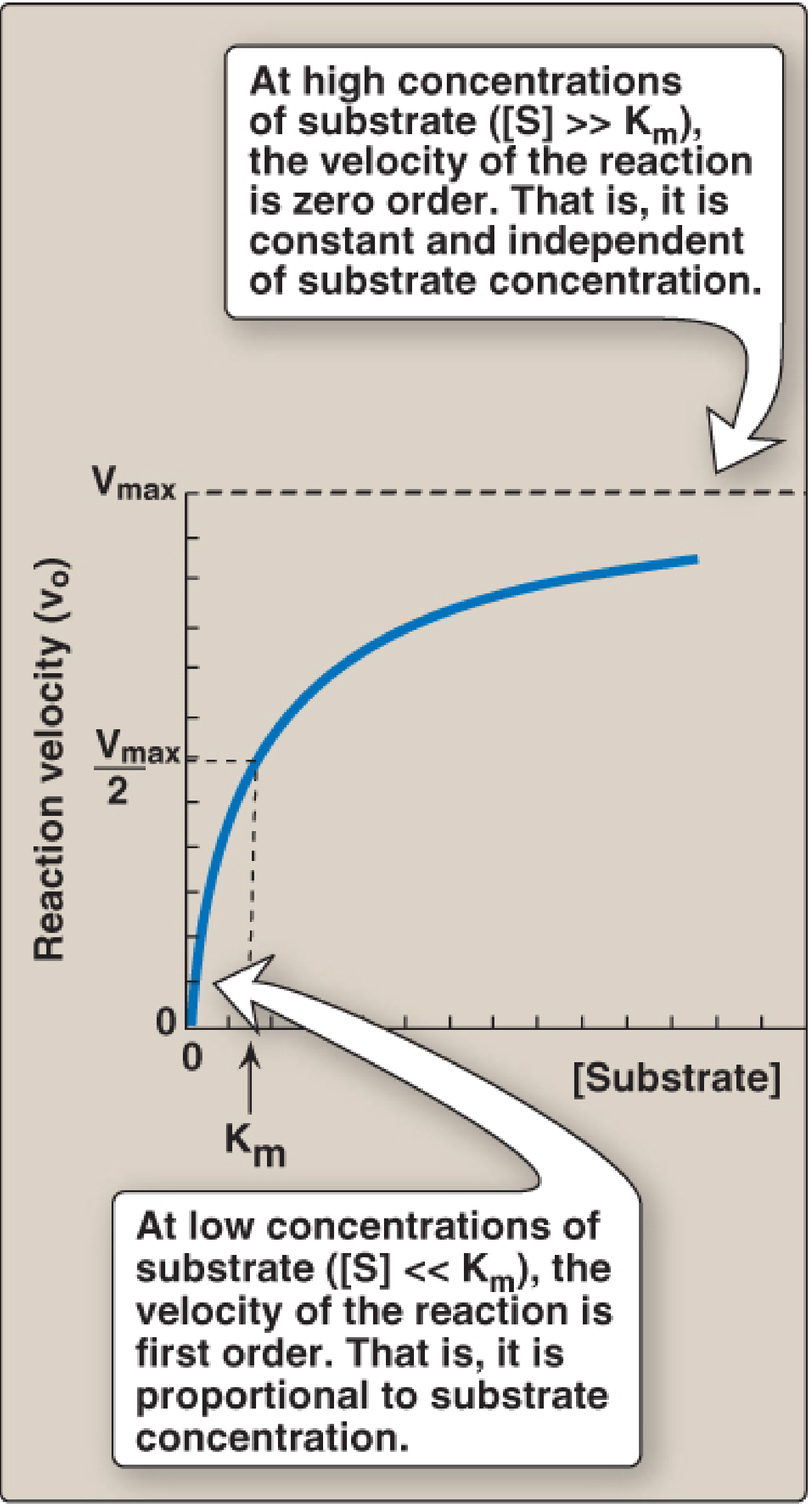
- Vmax: Maximum velocity when all enzyme active sites are saturated with substrate.
- Km (Michaelis constant): The [S] at which v₀ = Vmax/2. Km reflects the affinity of enzyme for substrate - a LOW Km means HIGH affinity.
- At low [S]: reaction is first-order (velocity proportional to [S]).
- At high [S]: reaction is zero-order (velocity independent of [S], enzyme is saturated).
b) Temperature
- Velocity increases with temperature up to an optimum (~37°C for human enzymes).
- Above 40°C, enzymes denature and velocity falls sharply.
- Thermophilic bacteria have optima of ~70°C.
c) pH
- Each enzyme has an optimal pH. Examples:
- Pepsin: pH 2 (stomach)
- Trypsin: pH 8 (small intestine)
- Alkaline phosphatase: pH ~10
- Extremes of pH alter ionization of active site residues and cause denaturation.
d) Enzyme Concentration
- At constant [S], velocity increases linearly with enzyme concentration (as long as substrate is not limiting).
3. Competitive Inhibition
The inhibitor structurally resembles the substrate and competes for the same active site.
| Parameter | Effect |
|---|---|
| Vmax | Unchanged (can be overcome by adding more substrate) |
| Km | Increased (apparent Km rises - lower affinity for substrate) |
| Lineweaver-Burk | Lines intersect on the Y-axis (same y-intercept = same Vmax; different x-intercepts = different Km) |
Classic example: Malonate inhibits succinate dehydrogenase (malonate resembles succinate). Statins (HMG-CoA reductase inhibitors) are a major clinical example - they competitively inhibit the rate-limiting step of cholesterol synthesis.
Memory trick: Competitive = Can be overcome by Competition (more substrate). Vmax preserved, Km increased.
4. Non-competitive Inhibition
The inhibitor binds to a site other than the active site (an allosteric site) - it can bind to the free enzyme OR the enzyme-substrate complex.
| Parameter | Effect |
|---|---|
| Vmax | Decreased (cannot be overcome by adding substrate) |
| Km | Unchanged (affinity for substrate is unaffected) |
| Lineweaver-Burk | Lines intersect on the X-axis (same x-intercept = same Km; different y-intercepts = different Vmax) |
Classic example: Heavy metal ions (Pb²⁺, Hg²⁺) bind -SH groups on enzymes away from the active site. Cyanide inhibits cytochrome oxidase non-competitively.
Memory trick: Non-competitive = Nothing you do (no extra substrate) can fix it. Vmax drops, Km stays.
Comparison Table
| Feature | Competitive | Non-Competitive |
|---|---|---|
| Inhibitor binding site | Active site | Allosteric site |
| Overcome by excess [S]? | Yes | No |
| Vmax | Unchanged | Decreased |
| Km | Increased | Unchanged |
| Lineweaver-Burk | Same Y-intercept, different slope | Same X-intercept, different slope |
5. Allosteric Enzymes
Allosteric enzymes are regulatory enzymes that do NOT follow Michaelis-Menten kinetics. They are controlled by molecules called effectors (modulators) that bind to a regulatory site distinct from the active site.
Key features:
- Usually multi-subunit proteins.
- Show a sigmoidal (S-shaped) v₀ vs [S] curve instead of hyperbolic - reflecting cooperativity between subunits.
- Often catalyze the committed step (first irreversible step) in a metabolic pathway.
- Use K₀.₅ (instead of Km) - the [S] giving half-maximal velocity.
Types of effectors:
- Positive effectors (activators): increase enzyme activity. Can increase Vmax or decrease K₀.₅ (shift curve left = more active).
- Negative effectors (inhibitors): decrease enzyme activity. Can decrease Vmax or increase K₀.₅ (shift curve right = less active).
Types by effector identity:
- Homotropic effectors: The substrate itself is the effector. Leads to cooperativity (binding of one substrate molecule facilitates binding of others - just like O₂ binding to hemoglobin).
- Heterotropic effectors: A molecule different from the substrate. The key mechanism is feedback inhibition - the end product of a pathway inhibits the first committed enzyme. Example: ATP inhibits phosphofructokinase-1 (PFK-1) in glycolysis; citrate also inhibits PFK-1.
Example: Aspartate transcarbamoylase (ATCase) - inhibited by CTP (end product), activated by ATP.
6. Isoenzymes (Isozymes)
Isoenzymes are different forms of the same enzyme that catalyze the same reaction but differ in amino acid sequence, physical properties, and tissue distribution. They arise from different genes or different post-translational modifications.
Classic clinical example - Lactate Dehydrogenase (LDH):
-
LDH is a tetramer made of two subunit types: H (heart) and M (muscle).
-
5 isoenzymes exist:
Isoenzyme Composition Location LDH-1 HHHH (4H) Heart, RBCs, kidney LDH-2 HHHM (3H1M) Heart (mainly) LDH-3 HHMM (2H2M) Lung, platelets LDH-4 HMMM (1H3M) Liver, skeletal muscle LDH-5 MMMM (4M) Liver, skeletal muscle -
Myocardial infarction (MI): LDH-1 > LDH-2 (called "flipped LDH ratio") - peaks at 24-48 hrs.
Creatine Kinase (CK) isoenzymes:
- CK-MM: Skeletal muscle (normal in blood)
- CK-MB: Cardiac muscle - rises in MI (marker of myocardial injury)
- CK-BB: Brain
Clinical significance of isoenzymes:
- Tissue-specific damage can be identified by the pattern of isoenzymes released into blood.
- Electrophoresis is used to separate them.
7. Lineweaver-Burk Plot (Double Reciprocal Plot)
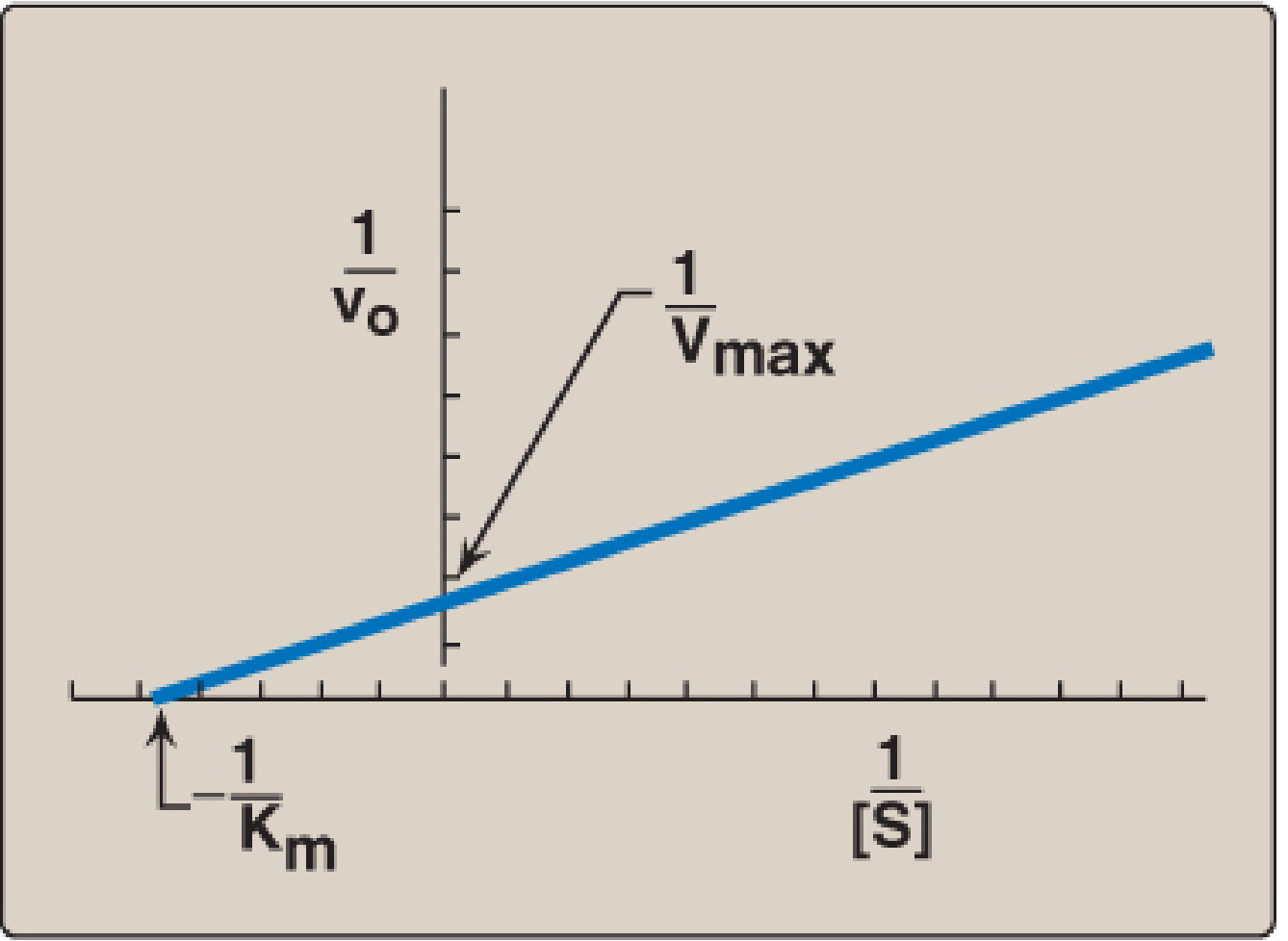
The Michaelis-Menten curve is a hyperbola, making it difficult to read Vmax and Km accurately. The Lineweaver-Burk plot linearizes the data by taking reciprocals.
Equation:
$$\frac{1}{v_0} = \frac{K_m}{V_{max}} \cdot \frac{1}{[S]} + \frac{1}{V_{max}}$$
This is in the form y = mx + c (a straight line):
| Intercept/Slope | Value |
|---|---|
| Y-intercept | 1/Vmax |
| X-intercept | -1/Km |
| Slope | Km/Vmax |
How inhibitors change the Lineweaver-Burk plot:
| Inhibitor Type | Y-intercept (1/Vmax) | X-intercept (-1/Km) | Lines |
|---|---|---|---|
| No inhibitor | 1/Vmax | -1/Km | Baseline |
| Competitive | Same (Vmax unchanged) | Moves right (Km increased) | Intersect on Y-axis |
| Non-competitive | Moves up (Vmax decreased) | Same (Km unchanged) | Intersect on X-axis |
Exam tip: The Lineweaver-Burk plot is the most tested way to distinguish competitive from non-competitive inhibition. In competitive inhibition, the lines fan out from a common Y-intercept. In non-competitive, they fan out from a common X-intercept.
Quick-Revision Summary Table
| Topic | Key Fact to Remember |
|---|---|
| Enzyme classes | 6 types: Oxidoreductase, Transferase, Hydrolase, Lyase, Isomerase, Ligase |
| Km | [S] at Vmax/2; low Km = high affinity |
| Competitive inhibition | Vmax same, Km up; overcome by substrate |
| Non-competitive inhibition | Vmax down, Km same; NOT overcome by substrate |
| Allosteric enzymes | Sigmoidal curve, effectors at allosteric site, cooperativity |
| Isoenzymes | Same reaction, different structure/tissue; LDH-1 in MI |
| Lineweaver-Burk | 1/v₀ vs 1/[S]; Y-intercept = 1/Vmax; X-intercept = -1/Km |
Sources: Lippincott's Illustrated Reviews: Biochemistry 8th Ed, pp. 180-196 | Basic Medical Biochemistry: A Clinical Approach 6th Ed, pp. 233-240
This is a shared conversation. Sign in to Orris to start your own chat.