
Loose stools 8-10 episodes Vomiting 4-6 episodes Abdominal pain Bp-130/80 Pr-125 Spo2-99 H/o fried rice consumption Symptoms started after 4-5 hrs
Reading File
This is a clinical case of acute food poisoning - most likely Bacillus cereus (emetic or diarrheal type) given the fried rice history and 4-5 hour onset. Let me search the library for a thorough answer.
Searching sources...
Finding Sources
Finding Sources
Finding Sources
Reading File
Reading File
Reading File
Finding Sources
Reading File
I now have comprehensive information to give a thorough clinical answer. Here is the full analysis:
Clinical Analysis: Acute Food Poisoning - Bacillus cereus (Emetic Form)
Diagnosis
Most Likely: Bacillus cereus Food Poisoning - Emetic Form
The history is classic:
| Feature | This Patient | B. cereus Emetic Pattern |
|---|---|---|
| Incubation period | 4-5 hours post meal | 1-6 hours (preformed toxin) |
| Food source | Fried rice | Fried rice, starchy foods |
| Vomiting | 4-6 episodes | Prominent |
| Diarrhea | 8-10 episodes | Present |
| Abdominal pain | Yes | Yes |
| Fever | Not mentioned | Typically absent |
B. cereus produces two distinct enterotoxins causing two distinct syndromes:
- Emetic form (this patient): Incubation 1-6 hours. Preformed heat-stable toxin (cerulide). Upper GI symptoms dominate - nausea, vomiting, diarrhea. Strongly linked to fried rice and starchy foods. Resembles Staphylococcus aureus food poisoning clinically.
- Diarrheal form: Incubation 8-16 hours. Lower GI symptoms dominate - abdominal cramps, diarrhea with little vomiting.
B. cereus spores are ubiquitous in uncooked rice. They survive boiling. If cooked rice is left at room temperature (rather than refrigerated), organisms germinate and produce toxin rapidly. - Harrison's Principles of Internal Medicine 22E
Vitals Assessment
| Parameter | Value | Interpretation |
|---|---|---|
| BP | 130/80 mmHg | Normal/slightly elevated - not hypotensive, no shock |
| PR | 125 bpm | Tachycardia - likely dehydration from losses |
| SpO2 | 99% | Normal |
The tachycardia (PR 125) with 8-10 loose stools + 4-6 vomiting episodes indicates mild-to-moderate dehydration and warrants active fluid management.
Differential Diagnosis
| Organism | Against this Dx |
|---|---|
| Staphylococcus aureus | Very similar picture (1-6h onset, nausea/vomiting/diarrhea) - distinguish by food source (S. aureus: ham, salads, mayo; B. cereus: fried rice) |
| Clostridium perfringens | Incubation 8-16h; diarrhea > vomiting; beef/poultry - doesn't fit |
| Viral gastroenteritis (norovirus) | No common-source outbreak pattern; slower onset |
| Cholera | No "rice water" stools; no epidemic setting; no secondary cases |
Management
1. Immediate Resuscitation
- IV fluid resuscitation given tachycardia (PR 125) - the elevated heart rate suggests active dehydration from high-volume losses
- Start Ringer's Lactate or Normal Saline - 500 mL bolus, then reassess HR
- Target HR < 100, urine output > 0.5 mL/kg/hr
- Once tolerating orally: transition to Oral Rehydration Solution (ORS) - WHO formula preferred
2. Anti-emetics
- Ondansetron (8 mg IV/oral) - first-line for vomiting control
- Or Metoclopramide 10 mg IV/IM
3. Dietary Advice
- Nil by mouth initially if vomiting is severe
- Resume with clear liquids, then soft/bland diet (BRAT: banana, rice, applesauce, toast) once vomiting settles
- Avoid dairy, fatty foods initially
4. Antibiotics - NOT Indicated
B. cereus food poisoning is self-limiting (resolves within 24 hours). Antibiotics are not recommended because:
- The disease is toxin-mediated (preformed toxin already ingested)
- Antibiotic treatment does not alter the clinical course
- Risk of antibiotic-associated complications - Rosen's Emergency Medicine
5. Monitoring
- Repeat vitals every 1-2 hours until HR normalizes
- Stool output chart
- Watch for signs of severe dehydration: orthostatic hypotension, oliguria, altered mentation
Investigations (If Needed)
For a straightforward case like this, investigations are not routinely required. Consider if:
- Symptoms persist >24-48 hours or worsen
- Bloody stools develop (would shift differential toward invasive organisms)
- Immunocompromised patient
- Outbreak investigation needed:
| Investigation | Purpose |
|---|---|
| Stool culture / microscopy | Rule out bacterial dysentery, parasites |
| Stool for ova & cysts | If symptoms persist >2 weeks |
| Stool C. difficile toxin | If recent antibiotic history |
| Blood CBC, electrolytes, creatinine | If moderate-severe dehydration |
| Stool B. cereus count | Outbreak investigation: ≥10⁵ organisms/gram confirms diagnosis - Park's Textbook |
| Remnant food culture | Send implicated fried rice for culture if available |
Prognosis
Excellent. B. cereus emetic food poisoning is self-limiting within 24 hours in immunocompetent patients. With adequate rehydration, full recovery is expected. No deaths expected in an otherwise healthy adult. - Rosen's Emergency Medicine
Key Teaching Points
- Fried rice + 1-6 hour onset = B. cereus emetic form - a classic and high-yield association
- Tachycardia in this setting = dehydration signal - do not ignore
- Antibiotics are contraindicated - this is toxin-mediated, not active infection
- Self-limiting: reassure patient, focus on supportive care
- Prevention: refrigerate cooked rice immediately; do not leave at room temperature
Foreign body consumption 3-4 yr old
Reading File
Searching sources...
This is a pediatric emergency - foreign body ingestion in a 3-4 year old is a classic and high-stakes scenario. Let me pull comprehensive textbook guidance.
Finding Sources
Finding Sources
Finding Sources
Finding Sources
Reading File
Reading File
Reading File
Finding Sources
Reading File
Finding Sources
Reading File
Reading File
Reading File
Now let me fetch the key X-ray images to include for visual learning.
Loading Image
Loading Image
Excellent textbook images retrieved. Now I have everything needed for a thorough answer.
Foreign Body Ingestion - 3 to 4 Year Old Child
Why This Age Group?
Foreign body ingestion peaks between 6 months and 3 years of age, making a 3-4 year old squarely in the highest-risk window. Boys are more commonly affected. The reasons are developmental:
- Lack of cognitive distinction between edible and inedible objects
- Tendency to explore objects orally
- Incomplete molars - poor chewing ability
- Immature swallowing coordination
Pediatric cases account for 80% of all foreign body ingestions. - Cummings Otolaryngology
Step 1: Immediate Assessment - Is It an Airway or GI Emergency?
First - Rule Out Complete Airway Obstruction
| Sign | Action |
|---|---|
| Conscious, coughing, can cry/speak | Do NOT intervene forcefully - coughing is protective. Monitor closely |
| Conscious but cannot cry, cyanotic, silent | Perform Heimlich maneuver immediately |
| Unconscious | Begin CPR cycles of 5 chest compressions; look in oropharynx between cycles for expelled object |
| Visible object in oropharynx | Remove with Magill forceps under direct/video laryngoscopy |
| Intubation fails | Needle cricothyrotomy (NOT surgical cricothyrotomy in young children) |
"In children, the Heimlich maneuver may be considered in the choking but conscious patient." - Rosen's Emergency Medicine
Step 2: History Taking
Key questions to ask the parent/caregiver:
- What was ingested? - coin, button battery, magnet, bone, toy part, food?
- When did it happen? - time elapsed matters
- Was it witnessed?
- Any symptoms since? - drooling, dysphagia, gagging, stridor, wheeze, refusal to eat
Three Clinical Phases of Foreign Body Ingestion:
| Phase | Description |
|---|---|
| Phase 1 | Immediate - choking, coughing, gagging at moment of ingestion |
| Phase 2 | Asymptomatic interval - object settles, reflexes attenuate. Can last hours to weeks - this is the dangerous phase that causes delayed diagnosis |
| Phase 3 | Complications - obstruction, infection, perforation |
Step 3: Imaging
X-ray is the first-line investigation - obtain PA AND lateral views of neck, chest, abdomen
Why both views?
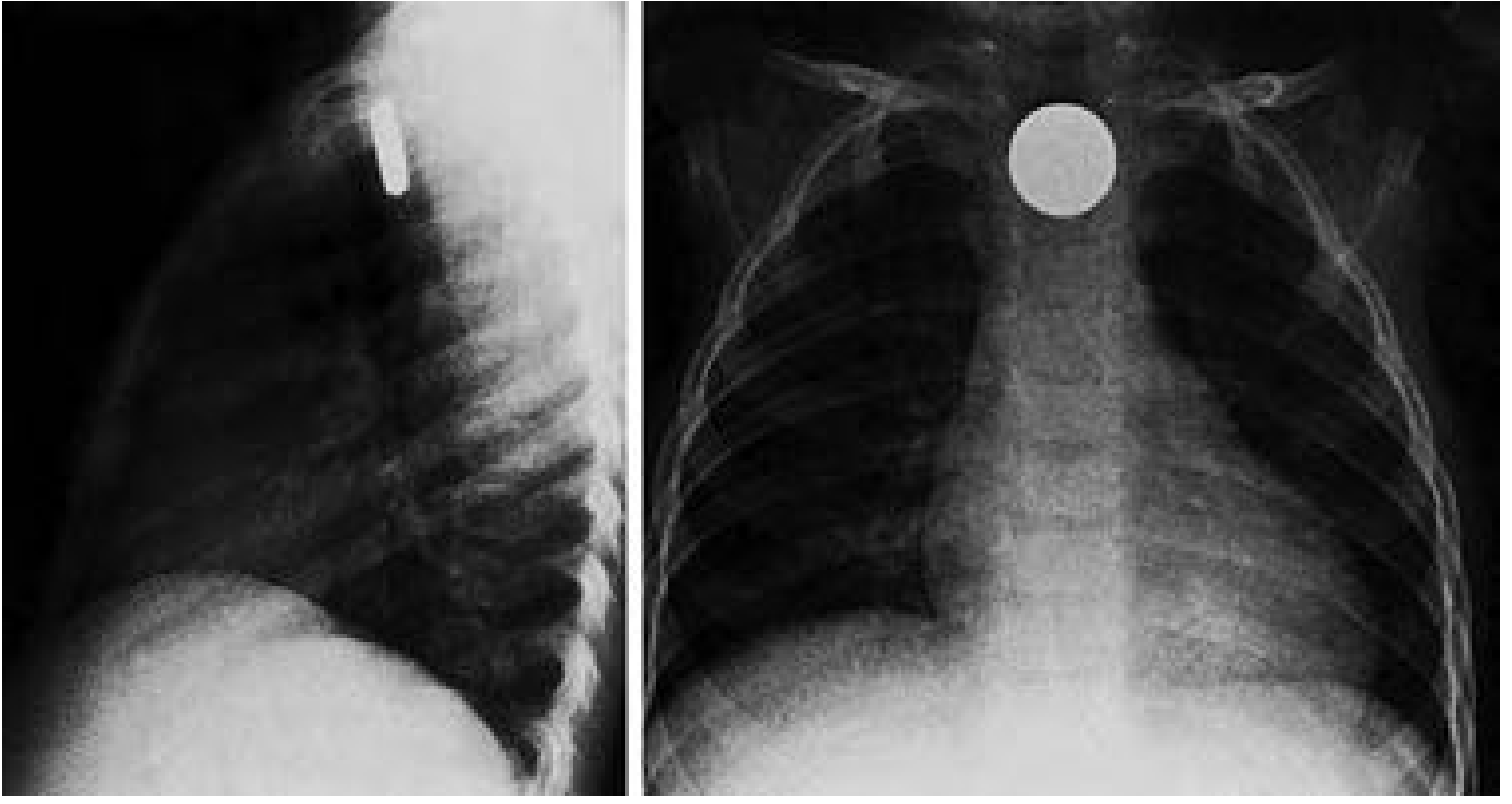
Radiographic rules:
- Object in esophagus: coronal (flat/face-on) orientation on PA view; posterior to trachea on lateral
- Object in trachea: sagittal orientation on PA; anterior on lateral
- Only ~11% of airway foreign bodies are radio-opaque - a normal X-ray does NOT rule out aspiration
- If X-ray negative but history compelling - low-dose CT airway ("virtual bronchoscopy") has 100% sensitivity
Button Battery - Special Recognition
- On PA view: "halo sign" or "double-ring" sign differentiates button battery from a coin
- On lateral view: "step-off sign" (double contour)
- Do NOT mistake a battery for a coin - the consequences are drastically different
Step 4: Management by Location
A. Esophageal Foreign Body
Most esophageal foreign bodies lodge at one of three anatomical narrowings:
- Cricopharyngeus (upper esophageal sphincter) - most common site, ~70-75%
- Aortic arch level
- Lower esophageal sphincter (gastro-esophageal junction)
| Object | Action | Urgency |
|---|---|---|
| Coin - esophagus | Endoscopic removal if symptomatic or impacted >24h; observe if asymptomatic and distal | Urgent within 24h |
| Button battery - esophagus | EMERGENCY - remove within 2 hours | EMERGENT |
| Sharp object (pin, bone, needle) - esophagus | Urgent endoscopic removal | Urgent |
| Magnet(s) - esophagus | Urgent removal; multiple magnets are especially dangerous (can perforate bowel) | Urgent |
| Smooth blunt object - stomach | Observe; most will pass spontaneously | Watchful waiting |
"Between 10 and 20% of esophageal foreign bodies require endoscopic removal; less than 1% require open operative intervention." - Cummings Otolaryngology
B. Airway Foreign Body
- Rigid bronchoscopy is the treatment of choice for bronchial foreign bodies
- 80-90% of airway foreign bodies lodge in the bronchi (right bronchus more common due to anatomy)
- Tracheal foreign bodies are more dangerous - higher risk of complete obstruction
- Organic matter (nuts, seeds): especially problematic - swells with moisture, causes inflammation
C. In the Stomach / Already Passed Esophagus
- Most objects will pass through the GI tract spontaneously without intervention
- Exceptions requiring surgical/endoscopic intervention:
- Objects >6 cm length or >2.5 cm width (too large to pass pylorus)
- Sharp objects (risk of perforation at bends)
- Multiple magnets (can pinch bowel walls together causing necrosis/perforation)
- Button batteries in stomach (if not passed within 48h)
- Advise parents to check stools for passage and return if:
- Abdominal pain, vomiting, fever, or bloody stools develop
Dangerous Objects - Special Considerations
1. Button Batteries ⚡ (Most Dangerous)
- Cause liquefactive necrosis via electrical current and alkali production
- Can perforate esophagus within 2 hours of lodgement
- Can cause aorto-esophageal fistula, tracheo-esophageal fistula, mediastinitis - all potentially fatal
- Remove IMMEDIATELY - this is a true emergency
2. Multiple Magnets
- Each magnet attracts to adjacent loops of bowel through the gut wall
- Causes pressure necrosis and perforation
- Must be removed urgently
3. Sharp/Pointed Objects
- Bones, pins, open safety pins, toothpicks
- Risk of perforation especially at intestinal bends (ileocecal junction, sigmoid)
- Endoscopic or surgical removal
4. Coins
- Most common ingested foreign body in children
- Usually benign if in stomach - most pass spontaneously
- Esophageal coins need removal (risk of ulceration, stricture)
Common Dangerous Household Objects (Memorize for Counselling)
From Cummings Otolaryngology - Box 211.1:
- Button batteries
- Coins, marbles
- Balloons (airway obstruction risk)
- Small ball toys
- Toys with small parts
- Pen/marker caps
- Medicine syringes
- Single-use laundry detergent pods (bright colors resemble candy)
Summary: Management Algorithm
Foreign Body Ingestion - Child 3-4 yrs
        |
        v
Is child choking / airway obstructed?
  YES → Heimlich / BLS / Laryngoscopy + Magill forceps / Needle cricothyrotomy
  NO  →
        |
        v
X-ray (neck + chest + abdomen - PA and lateral)
        |
   _____|__________
   |               |
Radio-opaque    Radiolucent
visible         (organic matter, plastic)
   |               |
   |          Strong history? → Empiric bronchoscopy
   |
Localize:
  Esophagus → urgent/emergent removal (urgency by object type)
  Airway    → rigid bronchoscopy
  Stomach   → observe OR remove if sharp/battery/magnet/large
  Below stomach → watchful waiting, stool check
Key High-Yield Points
- Peak age: 6 months to 3 years - exploratory behavior + immature chewing/swallowing
- Most common object: Coins (esophagus); Peanuts/nuts (airway)
- Most dangerous object: Button battery - 2-hour window before esophageal necrosis
- Most common site of esophageal impaction: Cricopharyngeus (upper esophageal sphincter)
- 80-90% of airway FBs: in bronchi, right > left
- Normal X-ray does NOT exclude airway FB - only 11% are radio-opaque
- Asymptomatic phase: Parents may report no current symptoms - doesn't mean safe
- Treatment: Rigid bronchoscopy for airway; endoscopy for esophagus; observation for stomach/intestine (with exceptions)
This is a shared conversation. Sign in to Orris to start your own chat.