
Auspitz sign
The Auspitz sign is a clinical finding in psoriasis where gentle scraping of a psoriatic plaque reveals pinpoint bleeding. This happens because the dermal papillae are elongated and the overlying suprapapillary epidermis is thinned, so scraping removes the scale and then the thin epithelium, exposing the dilated capillary tips.
Searching sources...
Reading File
Searching the Web
Auspitz sign psoriasis clinical significance
Finding Sources
Reading File
Reading File
Reading File
Loading Image
Reading File
Here is a complete summary of the Auspitz sign drawn from multiple authoritative dermatology and pathology textbooks:
Auspitz Sign
Definition: Pinpoint ("punctate") bleeding that appears when a psoriatic scale is removed by gentle scraping.
How to elicit it: The scale of a psoriatic plaque is removed layer by layer. Once the silvery-white (micaceous) scales are peeled away, a glossy, moist erythematous surface is exposed - and multiple tiny blood droplets appear at the tips of the dermal papillae.
Pathological Basis
The sign arises from two simultaneous histological changes in psoriasis (Robbins & Kumar Basic Pathology):
- Elongated, dilated, tortuous blood vessels in the dermal papillae - the vessels are abnormally close to the skin surface.
- Thinning of the suprapapillary epidermis - the layer of epidermis overlying each dermal papilla is markedly thinned.
When the scale is scraped off, this thin epidermal roof over each papilla is traumatized, exposing the dilated capillary tips directly - causing the characteristic pinpoint bleeding pattern.
The same histological picture also produces Munro microabscesses (neutrophil aggregates in the parakeratotic stratum corneum) and the spongiform pustule of Kogoj (neutrophil aggregates in the spongiotic upper epidermis).
(Robbins & Kumar Basic Pathology; Fitzpatrick's Dermatology Vol. 1-2; Dermatology 2-Volume Set 5e)
Clinical Image
The image below (from Fitzpatrick's Dermatology) shows the Auspitz sign - A shows the psoriatic plaque with scale, and B shows the pinpoint bleeding after scale removal:
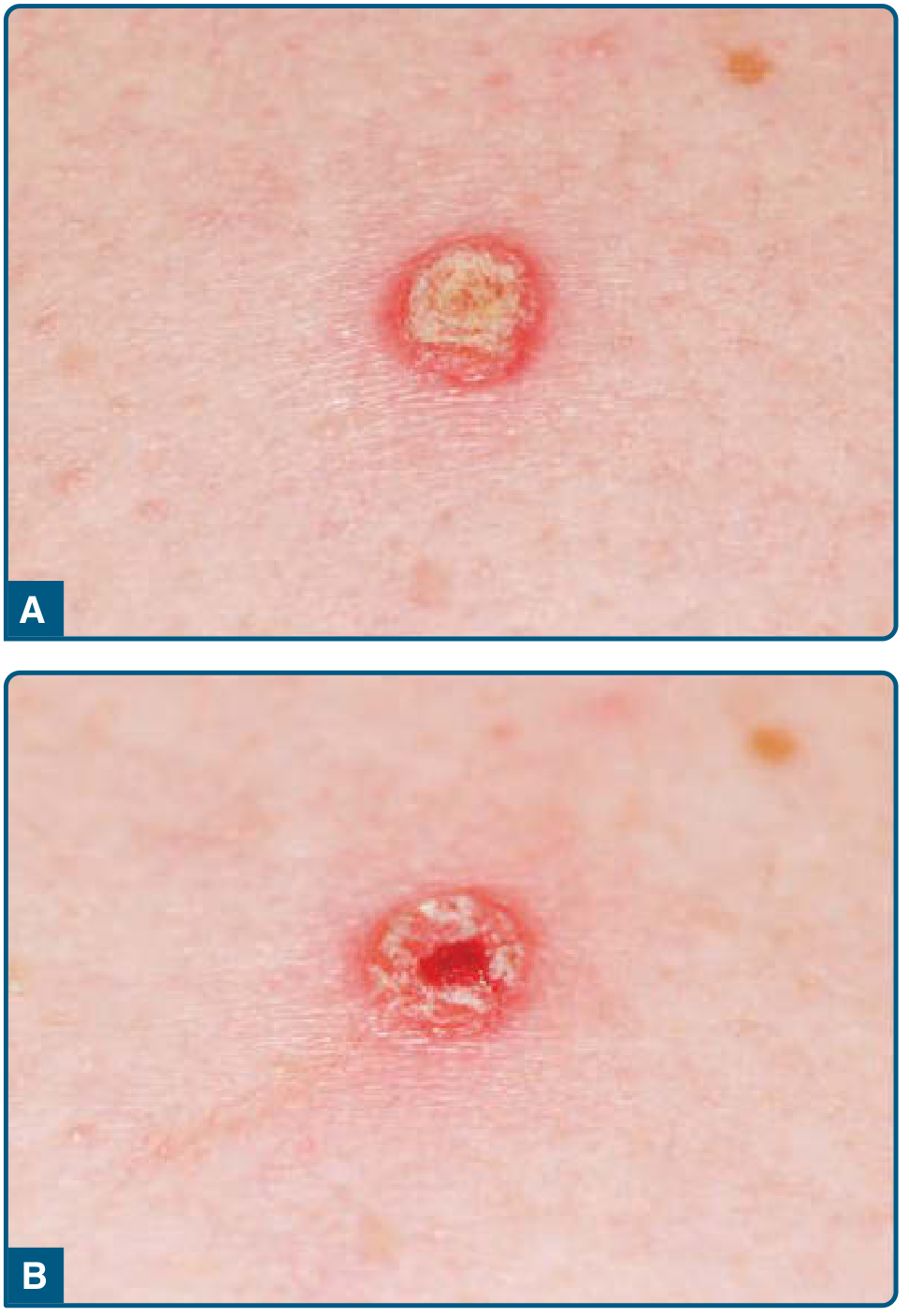
Figure 28-2: A. Psoriatic plaque with scale. B. Pinpoint bleeding after scale removal (Auspitz sign). - Fitzpatrick's Dermatology
Diagnostic Significance
-
Classic for psoriasis, but not pathognomonic - it has useful clinical utility but lacks great specificity (Andrews' Diseases of the Skin).
-
Helps differentiate psoriasis from:
- Seborrheic dermatitis - Auspitz sign is absent; scales are greasy and yellowish rather than dry and silvery.
- Pityriasis rosea - absent; collarette scaling instead.
- Lichen planus - absent.
- Dermatomyositis / SLE - absent.
- Stucco keratosis (SPP) - Auspitz sign absent in this psoriasis mimic.
-
Also seen in (other conditions):
- Actinic keratosis
- Darier's disease (keratosis follicularis)
Associated Signs in Psoriasis
| Sign | Description |
|---|---|
| Auspitz sign | Pinpoint bleeding on scale removal |
| Koebner phenomenon | New psoriatic lesions appearing at sites of skin trauma (7-14 days after injury) |
| Woronoff's ring | Pale blanching ring surrounding a psoriatic plaque |
| Candle wax sign | Silvery scales shed like scraped candle wax during the early stage of scraping |
Named After
Heinrich Auspitz (1835-1886), an Austrian dermatologist who described this sign in the context of psoriasis.
This is a shared conversation. Sign in to Orris to start your own chat.