
Initial infection in carbuncle
Reading File
Finding Sources
Finding Sources
Reading File
Reading File
Reading File
Loading Image
Reading File
Initial Infection in Carbuncle
Causative Organism
The initial infection in a carbuncle is caused by Staphylococcus aureus - the same organism responsible for the preceding furuncle (boil). Community-acquired MRSA (CA-MRSA) strains are now the most common cause of skin and soft-tissue infections presenting to emergency departments and must be suspected in any skin abscess.
- Medical Microbiology 9e, p. 216
How a Carbuncle Develops - The Progression
A carbuncle does not arise de novo. It follows a clear stepwise progression:
| Stage | Description |
|---|---|
| Folliculitis | Superficial infection of the hair follicle opening (earliest event) |
| Furuncle (boil) | Deeper infection of the hair follicle, sebaceous gland, or sweat gland; blockage of the gland duct with inspissation of its contents predisposes to infection |
| Carbuncle | Multiple, closely set furuncles coalesce and extend into deeper subcutaneous tissue, forming multiple communicating sinus tracts |
The furuncle is the primary/initial infection unit - the carbuncle is its extension. The infected patient is often a nasal carrier of the offending S. aureus (anterior nares carriage).
- Sherris & Ryan's Medical Microbiology, 8th Ed., p. 979
Pathogenesis of the Initial Infection
- S. aureus colonizes a hair follicle (or sebaceous/sweat gland)
- Blockage of the gland duct with inspissated secretions creates a nidus
- The bacteria multiply locally, producing leukocidin (Panton-Valentine Leukocidin, PVL) and other toxins that destroy neutrophils and tissue
- A localized abscess (furuncle) forms with a central necrotic plug
- When suppuration occurs in thick, inelastic skin and multiple furuncles coalesce, the carbuncle forms
- Fitzpatrick's Dermatology, 8th Ed.
Clinical Features at Onset
- Site: Nape of neck, back, thighs, buttocks - areas of thick inelastic skin
- Pain: Extremely painful lesion
- Systemic signs: Fever, malaise, and chills - these distinguish a carbuncle from a simple furuncle and indicate systemic spread via bacteremia
- Appearance: Red, indurated area with multiple pustules draining around multiple hair follicles; central yellow-gray irregular crater develops
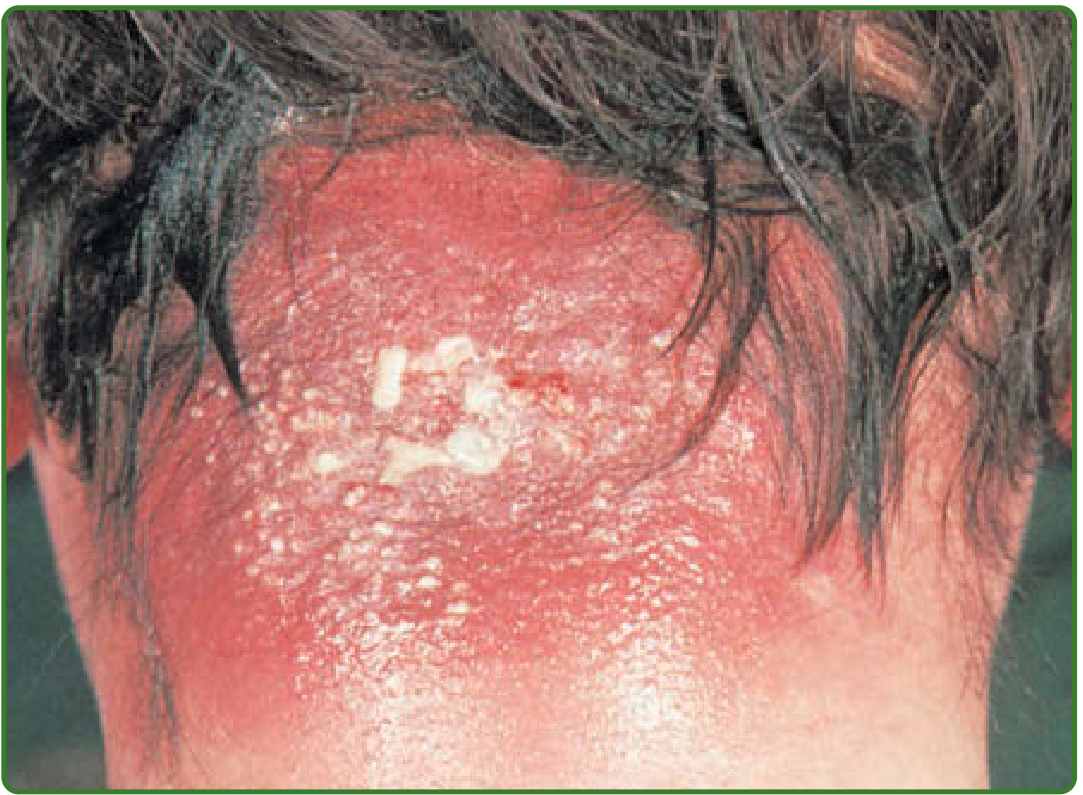
Carbuncle at the nape of neck showing multiple confluent furuncles draining pus (Fitzpatrick's Dermatology)
Predisposing Factors for Initial Infection
- Diabetes mellitus (process is more extensive)
- Obesity
- Blood dyscrasias
- Defects in neutrophil function
- Immunosuppression (systemic glucocorticoids, chemotherapy, immunoglobulin deficiency)
- Anterior nasal carriage of S. aureus
- Chronic furunculosis (same strain repeatedly causing infection, as there is little acquired immunity)
Key Summary
The initial infection in a carbuncle starts in a hair follicle infected by Staphylococcus aureus. Blockage of the follicle/gland duct creates a predisposition to infection. The furuncle (boil) forms first; when multiple furuncles in thick inelastic skin coalesce and extend into subcutaneous tissue with multiple sinus tracts, the result is a carbuncle. The presence of systemic features (fever, chills, malaise) marks extension beyond the local site, reflecting bacteremia.
Sources: Sherris & Ryan's Medical Microbiology 8e | Fitzpatrick's Dermatology | Medical Microbiology 9e
This is a shared conversation. Sign in to Orris to start your own chat.