
Lacunae ligament
Reading File
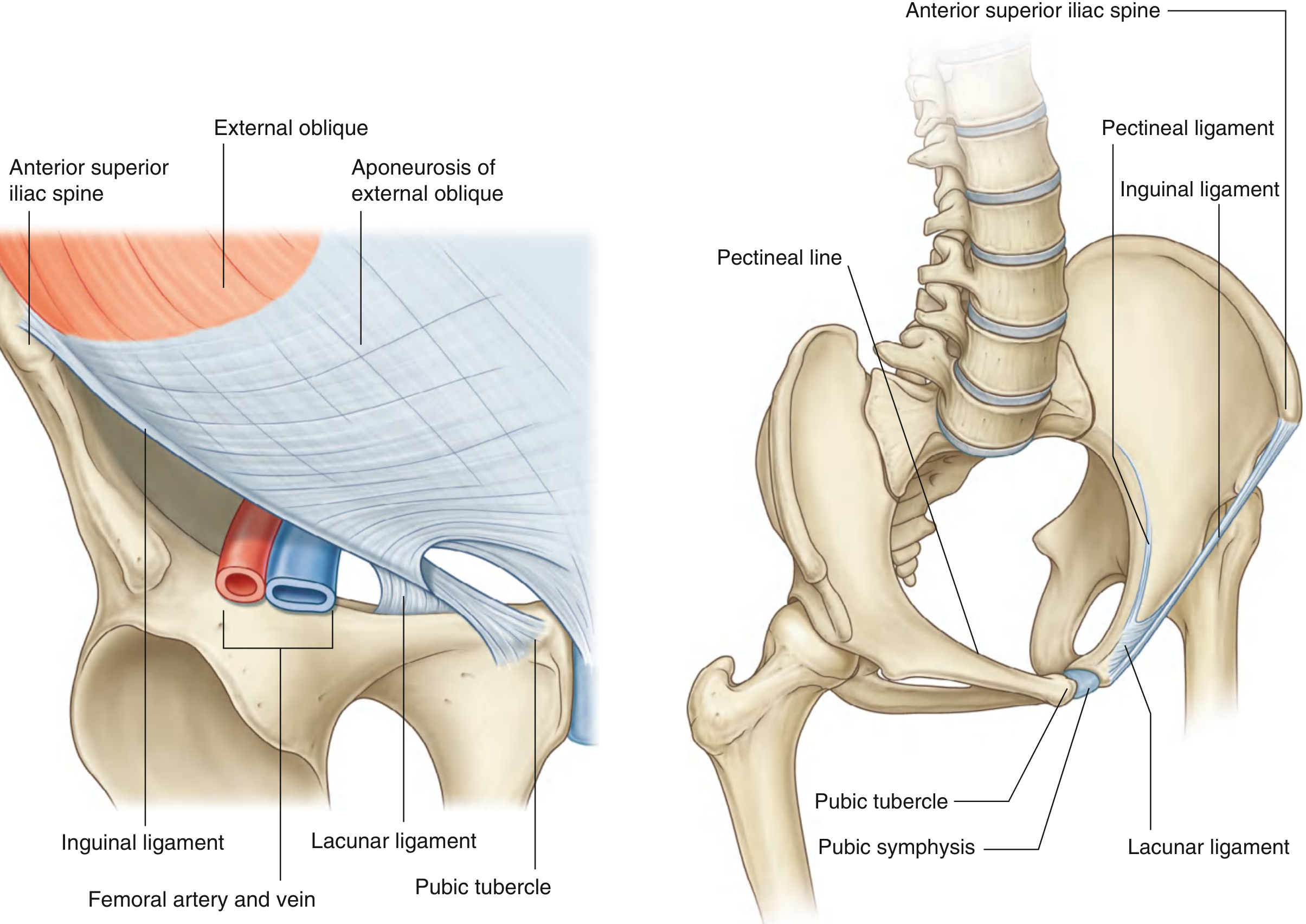
The lacunar ligament (also called Gimbernat's ligament) is a triangular fibrous band formed from the medial part of the inguinal ligament. It attaches from the inguinal ligament to the pectineal line of the pubis, forming the medial boundary of the femoral ring.
Searching sources...
Finding Sources
Finding Sources
Good results. Let me read the most relevant sections from Gray's Anatomy, Sabiston, and Schwartz's in parallel.
Reading File
Reading File
Reading File
Now let me fetch the key anatomy diagram and also read the Mulholland section for clinical relevance:
Loading Image
Loading Image
Reading File
Excellent - I have comprehensive information from multiple authoritative sources plus the diagrams. Here is the full answer:
Lacunar Ligament (Gimbernat's Ligament)
Definition and Eponym
The lacunar ligament is also called Gimbernat's ligament. It is a small but surgically important fibrous structure derived from the medial end of the inguinal ligament.
Embryology / Formation
The lacunar ligament is not a separate structure - it is a direct extension of the inguinal ligament itself. The inguinal ligament is formed by the rolled-under, thickened free edge of the external oblique aponeurosis, running from the anterior superior iliac spine (ASIS) to the pubic tubercle. At the medial end, its deep fibers do not simply attach to the pubic tubercle; instead, they fan out posteriorly and medially to insert onto the pectineal rim of the superior pubic ramus.
This fan-shaped posterior extension is the lacunar ligament.
"The inguinal ligament is the thickened and rolled-under edge of the aponeurosis of the external oblique that primarily attaches to the pubic tubercle. Its deep fibers, lacunar ligament (of Gimbernat), attach just lateral to the pubic tubercle forming the medial boundary of the subinguinal space."
- Fischer's Mastery of Surgery, 8th ed.
Shape and Attachments
| Feature | Detail |
|---|---|
| Shape | Crescent-shaped / fan-shaped / triangular |
| Origin | Medial end of the inguinal ligament (deep fibers) |
| Insertion | Pectineal line (pecten pubis) of the superior pubic ramus |
| Medial border | Concave, free edge facing the femoral ring |
| Lateral blend | Merges laterally into the pectineal (Cooper's) ligament |
"The lacunar ligament is a crescent-shaped extension of fibers at the medial end of the inguinal ligament that pass backward to attach to the pecten pubis on the superior ramus of the pubic bone."
- Gray's Anatomy for Students
Relationship to Cooper's Ligament
The lacunar ligament and Cooper's (pectineal) ligament are continuous:
- Additional fibers extend from the lacunar ligament along the pecten pubis of the pelvic brim to form the pectineal (Cooper's) ligament.
- Cooper's ligament is therefore the lateral extension of the lacunar ligament along the pectineal line.
Role in Femoral Ring / Canal Boundaries
The femoral ring is bounded by:
| Wall | Structure |
|---|---|
| Anterior | Inguinal ligament (and iliopubic tract) |
| Posterior | Superior pubic ramus (covered by pectineal fascia) |
| Lateral | Femoral vein |
| Medial | Lacunar ligament |
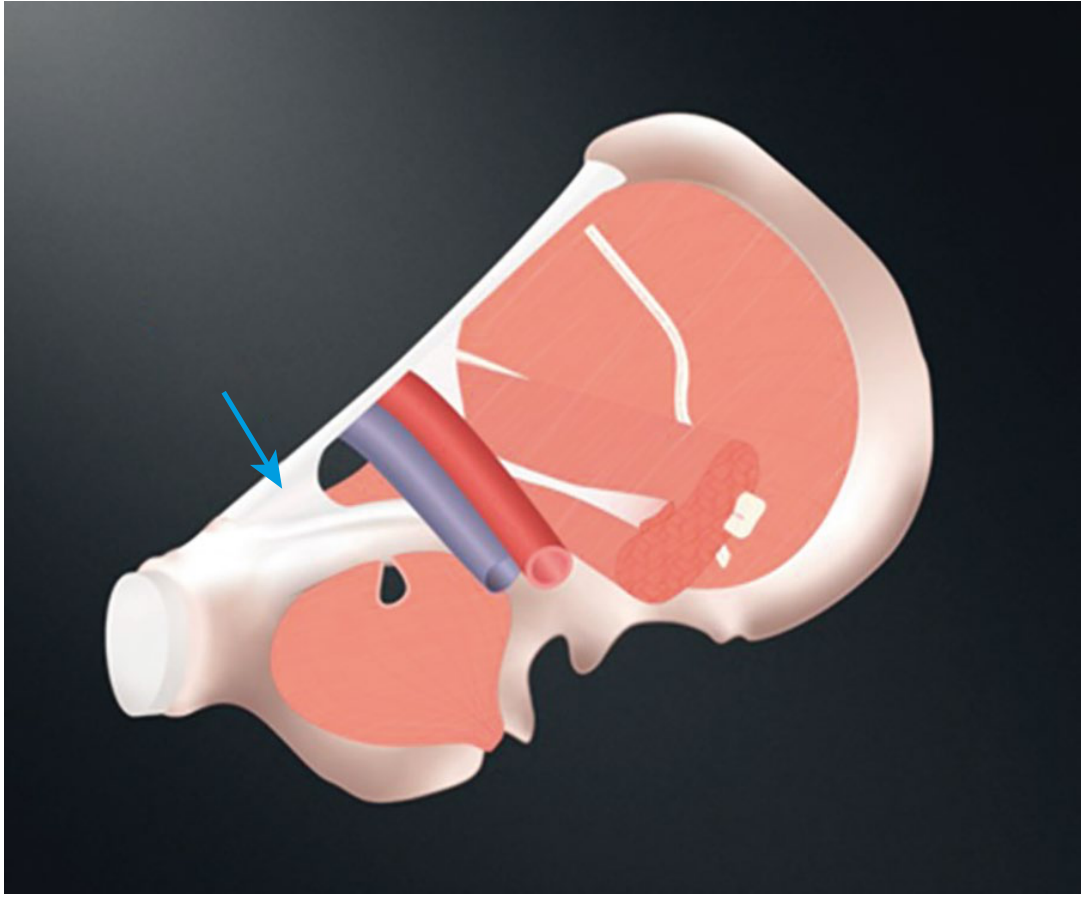
Important clinical misconception (Sabiston): It is commonly stated that the lacunar ligament forms the medial border of the femoral canal - but this is only true when a sizeable femoral hernia has extended medially. In most cases, the medial border of the femoral canal is actually formed by the medial extension of the iliopubic tract (IPT), which lies posterior to the inguinal ligament.
Clinical Relevance
1. Femoral Hernia
- The femoral canal, bounded medially by the lacunar ligament, is the site through which femoral hernias emerge.
- Femoral hernias are more common in women (wider pelvis, wider femoral ring).
- The rigid, unyielding nature of the lacunar ligament means femoral hernias are prone to incarceration and strangulation.
2. Surgical Division of the Lacunar Ligament
- To reduce an incarcerated femoral hernia, the medial border of the femoral canal may need to be divided (i.e., the lacunar ligament or the medial IPT extension is incised).
- Surgeons must be aware of an aberrant obturator artery (a common variant where the obturator artery arises from the inferior epigastric rather than the internal iliac) - it runs along the medial/posterior edge of the femoral ring, adjacent to the lacunar ligament. Inadvertent division of this vessel during hernia reduction can cause life-threatening hemorrhage. This vessel is historically referred to as the "corona mortis" (crown of death).
3. Hernia Repairs Using Cooper's / Lacunar Ligament
- The McVay (Cooper's ligament) repair uses the pectineal ligament (and by extension the lacunar ligament complex) as the structural anchor for herniorrhaphy.
- Understanding the lacunar ligament is essential for both open and laparoscopic (TEP/TAPP) groin hernia repairs.
Summary of Key Ligaments in the Inguinal Region
| Ligament | Formed From | Notable Feature |
|---|---|---|
| Inguinal (Poupart's) | Lower border of external oblique aponeurosis | ASIS to pubic tubercle |
| Lacunar (Gimbernat's) | Deep medial fibers of inguinal ligament | Fanlike; medial wall of femoral ring |
| Pectineal (Cooper's) | Extension of lacunar ligament | Along pecten pubis; used in McVay repair |
| Iliopubic tract (Thompson's) | Transversalis fascia condensation | Posterior to inguinal ligament |
| Reflected inguinal | Superficial fibers crossing midline | Reinforces opposite side |
Sources: Gray's Anatomy for Students; Fischer's Mastery of Surgery, 8th ed.; Sabiston Textbook of Surgery; Schwartz's Principles of Surgery, 11th ed.; Mulholland & Greenfield's Surgery, 7th ed.
This is a shared conversation. Sign in to Orris to start your own chat.