
Female genital tracts develpfrom
The female genital tract develops primarily from the Mullerian (paramesonephric) ducts, while the external genitalia develop from the urogenital sinus and genital tubercle.
Searching sources...
Reading File
Finding Sources
Finding Sources
Reading File
Reading File
Reading File
Finding Sources
Reading File
Reading File
Now let me fetch the key developmental diagrams:
Loading Image
Reading File
Here is a complete, textbook-sourced answer on the development of the female genital tract:
Development of the Female Genital Tract
1. The Indifferent (Bipotential) Stage
Up to ~7 weeks of gestation, both male and female embryos are anatomically identical - this is called the indifferent stage. Both sexes possess:
- Mesonephric (Wolffian) ducts - paired
- Paramesonephric (Mullerian) ducts - paired
- An undifferentiated gonad with cortex and medulla
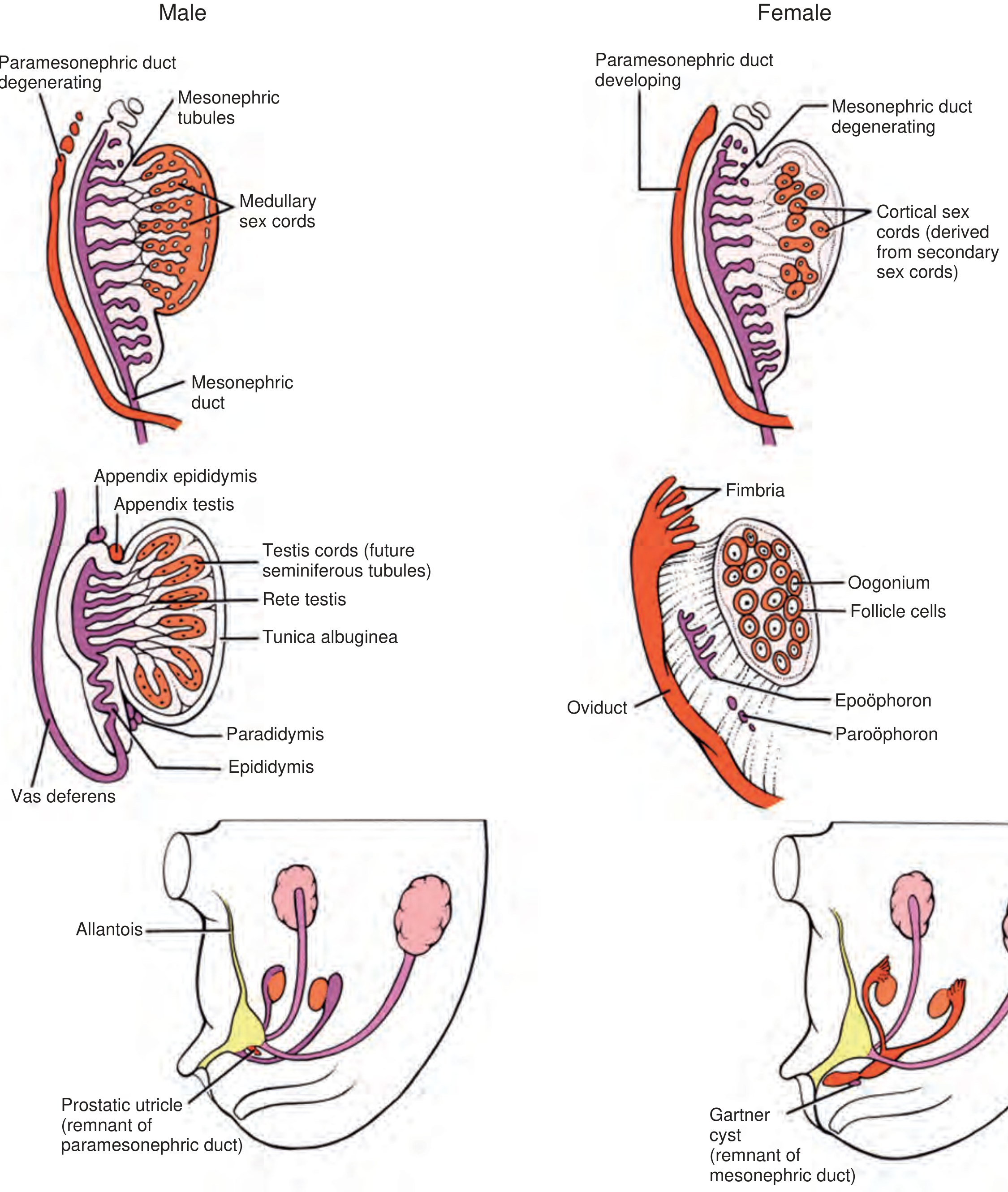
The paramesonephric duct arises as a longitudinal invagination of the coelomic epithelium on the anterolateral surface of the urogenital ridge. Cranially it opens into the abdominal cavity with a funnel-like structure. Caudally, it crosses the mesonephric duct ventrally and fuses with its partner from the opposite side in the midline, projecting into the posterior wall of the urogenital sinus as the sinus tubercle (Müller's tubercle).
Female development is the "default" or passive pathway - it requires the absence of testosterone and anti-Mullerian hormone (AMH), not the active presence of estrogen.
2. Gonadal Development - Ovary
In an XX embryo:
- Medullary sex cords regress
- A secondary generation of cortical cords develops
- These cortical cords break into isolated cell clusters = primordial follicles
- Germ cells differentiate into oogonia and enter the first meiotic division as primary oocytes (arrested until puberty)
3. Internal Genital Duct Development
In the absence of AMH and testosterone, the paramesonephric (Mullerian) ducts develop into the main internal genital ducts of the female. Three parts of each duct give rise to distinct structures:
| Part of Paramesonephric Duct | Derivative |
|---|---|
| Cranial vertical portion (opens into peritoneal cavity) | Fallopian tube (fimbriae + ampulla) |
| Horizontal part (crosses mesonephric duct) | Fallopian tube (isthmus) |
| Caudal vertical part (fuses with opposite side) | Uterus (corpus + cervix) + upper vagina |
The fused caudal portions form the uterovaginal canal, which gives rise to the epithelium and glands of the uterus and upper vagina. The surrounding mesenchyme differentiates into the myometrium (muscular coat) and perimetrium (peritoneal covering).
When the two paramesonephric ducts fuse in the midline, they drag two folds of peritoneum with them, forming the broad ligament of the uterus, which divides the pelvic cavity into:
- Rectouterine pouch (pouch of Douglas) - posterior
- Vesicouterine pouch - anterior
Fate of the Mesonephric (Wolffian) Ducts in Females
In the absence of testosterone, the mesonephric ducts degenerate. However, remnants may persist in ~25% of adult women:
- Epoophoron and paroophoron - in the mesovarium
- Gartner's duct cysts - along the anterolateral vaginal wall
4. Vaginal Development
The vagina forms during the 3rd month of embryonic life via a dual contribution:
| Contribution | Origin | Proportion |
|---|---|---|
| Upper ~80% of vagina | Fused paramesonephric ducts (uterovaginal canal) | Superior |
| Lower ~20% of vagina | Sinovaginal bulbs from the urogenital sinus endoderm | Inferior |
The caudal uterovaginal canal becomes occluded by a solid vaginal plate, which then elongates and canalizes by central desquamation over ~2 months. The hymen is the thin membrane remaining between the sinovaginal bulbs and the urogenital sinus.
5. External Genitalia Development
The external genitalia arise from a common indifferent mesodermal primordium around the cloaca. In the absence of testosterone (and dihydrotestosterone), the female pattern develops:
| Indifferent Anlage | Female Derivative |
|---|---|
| Genital tubercle | Clitoris + glans clitoris |
| Urogenital folds | Labia minora |
| Genital (labioscrotal) swellings | Labia majora |
| Urogenital sinus | Vestibule of vagina |
| Anal folds | Perineal raphe |
Sexual differentiation of external genitalia becomes evident by ~13 weeks and is complete by ~16 weeks.
6. Accessory Glands
The female accessory genital glands develop as outgrowths from:
- Urethra - paraurethral glands (Skene's glands)
- Urogenital sinus - greater vestibular glands (Bartholin's glands)
Summary: Key Sources of Female Genital Structures
| Structure | Embryological Origin |
|---|---|
| Ovary | Indifferent gonad (cortical sex cords + primordial germ cells) |
| Fallopian tubes | Paramesonephric (Mullerian) ducts - cranial unfused portions |
| Uterus (corpus + cervix) | Paramesonephric ducts - fused caudal portions |
| Upper vagina (~80%) | Paramesonephric ducts / uterovaginal canal |
| Lower vagina (~20%) | Sinovaginal bulbs from urogenital sinus |
| Hymen | Junction of sinovaginal bulbs and urogenital sinus |
| Clitoris | Genital tubercle |
| Labia minora | Urogenital folds |
| Labia majora | Genital (labioscrotal) swellings |
| Vestibule | Urogenital sinus |
| Bartholin's glands | Urogenital sinus outgrowths |
| Skene's glands | Urethral outgrowths |
| Gartner's duct (remnant) | Mesonephric (Wolffian) duct |
| Epoophoron / Paroophoron | Mesonephric tubules |
- Langman's Medical Embryology, pp. 289-292
- Berek & Novak's Gynecology, pp. 138-141
- Campbell-Walsh Wein Urology, p. 429-430
This is a shared conversation. Sign in to Orris to start your own chat.