
Acts as Othopedics and sports medicine spl , and advice me in detail management including drug management and conservative management of Supraspinatus tendinitis. History of 56 yrs old women , pain while doing overhead exercises and lifting weights , little pain radiation towards bicep area.
"Rotator Cuff Injuries"[MeSH Terms] AND "Exercise Therapy"[MeSH Terms]
AAOS rotator cuff tendinitis guideline nonoperative management NSAID physical therapy
https://www.guidelinecentral.com/guideline/9802
PMID: 42135016
1. Get an in-person examination soon
- Active and passive shoulder range of motion
- Painful arc, Hawkins-Kennedy and Neer impingement signs
- Supraspinatus strength, especially resisted abduction and external rotation
- Bicipital-groove tenderness and Speed's test
- Neck movement, sensation, reflexes, and arm strength
Imaging
- Plain shoulder X-rays are reasonable initially if symptoms are persistent, substantial, or there is night pain. They can identify arthritis, acromial changes, and calcium deposits.
- Diagnostic ultrasound is a good first test for rotator cuff and biceps tendons.
- MRI is appropriate if there is objective weakness, acute injury, suspected significant tear, or poor improvement after a structured 6-12 week rehabilitation course.
2. First 1-2 weeks: settle the pain, but do not fully immobilize
Modify, do not stop all movement
- Overhead presses, lateral raises above shoulder height, upright rows
- Heavy bench press, dips, push-ups if painful
- Repeated overhead reaching
- Lifting weights away from the body with the elbow straight
- Sleeping on the affected side
Ice or heat
- Ice pack for 10-15 minutes after aggravating activity, 3-5 times/day during a painful flare.
- Heat for 10-15 minutes before mobility exercises if the shoulder feels stiff.
- Use a cloth barrier to protect the skin.
Sleep
- Sleep on the back with a pillow supporting the painful arm, or on the unaffected side while hugging a pillow that supports the affected arm.
- Avoid having the painful arm overhead during sleep.
3. Medication options
Preferred first option: topical NSAID
- Diclofenac gel 1%: apply a thin measured dose to the painful shoulder area, commonly up to 4 times daily, following the specific local product label.
Oral pain relief, if safe
- Paracetamol/acetaminophen: 500-1,000 mg every 6-8 hours as required. A prudent maximum for self-treatment is 3,000 mg/day, especially in older adults or regular alcohol users. Avoid or seek clinician advice with liver disease or heavy alcohol use.
- Ibuprofen: 200-400 mg every 6-8 hours with food as needed. Do not exceed the product-label maximum, commonly 1,200 mg/day without clinician supervision.
- Naproxen sodium: 220 mg every 8-12 hours with food. Do not exceed the product-label maximum, commonly 660 mg/day without clinician supervision.
- Previous stomach ulcer or gastrointestinal bleed
- Kidney disease
- Heart failure, uncontrolled hypertension, coronary artery disease, previous stroke
- Use of blood thinners such as warfarin, apixaban, rivaroxaban, dabigatran, or clopidogrel
- Regular systemic steroid use
- NSAID-triggered asthma/allergic reaction
- Pregnancy
Medicines generally not recommended
- Opioid pain medicines: usually not appropriate for this condition.
- Oral corticosteroids: not routine treatment.
- Muscle relaxants: generally not useful unless there is a separate neck muscle-spasm problem.
- Supplements such as collagen, glucosamine, or turmeric: evidence is insufficient to rely on them for tendon recovery.
4. Rehabilitation: the main treatment
Phase A: mobility and pain control, daily for 1-2 weeks
-
Pendulum exercise
Lean forward, support yourself with the good arm, and let the painful arm hang. Make small circles or forward-back movements.- 30-60 seconds, 2-3 rounds.
-
Assisted forward elevation
Lie on the back. Use the unaffected hand or a stick to assist the affected arm upward.- 10 repetitions, 1-2 times/day.
-
Cross-body posterior shoulder stretch
Bring the painful arm gently across the chest, supporting it with the other hand.- Hold 20-30 seconds, 3 repetitions.
-
Doorway pectoral stretch
Keep the elbow below shoulder height initially.- Hold 20-30 seconds, 3 repetitions.
Phase B: rotator cuff and shoulder-blade activation, usually weeks 2-6
-
Isometric external rotation
Stand with elbow bent to 90 degrees and tucked against the body. Press the back of the hand gently into a wall or door frame without moving the arm.- Hold 5-10 seconds, 8-10 repetitions.
-
Isometric abduction
With elbow at the side, press the outer arm lightly into a wall.- Hold 5-10 seconds, 8-10 repetitions.
-
Band external rotation
Elbow remains close to the side, ideally with a small towel between elbow and rib cage.- 2-3 sets of 10-15.
-
Band rows
Pull the shoulder blades gently back and down. Avoid shrugging.- 2-3 sets of 10-15.
-
Serratus anterior wall slide or wall push-up plus
Start below shoulder height.- 2 sets of 8-12.
-
Scapular control
Practice “long neck, shoulders relaxed, shoulder blades gently back and down.” Avoid aggressive pinching.
Phase C: return to overhead strength, usually weeks 6-12
- Light dumbbell scaption, arm raised 30-45 degrees forward from the side, only to shoulder height
- Side-lying external rotation
- Incline or wall push-ups
- Light overhead press with neutral grip
- Gradual return to usual gym lifting
5. Injection treatment
- Do not use repeated, frequent steroid injections as routine management.
- Discuss diabetes, as steroid injections can temporarily increase blood glucose.
- Avoid heavy lifting for several days after injection, then restart graded rehabilitation.
- Injection should not be given into the tendon itself.
- If a significant tear is suspected, specialist review before injection is sensible.
6. When surgery is considered
- Confirmed high-grade partial tear or full-thickness tear with weakness
- Persistent disabling pain and loss of function after 3-6 months of well-performed conservative management
- Progressive weakness or tendon retraction on imaging
- Calcific tendinopathy that does not settle with nonoperative care
7. Seek urgent assessment if any of these occur
- Sudden inability to lift the arm after an injury
- A “pop” followed by marked weakness, bruising, or deformity
- Fever, hot/red swollen shoulder, or feeling unwell
- Severe unremitting night pain or unexplained weight loss
- Numbness, hand weakness, worsening neck pain, or pain radiating below the elbow
- New chest pain, shortness of breath, sweating, or nausea with shoulder/arm pain
Practical plan for her now
- Stop overhead presses, upright rows, and painful lifting for 2 weeks.
- Use topical diclofenac if medically safe; use paracetamol or one oral NSAID only if needed and safe.
- Start gentle daily mobility immediately.
- Begin rotator cuff and scapular strengthening within pain limits, ideally under physiotherapy supervision.
- Arrange shoulder examination and likely X-ray/ultrasound if there is weakness, persistent night pain, or no clear improvement in 4-6 weeks.
- Return to overhead weights gradually only after pain-free near-normal movement and good cuff strength.
Create a 6-week home exercise plan for supraspinatus tendinopathy
"Rotator Cuff Injuries"[MeSH Terms] AND "Exercise Therapy"[MeSH Terms]
rotator cuff related shoulder pain home exercise programme physiotherapy guideline
6-week home plan for supraspinatus tendinopathy
Safety and progression rules
- Exercise 5-6 days/week for mobility, and 3 days/week for strengthening with a rest day between strength sessions.
- Mild pain is acceptable: keep it at 0-3/10 during exercise.
- It should settle within about 30 minutes and not be worse the next morning.
- If pain is sharper, exceeds 4/10, lingers into the next day, or there is a painful catch, reduce repetitions, range, or resistance by 30-50%.
- Avoid overhead press, upright rows, heavy lateral raises, dips, and painful push-ups initially.
- Use a light resistance band and 0.5-2 kg weight, such as a small water bottle, only when specified.
- Move slowly: about 2 seconds up, 3 seconds down. Avoid shoulder shrugging.
Weeks 1-2: calm symptoms and restore comfortable motion
Daily mobility routine, 10-15 minutes
| Exercise | Instructions | Dose |
|---|---|---|
| Pendulum | Lean forward with the unaffected hand supported on a table. Let the affected arm hang relaxed. Shift body weight to make gentle forward-back, side-to-side, and small circular movements. | 30-60 seconds each direction, 1-2 rounds |
| Assisted forward raise | Lie on your back. Use the unaffected hand to support and lift the painful arm toward overhead, only as far as comfortable. | 2 sets of 10 |
| Cross-body stretch | Bring the painful arm across the chest at shoulder level. Use the other arm to assist gently. Feel a stretch behind the shoulder, not pinching at the front. | 3 holds of 20-30 seconds |
| Chest stretch | Stand in a doorway with the elbow below shoulder height. Step forward gently. | 3 holds of 20-30 seconds |
Strength and control, 3 days/week
| Exercise | Instructions | Dose |
|---|---|---|
| External-rotation isometric | Stand side-on to a wall. Keep elbow bent at 90 degrees and tucked to the side with a small towel between elbow and ribs. Press the back of the hand gently outward into the wall without moving the arm. | 8-10 holds of 5-10 seconds |
| Abduction isometric | Stand with the outer upper arm lightly against a wall, elbow at side. Press gently outward into wall without moving. | 8-10 holds of 5-10 seconds |
| Scapular setting | Sit or stand tall. Gently draw shoulder blades back and slightly down, without forcefully squeezing or shrugging. | 2 sets of 10, hold 5 seconds |
| Wall slides, short range | Forearms on wall, elbows below shoulder level. Slide arms upward only to a comfortable range, keeping shoulders relaxed. | 2 sets of 8 |
Weeks 3-4: build rotator cuff and shoulder-blade strength
Strengthening, 3 days/week
| Exercise | Instructions | Dose |
|---|---|---|
| Band external rotation | Attach band at elbow height. Keep elbow at side with towel roll. Rotate forearm outward, then return slowly. | 3 sets of 10-15 |
| Band internal rotation | Same setup, but pull forearm inward toward abdomen. Keep elbow at side. | 2-3 sets of 10-15 |
| Band row | Attach band at chest level. Pull elbows back close to body. Pause while drawing shoulder blades gently back and down. Do not shrug. | 3 sets of 10-15 |
| Wall push-up plus | Hands on wall slightly wider than shoulders. Do a shallow wall push-up. At the top, gently push the chest away to let shoulder blades move forward. | 2-3 sets of 8-12 |
| Scaption without weight | Stand with thumb pointing up. Lift arm about 30-45 degrees forward from the side, not directly out to the side. Raise only to shoulder height or less. | 2 sets of 8-12 |
| Side-lying external rotation | Lie on the unaffected side. Keep affected elbow bent at 90 degrees and tucked against ribs. Rotate forearm upward. Start with no weight, then use 0.5-1 kg if easy. | 2-3 sets of 8-12 |
Load adjustment
- If the final 2-3 repetitions are easy and next-day pain is unchanged, increase band resistance or add 0.25-0.5 kg.
- If scaption causes a painful arc, reduce the range to below the painful point or return to isometrics for several days.
Weeks 5-6: functional strength and graded return to lifting
| Exercise | Instructions | Dose |
|---|---|---|
| Weighted scaption | Same movement as above, thumb up. Use 0.5-2 kg. Stop at shoulder height. | 3 sets of 8-12 |
| Bent-over row | Support the unaffected arm on a bench/chair. Keep the painful-side elbow near the body and pull a light weight toward the hip. | 3 sets of 8-12 |
| Incline push-up | Progress from wall to a kitchen counter or sturdy table. Keep elbows below shoulder level and body straight. | 2-3 sets of 6-10 |
| Wall slide progression | Use a light band around wrists or a light weight only if pain-free. Slide upward with controlled shoulder blades. | 2 sets of 8-10 |
| Band external rotation at 45 degrees | Raise upper arm slightly away from body, about 30-45 degrees, elbow bent. Externally rotate gently against band. Do not progress to 90 degrees yet if it pinches. | 2 sets of 8-12 |
| Carry | Hold a light dumbbell/kettlebell at the side with good posture. Walk slowly, keeping shoulder relaxed. | 3 carries of 30-45 seconds |
Return to overhead lifting after week 6
- Start with neutral-grip light dumbbell press or landmine press.
- Use about 30-50% of prior usual load.
- Perform 2 sets of 8-12, once or twice weekly.
- Increase total load by no more than about 10% per week.
- Keep at least 48 hours between upper-body strength sessions.
A simple weekly schedule
| Day | Plan |
|---|---|
| Monday | Strength program + mobility |
| Tuesday | Mobility only, walking/lower body exercise |
| Wednesday | Strength program + mobility |
| Thursday | Mobility only |
| Friday | Strength program + mobility |
| Saturday | Mobility only or easy cardio |
| Sunday | Rest or gentle mobility |
Stop and get assessed sooner if
- New or progressive weakness, especially inability to lift the arm
- Sudden pop, bruising, deformity, or a traumatic onset
- Pain repeatedly wakes her at night despite changing position
- Neck pain with numbness, tingling, or pain extending below the elbow
- Fever, redness, warmth, or significant swelling
- No clear functional improvement after 6 weeks of consistent rehabilitation
Create a 6-week home exercise plan for supraspinatus tendinopathy
"Rotator Cuff Injuries"[MeSH Terms] AND "Exercise Therapy"[MeSH Terms]
rotator cuff related shoulder pain home exercise programme physiotherapy guideline
6-week home exercise plan: supraspinatus tendinopathy
Rules for the whole plan
- Mobility: 5-6 days/week.
- Strength work: 3 nonconsecutive days/week, for example Monday, Wednesday, Friday.
- Keep exercise pain at 0-3/10. A mild ache is acceptable if it settles within 30 minutes and is not worse the next morning.
- If pain is more than 4/10, sharp, causes catching, or remains worse the following day, reduce repetitions, range, or resistance by 30-50%.
- Avoid overhead press, upright rows, dips, heavy lateral raises, and painful push-ups for the first 4 weeks.
- Move slowly: about 2 seconds lifting, 3 seconds lowering. Do not shrug the shoulder.
Weeks 1-2: reduce irritation and restore motion
Do daily
| Exercise | How to do it | Dose |
|---|---|---|
| Pendulum | Lean forward, support yourself with the good arm on a table, and let the painful arm hang relaxed. Shift body weight to make small circles. | 30-60 sec each direction, 1-2 rounds |
| Assisted arm raise | Lie on your back. Use the unaffected hand to help lift the painful arm toward overhead. Stay below sharp pain. | 2 sets of 10 |
| Cross-body stretch | Bring the painful arm gently across the chest. Use the other arm to assist. Stretch should be felt at the back of shoulder. | 3 x 20-30 sec |
| Doorway chest stretch | Elbow stays below shoulder height. Step forward gently until a chest stretch is felt. | 3 x 20-30 sec |
Strength work: 3 days/week
| Exercise | How to do it | Dose |
|---|---|---|
| External rotation isometric | Elbow bent 90 degrees and tucked to your side with a towel between elbow and ribs. Press the back of the hand outward into a wall without moving the arm. | 8-10 holds x 5-10 sec |
| Abduction isometric | Stand with outer upper arm against wall, elbow at your side. Press lightly outward into wall. | 8-10 holds x 5-10 sec |
| Scapular setting | Sit or stand tall. Gently bring shoulder blades back and slightly down. Do not forcefully squeeze or shrug. | 2 sets of 10, hold 5 sec |
| Short wall slides | Forearms on wall with elbows below shoulder height. Slide upward only in a comfortable range. | 2 sets of 8 |
Weeks 3-4: build cuff and shoulder-blade strength
| Exercise | How to do it | Dose |
|---|---|---|
| Band external rotation | Band at elbow height. Keep elbow tucked to side. Rotate forearm outward slowly. | 3 sets of 10-15 |
| Band internal rotation | Same position, but pull forearm inward toward abdomen. | 2-3 sets of 10-15 |
| Band row | Pull band toward the ribs with elbows close to body. Finish with shoulder blades gently back and down. | 3 sets of 10-15 |
| Wall push-up plus | Do a shallow wall push-up. At the top, gently push the chest away from wall to move shoulder blades forward. | 2-3 sets of 8-12 |
| Scaption | Thumb points upward. Lift the arm 30-45 degrees forward from the side, not directly out sideways. Stay at or below shoulder height. Begin without weight. | 2 sets of 8-12 |
| Side-lying external rotation | Lie on the unaffected side. Affected elbow is bent and against ribs. Rotate forearm upward. Begin without weight, then add 0.5-1 kg if comfortable. | 2-3 sets of 8-12 |
Weeks 5-6: functional strength and gradual return to lifting
| Exercise | How to do it | Dose |
|---|---|---|
| Weighted scaption | Same as before, holding 0.5-2 kg. Thumb up. Raise no higher than shoulder level. | 3 sets of 8-12 |
| Bent-over row | Support the good arm on a chair or table. Pull a light dumbbell toward the painful-side hip, keeping elbow near body. | 3 sets of 8-12 |
| Incline push-up | Progress from wall to a counter or stable table. Keep elbows below shoulder level. | 2-3 sets of 6-10 |
| External rotation at 30-45 degrees | Lift the elbow slightly away from the body, not above shoulder level. Use a light band and externally rotate. | 2 sets of 8-12 |
| Farmer carry | Hold a light weight at the affected side, stand tall, shoulder relaxed, and walk slowly. | 3 x 30-45 sec |
| Wall-slide progression | Slide arms up wall with light band around wrists only if the basic wall slide is pain-free. | 2 sets of 8-10 |
Returning to gym overhead exercises
- Near-full shoulder motion is comfortable
- There is no significant pain at rest or during daily activities
- Strength work does not cause next-day worsening
- You can perform 2-3 sets of scaption and external rotation with good control
Seek assessment earlier if
- There is new or increasing weakness
- The arm cannot be lifted after an injury
- A pop, bruising, deformity, or sudden severe pain occurred
- There is persistent night pain, numbness, tingling, or pain extending below the elbow
- No clear improvement occurs after 6 weeks of consistent exercise
Add illustrations for each shoulder exercise
illustrated shoulder rehabilitation exercises pendulum assisted shoulder flexion cross body stretch doorway stretch
illustrated rotator cuff exercises external rotation resistance band rows wall slide wall push up scapular setting
illustrated shoulder exercises scaption side lying external rotation incline push up farmer carry
shoulder exercise illustrations pendulum external rotation wall slide scaption physiotherapy
A clear medical rehabilitation instruction sheet with four separate labeled exercise panels for supraspinatus tendinopathy: pendulum exercise, assisted shoulder forward raise lying on back, cross-body shoulder stretch, and doorway chest stretch. Show an adult woman in simple athletic clothes, correct posture, movement arrows, and no decorative content.
A clear medical rehabilitation instruction sheet with four separate labeled exercise panels for supraspinatus tendinopathy: external rotation isometric against a wall with elbow at side and towel under elbow, shoulder abduction isometric against wall, scapular setting, and short-range forearm wall slides. Show an adult woman in simple athletic clothes, correct posture, movement arrows, and no decorative content.
A clear medical rehabilitation instruction sheet with four separate labeled exercise panels for supraspinatus tendinopathy: resistance band external rotation with elbow at side, resistance band internal rotation with elbow at side, resistance band rows, wall push-up plus, and thumb-up scaption below shoulder height. Show an adult woman in simple athletic clothes, correct posture, movement arrows, and no decorative content.
A clear medical rehabilitation instruction sheet with five separate labeled exercise panels for supraspinatus tendinopathy: side-lying external rotation holding a light weight, weighted thumb-up scaption below shoulder height, bent-over dumbbell row, incline push-up at a counter, external rotation with elbow 30 to 45 degrees away from body, and farmer carry. Show an adult woman in simple athletic clothes, correct posture, movement arrows, and no decorative content.
Weeks 1-2: mobility and early activation
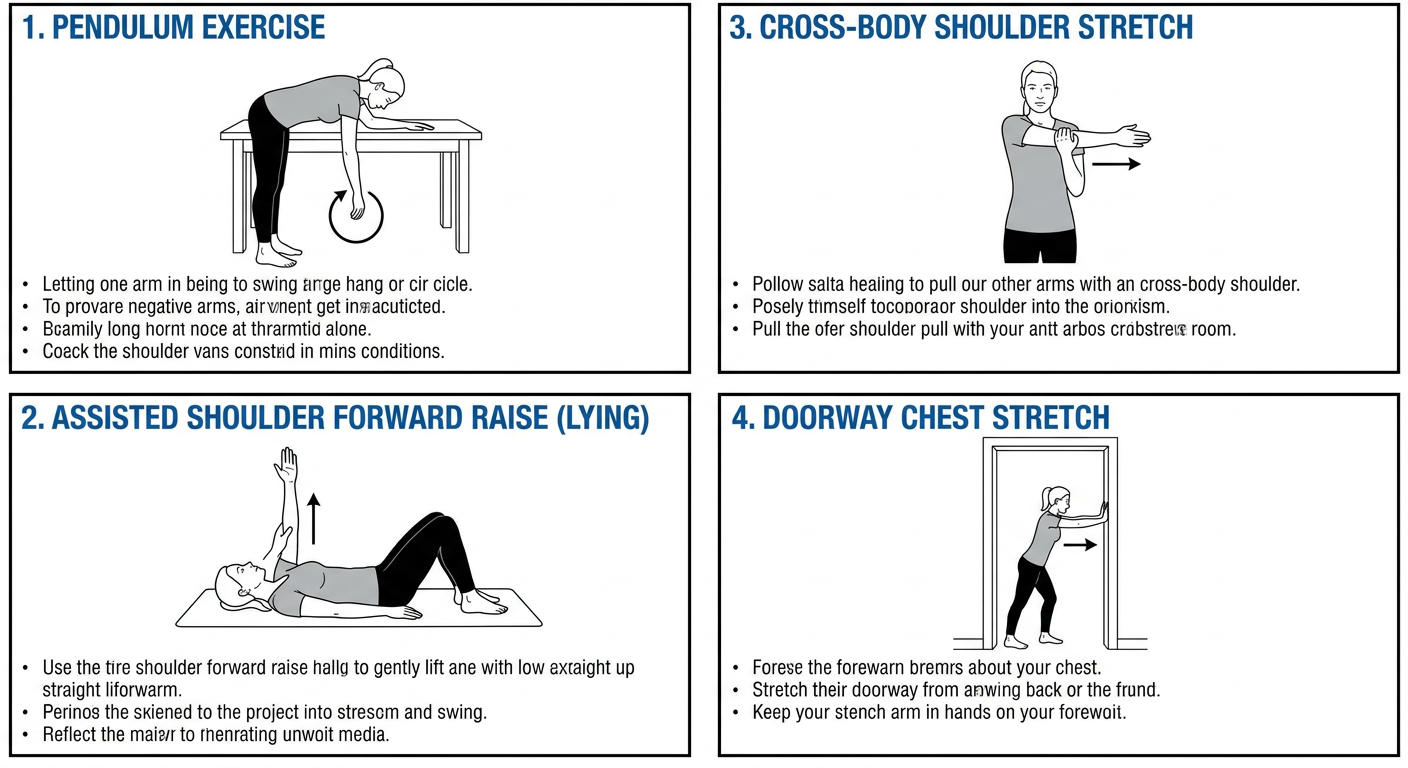
- Pendulum: keep the arm relaxed. Movement comes from shifting the body, not actively lifting the shoulder.
- Assisted forward raise: use the unaffected arm to guide the affected arm upward within a comfortable range.
- Cross-body stretch: feel a gentle stretch at the back of the shoulder.
- Doorway chest stretch: keep the elbow below shoulder height at first.
Weeks 1-2: isometrics and shoulder-blade control
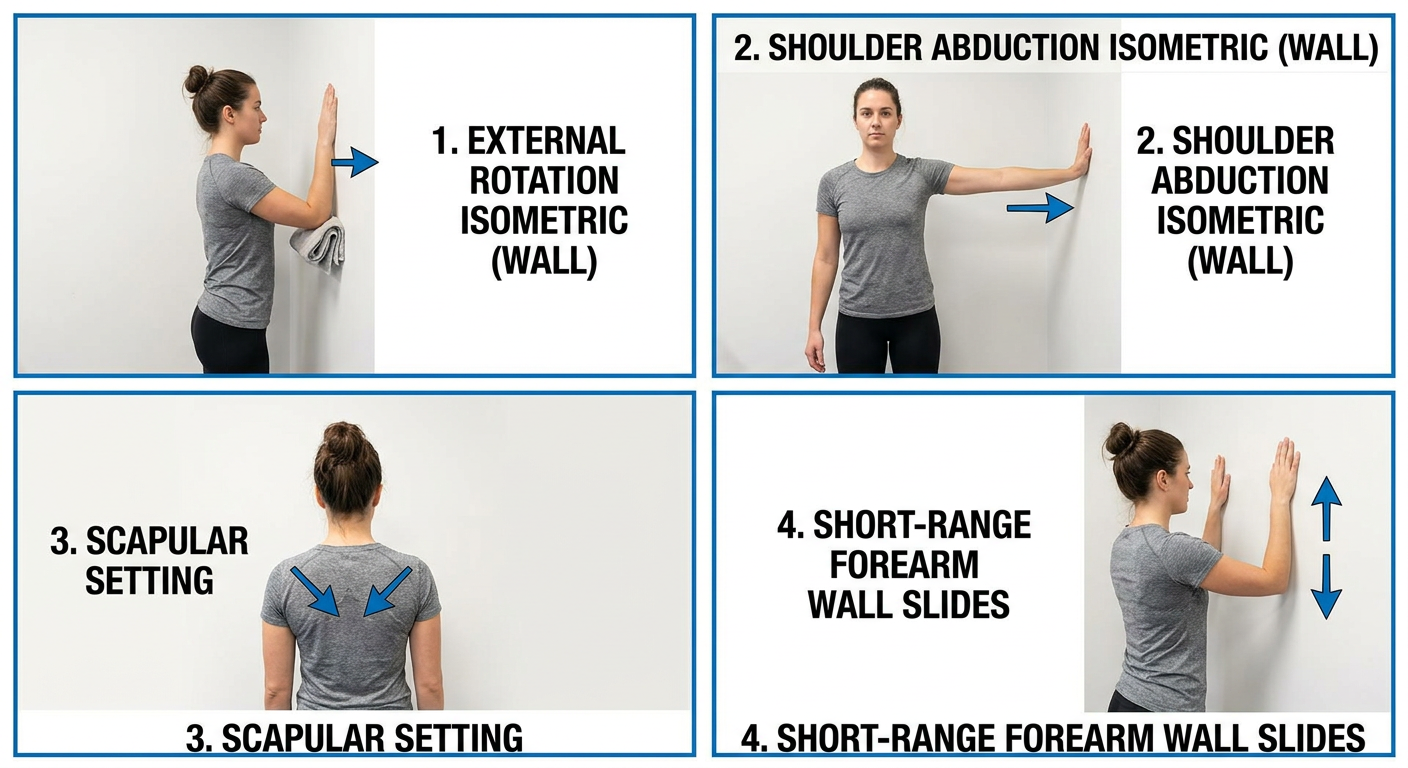
- External rotation isometric: elbow stays tucked to the body, ideally with a small towel under it. Press gently outward without moving.
- Abduction isometric: press the outside of the upper arm gently into the wall.
- Scapular setting: shoulders gently back and down, without shrugging.
- Wall slides: slide only as high as comfortable. Avoid a painful pinch.
Weeks 3-4: band and control exercises
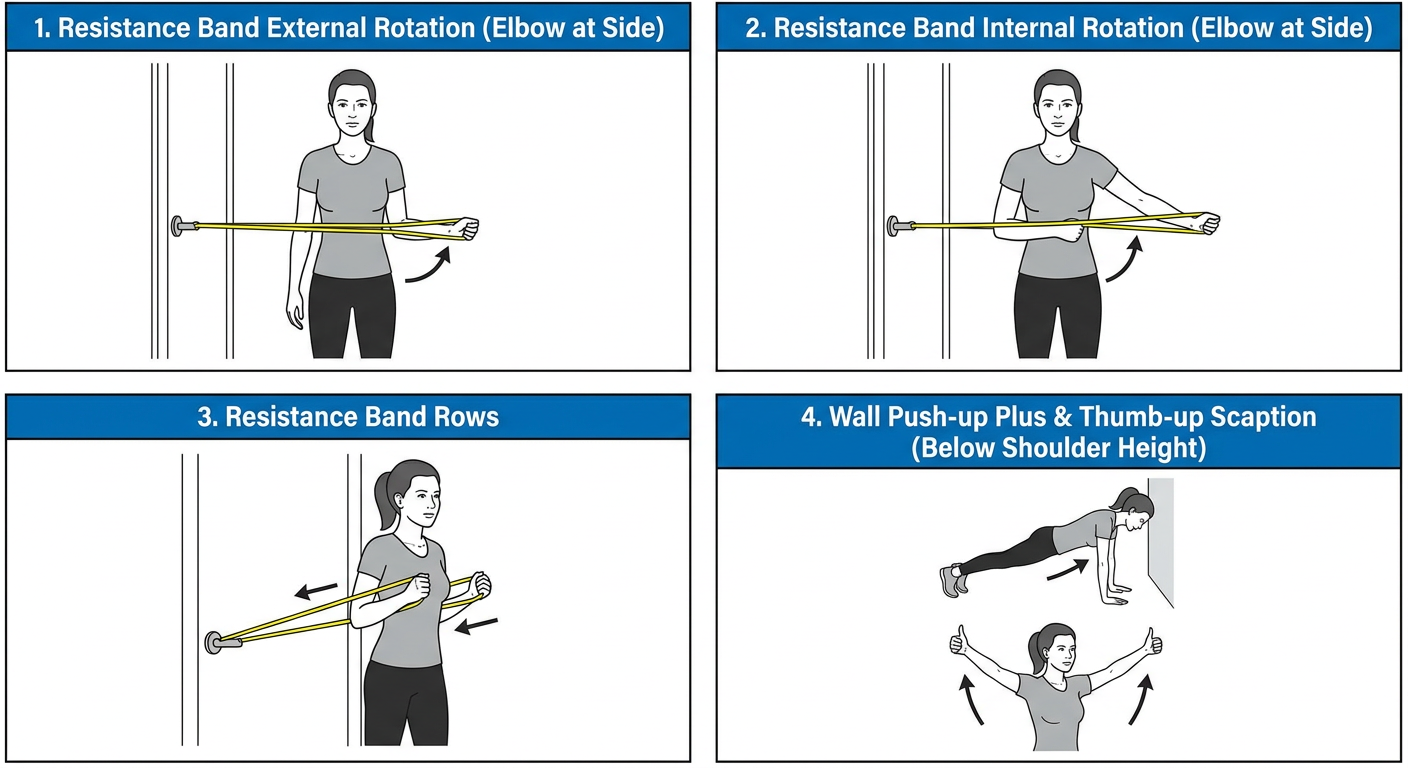
- Band external rotation: rotate the forearm outward with elbow at side.
- Band internal rotation: pull the forearm inward toward the abdomen.
- Band row: pull elbows toward ribs, keeping the neck relaxed.
- Wall push-up plus: at the top, gently push away from the wall to move the shoulder blades forward.
- Scaption: raise the thumb-up arm slightly forward from the side, not straight out to the side, and initially no higher than shoulder level.
Weeks 5-6: progressive functional strength
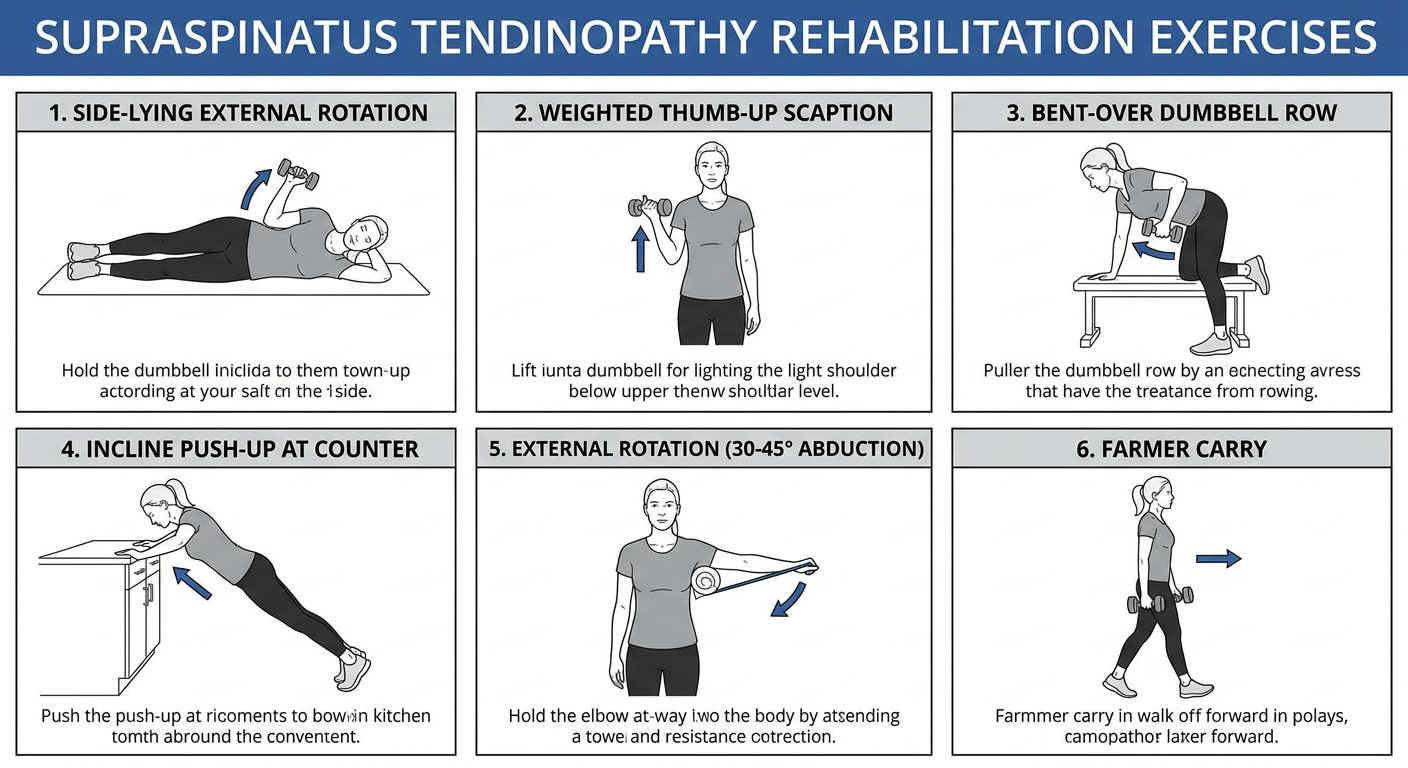
- Side-lying external rotation: keep the elbow against the ribs and use a very light weight.
- Weighted scaption: begin with 0.5-2 kg, thumb upward, stopping at shoulder height.
- Bent-over row: support the other hand on a chair/table and pull toward the hip.
- Incline push-up: begin at a wall, then progress to a counter when comfortable.
- External rotation at 30-45 degrees: use light resistance only and keep the shoulder relaxed.
- Farmer carry: walk upright while holding a light weight at the side, avoiding shoulder shrugging.
Create a printable PDF of this exercise plan
~/
mkdir -p "/tmp/workspace/supraspinatus-exercise-plan/assets" "/tmp/workspace/supraspinatus-exercise-plan/src" "/tmp/workspace/supraspinatus-exercise-plan/output" && curl -L --fail --silent --show-error "https://cdn.orris.care/image-gen/bcc21237eeda44ab8b9e752494e3e253.png" -o "/tmp/workspace/supraspinatus-exercise-plan/assets/weeks1_2_mobility.png" && curl -L --fail --silent --show-error "https://cdn.orris.care/image-gen/9beb325d03fd49f4865925d63a6949ca.png" -o "/tmp/workspace/supraspinatus-exercise-plan/assets/weeks1_2_activation.png" && curl -L --fail --silent --show-error "https://cdn.orris.care/image-gen/dc04a6a819ce44a58168295d29e24282.png" -o "/tmp/workspace/supraspinatus-exercise-plan/assets/weeks3_4_bands.png" && curl -L --fail --silent --show-error "https://cdn.orris.care/image-gen/452af0cb76f3486291d505c898e01fcc.png" -o "/tmp/workspace/supraspinatus-exercise-plan/assets/weeks5_6_functional.png" && file "/tmp/workspace/supraspinatus-exercise-plan/assets/"*.png
python - <<'PY' from pathlib import Path p=Path('/tmp/workspace/supraspinatus-exercise-plan/src/create_pdf.py') p.write_text(r'''from reportlab.lib import colors from reportlab.lib.pagesizes import A4 from reportlab.lib.styles import getSampleStyleSheet, ParagraphStyle from reportlab.lib.enums import TA_CENTER from reportlab.lib.units import mm from reportlab.platypus import SimpleDocTemplate, Paragraph, Spacer, Image, Table, TableStyle, PageBreak, KeepTogether from reportlab.pdfbase.ttfonts import TTFont from reportlab.pdfbase import pdfmetrics from reportlab.lib.colors import HexColor from reportlab.pdfbase.pdfmetrics import stringWidth from pathlib import Path BASE=Path('/tmp/workspace/supraspinatus-exercise-plan') OUT=BASE/'output'/'Supraspinatus_Tendinopathy_6_Week_Home_Exercise_Plan.pdf' ASSETS=BASE/'assets' NAVY=HexColor('#17324D'); BLUE=HexColor('#1E6A8A'); TEAL=HexColor('#008C8C'); PALE=HexColor('#EAF5F7'); LIGHT=HexColor('#F5F8FA'); ORANGE=HexColor('#E07A27'); RED=HexColor('#A32F2F'); GREY=HexColor('#50606D') styles=getSampleStyleSheet() styles.add(ParagraphStyle(name='TitleX', parent=styles['Title'], fontName='Helvetica-Bold', fontSize=22, leading=26, textColor=NAVY, alignment=TA_CENTER, spaceAfter=8)) styles.add(ParagraphStyle(name='SubX', parent=styles['Normal'], fontName='Helvetica', fontSize=10.2, leading=14, textColor=GREY, alignment=TA_CENTER, spaceAfter=10)) styles.add(ParagraphStyle(name='H1X', parent=styles['Heading1'], fontName='Helvetica-Bold', fontSize=15, leading=18, textColor=NAVY, spaceBefore=8, spaceAfter=7)) styles.add(ParagraphStyle(name='H2X', parent=styles['Heading2'], fontName='Helvetica-Bold', fontSize=12, leading=15, textColor=BLUE, spaceBefore=6, spaceAfter=4)) styles.add(ParagraphStyle(name='BodyX', parent=styles['BodyText'], fontName='Helvetica', fontSize=9.1, leading=12.5, spaceAfter=4)) styles.add(ParagraphStyle(name='SmallX', parent=styles['BodyText'], fontName='Helvetica', fontSize=8.2, leading=10.5, textColor=GREY)) styles.add(ParagraphStyle(name='CellX', parent=styles['BodyText'], fontName='Helvetica', fontSize=8.2, leading=10.1)) styles.add(ParagraphStyle(name='CellBoldX', parent=styles['BodyText'], fontName='Helvetica-Bold', fontSize=8.2, leading=10.1, textColor=NAVY)) def P(text, style='BodyX'): return Paragraph(text, styles[style]) def footer(canvas, doc): canvas.saveState() canvas.setStrokeColor(HexColor('#C9D6DD')); canvas.line(18*mm, 13*mm, 192*mm, 13*mm) canvas.setFont('Helvetica', 7.7); canvas.setFillColor(GREY) canvas.drawString(18*mm, 8.5*mm, 'Supraspinatus tendinopathy: 6-week home exercise plan') canvas.drawRightString(192*mm, 8.5*mm, f'Page {doc.page}') canvas.restoreState() def banner(text, col=PALE): t=Table([[P(text,'BodyX')]], colWidths=[174*mm]) t.setStyle(TableStyle([('BACKGROUND',(0,0),(-1,-1),col),('BOX',(0,0),(-1,-1),0.5,HexColor('#9CBCC5')),('LEFTPADDING',(0,0),(-1,-1),8),('RIGHTPADDING',(0,0),(-1,-1),8),('TOPPADDING',(0,0),(-1,-1),6),('BOTTOMPADDING',(0,0),(-1,-1),6)])) return t def ex_table(rows): data=[[P('<b>Exercise</b>','CellBoldX'),P('<b>How to do it</b>','CellBoldX'),P('<b>Dose</b>','CellBoldX')]] for a,b,c in rows: data.append([P(a,'CellBoldX'),P(b,'CellX'),P(c,'CellX')]) t=Table(data,colWidths=[38*mm,99*mm,37*mm],repeatRows=1) ts=[('BACKGROUND',(0,0),(-1,0),BLUE),('TEXTCOLOR',(0,0),(-1,0),colors.white),('VALIGN',(0,0),(-1,-1),'TOP'),('GRID',(0,0),(-1,-1),0.3,HexColor('#B7C8D0')),('LEFTPADDING',(0,0),(-1,-1),5),('RIGHTPADDING',(0,0),(-1,-1),5),('TOPPADDING',(0,0),(-1,-1),5),('BOTTOMPADDING',(0,0),(-1,-1),5)] for i in range(1,len(data)): if i%2==0: ts.append(('BACKGROUND',(0,i),(-1,i),LIGHT)) t.setStyle(TableStyle(ts)); return t def add_img(name, cap): im=Image(str(ASSETS/name), width=169*mm, height=92.2*mm) return KeepTogether([im, Spacer(1,2*mm), P(cap,'SmallX'), Spacer(1,3*mm)]) story=[] story += [Spacer(1,6*mm), P('6-Week Home Exercise Plan','TitleX'), P('For supraspinatus tendinopathy / rotator cuff-related shoulder pain','SubX')] story.append(banner('<b>Purpose:</b> gradually restore comfortable shoulder movement, rotator cuff strength, and shoulder-blade control. This guide is for a stable, non-traumatic presentation. It does not replace an individual examination by a physiotherapist or clinician.')) story += [Spacer(1,5*mm), P('Before you begin','H1X')] story.append(ex_table([ ('Equipment','A light resistance band, 0.5-2 kg dumbbell or water bottle, a wall, a towel, and a stable chair/table.',''), ('Frequency','Mobility: 5-6 days/week. Strength: 3 nonconsecutive days/week, such as Monday, Wednesday, Friday.',''), ('Pain rule','Keep pain mild, about 0-3/10. A mild ache is acceptable if it settles within 30 minutes and is not worse the next morning.',''), ('Flare-up rule','If pain is sharp, exceeds 4/10, catches, or is worse the next day, reduce range, repetitions, or resistance by 30-50%.',''), ('Avoid initially','Avoid painful overhead presses, upright rows, dips, heavy lateral raises, and painful push-ups during the first 4 weeks.','') ])) story += [Spacer(1,5*mm), P('Seek in-person assessment promptly if','H2X'), P('You develop sudden inability to lift the arm, a pop with bruising or deformity, increasing weakness, fever/redness/warmth, numbness or tingling, pain below the elbow, or severe unremitting night pain. If there is no clear improvement after six weeks, arrange review.','BodyX'), Spacer(1,4*mm), P('Weekly schedule','H2X')] story.append(ex_table([('Monday','Strength program + mobility',''),('Tuesday','Mobility only, walking or lower-body exercise',''),('Wednesday','Strength program + mobility',''),('Thursday','Mobility only',''),('Friday','Strength program + mobility',''),('Saturday','Mobility only or easy cardio',''),('Sunday','Rest or gentle mobility','')])) story.append(PageBreak()) story += [P('Weeks 1-2: reduce irritation and restore motion','H1X'), P('<b>Goal:</b> keep the shoulder moving comfortably and begin low-load activation. Avoid painful loaded overhead activity.','BodyX'), P('Daily mobility routine','H2X')] story.append(ex_table([ ('Pendulum','Lean forward with the unaffected hand supported on a table. Let the painful arm hang relaxed. Shift body weight to make small circles and gentle swings.','30-60 sec each direction, 1-2 rounds'), ('Assisted arm raise','Lie on your back. Use the unaffected hand to guide the painful arm upward. Stop before sharp pain.','2 sets of 10'), ('Cross-body stretch','Gently bring the painful arm across the chest. You should feel stretch at the back of the shoulder, not a front pinch.','3 holds of 20-30 sec'), ('Doorway chest stretch','Place forearm on a doorway with elbow below shoulder height. Step forward gently.','3 holds of 20-30 sec')])) story += [Spacer(1,4*mm), add_img('weeks1_2_mobility.png','Illustrations: pendulum, assisted forward raise, cross-body stretch, and doorway chest stretch.'), P('Strength and control: 3 days/week','H2X')] story.append(ex_table([ ('External rotation isometric','Elbow bent to 90 degrees at the side with a small towel between elbow and ribs. Press the back of the hand gently out into a wall without arm movement.','8-10 holds of 5-10 sec'), ('Abduction isometric','Stand with the outer upper arm against a wall, elbow at side. Press outward gently without moving.','8-10 holds of 5-10 sec'), ('Scapular setting','Stand tall. Gently guide shoulder blades back and slightly down. Do not forcefully squeeze or shrug.','2 sets of 10; hold 5 sec'), ('Short wall slides','Forearms on wall, elbows below shoulder height. Slide upward only in a comfortable range.','2 sets of 8')])) story += [Spacer(1,4*mm), add_img('weeks1_2_activation.png','Illustrations: external rotation isometric, abduction isometric, scapular setting, and short wall slides.')] story.append(PageBreak()) story += [P('Weeks 3-4: build rotator cuff and shoulder-blade strength','H1X'), P('<b>Progress when:</b> symptoms settle quickly after activity and the Week 1-2 exercises are tolerated. Continue the mobility routine daily. Complete this strengthening plan 3 days/week.','BodyX')] story.append(ex_table([ ('Band external rotation','Band at elbow height. Keep elbow against the side with towel support. Rotate forearm outward slowly, then return with control.','3 sets of 10-15'), ('Band internal rotation','Same position. Pull forearm inward toward abdomen, keeping elbow close to body.','2-3 sets of 10-15'), ('Band row','Pull elbows toward ribs. Finish with shoulder blades gently back and down. Keep neck relaxed.','3 sets of 10-15'), ('Wall push-up plus','Perform a shallow wall push-up. At the top, gently push chest away from the wall to allow the shoulder blades to move forward.','2-3 sets of 8-12'), ('Scaption','Thumb points upward. Raise the arm 30-45 degrees forward from the side, initially without weight. Stay at or below shoulder height.','2 sets of 8-12'), ('Side-lying external rotation','Lie on unaffected side, affected elbow bent and against ribs. Rotate forearm upward. Begin without weight, then add 0.5-1 kg if easy.','2-3 sets of 8-12')])) story += [Spacer(1,4*mm), add_img('weeks3_4_bands.png','Illustrations: band external/internal rotation, band rows, wall push-up plus, and thumb-up scaption.'), banner('<b>Progression:</b> if the final repetitions are comfortable and there is no next-day flare, progress to a slightly stronger band or add 0.25-0.5 kg.',HexColor('#FDF1E6'))] story.append(PageBreak()) story += [P('Weeks 5-6: functional strength and graded return to lifting','H1X'), P('<b>Progress when:</b> motion is nearly full and comfortable, resting pain is low, and the Week 3-4 plan does not cause next-day worsening. Keep band rotations, rows, and wall push-up plus twice weekly. Add the following 3 days/week.','BodyX')] story.append(ex_table([ ('Weighted scaption','Hold 0.5-2 kg with thumb upward. Raise 30-45 degrees forward from the side. Stop at shoulder height.','3 sets of 8-12'), ('Bent-over row','Support unaffected hand on chair/table. Pull light weight toward the painful-side hip with elbow close to body.','3 sets of 8-12'), ('Incline push-up','Progress from wall to counter or stable table. Keep elbows below shoulder level and maintain a straight body line.','2-3 sets of 6-10'), ('External rotation at 30-45 degrees','Lift elbow slightly away from body, but well below shoulder height. Use a light band and rotate outward without shrugging.','2 sets of 8-12'), ('Farmer carry','Hold a light weight at the painful side, stand tall, keep shoulder relaxed, and walk slowly.','3 carries of 30-45 sec'), ('Wall slide progression','If basic wall slides are pain-free, add a light band around wrists during the slide.','2 sets of 8-10')])) story += [Spacer(1,4*mm), add_img('weeks5_6_functional.png','Illustrations: side-lying external rotation, weighted scaption, bent-over row, incline push-up, external rotation progression, and farmer carry.'), P('Return to gym overhead lifting','H2X'), P('Start only when daily overhead reach is nearly pain-free and the above exercises do not cause a next-day flare. Begin with a neutral-grip dumbbell press or landmine press at about 30-50% of the previous load, for 2 sets of 8-12 once or twice weekly. Increase only one variable at a time, preferably no more than 10% per week. Delay upright rows, deep dips, heavy barbell overhead press, and heavy lateral raises until later.','BodyX')] story += [Spacer(1,4*mm), banner('<b>Technique reminder:</b> move slowly, about 2 seconds lifting and 3 seconds lowering. Good form and steady progression matter more than heavy resistance.',HexColor('#EAF5F7'))] story += [Spacer(1,5*mm), P('Clinical note','H2X'), P('This exercise plan is educational and is not a diagnosis or prescription. A clinician should individualize the plan if there is diabetes, inflammatory arthritis, prior shoulder surgery, a suspected rotator cuff tear, neck-related symptoms, or substantial loss of movement.','SmallX')] doc=SimpleDocTemplate(str(OUT),pagesize=A4,rightMargin=18*mm,leftMargin=18*mm,topMargin=15*mm,bottomMargin=18*mm,title='Supraspinatus Tendinopathy - 6 Week Home Exercise Plan',author='Orris') doc.build(story,onFirstPage=footer,onLaterPages=footer) print(OUT) ''') PY python "/tmp/workspace/supraspinatus-exercise-plan/src/create_pdf.py" ls -lh "/tmp/workspace/supraspinatus-exercise-plan/output/Supraspinatus_Tendinopathy_6_Week_Home_Exercise_Plan.pdf"
python - <<'PY' from pypdf import PdfReader from pathlib import Path p=Path('/tmp/workspace/supraspinatus-exercise-plan/output/Supraspinatus_Tendinopathy_6_Week_Home_Exercise_Plan.pdf') r=PdfReader(str(p)) print('exists:',p.exists(),'bytes:',p.stat().st_size,'pages:',len(r.pages)) for i,page in enumerate(r.pages,1): text=page.extract_text() or '' print(f'PAGE {i}: chars={len(text)} | '+text[:140].replace('\n',' | ')) assert len(r.pages)==4 assert all(len((page.extract_text() or ''))>400 for page in r.pages) assert 'Weeks 1-2' in (r.pages[1].extract_text() or '') assert 'Weeks 3-4' in (r.pages[2].extract_text() or '') assert 'Weeks 5-6' in (r.pages[3].extract_text() or '') PY
~/supraspinatus-exercise-plan/src/create_pdf.py
Successfully replaced 1 instance(s) of the string in '/tmp/workspace/supraspinatus-exercise-plan/src/create_pdf.py'
python "/tmp/workspace/supraspinatus-exercise-plan/src/create_pdf.py" && python - <<'PY' from pypdf import PdfReader from pathlib import Path p=Path('/tmp/workspace/supraspinatus-exercise-plan/output/Supraspinatus_Tendinopathy_6_Week_Home_Exercise_Plan.pdf') r=PdfReader(str(p)) print('exists:',p.exists(),'bytes:',p.stat().st_size,'pages:',len(r.pages)) for i,page in enumerate(r.pages,1): text=page.extract_text() or '' print(f'PAGE {i}: chars={len(text)} | '+text[:120].replace('\n',' | ')) assert 4 <= len(r.pages) <= 5 alltext='\n'.join((p.extract_text() or '') for p in r.pages) for term in ['Weeks 1-2','Weeks 3-4','Weeks 5-6','Pendulum','Band external rotation','Weighted scaption']: assert term in alltext, term assert p.stat().st_size > 100000 PY
~/supraspinatus-exercise-plan/src/create_pdf.py
Successfully replaced 1 instance(s) of the string in '/tmp/workspace/supraspinatus-exercise-plan/src/create_pdf.py'
python "/tmp/workspace/supraspinatus-exercise-plan/src/create_pdf.py" && python - <<'PY' from pypdf import PdfReader from pathlib import Path p=Path('/tmp/workspace/supraspinatus-exercise-plan/output/Supraspinatus_Tendinopathy_6_Week_Home_Exercise_Plan.pdf') r=PdfReader(str(p)) print('exists:',p.exists(),'bytes:',p.stat().st_size,'pages:',len(r.pages)) for i,page in enumerate(r.pages,1): text=page.extract_text() or '' print(f'PAGE {i}: chars={len(text)} | '+text[:120].replace('\n',' | ')) alltext='\n'.join((page.extract_text() or '') for page in r.pages) for term in ['Weeks 1-2','Weeks 3-4','Weeks 5-6','Pendulum','Band external rotation','Weighted scaption']: assert term in alltext, term assert p.exists() and p.stat().st_size > 100000 assert 4 <= len(r.pages) <= 5 PY
~/supraspinatus-exercise-plan/src/create_pdf.py
Successfully replaced 1 instance(s) of the string in '/tmp/workspace/supraspinatus-exercise-plan/src/create_pdf.py'
python "/tmp/workspace/supraspinatus-exercise-plan/src/create_pdf.py" && python - <<'PY' from pypdf import PdfReader from pathlib import Path p=Path('/tmp/workspace/supraspinatus-exercise-plan/output/Supraspinatus_Tendinopathy_6_Week_Home_Exercise_Plan.pdf') r=PdfReader(str(p)) print('exists:',p.exists(),'bytes:',p.stat().st_size,'pages:',len(r.pages)) for i,page in enumerate(r.pages,1): text=page.extract_text() or '' print(f'PAGE {i}: chars={len(text)} | '+text[:110].replace('\n',' | ')) alltext='\n'.join((page.extract_text() or '') for page in r.pages) for term in ['Weeks 1-2','Weeks 3-4','Weeks 5-6','Pendulum','Band external rotation','Weighted scaption']: assert term in alltext, term assert p.exists() and p.stat().st_size > 100000 assert len(r.pages) == 5 PY
Supraspinatus Tendinopathy 6 Week Home Exercise Plan
PDF Document · PDF