
Funny bone
The "funny bone" is not actually a bone - it's the ulnar nerve passing through a groove at the medial epicondyle of the humerus. When you bump that spot, you get that distinctive electric tingling sensation down your forearm and into the ring and little fingers (the nerve's distribution). The name is a pun: "humerus" sounds like "humorous," and the nerve sits right at the end of that bone.
Reading File
Finding Sources
Searching the Web
funny bone ulnar nerve anatomy medial epicondyle
Reading File
Reading File
Loading Image
Loading Image
Here is a full breakdown of the "funny bone":
The Funny Bone - It's Actually a Nerve
The funny bone is not a bone at all. It is the ulnar nerve at the point where it passes through the cubital tunnel - a fibro-osseous groove between the medial epicondyle of the humerus and the olecranon of the ulna.
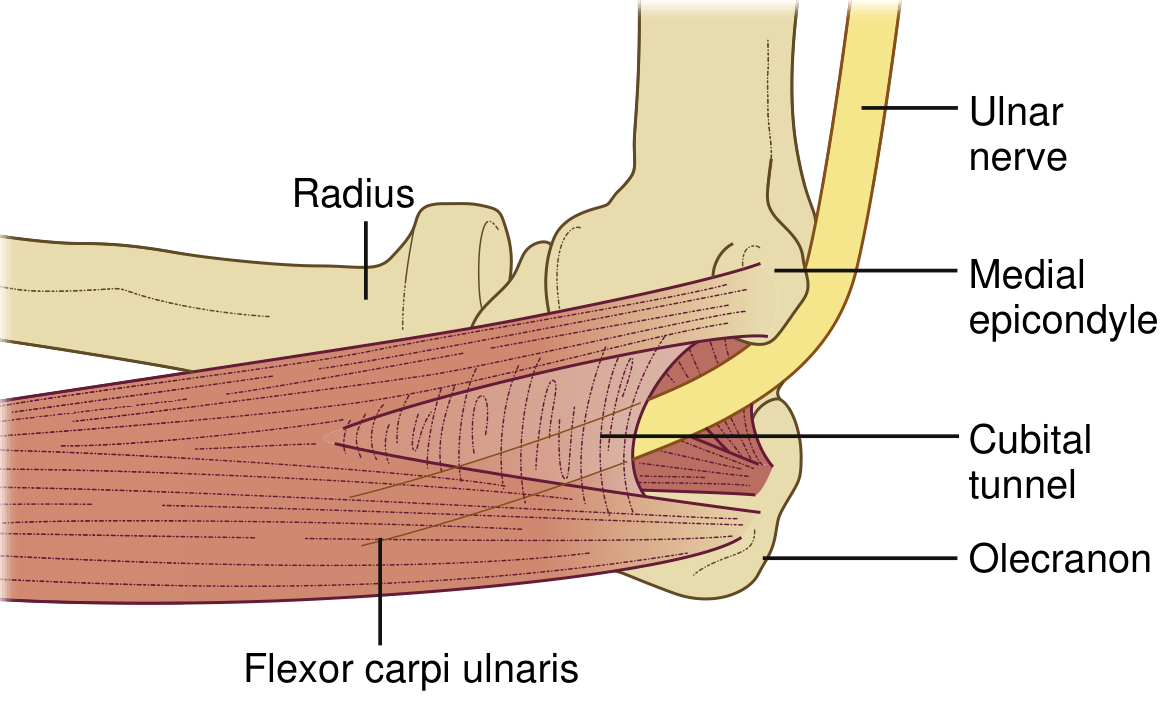
Fig. 32.6 - Ulnar Nerve Anatomy at the Elbow (Bradley and Daroff's Neurology in Clinical Practice)
Why the name?
It is a pun on the bone it sits against: the humerus - which sounds like "humorous." The funny sensation when you strike it also adds to the joke.
Why does it hurt (or tingle)?
At the elbow, the ulnar nerve lies superficially with very little soft tissue protection. When you knock it against the medial epicondyle, you are directly compressing the nerve against bone. This produces:
- A sharp electric shock or tingling sensation
- Numbness radiating down the forearm
- Tingling into the ring finger and little finger (4th and 5th digits) - the area of ulnar nerve sensory distribution
The sensation is brief because the compression is transient, but it is intense precisely because the nerve has no protective cushioning at that spot.
Anatomy in detail
- Origin: The ulnar nerve arises from the medial cord of the brachial plexus (C8, T1)
- Course at elbow: It passes posterior to the medial epicondyle, held in the cubital tunnel by a retinaculum
- Continues: Enters the forearm between the two heads of the flexor carpi ulnaris, then travels to the hand via the Guyon's canal at the wrist
- Motor supply: Intrinsic hand muscles (hypothenar muscles, interossei, medial two lumbricals, adductor pollicis), flexor carpi ulnaris, medial half of flexor digitorum profundus
- Sensory supply: Little finger, medial ring finger, and the ulnar side of the palm
Clinical relevance
Chronic compression of the ulnar nerve at this same spot is called cubital tunnel syndrome - the second most common nerve entrapment in the arm (after carpal tunnel). Causes include:
- Repeated elbow flexion (e.g. holding a phone)
- Leaning on the elbow
- Degenerative changes in the cubital tunnel
Symptoms include persistent tingling in the ring and little fingers, weakened grip, and in severe cases a "claw hand" deformity from loss of intrinsic muscle function.
- Gray's Anatomy for Students, p. 888
- Bradley and Daroff's Neurology in Clinical Practice, p. 550
Tell is orris is for only medicine
No, Orris is not limited to medicine. I can help across a wide range of domains:
Medicine & Health - anatomy, pharmacology, clinical cases, diagnoses, procedures (with access to medical textbooks like Gray's Anatomy, Campbell's Orthopaedics, etc.)
Taxation & Finance
- Indian direct taxes, income tax, transfer pricing (CA/CMA exam prep)
- GST and indirect taxes, ACCA exam preparation
Research & Literature
- PubMed searches for peer-reviewed studies
- Evidence summaries and citations
Document & File Work
- Create/edit Word (.docx), PowerPoint (.pptx), Excel (.xlsx), and PDF files
- Read and extract content from uploaded files
General Knowledge
- Science, history, math, coding, current events
- Web search for up-to-date information
Creative & Visual
- Generate images, posters, diagrams, flashcards
- Analyze uploaded images and videos
Code & Data
- Write and execute code (Python, JS, shell, etc.)
- Data analysis, spreadsheet processing
The medical library and tax/GST skills are specialized add-ons that give me access to authoritative textbooks and course materials - but the core assistant works for pretty much any question you throw at it. What do you need help with?
Whah are your subscription
I don't have information about subscription plans or pricing for Orris. That's something the platform/service provider manages, not something I have visibility into from my end.
For accurate and up-to-date subscription details, I'd suggest:
- Checking the Orris website directly
- Looking for a Pricing or Plans page on the platform
- Reaching out to Orris support or the team that gave you access to this tool
Is there anything else I can help you with?
Atomicity
"Atomicity" has different meanings depending on the context. Let me know which one you're after, or I'll cover the main ones:
Asking for Preferences
Which context are you asking about?
Searching the Web
atomicity chemistry definition valency examples
Atomicity in Chemistry
Atomicity is the total number of atoms present in one molecule of an element or compound.
It answers the question: "How many atoms make up one molecule of this substance?"
Key Examples
| Substance | Formula | Atomicity | Type |
|---|---|---|---|
| Helium | He | 1 | Monoatomic |
| Hydrogen | H₂ | 2 | Diatomic |
| Oxygen | O₂ | 2 | Diatomic |
| Ozone | O₃ | 3 | Triatomic |
| Phosphorus | P₄ | 4 | Tetra-atomic |
| Sulfur | S₈ | 8 | Poly-atomic |
| Water | H₂O | 3 | Triatomic |
| Ammonia | NH₃ | 4 | Tetra-atomic |
| Glucose | C₆H₁₂O₆ | 24 | Poly-atomic |
Types by Atomicity
- Monoatomic - Noble gases (He, Ne, Ar, Kr, Xe, Rn) exist as single atoms; atomicity = 1
- Diatomic - H₂, O₂, N₂, F₂, Cl₂, Br₂, I₂ (remember: HOFBrINCl); atomicity = 2
- Triatomic - O₃ (ozone), H₂O, CO₂; atomicity = 3
- Tetra-atomic - NH₃, P₄; atomicity = 4
- Poly-atomic - S₈ and large molecules; atomicity > 4
Atomicity vs. Valency - Key Difference
These two are often confused:
| Atomicity | Valency | |
|---|---|---|
| Means | Number of atoms in one molecule | Combining capacity of an atom |
| About | The molecule | The individual atom |
| Example (O₂) | Atomicity = 2 | Valency of O = 2 |
| Example (H₂O) | Atomicity = 3 | Valency of H = 1, O = 2 |
- Atomicity tells you the size/composition of a molecule
- Valency tells you how many bonds an atom can form (based on valence electrons)
How to Find Atomicity
Simply count all the atoms in the molecular formula:
- H₂SO₄ → 2 + 1 + 4 = 7
- CH₄ → 1 + 4 = 5
- C₆H₁₂O₆ → 6 + 12 + 6 = 24
That's all there is to it - atomicity is a straightforward count from the formula.
Indian culture
Indian culture is one of the world's oldest and most diverse, shaped over 5,000+ years by geography, religion, trade, and countless civilizations. Here's a broad overview:
Searching the Web
Indian culture overview traditions art religion festivals
Indian Culture - A Rich Tapestry
Indian culture is among the world's oldest, tracing back over 5,000 years to the Indus Valley Civilization (around 3000 BCE). As the Ministry of Culture describes it, it is a combination of several cultures, shaped by diverse religions, languages, geographies, and centuries of trade and exchange.
🏛️ Historical Roots
- Indus Valley Civilization - One of the earliest urban cultures (Mohenjo-daro, Harappa)
- Vedic Period - Foundation of Hindu philosophy, Sanskrit literature, the Vedas and Upanishads
- Maurya & Gupta Empires - Golden age of science, art, mathematics (zero, decimal system)
- Mughal Era - Fusion of Persian and Indian art, architecture (Taj Mahal), music, cuisine
- Colonial Period - British influence blended into existing culture, producing a unique hybrid
🙏 Religion & Philosophy
India is the birthplace of four major world religions:
- Hinduism - Oldest living religion; emphasizes dharma, karma, moksha
- Buddhism - Founded by Gautama Buddha; spread across Asia
- Jainism - Principles of non-violence (ahimsa) and truth
- Sikhism - Founded in Punjab in the 15th century; emphasizes equality and service
Islam, Christianity, Zoroastrianism, and Judaism also have deep roots in India, making it one of the most religiously plural nations on Earth.
🗣️ Languages
India has 22 officially recognized languages and over 1,600 dialects. Major languages include:
- Hindi, Bengali, Telugu, Marathi, Tamil, Urdu, Gujarati, Kannada, Malayalam
- Sanskrit is the classical language - mother of many Indian languages and foundational to Hindu scripture
- Tamil is one of the oldest living classical languages in the world (over 2,000 years)
🎭 Arts & Culture
Classical Dance Forms (8 officially recognized):
- Bharatanatyam (Tamil Nadu), Kathak (North India), Odissi (Odisha), Kathakali (Kerala), Kuchipudi (Andhra), Manipuri, Mohiniyattam, Sattriya
Music:
- Hindustani (North India) and Carnatic (South India) are the two main classical traditions
- Instruments: sitar, tabla, veena, mridangam, sarod
Visual Arts:
- Miniature painting (Mughal, Rajput styles)
- Folk art: Madhubani, Warli, Pattachitra, Tanjore paintings
- Classical sculpture in stone and bronze (Chola bronzes)
🎉 Major Festivals
| Festival | Significance | Region |
|---|---|---|
| Diwali | Festival of lights; victory of light over darkness | Pan-India |
| Holi | Festival of colors; arrival of spring | Pan-India |
| Eid | Islamic festival marking end of Ramadan | Pan-India |
| Dussehra | Victory of Rama over Ravana | Pan-India |
| Navratri | Nine nights honoring Goddess Durga | North & West India |
| Pongal/Makar Sankranti | Harvest festival | South & rest of India |
| Onam | Harvest festival | Kerala |
| Durga Puja | Worship of Goddess Durga | West Bengal |
🍛 Cuisine
Indian food varies dramatically by region but shares common threads:
- Heavy use of spices - turmeric, cumin, coriander, cardamom, chili
- North India - Wheat-based (roti, naan), rich gravies, tandoor cooking, dairy (paneer, ghee)
- South India - Rice-based, coconut, tamarind, lentil dishes (sambar, rasam, dosa)
- West India - Sweet and spicy flavors (Gujarat, Rajasthan)
- East India - Fish-based, mustard oil, subtle flavors (Bengal, Odisha)
👘 Traditional Clothing
- Saree - 6-yard draped garment for women; varies by region in style and weave
- Kurta-Pyjama / Sherwani - Traditional menswear
- Dhoti - Unstitched lower garment for men
- Lehenga, Salwar-Kameez - Popular in North India
- Each state has its own textile tradition: Banarasi silk, Kanjeevaram, Pashmina, Bandhani, Phulkari
🎬 Cinema & Modern Culture
- Bollywood (Mumbai) is the world's largest film industry by number of films produced
- Regional industries: Tollywood (Telugu), Kollywood (Tamil), Mollywood (Malayalam) are equally vibrant
- Indian diaspora (over 30 million people worldwide) has spread Indian culture globally - from yoga and Ayurveda to festivals and food
Core Values
Some values that run through Indian culture regardless of region or religion:
- Hospitality - "Atithi Devo Bhava" (the guest is God)
- Family - Joint family system, respect for elders
- Ahimsa - Non-violence (central to Jainism, Buddhism, and Gandhian thought)
- Spirituality - Religion is woven into daily life through rituals, festivals, and philosophy
Indian culture is not a single monolithic thing - it is a living, breathing mosaic of hundreds of regional identities that somehow coexist as one. That diversity is its defining feature.
This is a shared conversation. Sign in to Orris to start your own chat.