
Role of Vitamin d in human body
Reading File
Now I'll search the medical library and PubMed in parallel for comprehensive coverage.
Finding Sources
Searching PubMed
"vitamin D"[MeSH Terms] AND "physiology"[MeSH Terms]
Searching the Web
role of vitamin D in human body physiology functions 2025
Good results. Now let me read the most relevant textbook sections in parallel.
Reading File
Reading File
Finding Sources
Excellent content. Let me now read the Robbins Pathology section and fetch the vitamin D metabolism diagram in parallel.
Reading File
Loading Image
Reading File
I now have comprehensive textbook content. Let me read the remaining key sections on functions and deficiency.
Reading File
Loading Image
I now have excellent, comprehensive information from multiple authoritative textbooks. Let me compile a thorough answer.
Role of Vitamin D in the Human Body
What Is Vitamin D?
Vitamin D is a fat-soluble secosteroid hormone — unique because it can be entirely synthesized endogenously and acts through a specific nuclear receptor, giving it properties of both a vitamin and a hormone. Two biologically important forms exist:
- Vitamin D₃ (cholecalciferol) — from skin synthesis and animal dietary sources (fatty fish, fish oils, egg yolks)
- Vitamin D₂ (ergocalciferol) — from plant sources (fungi, yeasts)
Synthesis & Metabolism
The activation of vitamin D follows a precise two-step hydroxylation pathway:
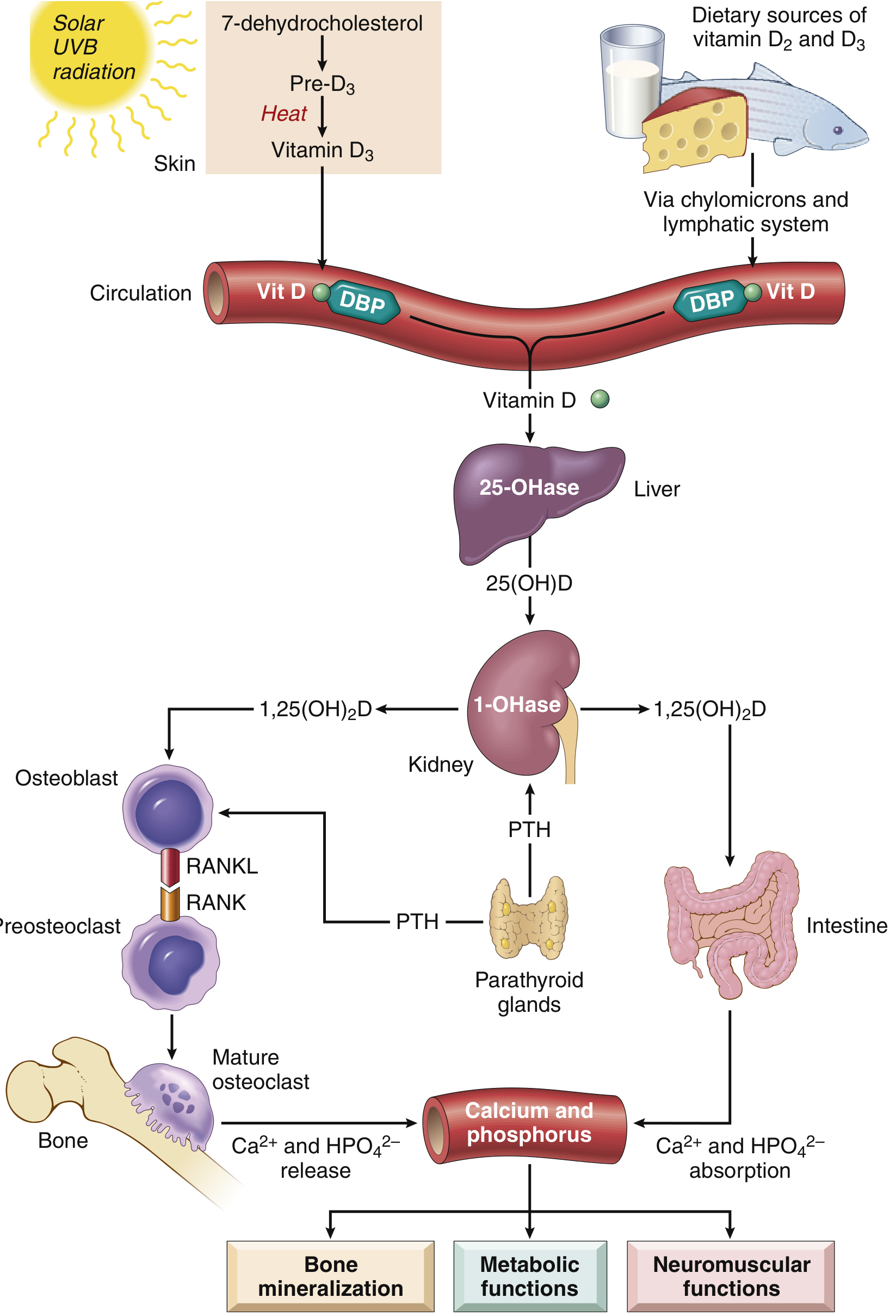
| Step | Location | Enzyme | Product |
|---|---|---|---|
| UV-B irradiation of 7-dehydrocholesterol | Skin | Photochemical | Vitamin D₃ |
| First hydroxylation | Liver | CYP27A1 (25-hydroxylase) | 25(OH)D (calcidiol — storage form, measured clinically) |
| Second hydroxylation | Kidney | CYP27B1 (1α-hydroxylase) | 1,25(OH)₂D (calcitriol — active form) |
| Inactivation | Kidney/tissues | CYP24A1 (24-hydroxylase) | 24,25(OH)₂D (inactive) |
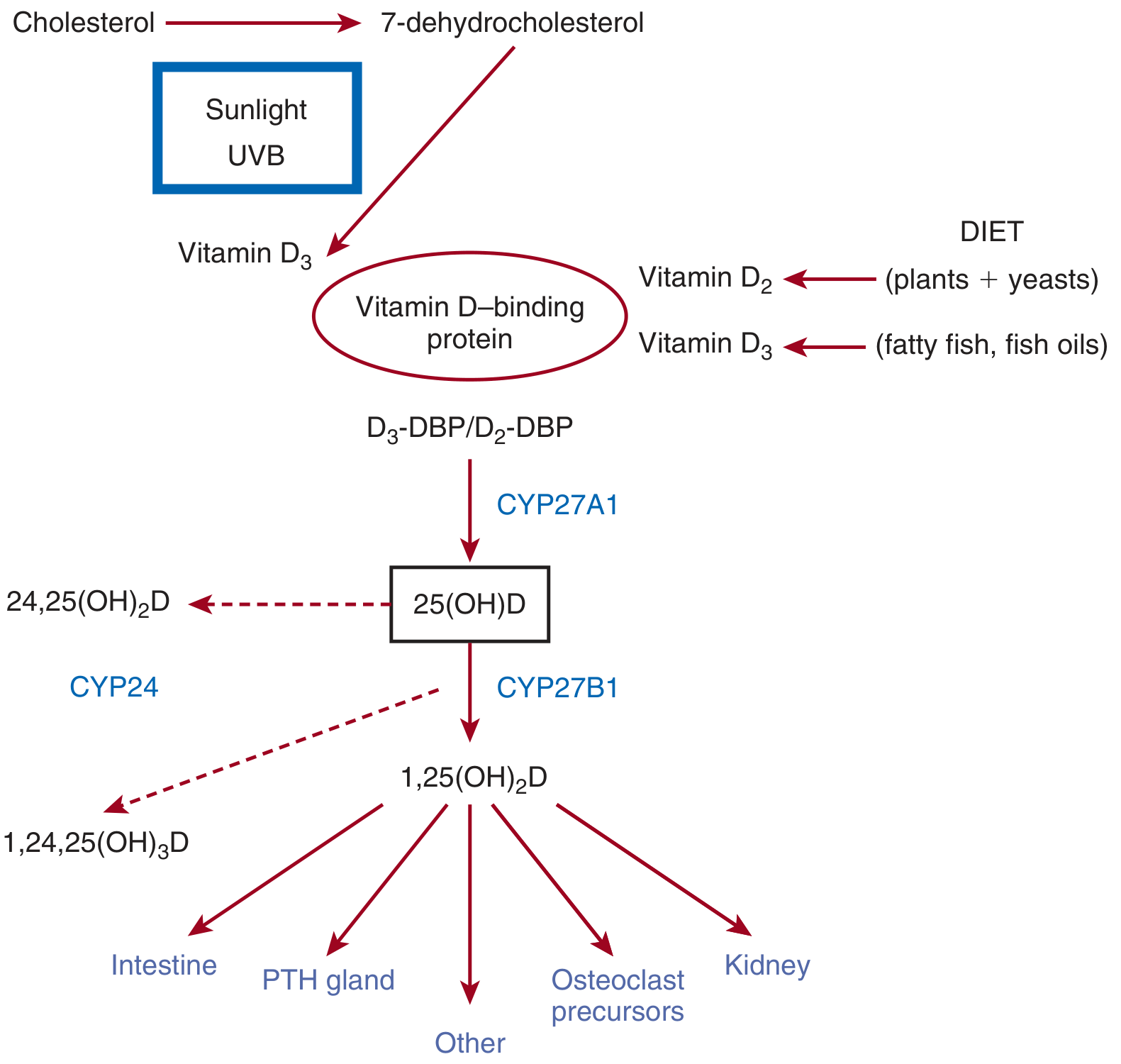
Key regulation points:
- Under normal sun exposure, ~90% of vitamin D is endogenously derived; melanin in darker skin tones reduces UV-light penetration and lowers cutaneous synthesis
- PTH stimulates 1α-hydroxylase (renal activation) in response to hypocalcemia
- Hypophosphatemia directly activates 1α-hydroxylase
- FGF-23 (produced by osteocytes) inhibits CYP27B1 and activates CYP24A1, creating a feedback loop that limits excess calcitriol
- Calcitriol downregulates its own synthesis via negative feedback on 1α-hydroxylase
- Both 25(OH)D and calcitriol are transported in blood bound to vitamin D-binding protein (DBP), a 58-kDa α₁-globulin synthesized in the liver
Core Functions
1. Calcium & Phosphorus Homeostasis (Primary Role)
The most critical function of vitamin D is maintaining adequate plasma Ca²⁺ and phosphate levels for bone mineralization, metabolic functions, and neuromuscular transmission. Calcitriol [1,25(OH)₂D] acts on three main organs:
Intestine:
- Stimulates intestinal absorption of dietary calcium by upregulating calcium transport proteins in enterocytes
- Increases phosphate absorption
Kidney (Distal Tubules):
- Stimulates calcium reabsorption by upregulating epithelial calcium channels, calbindin (intracellular calcium transporter), and plasma membrane calcium pump
- Reduces urinary calcium losses
Bone:
- Required for mineralization of osteoid matrix and epiphyseal cartilage during formation of flat and long bones
- Upregulates RANKL expression on osteoblasts, activating RANK on osteoclast precursors → osteoclast differentiation and bone resorption to mobilize Ca²⁺ when needed
- Works synergistically with PTH in calcium mobilization
Parathyroid Glands:
- High 1,25(OH)₂D concentrations suppress PTH gene transcription by chief cells — a key negative feedback mechanism
2. Mechanism of Action (Genomic Signaling)
Like steroid hormones, 1,25(OH)₂D binds to the Vitamin D Receptor (VDR) — a high-affinity nuclear receptor present in most nucleated cells of the body. Upon ligand binding:
- VDR translocates to the nucleus
- Heterodimerizes with the Retinoid X Receptor (RXR)
- The complex binds Vitamin D Response Elements (VDREs) in DNA
- Recruits transcription co-activators/co-repressors → modulates gene expression
This genomic pathway explains vitamin D's wide-reaching effects across multiple organ systems.
3. Bone Health
| Condition | Age Group | Mechanism |
|---|---|---|
| Rickets | Children (open epiphyses) | Defective mineralization → unmineralized osteoid → bowing of long bones |
| Osteomalacia | Adults | Same histology; no bowing but decreased bone strength, fracture risk ↑ |
| Osteoporosis | Elderly | Chronic deficiency → secondary hyperparathyroidism → ongoing bone resorption |
4. Immune System Regulation
VDR is expressed on immune cells including T cells, B cells, macrophages, and dendritic cells. Active vitamin D:
- Modulates innate and adaptive immune responses
- Has anti-inflammatory effects
- Plays a role in slowing autoimmunity
- Regulates the renin-angiotensin system, helping prevent hypertension
5. Neuromuscular Function
Adequate vitamin D maintains the correct concentration of ionized calcium in extracellular fluid. Deficiency → drop in Ca²⁺ → continuous excitation of nerves and muscles (tetany):
- Sensory nerves: numbness, tingling, burning
- Motor nerves: spontaneous muscle contractions (carpopedal spasm)
6. Other Emerging Roles
Vitamin D receptors are found in virtually every tissue, and research continues to establish links with:
- Cardiovascular health — regulation of renin-angiotensin system, myocardial function
- Cancer prevention — cell proliferation and differentiation regulation
- Metabolic diseases — insulin secretion and glucose metabolism
- Skin — regulation of keratinocyte differentiation and proliferation
Vitamin D Deficiency
Causes:
- Insufficient sun exposure (elderly, institutionalized, darkly pigmented skin)
- Dietary insufficiency
- Fat malabsorption (Crohn's disease, celiac, cystic fibrosis)
- Chronic kidney disease (impaired 1α-hydroxylase activity)
- Chronic liver disease (impaired 25-hydroxylation)
- Genetic 1α-hydroxylase deficiency (vitamin D-dependent rickets — autosomal recessive)
Clinical features:
- Children: Rickets (bowed legs, frontal bossing, rachitic rosary, delayed dentition)
- Adults: Osteomalacia (bone pain, fragility fractures, proximal myopathy)
- Hypocalcemia → secondary hyperparathyroidism → further bone resorption
- Tetany (in severe hypocalcemia)
Laboratory:
- Serum 25(OH)D is the clinical marker of vitamin D status (not 1,25(OH)₂D, which may be normal or elevated due to secondary hyperparathyroidism)
- Hypocalcemia, hypophosphatemia, elevated ALP and PTH
Dietary Sources
| Source | Form |
|---|---|
| Fatty fish (salmon, tuna, mackerel) | D₃ |
| Fish liver oils | D₃ |
| Egg yolks, beef liver | D₃ |
| Fortified milk, cereals | D₂ or D₃ |
| Mushrooms (UV-exposed) | D₂ |
| Sunlight (UVB, 290–315 nm) | D₃ (skin synthesis) |
Summary
Vitamin D is far more than a bone vitamin. As a pleiotropic hormone, it regulates calcium/phosphorus metabolism, bone integrity, immune function, neuromuscular transmission, and gene expression across virtually every tissue via its nuclear receptor. Its unique two-step activation (liver → kidney) makes it vulnerable to disruption at multiple points, with deficiency producing consequences ranging from rickets in children to osteomalacia, fractures, and immune dysregulation in adults.
Sources:
- Robbins & Kumar Basic Pathology, pp. 293–296
- Medical Physiology (Boron & Boulpaep), p. 1558
- Brenner and Rector's The Kidney, pp. 2393–2396
- Recent systematic review supporting Endocrine Society guidelines: Shah VP et al., J Clin Endocrinol Metab, 2024 (PMID: 38828942)
This is a shared conversation. Sign in to Orris to start your own chat.