
Physiology of cortex
Reading File
Now let me search for cortex physiology content in parallel across multiple angles:
Finding Sources
Finding Sources
Finding Sources
Finding Sources
Excellent results. Let me read the key sections from Guyton & Hall and Costanzo simultaneously:
Reading File
Reading File
Reading File
Finding Sources
Reading File
Finding Sources
Reading File
Reading File
I now have comprehensive content from Guyton & Hall. Let me fetch the key diagrams and compile the full answer:
Loading Image
Loading Image
Loading Image
I now have rich content from Guyton & Hall. Let me compile the comprehensive answer.
Physiology of the Cerebral Cortex
Source: Guyton and Hall Textbook of Medical Physiology, 14th Ed.
1. Physiological Anatomy
The cerebral cortex is a thin layer of neurons (2–5 mm thick) covering the surface of all cerebral convolutions, with a total surface area of ~0.25 m². It contains over 80 billion neurons organized into six layers:
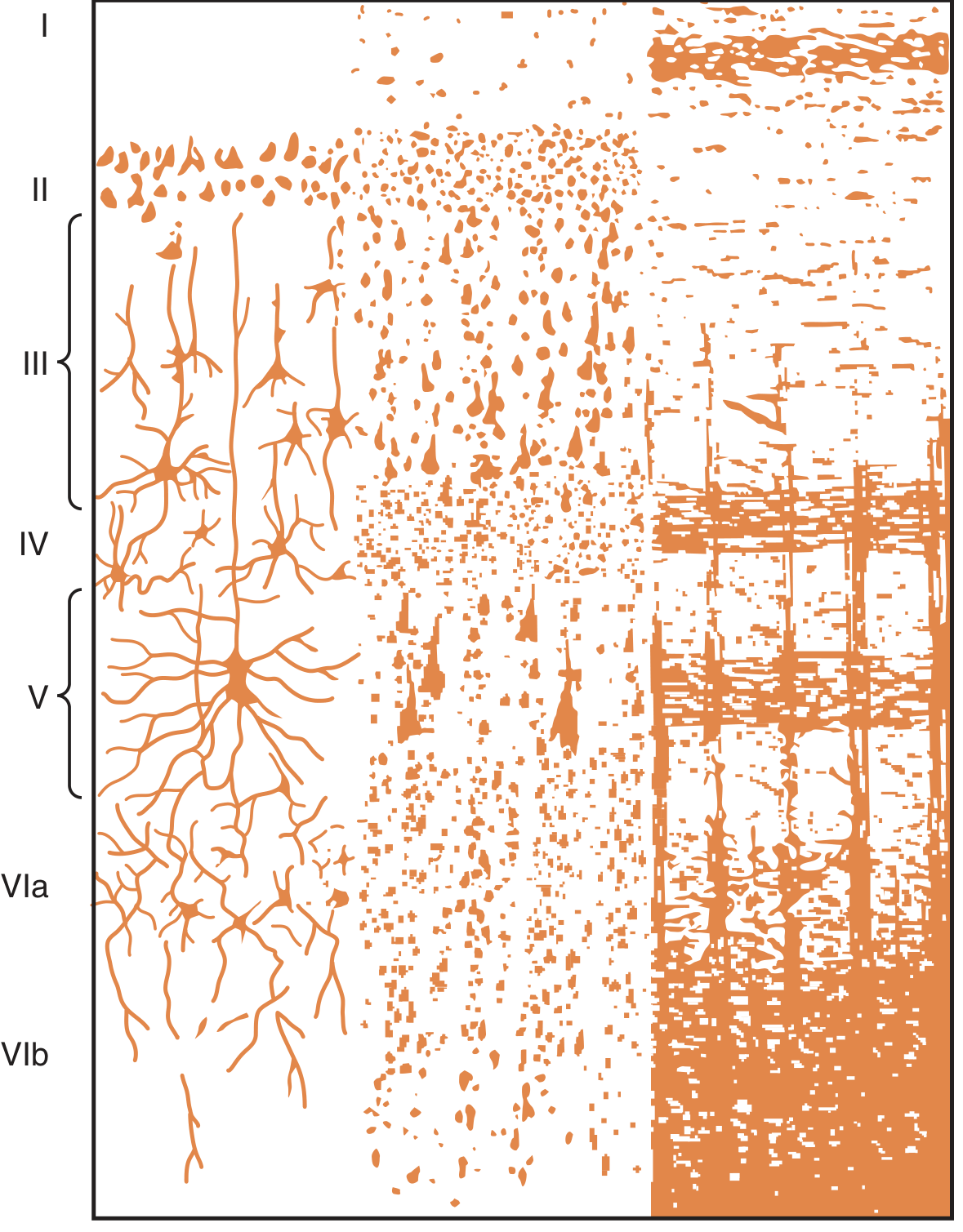
Figure: Structure of the cerebral cortex showing layers I–VI (Guyton & Hall, Fig. 58.1)
Three Main Neuron Types
| Type | Characteristics | Function |
|---|---|---|
| Granular (stellate) | Short axons, interneurons | Intracortical processing; excitatory (glutamate) or inhibitory (GABA); concentrated in sensory/association areas |
| Pyramidal | Large, numerous; long axons | Output to spinal cord, brain stem; major source of corticospinal tract |
| Fusiform | Smaller output neurons | Output to thalamus and other cortical regions |
Layer Functions
| Layer | Function |
|---|---|
| I–III | Intracortical association (horizontal connections) |
| IV | Main input — receives incoming sensory signals |
| V | Output — large fibers to brain stem and spinal cord |
| VI | Output to thalamus |
2. Thalamocortical System
All areas of the cortex have bidirectional connections with the thalamus. When thalamic connections are severed, the corresponding cortical area loses function almost entirely. For this reason, the thalamus and cortex are functionally treated as a unit — the thalamocortical system. Nearly all sensory pathways (except olfaction) relay through the thalamus before reaching the cortex.
3. Functional Areas of the Cortex
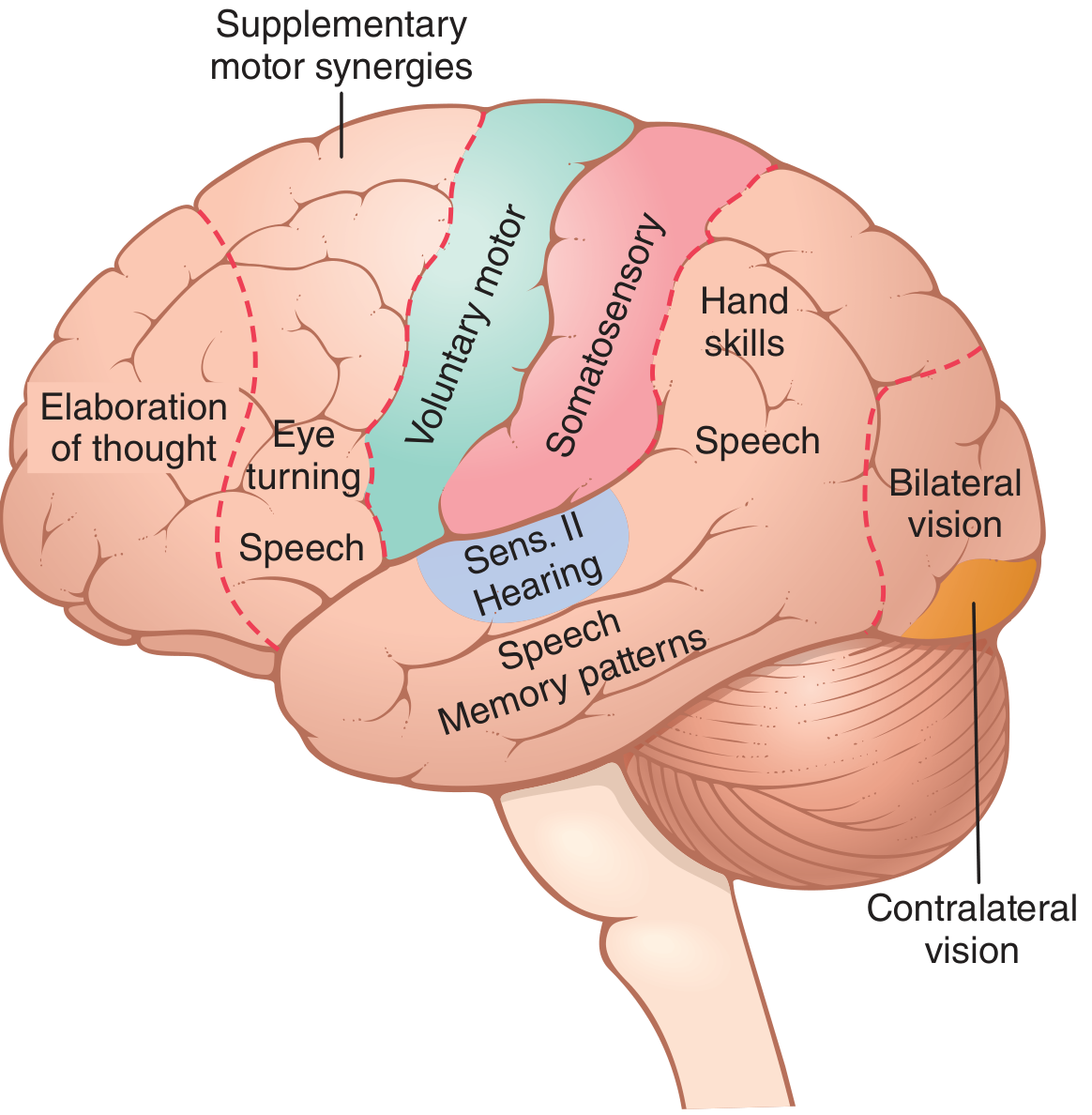
Figure: Functional areas of the human cerebral cortex — voluntary motor, somatosensory, speech, hearing, vision, elaboration of thought (Guyton & Hall, Fig. 58.3)
A. Primary Motor Cortex (Brodmann Area 4)
- Located in the precentral gyrus, anterior to the central sulcus
- Somatotopically organized — face/mouth laterally → hand/arm in midportion → trunk at apex → leg/foot in the longitudinal fissure
- More than half of the primary motor cortex is dedicated to the hands and speech muscles
- Stimulation of a single neuron typically produces a coordinated movement pattern, not contraction of a single muscle
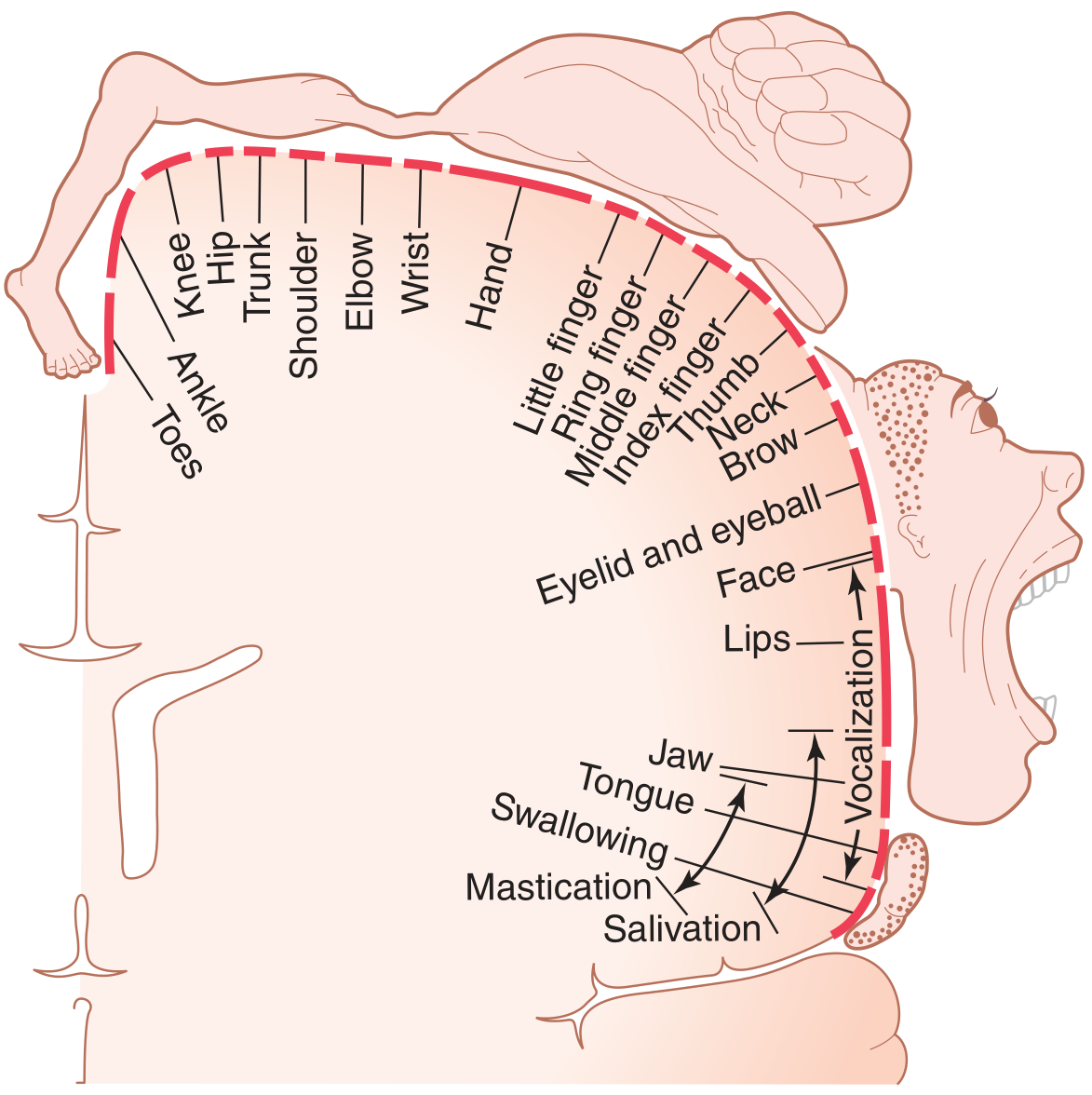
Figure: Motor homunculus — degree of motor cortex representation for each body part (Penfield & Rasmussen)
B. Premotor Area (Brodmann Area 6)
- Located 1–3 cm anterior to the primary motor cortex
- Generates more complex movement patterns (e.g., positioning the shoulder/arm for a task)
- The anterior premotor cortex builds a motor image; the posterior portion executes sequential muscle patterns
- Sends signals to the primary motor cortex or directly via the corticospinal tract
C. Supplementary Motor Area
- Located in the longitudinal fissure, adjacent to the premotor area
- Functions similarly to the premotor area — bilateral body movements and postural control
D. Somatosensory Cortex (Postcentral Gyrus, Brodmann Areas 3, 1, 2)
- Receives somatic sensations from the body
- Also somatotopically organized (mirroring the motor homunculus)
- Secondary somatosensory area (Sens. II) interprets texture, shape, and object identity in hand
E. Visual Cortex
- Primary visual cortex (calcarine fissure, occipital lobe): receives raw visual signals; processes contralateral visual field
- Secondary visual areas: interpret color, light intensity, line orientation, movement
- A small area at the occipital pole processes bilateral vision
F. Auditory Cortex (Superior Temporal Gyrus)
- Primary auditory cortex receives raw tonal signals
- Secondary areas interpret sequences of tones and speech sounds
4. Association Areas
Wernicke Area (Posterior Superior Temporal Lobe)
- Located where temporal, parietal, and occipital lobes converge
- Called the general interpretative area or gnostic area
- Integrates somatic, visual, and auditory information into complex thought
- Damage → Wernicke's aphasia: can hear words but cannot arrange them into coherent thought; can see words but cannot grasp meaning
- Electrical stimulation evokes complex multi-modal memory patterns (scenes, music, speech)
Angular Gyrus
- Immediately posterior to Wernicke area; connects to visual cortex
- Destruction → alexia (word blindness): can see words but cannot interpret their meaning
- Difficulty in learning written language = dyslexia
Prefrontal Association Area
- Executive functions: complex problem-solving, sequential planning, multi-tasking, working memory
- Functions as a "working memory" — holds multiple thoughts simultaneously while making decisions
- Damage or prefrontal lobotomy results in:
- Inability to solve complex sequential problems
- Loss of ambition and appropriate social behavior
- Easy distractibility, inability to sustain logical trains of thought
- Preserved routine motor skills but purposeless execution
Limbic Association Area
- Anterior temporal pole, ventral frontal lobe, cingulate gyrus
- Controls behavior, emotions, and motivation
- Part of the broader limbic system; provides emotional and motivational drive for learning
5. Cerebral Dominance
- In ~95% of people, the left hemisphere is dominant
- Even at birth, the Wernicke area region is ~50% larger in the left hemisphere in >50% of neonates
- The dominant hemisphere handles language comprehension, speech production, analytical tasks
- The non-dominant hemisphere handles spatial perception, face recognition, musical appreciation
- If the dominant hemisphere is damaged in early childhood, the opposite hemisphere can acquire dominant functions
6. Language and Speech Areas
| Area | Location | Function |
|---|---|---|
| Broca's area | Inferior frontal gyrus (left) | Motor programming of speech; damage → expressive (motor) aphasia |
| Wernicke's area | Posterior superior temporal gyrus | Language comprehension; damage → receptive aphasia |
| Angular gyrus | Inferior posterior parietal lobe | Integrates written language with auditory representation |
7. Summary of Key Concepts
- Input arrives at layer IV → processed by intracortical circuits (layers I–III) → output leaves via layers V and VI
- The cortex is functionally inseparable from the thalamus (thalamocortical system)
- Primary areas detect specific sensory/motor signals; secondary/association areas give them meaning
- The Wernicke area is the single most important region for higher intellectual function
- The prefrontal cortex provides working memory, executive planning, and behavioral regulation
- Cortical representation is proportional to functional importance, not body size (motor homunculus)
— Guyton and Hall Textbook of Medical Physiology, 14th Ed., Chapters 56 & 58
This is a shared conversation. Sign in to Orris to start your own chat.