
Explain regulatory steps of glycolysis with respect to name structure of intermediate enzyme and covector
Reading File
Glycolysis has three main regulatory enzymes: hexokinase/glucokinase, phosphofructokinase-1 (PFK-1), and pyruvate kinase. PFK-1 is the most important rate-limiting step. Key coenzymes include NAD+/NADH and ATP/ADP/AMP.
Searching sources...
Finding Sources
Finding Sources
Reading File
Reading File
Reading File
Finding Sources
Reading File
Reading File
I now have rich content from the textbooks. Let me fetch the regulatory diagram image and compile the full answer.
Loading Image
Here is a complete, structured explanation of the regulatory steps of glycolysis covering the intermediate/substrate, enzyme, and coenzyme (cofactor) at each regulated step.
Regulation of Glycolysis
Glycolysis is regulated at three physiologically irreversible (non-equilibrium) reactions. These are the major control points because a small change in their rate affects flux through the entire pathway.
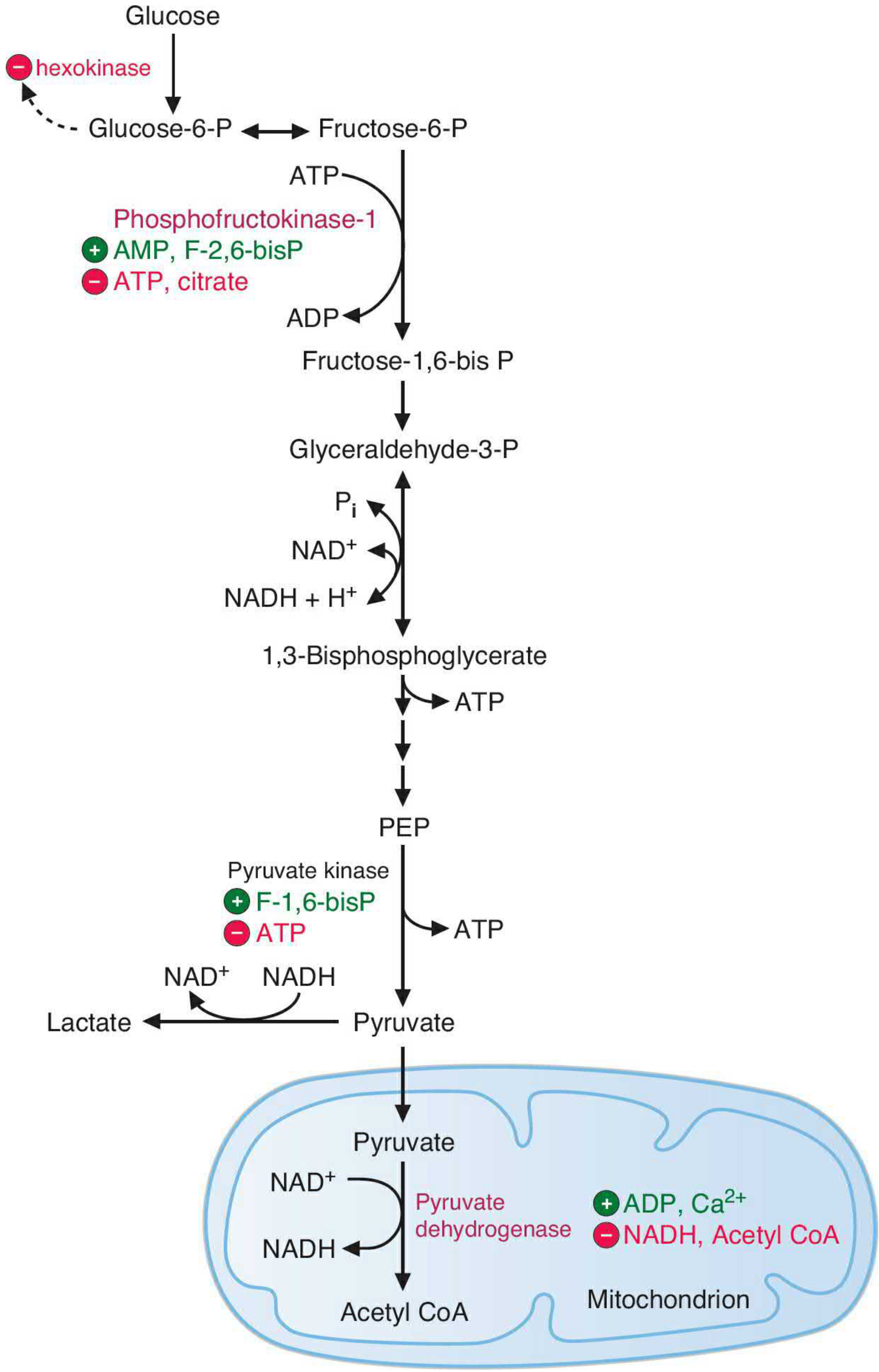
Step 1 - Glucose → Glucose 6-Phosphate
| Feature | Detail |
|---|---|
| Intermediate (substrate) | Glucose |
| Product | Glucose 6-phosphate (Glucose 6-P) |
| Enzyme | Hexokinase (all tissues) / Glucokinase (liver & pancreatic β-cells) |
| Coenzyme/Cofactor | ATP → ADP (Mg²⁺ required) |
| Regulation type | Allosteric + product inhibition |
Regulation details:
- Hexokinase (isoenzymes I-III): has a high affinity for glucose (low Km ~0.1 mM), is inhibited by its own product - glucose 6-phosphate (product/feedback inhibition). It is saturated at normal blood glucose levels.
- Glucokinase (hexokinase IV, liver): has a low affinity for glucose (high Km ~10 mM), is NOT inhibited by glucose 6-P, and is induced by insulin. It acts as a glucose sensor in the liver and pancreatic β-cells.
- Both are irreversible under physiological conditions. Glucose 6-P is a metabolic branch point - it can enter glycolysis, the pentose phosphate pathway, or glycogen synthesis.
Step 2 - Fructose 6-Phosphate → Fructose 1,6-Bisphosphate
| Feature | Detail |
|---|---|
| Intermediate (substrate) | Fructose 6-phosphate (Fructose 6-P) |
| Product | Fructose 1,6-bisphosphate (F-1,6-bisP) |
| Enzyme | Phosphofructokinase-1 (PFK-1) - the KEY rate-limiting enzyme |
| Coenzyme/Cofactor | ATP → ADP (Mg²⁺ required) |
| Regulation type | Allosteric (most important regulatory site) |
Regulation details:
PFK-1 is the committed, rate-limiting step of glycolysis - it is both inducible and subject to allosteric regulation.
| Regulators | Effect | Signal meaning |
|---|---|---|
| AMP | Activates (+) | Low energy state - need more ATP |
| Fructose 2,6-bisphosphate (F-2,6-bisP) | Activates (+) | Fed state (insulin-driven) |
| ATP (high concentration) | Inhibits (-) | Energy is plentiful, slow down |
| Citrate | Inhibits (-) | TCA cycle is running well, substrates not needed |
| H⁺ (low pH) | Inhibits (-) | Prevents lactic acidosis |
Fructose 2,6-bisphosphate is a particularly powerful activator. It is synthesized by PFK-2 (a bifunctional enzyme). In the fed state, insulin-driven dephosphorylation of PFK-2 activates it, raising F-2,6-bisP levels and stimulating glycolysis in the liver. In the fasted state, glucagon activates PKA, phosphorylates PFK-2 (deactivating its kinase activity), and F-2,6-bisP falls, slowing glycolysis.
Key concept: AMP signals low energy because the adenylate kinase reaction (2 ADP → ATP + AMP) means AMP concentration rises manyfold even when ATP drops by only ~20%, making AMP a highly sensitive indicator of energy state.
Step 3 - Phosphoenolpyruvate (PEP) → Pyruvate
| Feature | Detail |
|---|---|
| Intermediate (substrate) | Phosphoenolpyruvate (PEP) |
| Product | Pyruvate |
| Enzyme | Pyruvate Kinase (PK) |
| Coenzyme/Cofactor | ADP → ATP (Mg²⁺, K⁺ required); also generates ATP |
| Regulation type | Allosteric + covalent modification (liver isoenzyme only) |
Regulation details:
| Regulators | Effect | Notes |
|---|---|---|
| Fructose 1,6-bisphosphate | Activates (+) | Feed-forward activation - the product of PFK-1 activates PK |
| ATP (high) | Inhibits (-) | Energy is sufficient |
| Alanine | Inhibits (-) | Signals sufficient amino acid pool |
| Glucagon (via cAMP/PKA) | Inhibits (-) | Liver L-isoenzyme only - phosphorylation inactivates it |
- In the liver, the L-isoenzyme of pyruvate kinase is subject to covalent regulation: glucagon → cAMP → PKA → phosphorylates PK → inhibits it (diverts PEP to gluconeogenesis).
- In muscle, the M-isoenzyme is NOT regulated by phosphorylation.
The Non-Regulated But Coenzyme-Critical Step
Glyceraldehyde 3-Phosphate → 1,3-Bisphosphoglycerate
| Feature | Detail |
|---|---|
| Intermediate | Glyceraldehyde 3-phosphate (G3P) |
| Enzyme | Glyceraldehyde 3-phosphate dehydrogenase (GAPDH) |
| Coenzyme | NAD⁺ → NADH + H⁺ (the only redox step in glycolysis) |
This is the only oxidation-reduction reaction in glycolysis. NAD⁺ is a mandatory coenzyme. If NAD⁺ is not regenerated (by lactate dehydrogenase in anaerobic conditions, or by the electron transport chain aerobically), GAPDH stops and glycolysis halts. This is why:
- In anaerobic conditions: pyruvate + NADH → lactate + NAD⁺ (via LDH, which uses NADH as coenzyme)
- Net per glucose: 2 ATP + 2 NADH + 2 pyruvate
Summary Table
| Step | Substrate (Intermediate) | Enzyme | Coenzyme/Cofactor | Key Regulators |
|---|---|---|---|---|
| 1 | Glucose | Hexokinase / Glucokinase | ATP (Mg²⁺) | (-) Glucose 6-P (HK); not inhibited by G6P (GK) |
| 2 (Rate-limiting) | Fructose 6-P | PFK-1 | ATP (Mg²⁺) | (+) AMP, F-2,6-bisP; (-) ATP, citrate, H⁺ |
| 6 (Redox step) | Glyceraldehyde 3-P | GAPDH | NAD⁺ (→ NADH) | Availability of NAD⁺ |
| 10 | Phosphoenolpyruvate | Pyruvate Kinase | ADP (Mg²⁺, K⁺) | (+) F-1,6-bisP; (-) ATP, alanine, glucagon (liver) |
Coenzyme Summary
| Coenzyme | Role in Glycolysis |
|---|---|
| ATP | Phosphate donor in steps 1 and 3 (investment phase); allosteric inhibitor of PFK-1 and PK |
| ADP | Phosphate acceptor in steps 7 and 10 (ATP generation); AMP formed from 2 ADP activates PFK-1 |
| NAD⁺ | Oxidizing agent in step 6 (GAPDH reaction); must be regenerated for glycolysis to continue |
| NADH | Produced in step 6; inhibits pyruvate dehydrogenase; used by LDH anaerobically |
| Mg²⁺ | Cofactor for all kinase reactions (forms Mg-ATP complex) |
| Fructose 2,6-bisphosphate | Not a coenzyme but the most potent allosteric activator of PFK-1 |
Sources: Basic Medical Biochemistry - A Clinical Approach, 6e, Chapter 22; Harper's Illustrated Biochemistry, 32nd Ed, Chapter 17
This is a shared conversation. Sign in to Orris to start your own chat.