

IMG-20260521-WA0016.jpg
*Young boy was brought to clinic because his parents noticed that his left leg had been “growing bigger and longer every year.” What is the diagnosis?*
Reading File
Finding Sources
Finding Sources
Reading File
Finding Sources
Reading File
Loading Image
Diagnosis: Klippel-Trénaunay Syndrome (KTS)
The clinical illustration perfectly matches the classic triad of this rare congenital vascular malformation:
| Feature in Image | KTS Finding |
|---|---|
| Port-wine stain (capillary naevus) on face, arm, and trunk | Cutaneous capillary malformation |
| Prominent, tortuous veins on the left leg | Varicose veins / persistent vestigial veins |
| Left leg visibly larger and longer than the right | Soft-tissue and bony hypertrophy of the affected limb |
What is Klippel-Trénaunay Syndrome?
KTS is a mesodermal abnormality (non-familial, sporadic) characterized by the triad of:
- Cutaneous capillary malformation (port-wine birthmark/naevus) — typically on the affected limb, but can extend to the trunk and face as seen here
- Varicose veins / venous malformations — often involving a persistent lateral embryonic vein (lateral anomalous axial vein); segments of the deep veins may be hypoplastic or aplastic
- Hypertrophy of the affected limb — progressive overgrowth of both soft tissue and bone → leg length discrepancy that worsens with age
This is precisely what the parents observed: the left leg "growing bigger and longer every year."
Key Distinction
KTS must be distinguished from Parkes-Weber syndrome, which also has a port-wine stain and limb hypertrophy, but is characterized by multiple arteriovenous fistulae causing venous hypertension, ulceration, and high-output cardiac failure (KTS has no AV fistulae — it is a low-flow lesion).
Management
| Approach | Indication |
|---|---|
| Compression hosiery | First-line for virtually all patients |
| Laser ablation of naevus | Cosmetic / capillary malformation |
| Epiphysiodesis (bone stapling) | Leg length discrepancy |
| Sclerotherapy / vein removal | Large superficial varicose veins (only if deep veins are patent) |
| LMWH perioperatively | Increased VTE risk with any surgery |
Bailey and Love's Short Practice of Surgery, 28th Ed. — real textbook image of KTS for comparison:
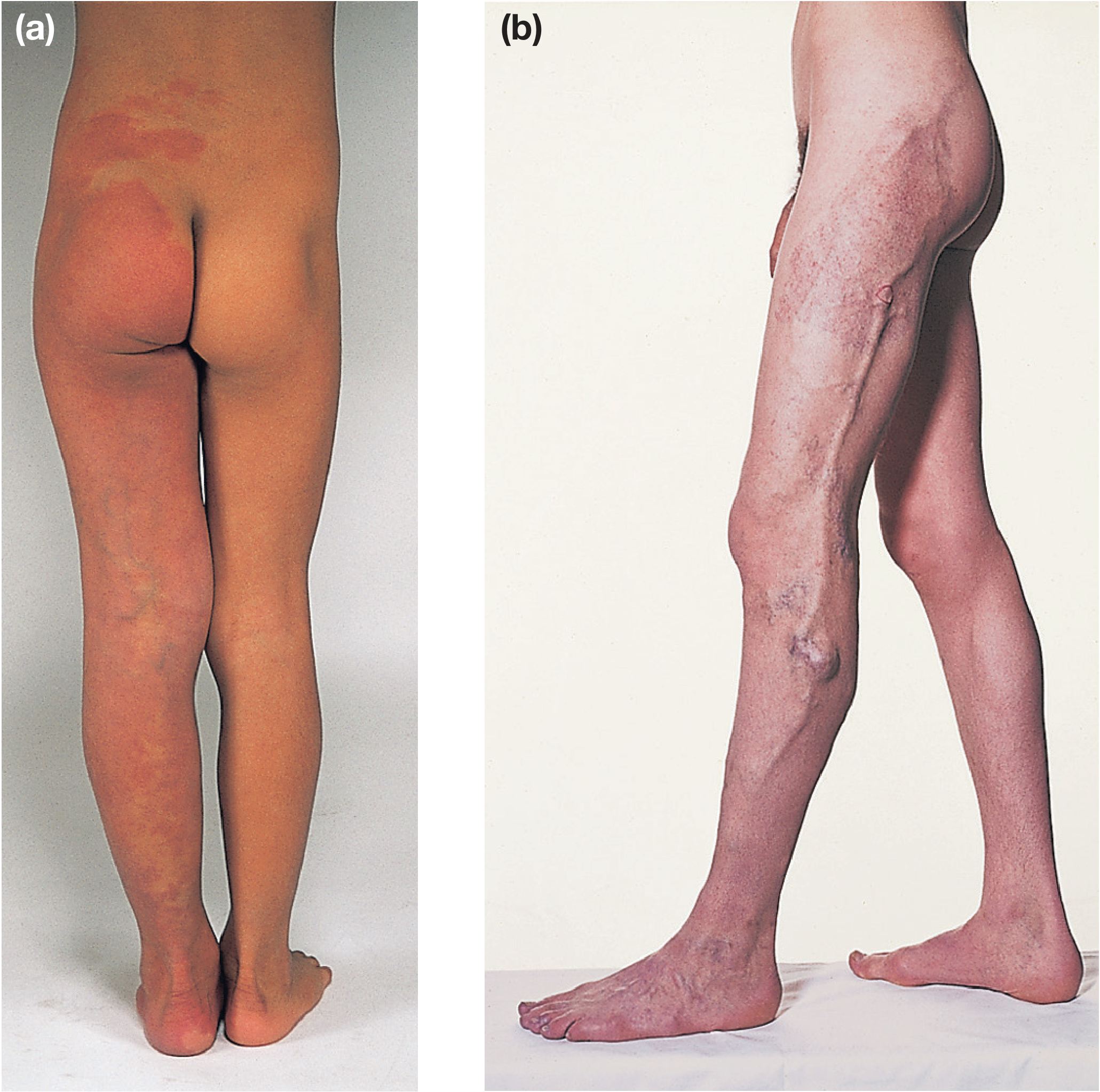
(a) Longer leg with capillary naevus; (b) Large lateral anomalous axial vein — Bailey and Love's Short Practice of Surgery, 28th Ed.
This is a shared conversation. Sign in to Orris to start your own chat.