
Syndromic management of sexually transmitted diseases
Reading File
Syndromic management of STDs is a WHO-recommended approach where treatment is given based on the clinical syndrome (a recognizable cluster of symptoms/signs) rather than waiting for laboratory confirmation. The main syndromes include urethral discharge, vaginal discharge, genital ulcer disease, inguinal bubo, scrotal swelling, and lower abdominal pain. Each syndrome has a specific drug regimen targeting the most likely causative organisms.
Searching sources...
Finding Sources
Finding Sources
Finding Sources
Finding Sources
Reading File
Finding Sources
Reading File
Reading File
Reading File
Reading File
Reading File
Reading File
Reading File
I now have comprehensive data from Park's Textbook of Preventive and Social Medicine to compile a thorough answer. Let me also fetch the flowchart images that were referenced.
Loading Image
Loading Image
I now have all the data needed for a comprehensive answer. Here is the full structured response:
Syndromic Management of Sexually Transmitted Diseases (STDs)
What is Syndromic Management?
The traditional method of diagnosing STDs relies on laboratory tests, but these are often unavailable or unaffordable in resource-limited settings. Since 1990, the WHO has recommended syndromic management of STDs - a scientifically derived approach where treatment is given immediately based on recognized clinical syndromes (clusters of symptoms and signs) rather than waiting for laboratory confirmation. It uses flowcharts and is more cost-effective than laboratory-based diagnosis.
- Park's Textbook of Preventive and Social Medicine, p. 381
The Six Major Syndromes
1. Urethral Discharge in Males
Causative organisms: Neisseria gonorrhoeae (gonorrhea) + Chlamydia trachomatis
Since dual infection is common, treatment must cover both organisms.
Flowchart:
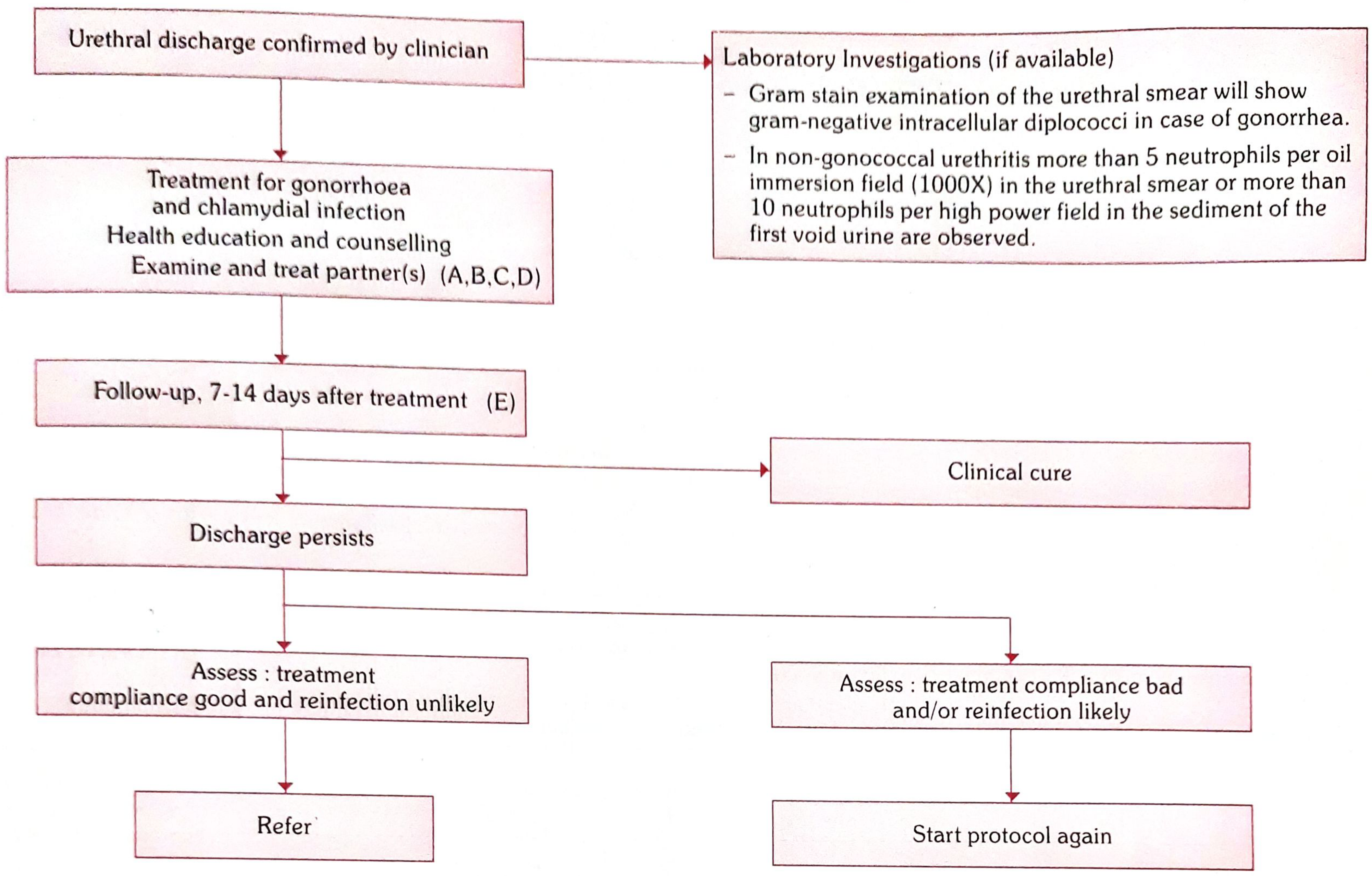
Treatment:
| Drug | Dose | Purpose |
|---|---|---|
| Tab. Cefixime | 400 mg orally, single dose | Gonorrhea |
| Tab. Azithromycin | 1 g orally, single dose (supervised) | Chlamydia |
- If symptoms persist at 7 days: Tab. Secnidazole 2 g single dose (for Trichomonas vaginalis)
- Azithromycin allergy: Erythromycin 500 mg four times daily x 7 days
- Pregnant partner: Cefixime 400 mg single dose + Erythromycin base 500 mg four times daily x 7 days (quinolones and doxycycline are contraindicated)
- Follow-up at: 7 days
2. Vaginal Discharge
Causative organisms:
- Vaginitis: Trichomonas vaginalis, Candida albicans, Gardnerella vaginalis (bacterial vaginosis)
- Cervicitis: Neisseria gonorrhoeae, Chlamydia trachomatis, T. vaginalis, Herpes simplex virus
Examination: Per speculum to differentiate vaginitis from cervicitis:
- Trichomoniasis - greenish frothy discharge
- Candidiasis - curdy white discharge
- Bacterial vaginosis - adherent discharge
- Cervicitis - cervical erosion / mucopurulent cervical discharge
Treatment:
| Condition | Drug | Dose |
|---|---|---|
| Vaginitis (TV + BV) | Tab. Secnidazole OR Tab. Tinidazole | 2 g single dose OR 500 mg BD x 5 days |
| Candidiasis | Tab. Fluconazole OR Clotrimazole pessary | 150 mg single dose OR 500 mg once |
| Cervicitis (Gonorrhea + Chlamydia) | Tab. Cefixime + Azithromycin | 400 mg + 1 g, both single dose |
- First trimester of pregnancy: Local clotrimazole only; oral fluconazole and oral metronidazole contraindicated
- Second/third trimester: Secnidazole 2 g or tinidazole can be used
- Partner management: Treat partner only if there is no improvement after initial treatment or partner is symptomatic
- Follow-up at: 7 days
3. Lower Abdominal Pain in Females (Pelvic Inflammatory Disease - PID)
Causative organisms: N. gonorrhoeae, C. trachomatis, Mycoplasma, Gardnerella, anaerobes (Bacteroides, gram-positive cocci)
Differential diagnosis: Ectopic pregnancy, twisted ovarian cyst, appendicitis, abdominal tuberculosis
Key: A urine pregnancy test should be done in ALL women suspected of having PID to rule out ectopic pregnancy.
Treatment (outpatient - mild/moderate PID):
- Tab. Cefixime 400 mg orally twice daily x 7 days
-
- Tab. Metronidazole 400 mg twice daily x 14 days
-
- Cap. Doxycycline 100 mg twice daily x 2 weeks (for chlamydia)
- Tab. Ibuprofen 400 mg three times daily x 3-5 days (analgesia)
- Remove IUD if present under antibiotic cover
Criteria for hospitalization:
-
Uncertain diagnosis; cannot exclude ectopic pregnancy or appendicitis
-
Pelvic abscess suspected
-
Severe illness
-
Pregnant patient
-
Failed outpatient therapy
-
Non-compliance
-
Doxycycline and metronidazole (in first trimester) are contraindicated in pregnancy.
-
Follow-up at: 3 days, 7 days, and 14 days
4. Genital Ulcer Disease
Causative organisms:
| Organism | Disease | Ulcer Character |
|---|---|---|
| Treponema pallidum | Syphilis | Painless, hard, "shotty" lymph nodes |
| Haemophilus ducreyi | Chancroid | Painful, single, + painful bubo |
| Klebsiella granulomatis | Granuloma inguinale | Painless + inguinal nodes |
| Chlamydia trachomatis (L1-L3) | LGV | Painless + inguinal nodes |
| Herpes simplex virus | Genital herpes | Painful vesicles/multiple ulcers |
Treatment:
- Vesicles or multiple painful ulcers (herpes): Tab. Acyclovir 400 mg three times daily x 7 days
- Ulcer without vesicles (syphilis + chancroid):
- Inj. Benzathine penicillin 2.4 million IU IM (after test dose, with emergency tray ready)
-
- Tab. Azithromycin 1 g single dose OR Tab. Ciprofloxacin 500 mg twice daily x 3 days (for chancroid)
- Penicillin allergy: Doxycycline 100 mg twice daily x 14 days
In pregnancy:
- Quinolones, doxycycline, sulfonamides are contraindicated
- Benzathine penicillin 2.4 million IU IM; second dose 1 week later for primary/secondary/early latent syphilis
- Herpes with active lesions at delivery: caesarean section; acyclovir may be given orally for severe cases
- Erythromycin estolate is contraindicated (hepatotoxicity); use erythromycin base or erythromycin ethyl succinate
Partner management: Treat all contacts in past 3 months for syphilis and chancroid.
5. Scrotal Swelling (Epididymo-orchitis)
Causative organisms (STI-related): N. gonorrhoeae, C. trachomatis
Differential diagnosis: TB, filariasis, coliforms, pseudomonas, mumps, trauma, hernia, hydrocele, testicular torsion, testicular tumors
Key examination: Transillumination test to rule out hydrocele
Treatment:
- Tab. Cefixime 400 mg orally twice daily x 7 days
-
- Cap. Doxycycline 100 mg twice daily x 14 days
- Supportive: bed rest, scrotal elevation with T-bandage, analgesics
If quick and effective therapy is not given, testicular scarring and sub-fertility may result.
- Pregnant partner: Doxycycline contraindicated; use erythromycin base or amoxicillin
6. Inguinal Bubo
Causative organisms: Chlamydia trachomatis serovars L1, L2, L3 (LGV), Haemophilus ducreyi (chancroid)
Differential diagnosis: Mycobacterium tuberculosis, filariasis, acute infections of the skin of the pubic area, genitals, buttocks, anus, and lower limbs
Flowchart:
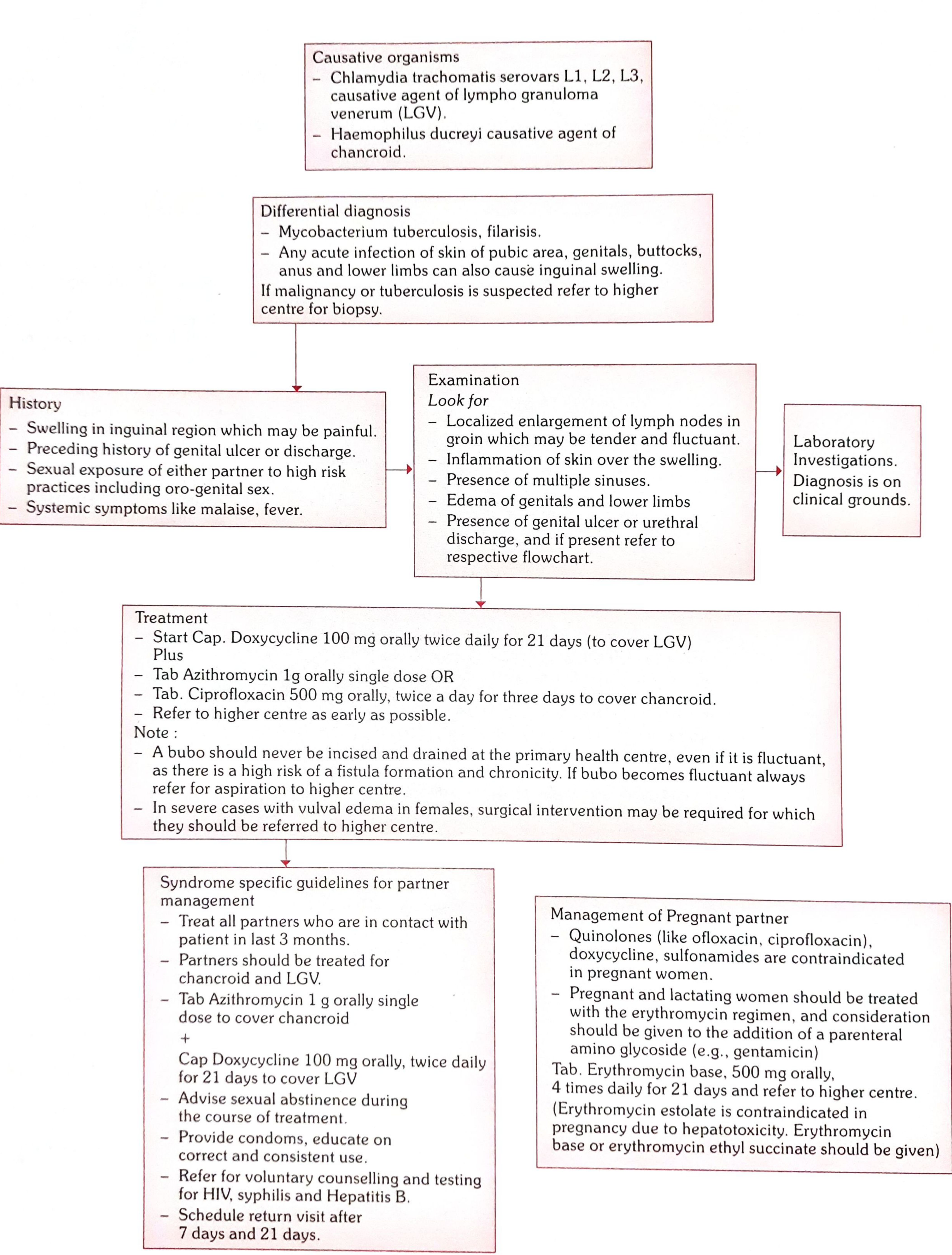
Treatment:
- Cap. Doxycycline 100 mg orally twice daily x 21 days (for LGV)
-
- Tab. Azithromycin 1 g single dose OR Tab. Ciprofloxacin 500 mg twice daily x 3 days (for chancroid)
Important: A bubo should never be incised and drained at a primary health centre, even if fluctuant - there is a high risk of fistula formation. If fluctuant, refer for aspiration at a higher centre.
Pregnant partner: Erythromycin base 500 mg orally four times daily x 21 days (quinolones, doxycycline contraindicated).
Follow-up at: 7 days and 21 days.
Common Principles Across All Syndromes
- Treat empirically and immediately - do not wait for lab results
- Partner management is mandatory - treat all recent partners (usually contacts within past 2-3 months)
- Advise sexual abstinence during the course of treatment
- Provide condoms and educate on correct, consistent use
- Refer for VCT (voluntary counselling and testing) for HIV, syphilis, and Hepatitis B
- Pregnancy precautions: Quinolones, doxycycline, sulfonamides, oral fluconazole, and erythromycin estolate are all contraindicated in pregnancy
- Refer to higher centre if no response to treatment, recurrent lesions, or complications arise
Summary Table: Syndromes and First-Line Treatment
| Syndrome | Key Organisms | First-Line Treatment |
|---|---|---|
| Urethral discharge | Gonorrhea + Chlamydia | Cefixime 400 mg SD + Azithromycin 1 g SD |
| Vaginal discharge (cervicitis) | Gonorrhea + Chlamydia | Cefixime 400 mg SD + Azithromycin 1 g SD |
| Vaginal discharge (vaginitis) | TV + BV + Candida | Secnidazole 2 g SD + Fluconazole 150 mg SD |
| Lower abdominal pain (PID) | GC + CT + Anaerobes | Cefixime + Metronidazole + Doxycycline |
| Genital ulcer (vesicles) | HSV | Acyclovir 400 mg TDS x 7 days |
| Genital ulcer (no vesicles) | Syphilis + Chancroid | Benzathine penicillin 2.4 MIU IM + Azithromycin 1 g SD |
| Scrotal swelling | Gonorrhea + Chlamydia | Cefixime 400 mg BD x 7d + Doxycycline 100 mg BD x 14d |
| Inguinal bubo | LGV + Chancroid | Doxycycline 100 mg BD x 21d + Azithromycin 1 g SD |
SD = single dose; BD = twice daily; TDS = three times daily
Source: Park's Textbook of Preventive and Social Medicine, pp. 381-387
This is a shared conversation. Sign in to Orris to start your own chat.