
Grades of clubbing
Reading File
Clubbing has 4 grades based on the degree of nail and soft tissue changes. Let me get the full textbook detail.
Searching sources...
Finding Sources
Finding Sources
Reading File
Reading File
Reading File
Now let me search specifically for the grading system (Schamroth/Lovibond/grades):
Finding Sources
Finding Sources
Reading File
Finding Sources
Loading Image
Searching the Web
grades of clubbing fingers Schamroth Lovibond angle grading system clinical
I now have all the information needed for a comprehensive answer.
Grades of Clubbing
Clubbing is graded from Grade 1 to Grade 4 based on progressive changes in the nail bed and periarticular soft tissues.
Grading System
| Grade | Feature |
|---|---|
| Grade 1 | Softening/fluctuation of the nail bed (the nail feels spongy when pressed at its base); increased periungual erythema |
| Grade 2 | Obliteration of the Lovibond angle (the angle between the nail plate and the proximal nail fold becomes ≥180°; normally it is ~160°) |
| Grade 3 | Parrot-beaking - the nail curves excessively in both longitudinal and transverse planes, giving a watch-glass or drumstick appearance; the distal phalangeal depth exceeds the interphalangeal depth |
| Grade 4 | Hypertrophic osteoarthropathy (HOA) - subperiosteal new bone formation at the distal ends of long bones (radius, ulna, tibia, fibula), causing painful swollen wrists and ankles |
Key Clinical Signs Used to Assess Clubbing
Lovibond angle (profile sign)
- Normally ≤160°
-
180° = definitive clubbing
- 160-180° = early/borderline clubbing
Schamroth sign
- When dorsal surfaces of the same finger of each hand are placed back-to-back, a diamond-shaped window is normally visible at the nail bases
- Obliteration of this window = positive Schamroth sign (earliest sign of clubbing)
- A prominent distal angle >30° between the free nail margins forms in clubbing
- Sensitivity 77-87%, specificity 90%
Phalangeal depth ratio
- Distal phalangeal depth (DPD) / interphalangeal depth (IPD) >1 supports clubbing
- Normally IPD > DPD
Hyponychial angle
- Normally <192°; above this is abnormal
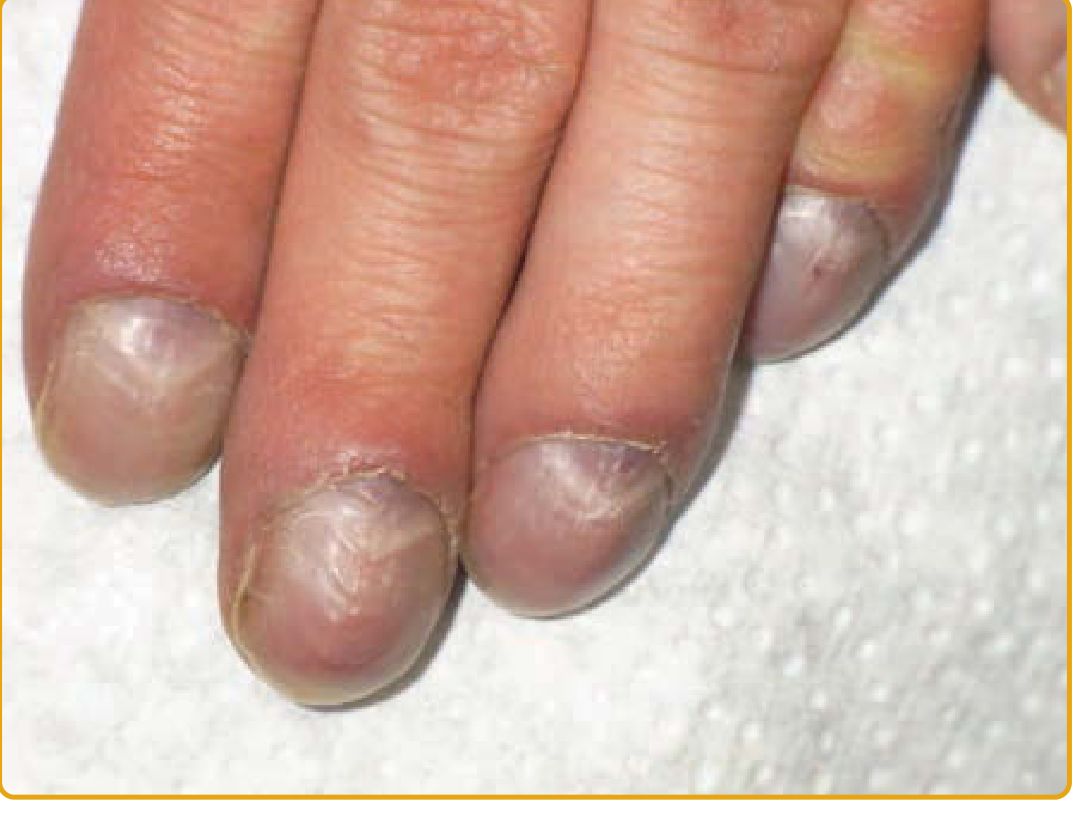
Clinical Image
Clubbing with rounded, convex nails in a patient with Eisenmenger complex (trisomy 21):
Pathophysiology (brief)
The underlying mechanism involves:
- Increased capillary density driven by hypoxia - upregulation of VEGF, PDGF, HIF-1α, and HIF-2α
- Right-to-left shunting (cardiac/pulmonary) - megakaryocytes bypass the pulmonary circulation, reach digital capillaries, fragment there, and release angiogenic growth factors
- This drives soft tissue proliferation and periosteal new bone formation
Causes by Grade Severity
- Pulmonary: bronchogenic carcinoma, bronchiectasis, lung abscess, empyema, cystic fibrosis, IPF (up to 50% of patients)
- Cardiac: cyanotic congenital heart disease (Eisenmenger, Fallot), infective endocarditis, cor pulmonale
- GI: liver cirrhosis, hepatopulmonary syndrome, inflammatory bowel disease, GI neoplasms
- Other: HIV (in ~36%), thyroid disease, idiopathic/familial (HPGD gene mutation)
Note: HOA (Grade 4) is almost exclusively associated with bronchogenic carcinoma and other intrathoracic malignancies.
Sources: - Fishman's Pulmonary Diseases and Disorders | - Murray & Nadel's Textbook of Respiratory Medicine | - Fitzpatrick's Dermatology | - Indian J Cardiovascular Disease in Women - Grading of Clubbing
This is a shared conversation. Sign in to Orris to start your own chat.