
Hepatitis A and E management
I'll start by reading the medical library skill, then search for Hepatitis A and E management content in parallel.
Reading File
Now I'll search the library and PubMed in parallel for Hepatitis A and E management.
Finding Sources
Finding Sources
Searching PubMed
"hepatitis A" AND "hepatitis E" AND management
Now let me read the most comprehensive sources in parallel - Goldman-Cecil, Sleisenger, Yamada, and Henry's for both viruses.
Reading File
Reading File
Reading File
Reading File
Excellent content. Now let me read more from Goldman-Cecil for management details and from Sleisenger for Hep E management, and Park's for prevention.
Reading File
Reading File
Reading File
Now let me get the Hep E management/treatment section from Sleisenger, and also the Goldman-Cecil Hep E section, and the Red Book section for completeness.
Finding Sources
Reading File
Reading File
I now have comprehensive information from multiple authoritative sources. Let me also fetch the key serologic timeline image and do a quick PubMed search on Hep E treatment.
Loading Image
Searching PubMed
"hepatitis E" AND ribavirin AND chronic
I now have comprehensive data from multiple authoritative sources. Here is the full structured answer:
Hepatitis A and Hepatitis E - Management
HEPATITIS A (HAV)
The Pathogen & Epidemiology
HAV is a non-enveloped, positive-sense RNA virus of the family Picornaviridae, genus Hepatovirus. It is a 27-nm icosahedral particle with a ~7.5 kb genome. Three human genotypes exist (I, II, III), with genotype I predominating globally. Transmission is via the fecal-oral route - through direct person-to-person contact or ingestion of fecally contaminated food or water.
High-risk groups:
- Travelers to developing countries
- Men who have sex with men
- Injection drug users
- Homeless persons
- Children in day-care centers (and their parents)
- Patients receiving clotting factor concentrates (hemophilia)
- Persons in institutional settings
Incubation period: 15-50 days (mean ~28-30 days)
Clinical Features
- Often mild and anicteric, especially in children
- Symptomatic icteric disease becomes more common with older age at infection
- Prodrome: fatigue, anorexia, nausea, right upper quadrant discomfort, fever
- Icteric phase: jaundice, dark urine, pale stools, pruritus
- Elevated ALT/AST (peaks early in acute phase), conjugated hyperbilirubinemia
- In 5-10% of cases, a secondary enzyme rise ("relapse") occurs
- Self-limited in nearly all cases - never progresses to chronic hepatitis
- Rare complication: fulminant hepatic failure (acute liver failure - ALF)
- Prolonged cholestatic course can occasionally occur
Serologic Course
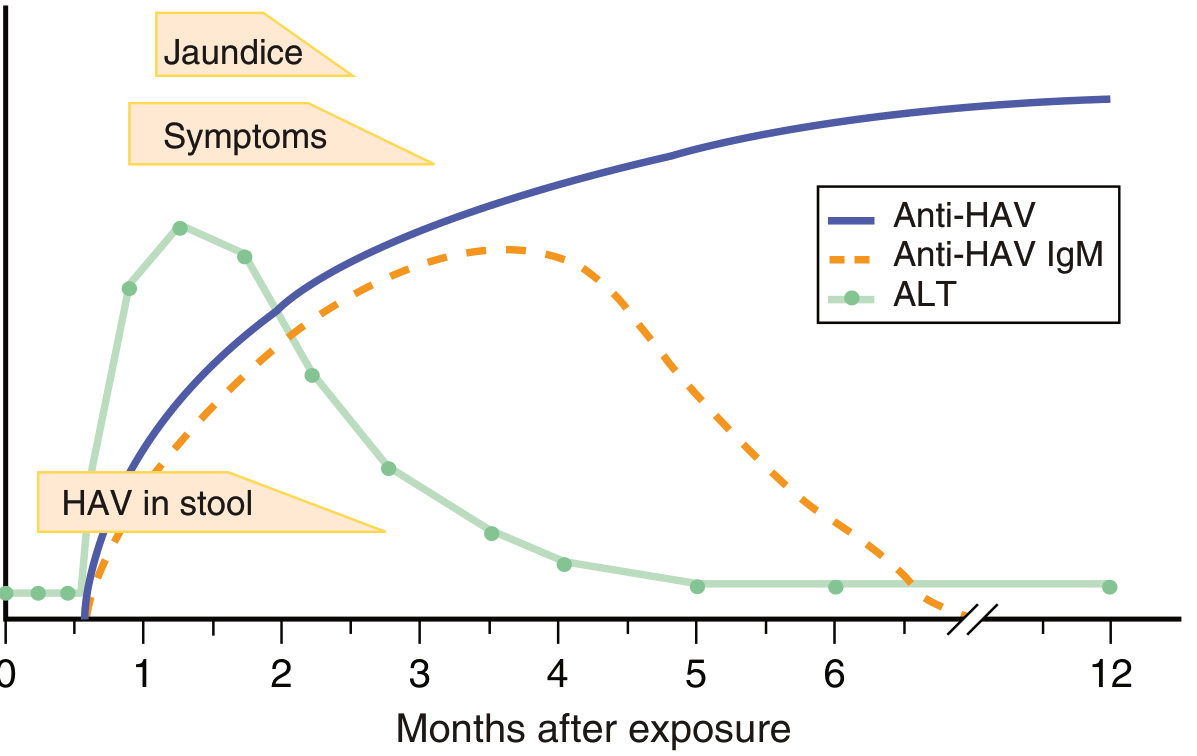
| Marker | Significance | Duration |
|---|---|---|
| HAV RNA (stool/serum) | Earliest marker; infectious period | 3-10 days before illness, ~1-2 weeks after onset |
| Anti-HAV IgM | Diagnostic of acute infection | Peaks ~2nd month; clears at 4-12 months |
| Anti-HAV IgG | Past exposure / immunity | Lifelong |
Diagnosis
- Anti-HAV IgM by enzyme immunoassay is the standard diagnostic test
- HAV RNA (PCR) can be detected in stool/body fluids but is not routinely required
- "Total anti-HAV" assays (IgM + IgG combined) indicate exposure/immunity but cannot distinguish acute from past infection
- Serology should only be ordered in symptomatic individuals to avoid false positives
Treatment
No specific antiviral therapy is required or available. Management is entirely supportive:
| Situation | Management |
|---|---|
| Uncomplicated acute HAV | Supportive care: rest, hydration, avoid hepatotoxic drugs/alcohol |
| Hospitalization indications | Factor V < 40%, any encephalopathy, persistent worsening jaundice, ascites, rapid liver shrinkage |
| Fulminant hepatic failure (ALF) | ICU care, management of cerebral edema; liver transplantation is the only definitive option |
- Prothrombin time prolongation and bilirubin/lactate levels are the key prognostic markers
- Serum aminotransferase levels and viral load do NOT carry prognostic value
- Prognosis is generally excellent; death is exceedingly rare, confined to fulminant cases
Prevention
Active immunization (HAV vaccine):
- Inactivated virus vaccine (purified from cell culture)
- Standard schedule: 2 doses, 6-18 months apart
- Accelerated schedule: Days 0, 7, and 21 (for last-minute travelers to endemic areas)
- Seroconversion: virtually 100% in healthy individuals; lower in immunocompromised
- Protective antibodies persist for at least 27 years after childhood/young adult vaccination
- A combination HAV + HBV vaccine is available
- Part of routine childhood immunization in many countries
Recommended vaccination groups:
- Non-immune travelers to endemic countries
- Healthcare workers
- MSM
- Close contacts of HAV cases
- Patients with chronic liver disease (CLD)
Passive immunization (Immunoglobulin - Ig):
- ~98% effective for post-exposure prophylaxis
- Used together with HAV vaccine in the post-exposure setting
- HAV vaccine preferred as it also prevents secondary cases
Post-exposure prophylaxis: Both HAV vaccine and Ig are ~98% effective; vaccination is preferred when no contraindications exist.
HEPATITIS E (HEV)
The Pathogen & Epidemiology
HEV is a non-enveloped, positive-sense RNA virus. 4 major genotypes with distinct epidemiological patterns:
| Genotype | Distribution | Features |
|---|---|---|
| GT1 | Developing countries (India, Asia, Africa) | Causes large waterborne community outbreaks; most common in India |
| GT2 | Mexico, West Africa | Community outbreaks |
| GT3 | Developed countries (Europe, USA) | Sporadic, zoonotic (pigs, boar, deer); no outbreaks; older patients with comorbidities |
| GT4 | China, Japan | Zoonotic; similar to GT3 |
- ~20 million infections and 3.3 million symptomatic cases per year worldwide
- ~44,000 deaths per year (2015 estimate)
- Over 60% of cases and deaths in East and South Asia
Routes of transmission:
- Fecal-oral (contaminated water) - primary route for GT1/2
- Zoonotic/foodborne (undercooked pork, boar, deer meat) - GT3/4
- Blood transfusion
- Vertical (mother to fetus)
Incubation period: 3-8 weeks (mean 40 days)
Clinical Features
Acute hepatitis E (GT1/2 - typical):
- Resembles acute hepatitis A clinically
- Prodrome: flu-like symptoms, fever, chills, abdominal pain, anorexia, nausea, vomiting, arthralgia, transient rash
- Icteric phase (1-7 days later): jaundice, dark urine, clay-colored stools, pruritus (lasting weeks)
- Labs: elevated ALT, AST, GGTP, conjugated hyperbilirubinemia, mild leukopenia, relative lymphocytosis
- Case-fatality rate: 0.5-4% in hospital-based data; 0.07-0.6% in population surveys
- Usually self-limited; may have a prolonged cholestatic variant with spontaneous resolution
Special populations:
| Group | Risk |
|---|---|
| Pregnant women (2nd-3rd trimester) | Mortality 5-25%; high rates of ALF (~22%), abortion, stillbirths, neonatal deaths |
| Immunosuppressed / organ transplant recipients | Risk of chronic HEV infection (GT3/4) |
| Chronic liver disease | More severe acute-on-chronic liver failure |
| GT3 patients | Older, more comorbidities; milder liver disease but neurologic manifestations more common |
Extrahepatic manifestations (mostly GT3):
- Neurological: Guillain-Barre syndrome, neuralgic amyotrophy, encephalitis
- Renal, hematologic, autoimmune manifestations
- Acute pancreatitis
Diagnosis
| Test | Indication | Notes |
|---|---|---|
| Anti-HEV IgM | Acute infection (primary diagnostic test) | Appears early, lasts 4-5 months; detectable in 80-100% during outbreaks |
| Anti-HEV IgG | Convalescent/past exposure | Appears days after IgM; persists years but may wane |
| HEV RNA (RT-PCR) | Confirmatory; chronic infection; immunosuppressed patients | Essential in endemic areas with low PPV for serology; required to diagnose and monitor chronic HEV |
| HEV antigen (EIA) | Early acute phase | Newer test; may detect virus longer than previously thought |
- In endemic areas: IgM anti-HEV is sufficient for clinical diagnosis
- In non-endemic areas (low pre-test probability): HEV RNA confirmation recommended
- Immunodeficient patients may lack antibody response - HEV RNA is essential
Treatment
Acute Hepatitis E
Supportive care only - no antiviral therapy has a proven role in acute HEV.
| Situation | Management |
|---|---|
| Uncomplicated acute HEV | Supportive care |
| Acute/acute-on-chronic liver failure | ICU admission, cerebral edema management, consider liver transplantation (LT) |
| Pregnant women with ALF | Supportive care; termination of pregnancy has NOT been shown to improve outcomes; treat postpartum hemorrhage with fresh frozen plasma (FFP) |
Chronic Hepatitis E (mainly in immunosuppressed GT3/4)
Chronic HEV (viremia > 3 months) occurs almost exclusively in immunosuppressed individuals (organ transplant recipients, HIV patients, hematologic malignancy patients on chemotherapy).
Step-wise approach:
- Step 1 - Reduce immunosuppression: Reduction or withdrawal of immunosuppressive drugs leads to spontaneous clearance of HEV in approximately one-third of transplant patients
- Step 2 - Ribavirin: If immunosuppression cannot be adequately reduced, or if reduction fails:
- Ribavirin ~600 mg/day for 3 months
- High rates of sustained virologic response (SVR) - defined as undetectable HEV RNA 3-6 months after treatment cessation
- No controlled RCTs available; evidence from retrospective case series
- Some patients show HEV genome mutations conferring ribavirin resistance at treatment failure
- Step 3 - Pegylated interferon-alpha (PEG-IFN-α): Used in select patients (e.g., those who fail ribavirin or in liver transplant recipients when ribavirin is not appropriate); evidence is limited to case reports/series
A 2025 review (PMID: 40693961) highlights the management of HEV in organ transplant recipients as an evolving area, reinforcing the ribavirin-first approach for chronic HEV post-transplant.
Prevention of Hepatitis E
| Measure | Details |
|---|---|
| Safe water/sanitation | Primary public health intervention for GT1/2 outbreaks |
| Food hygiene | Thoroughly cook pork, game meat; avoid raw/undercooked animal products (GT3/4) |
| HAV/water precautions for travelers | Standard food and water hygiene in endemic areas |
| HEV vaccine (HEV 239 / Hecolin) | Licensed in China only; 3-dose schedule; ~100% efficacy in trials; recommended for travelers, pregnant women, and those with CLD in endemic areas. Not yet licensed globally. |
| Blood product screening | Relevant in transplant/immunocompromised settings to prevent GT3 transfusion-transmitted HEV |
Key Comparison: HAV vs. HEV
| Feature | Hepatitis A | Hepatitis E |
|---|---|---|
| Virus family | Picornaviridae | Hepeviridae |
| Genome | +ssRNA | +ssRNA |
| Transmission | Fecal-oral (person-to-person, food, water) | Fecal-oral (water GT1/2); zoonotic (GT3/4) |
| Incubation | 15-50 days (avg. 25-30) | 3-8 weeks (avg. 40 days) |
| Chronicity | Never | Only in immunosuppressed (GT3/4) |
| Pregnancy risk | Mild | Severe - 5-25% mortality (GT1) |
| Fulminant hepatitis | Rare | Rare except in pregnancy |
| Specific treatment | None | Ribavirin (chronic only) |
| Vaccine | Yes - inactivated; globally available | Yes - China only (Hecolin) |
| Diagnosis | Anti-HAV IgM | Anti-HEV IgM / HEV RNA |
| Prognosis | Excellent; CFR <0.1% | Generally good; higher in pregnancy/immunosuppressed |
Sources: Goldman-Cecil Medicine, Sleisenger & Fordtran's GI and Liver Disease, Henry's Clinical Diagnosis and Management by Laboratory Methods, Park's Textbook of Preventive and Social Medicine, Creasy & Resnik's Maternal-Fetal Medicine.
This is a shared conversation. Sign in to Orris to start your own chat.