
Pop tent sign in lichen planus.
Reading File
The "pop tent sign" in lichen planus refers to the characteristic histopathological finding of hypergranulosis (wedge-shaped thickening of the granular layer) beneath the epidermis, creating a tent-like elevation. Let me get the full textbook details.
Searching sources...
Finding Sources
Finding Sources
Searching the Web
pop tent sign lichen planus histopathology hypergranulosis
Now let me read the relevant Fitzpatrick's section for full detail and fetch the histology image:
Reading File
Finding Sources
Loading Image
Here is a complete answer on the Pop Tent Sign in Lichen Planus:
Pop Tent Sign in Lichen Planus
What It Is
The pop tent sign (also called the "tent sign") refers to the histopathological appearance of wedge-shaped hypergranulosis seen in lichen planus on hematoxylin and eosin (H&E) sections. When the granular cell layer is focally thickened in a triangular or wedge shape - widest at the top and tapering downward - it creates the visual impression of a tent being "popped up" from the skin surface. This corresponds to the increased keratohyalin granules in the stratum granulosum overlying the tips of the elongated rete ridges.
Histopathological Context
The classic histopathological findings of lichen planus include:
| Feature | Description |
|---|---|
| Wedge-shaped hypergranulosis (Pop Tent Sign) | Focal, triangular thickening of the granular layer overlying rete ridge tips |
| Compact orthohyperkeratosis | Thickened, compact stratum corneum without parakeratosis |
| Sawtooth rete ridges | Elongated, pointed ("sawtooth" or "zigzag") rete pegs |
| Band-like lichenoid infiltrate | Dense, continuous lymphohistiocytic infiltrate at the dermoepidermal junction (DEJ) |
| Basal cell vacuolization / degeneration | Interface dermatitis pattern with vacuolar change |
| Civatte (colloid) bodies | Eosinophilic apoptotic keratinocytes at the DEJ and papillary dermis |
| Max-Joseph spaces | Small cleft-like spaces at the DEJ (seen in ~20% of cases) |
| Pigment incontinence | Melanin in dermal melanophages, more prominent in dark skin |
The pop tent sign is a key feature of classic (cutaneous) lichen planus and is notably absent in:
- Esophageal lichen planus (which shows parakeratosis and epithelial atrophy instead)
- Lichenoid drug reactions (which may also have eosinophils and parakeratosis)
Histology Image (Fitzpatrick's Dermatology, Fig. 32-18A, H&E x100)
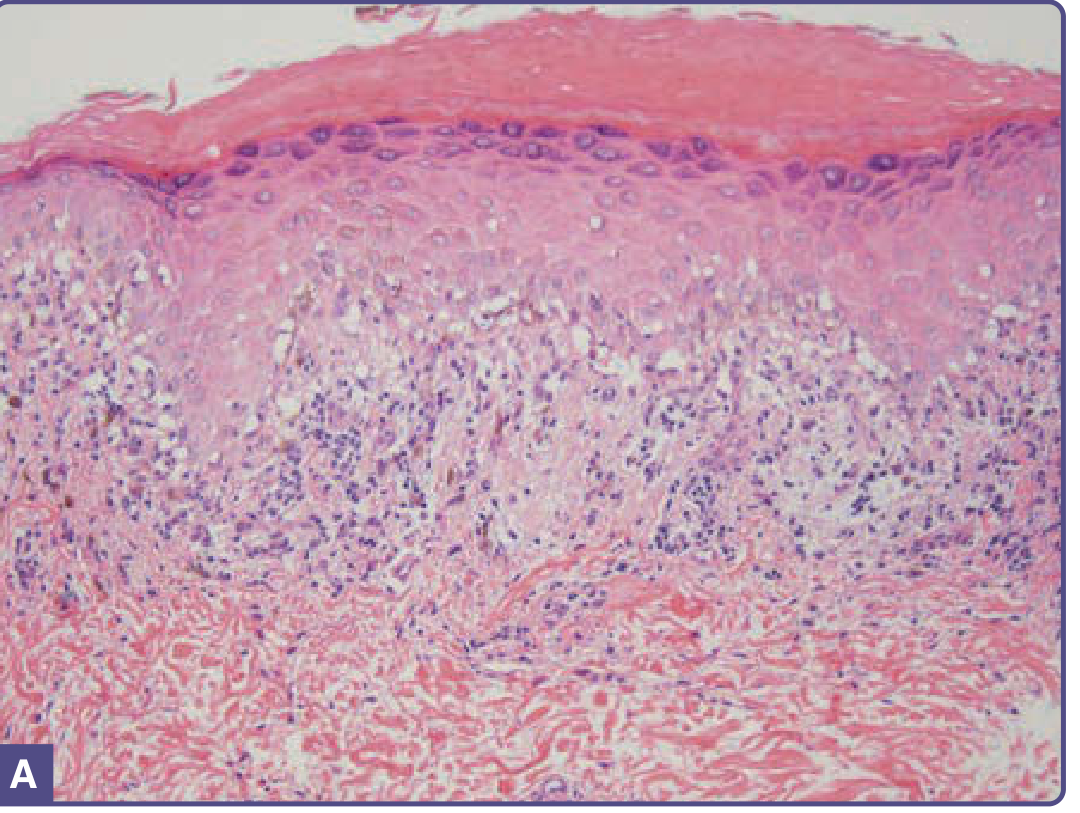
The image shows the thick, pink granular layer at the top (hypergranulosis), the sawtooth rete ridges, and the dense band of blue lymphocytes crowding the DEJ below.
Diagnostic Significance
- Wedge-shaped hypergranulosis is one of the essential histological features of lichen planus and is listed as a key criterion on PathologyOutlines alongside sawtooth rete ridges, band-like infiltrate, and colloid bodies.
- It helps distinguish lichen planus from lichenoid keratosis (LK): LP typically shows more prominent wedge-shaped hypergranulosis and less parakeratosis compared to LK. - Dermatology 2-Volume Set 5e
- It also helps distinguish LP from squamous cell carcinoma (keratoacanthoma type), where wedge-shaped hypergranulosis is absent.
- In hypertrophic LP, the wedge-shaped hypergranulosis is more pronounced, accompanied by acanthosis, papillomatosis, and thickened dermal collagen.
Summary
The pop tent sign = wedge-shaped (focal) hypergranulosis at the tips of the sawtooth rete ridges in lichen planus. It is a reliable histological marker of classic cutaneous LP, representing increased keratohyalin granule production as part of the chronic interface dermatitis reaction, and is a useful feature in differentiating LP from its histological mimics.
- Fitzpatrick's Dermatology, 9th ed., Chapter 32 (Lichen Planus), p. PATHOLOGY section
- Robbins & Cotran Pathologic Basis of Disease, 10th ed.
This is a shared conversation. Sign in to Orris to start your own chat.