
Rules of wedge excision and reconstruction by pentagon
Reading File
Quick answer: Wedge excision of the eyelid involves removing a full-thickness triangular (V-shaped) segment of the lid. When the defect is up to about one-third of the lid margin, direct closure is possible. Larger defects require a pentagon excision - the V-shape is converted to a pentagon by adding small relieving cuts at the base - which redistributes tension and allows primary closure without distortion. Key rules include proper alignment of the lid margin, meticulous layered closure, and avoiding notching.
Searching sources...
Finding Sources
Finding Sources
Finding Sources
Finding Sources
Reading File
Finding Sources
Reading File
Reading File
Finding Sources
Finding Sources
Searching the Web
wedge excision pentagon reconstruction eyelid rules lid margin surgery ophthalmology
Reading Web Page
https://eyewiki.org/Eyelid_Reconstruction
Finding Sources
Now I have comprehensive information. Let me also fetch the key images from Kanski's to include visually.
Loading Image
Reading File
I now have all the information needed for a comprehensive answer. Here is the full response:
Wedge Excision and Pentagon Reconstruction of the Eyelid
Concept and Geometry
A wedge excision is a full-thickness V-shaped (triangular) cut through the eyelid to remove a lesion or excess tissue, with the base at the lid margin. A pentagon excision is a modification where the wedge is extended by adding two short oblique cuts at its base (away from the lid margin), converting the V into a five-sided figure. This pentagon shape is preferred for full-thickness eyelid repairs because the parallel vertical sides allow more precise, tension-free apposition of the cut edges.
Pentagon geometry rules:
- The base is the eyelid margin
- The two parallel vertical sides are perpendicular to the lid margin and cover the full height of the tarsal plate
- The two oblique lower arms converge at a point toward the fornix (like an inverted "V"), completing the five sides
- All sides of the excision should be of equal length to ensure symmetric apposition
- The plane of section through the eyelid must be perpendicular to the lid margin - any oblique cut leads to misalignment and notching
Rules of Wedge/Pentagon Excision
1. The One-Third Rule (Size Limit for Direct Closure)
- Defects up to one-third of the lid margin length can be closed directly by simple apposition of the cut edges, because the eyelid has inherent elasticity
- In the elderly with lax skin, this extends to about one-quarter to one-third still applies, though some authors allow up to 40%
- Defects larger than one-third require additional tissue mobilization (lateral canthotomy/cantholysis, Tenzel semicircular flap, or more complex reconstruction)
2. Symmetry is Mandatory
- Both sides of the pentagon must be equal in length and depth
- Asymmetric sides cause one edge to ride higher than the other, creating a step deformity or notch at the lid margin
3. Perpendicularity of Cut
- The incision must be at 90° to the lid margin through the full thickness (skin, orbicularis, tarsus, conjunctiva)
- Any angling produces a beveled edge that cannot be perfectly apposed
4. Complete Full-Thickness Division
- Each layer must be cut cleanly: skin - orbicularis - tarsus - conjunctiva
- Partial cuts leave tethered tissue that puckers the margin on closure
5. Correction for Wound Contraction
- The amount of margin removed should be slightly less than the measured correction needed, because fibrosis and wound contraction provide an additional 0.5-1.0 mm of tightening
Layered Closure - Rules of Reconstruction
Reconstruction after pentagon excision is done in three layers, from deep to superficial:
Layer 1: Tarsoconjunctival Layer (Posterior Lamella)
- Use 5-0 or 6-0 absorbable suture (e.g., Vicryl)
- Place a horizontal mattress suture through the anterior surface of the tarsus (partial thickness - must NOT penetrate conjunctiva, or the knot will abrade the cornea)
- The plane of the bites must be parallel to the lid margin
- The knot must be buried away from the margin and not exposed through the palpebral conjunctiva
- For very small resections (1-2 mm), this tarsal suture can be omitted and may actually hinder alignment
Layer 2: Lid Margin (the Most Critical Layer)
- Use 7-0 Vicryl or 6-0 silk sutures
- Place a vertical mattress (figure-of-eight) suture at the level of the Meibomian gland orifices - this is the landmark for perfect anatomical alignment
- A second vertical mattress suture at the level of the lash follicles (anterior lamella of the margin)
- Evert the lid margin slightly - slight eversion prevents late notching as the scar contracts
- Leave suture tails long and pull them away from the eye by incorporating them into the skin sutures or taping them to the skin - prevents corneal abrasion
Layer 3: Skin and Orbicularis (Anterior Lamella)
- Close with interrupted 6-0 or 7-0 absorbable or monofilament sutures
- Place skin sutures so they incorporate the long tags of the lid margin sutures to keep them off the cornea
Key Rules Summary Table
| Rule | Detail |
|---|---|
| Size limit for direct closure | ≤ 1/3 of lid length (up to ~40% in elderly) |
| Pentagon shape | Base at lid margin; vertical sides perpendicular to margin; oblique arms converge at fornix |
| Equal-length sides | Prevents step deformity |
| Perpendicular cut | Prevents beveling and malalignment |
| Wound contraction | Remove 0.5-1 mm less than calculated |
| Tarsal suture | Horizontal mattress, partial thickness, knot away from conjunctiva |
| Margin suture | Figure-of-eight at Meibomian gland orifices + lash line |
| Eversion of margin | Slight eversion prevents notching |
| Suture tags | Long, incorporated into skin closure away from cornea |
Clinical Indications for Pentagon Excision
- Eyelid tumors (e.g., basal cell carcinoma after Mohs excision)
- Ectropion repair - tarsoconjunctival pentagon excision to tighten a lax lid and correct misdirected lashes or keratinized conjunctiva (Kanski's Clinical Ophthalmology, 10th ed.)
- Entropion - localized marginal entropion, particularly after trauma
- Trichiasis - focal group of aberrant lashes
- Eyelid imbrication syndrome - pentagon resection combined with lateral canthal tightening
- Biopsy defects requiring full-thickness repair
What to Do When Pentagon Excision Alone is Insufficient
When the defect exceeds one-third of the lid:
- Lateral canthotomy and inferior cantholysis - releases the lateral canthal tendon to mobilize 3-5 mm of extra tissue medially
- Tenzel semicircular rotation-advancement flap - skin and orbicularis pivoted on the lateral canthus; useful for defects up to ~50%
- For >50% defects: Cheek rotation flap (lower lid), glabellar transposition flap, Cutler-Beard advancement flap, or switch flap (upper lid)
Sources: Kanski's Clinical Ophthalmology: A Systematic Approach, 10th ed.; Scott-Brown's Otorhinolaryngology Head & Neck Surgery; EyeWiki - Eyelid Reconstruction; University of Iowa EyeRounds - Full Thickness Wedge Resection
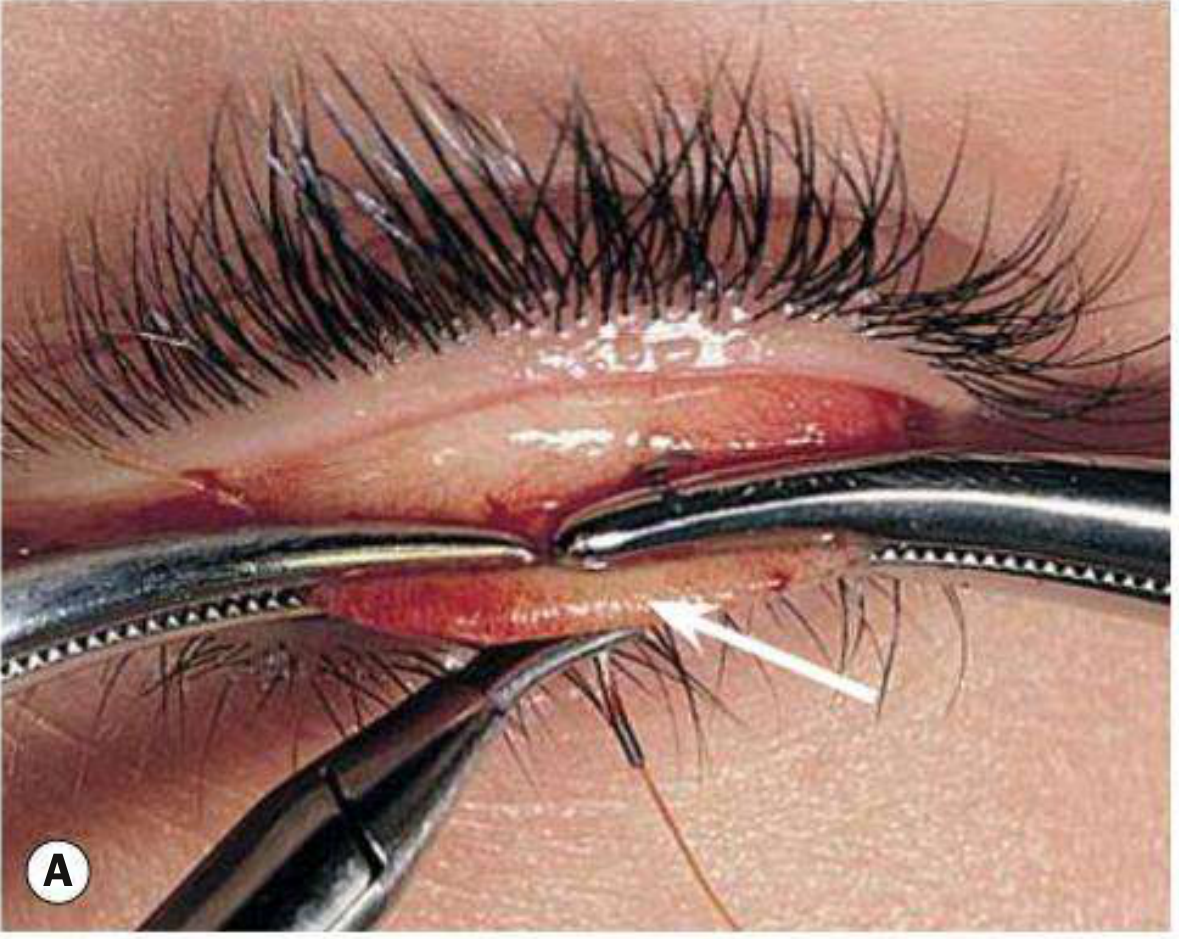
Surgical view of lower eyelid pentagon excision and margin reconstruction (Kanski's Clinical Ophthalmology)
This is a shared conversation. Sign in to Orris to start your own chat.