
Post acne scar management
Reading File
Post-acne scar management involves assessing scar type (atrophic, hypertrophic, keloid, pigmented), then applying layered treatments - topical retinoids/AHAs for surface pigmentation, chemical peels, microneedling, laser resurfacing (ablative/fractional), subcision for bound-down scars, and fillers or punch techniques for deeper ice-pick/boxcar scars.
Searching sources...
Finding Sources
Searching PubMed
"acne scar" AND treatment
Finding Sources
Finding Sources
Finding Sources
Finding Sources
Reading File
Finding Sources
Reading File
Finding Sources
Finding Sources
Finding Sources
Reading File
Reading File
I now have sufficient content from authoritative dermatology textbooks and recent PubMed literature. Let me compile the comprehensive answer.
Loading Image
Post-Acne Scar Management
Post-acne scarring is one of the most distressing sequelae of acne vulgaris. Management must be tailored to the scar type, skin phototype, and depth of involvement. A correct classification drives treatment selection.
1. Classification of Post-Acne Scars
| Type | Subtype | Features |
|---|---|---|
| Atrophic | Ice-pick | Narrow, deep, V-shaped; most common |
| Boxcar | Round/oval depression with sharp vertical walls | |
| Rolling | Broad shallow depressions with sloping edges; bound to deep tissue | |
| Hypertrophic / Keloid | - | Raised; excess collagen; more in darker skin types, jaw/chest |
| Post-inflammatory hyperpigmentation (PIH) | - | Tan/brown macules; not true scars but commonly grouped with them |
| Post-inflammatory erythema | - | Pink/red macules persisting after active lesion resolution |
2. Step 1 - Control Active Acne First
No scar treatment is effective if acne is still active. Ensure adequate acne control with retinoids, antibiotics, hormonal agents, or isotretinoin before initiating scar therapy.
3. Management by Scar Type
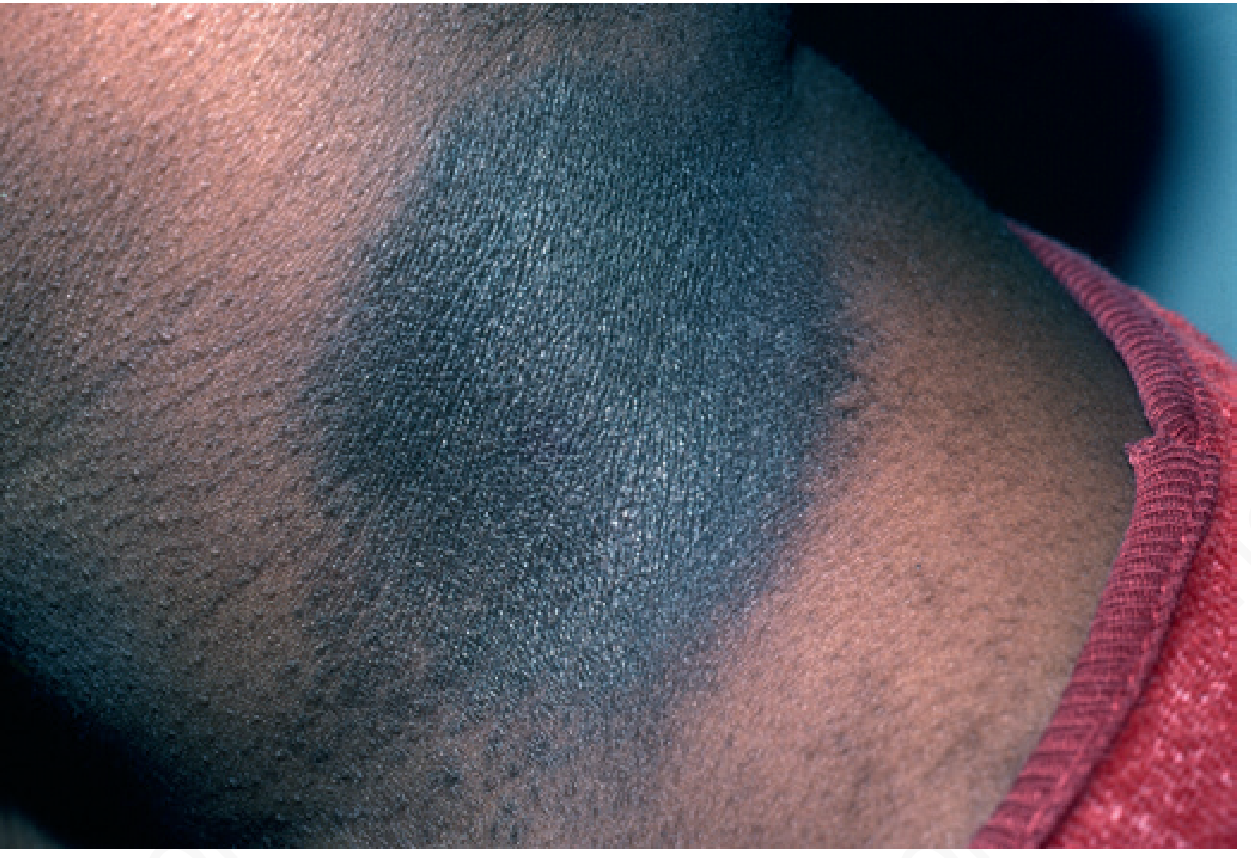
A. Post-Inflammatory Hyperpigmentation (PIH)
PIH is more common in Fitzpatrick skin types IV-VI and may arise from two mechanisms:
- Increased epidermal melanocyte activity
- Dermal melanosis (melanin dropout into dermis - gives a gray hue)
Wood's lamp helps distinguish epidermal (enhancement visible) from dermal (no enhancement) PIH, with implications for treatment response.
Treatment:
- Hydroquinone (4-6%) - first-line depigmenting agent; more effective for epidermal PIH
- Tretinoin - enhances hydroquinone's effect and has independent depigmenting action
- Chemical peels (glycolic acid, salicylic acid) - used with caution; unpredictable results in darker skin; can worsen pigmentation
- Laser treatments - must be performed with extreme caution in darker phototypes; increased pigmentation can result
From Andrews' Diseases of the Skin, p. 614: "Postinflammatory dyspigmentation will often resolve on its own as long as the process that led to the dyspigmentation does not continue... For hyperpigmented lesions, hydroquinone may be used in cases that enhance with Wood's light."
B. Atrophic Scars (Ice-pick, Boxcar, Rolling)
Topical Agents
- Retinoids (tretinoin, adapalene): stimulate collagen synthesis and epidermal turnover; modest improvement in shallow scars
- Alpha-hydroxy acids (AHAs): glycolic acid peels decrease corneocyte cohesion and improve scar texture
Chemical Peels
- Glycolic acid (20-70%), salicylic acid, trichloroacetic acid (TCA), phenol peels
- Improve surface irregularities; deeper peels for deeper scars; risk of PIH in darker skin
- Dermatology 2-Volume Set 5e: "Low-concentration chemical peels are beneficial... Common peeling agents include AHAs (including glycolic acid), salicylic acid, and trichloroacetic acid."
Microneedling / Dermaroller
- Induces collagen neogenesis via controlled micro-injury
- Safe across all skin phototypes (low PIH risk compared to ablative lasers)
- Effective for rolling and boxcar scars; multiple sessions required
Laser Resurfacing
The choice of laser depends on scar type, depth, skin phototype, and erythema/dyschromia:
| Laser | Type | Best For |
|---|---|---|
| CO2 (10,600 nm) | Ablative fractional | Hypertrophic, contracted, deep atrophic scars |
| Er:YAG (2940 nm) | Ablative | Surface irregularity; less thermal damage than CO2 |
| 1550 nm Erbium-doped (Fraxel) | Non-ablative fractional | All atrophic scar types; safer for darker skin |
| 1927 nm Thulium | Non-ablative fractional | Pigmentation + texture |
| Pulsed-dye laser (PDL) | Vascular | Erythematous scars; targets oxyhemoglobin |
From Dermatology 5e: "Laser resurfacing (fractionated as well as traditional), dermabrasion, and deeper chemical peels seek to reduce the variability of the skin surface and smooth out depressed scars that improve when the skin is stretched."
Key principles for laser treatment:
- Laser penetration should be 50-75% of scar depth
- Ablative fractional lasers induce robust tissue remodeling for hypertrophic/contracted scars
- Non-ablative fractional lasers improve texture with less downtime; can be supplemented with prostaglandin analogues (e.g., bimatoprost + tretinoin)
- Individuals with darker skin phototypes are at higher risk of PIH post-laser
Recent evidence (2026): A meta-analysis comparing fractional CO2 laser vs. needling-based modalities (PMID 42334669) found both effective for facial acne scars. A systematic review of ablative vs. non-ablative laser therapies (PMID 40515775) confirmed clinical efficacy and safety across scar types.
Dermabrasion
- Mechanical resurfacing; historically used for acne scars
- Largely replaced by fractional lasers in modern practice
- Risk of PIH; contraindicated in active isotretinoin use (traditionally 6-12 month wait, though evidence for this interval is debated)
Soft Tissue Augmentation (Fillers)
- Indicated for discrete depressed scars that improve with stretching
- Agents: poly-L-lactic acid, calcium hydroxylapatite, autologous fat, hyaluronic acid
- Effect is temporary; does not correct the scar itself
Subcision
- Needle or cannula inserted beneath rolling/boxcar scars to release fibrous tethering bands
- Induces collagen deposition; effective for rolling scars
- Often combined with fractional laser or microneedling for additive benefit
C. Ice-Pick Scars (Specific Techniques)
Ice-pick scars are narrow and too deep for surface resurfacing alone.
- Punch excision: excise the scar core, then close primarily or with a punch graft
- Punch elevation: lift the base of the scar to the surface level without excision
- TCA CROSS (chemical reconstruction of skin scars): focal application of high-concentration TCA (70-100%) into the scar base; triggers collagen synthesis; multiple sessions
D. Hypertrophic Scars and Keloids
- Intralesional corticosteroids (triamcinolone acetonide 10-40 mg/mL): flatten hypertrophic scars; risk of hypopigmentation and atrophy, especially in darker skin
- Silicone gel sheets: first-line for hypertrophic scar prevention and treatment
- Pulsed-dye laser (PDL): reduces erythema and scar bulk
- Ablative fractional laser: most effective for hypertrophic and contracted scars; induces remodeling
- Full-thickness surgical excision: for larger hypertrophic scars, aggregated pitted scars, and sinus tracts - improves scar placement and cosmetic appearance
- Compression therapy: adjunct for keloid prevention
4. Special Considerations by Skin Phototype
| Consideration | Fair Skin (I-III) | Darker Skin (IV-VI) |
|---|---|---|
| PIH risk | Low | High |
| Laser choice | Ablative or non-ablative fractional | Non-ablative preferred; lower fluences |
| Peel depth | Deeper peels tolerated | Superficial to medium; close monitoring |
| Hydroquinone | Effective | First-line for PIH |
5. Combination Approach (Practical Algorithm)
Active acne controlled?
        ↓ Yes
Assess scar type(s)
        ↓
PIH only → Topical HQ + retinoid ± superficial peel
        ↓
Rolling scars → Subcision + fractional laser/microneedling
        ↓
Boxcar scars → Fractional laser ± microneedling ± filler
        ↓
Ice-pick scars → TCA CROSS and/or punch excision
        ↓
Hypertrophic → Intralesional steroid + silicone + PDL
        ↓
Multiple types → Combined modality (3-6 sessions, 4-8 weeks apart)
6. Emerging / Regenerative Approaches
A 2026 systematic review (PMID 41099835) examined regenerative medicine approaches for atrophic scars including:
- Extracellular vesicles and conditioned media - modulate collagen synthesis and wound healing
- Stromal vascular fraction (SVF) and mesenchymal stem cells - autologous cell-based repair These remain investigational but show promise for treatment-resistant atrophic scarring.
Sources: Dermatology 2-Volume Set 5e (Bologna), Andrews' Diseases of the Skin, Fitzpatrick's Dermatology; supplemented with PubMed systematic reviews 2025-2026.
This is a shared conversation. Sign in to Orris to start your own chat.