
Multidisciplinary approach in minimally verbal autism
minimally verbal autism multidisciplinary
multidisciplinary approach minimally verbal autism 2024 2025 intervention
minimally verbal autism AAC intervention communication
https://pmc.ncbi.nlm.nih.gov/articles/PMC12469184
PMID: 42004683
autism nonverbal speech language therapy occupational therapy
augmentative alternative communication autism nonverbal children
autism spectrum disorder early intervention behavioral outcomes children
PMID: 37963634
Multidisciplinary Approach in Minimally Verbal Autism
Definition and Prevalence
Why a Multidisciplinary Approach Is Essential
- Severe expressive language deficits
- Sensory processing disorders
- Motor planning difficulties (dyspraxia)
- Behavioral dysregulation
- Cognitive and intellectual disability (in many cases)
- Feeding, sleep, and GI comorbidities
- Psychiatric comorbidities (anxiety, ADHD)
The Multidisciplinary Team: Roles and Responsibilities
1. Speech-Language Pathologist (SLP)
- Comprehensive communication evaluation (receptive, expressive, pragmatic)
- Differential diagnosis (distinguishing ASD from Landau-Klefner syndrome, selective mutism, severe language disorder)
- Implementation of Augmentative and Alternative Communication (AAC) - the primary evidence-based approach for MVA
- Parent-mediated communication training
- Targeting prelinguistic skills: joint attention, turn-taking, requesting
| Type | Examples |
|---|---|
| Unaided | Sign language, gestures |
| Low-tech aided | PECS (Picture Exchange Communication System), communication boards |
| High-tech aided | Speech-generating devices (SGDs), voice output devices, tablet-based apps |
2. Applied Behavior Analysis (ABA) Therapist / Behavior Analyst (BCBA)
- Encourages positive behaviors, discourages maladaptive ones
- Uses discrete trial training (DTT) and naturalistic teaching approaches
- Tracks and measures progress systematically
- Can be used to develop functional communication through mand training and verbal behavior approaches
3. Occupational Therapist (OT)
- Sensory integration therapy
- Fine motor and adaptive skills
- Self-care activities of daily living (feeding, dressing, toileting)
- Handwriting and visual-motor skills
- Participation in classroom routines
4. Developmental/Behavioral Pediatrician or Child Psychiatrist
- Formal ASD diagnosis and severity grading
- Evaluation and management of comorbidities (ADHD, anxiety, intellectual disability, epilepsy)
- Pharmacotherapy for associated symptoms (not core MVA, but critical for function):
- Risperidone and aripiprazole (FDA-approved for irritability/aggression in ASD)
- Stimulants / alpha-2 agonists for co-occurring ADHD
- SSRIs for anxiety/repetitive behaviors
- Melatonin for sleep disorders
- Butenafide (emerging evidence for improving communicative and cognitive abilities - Katzung's Pharmacology, p. 409)
- Educational placement planning
5. Child Neurologist
- There is language regression - to rule out Landau-Klefner syndrome (acquired epileptic aphasia) or other epileptic encephalopathies
- Seizure activity is suspected (epilepsy occurs in 20-30% of ASD cases)
- EEG monitoring is needed
- Genetic causes are being worked up
6. Audiologist
- Fails to respond to their name
- Shows delayed expressive language
- Cannot follow directions
7. Special Educator / Psychoeducational Team
- Formal cognitive and adaptive functioning assessment
- Individualized Education Program (IEP) development
- Classroom modifications and visual supports
- Social skills training in structured settings
- Naturalistic developmental behavioral interventions (NDBIs) - integrating behavioral and child-responsive strategies to teach developmentally appropriate skills in natural, interactive settings (Harriet Lane Handbook, p. 336)
- Transition planning for adolescents/adults
8. Psychologist
- Cognitive and neuropsychological testing
- Differential diagnosis (ASD vs. ID, ADHD, selective mutism)
- Degree of cognitive impairment determination
- Caregiver/family counseling and psychoeducation
- Behavioral assessment of challenging behaviors
9. Physical Therapist (PT)
- Gross motor delays
- Hypotonia
- Gait abnormalities
- Participation in physical activity (important for behavior regulation)
10. Genetics Counselor
- A genetic condition identified as the cause of ASD (Fragile X, Rett syndrome, 22q11.2 deletion, PTEN mutations, etc.)
- Recurrence risk counseling
- Whole exome or chromosomal microarray interpretation
11. Additional Therapies
- Music therapy - A 2022 Cochrane systematic review (Geretsegger et al., PMID 35532041) found music therapy beneficial for social interaction and communication in ASD
- Yoga/psychomotricity - for body awareness, motor skills, and self-regulation
- DIR/Floortime - developmental, relationship-based approach emphasizing emotional engagement and play
- JASPER (Joint Attention, Symbolic Play, Engagement, and Regulation) - a systematic review found significant effects on play and communication outcomes (Waddington et al., 2021, PMID 34348479)
- Family therapy - for caregiver coaching and family system support
Early Referral Pathway
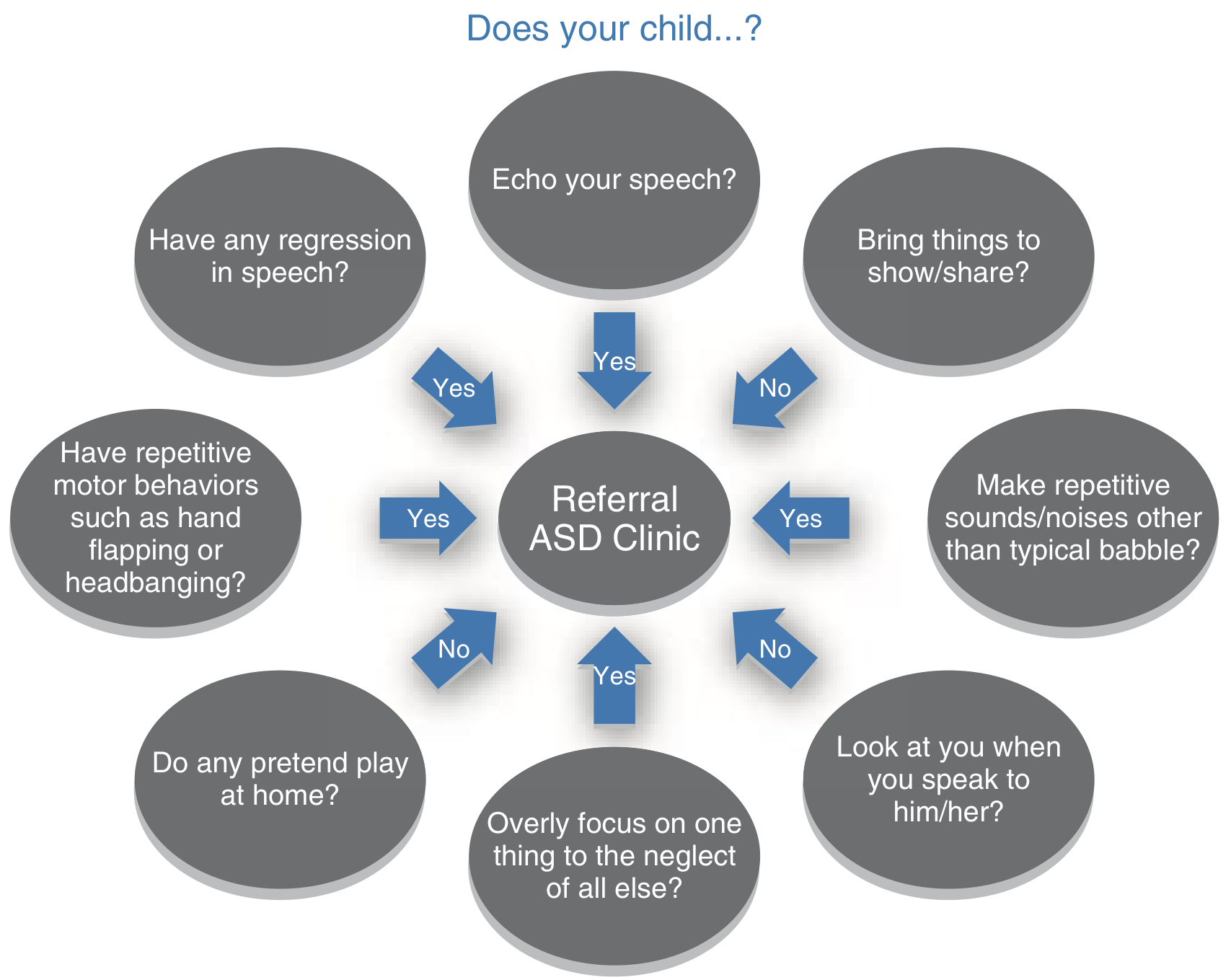
Models of Collaboration
| Model | Description | Applicability in MVA |
|---|---|---|
| Multidisciplinary | Professionals work in parallel, each from their own perspective, then share findings | Common in diagnostic centers |
| Interdisciplinary | Professionals share assessments and coordinate treatment plans collaboratively | Preferred for treatment |
| Transdisciplinary | Professionals cross role boundaries, develop shared frameworks, and one therapist delivers integrated therapy (role release) | Optimal for MVA - reduces child/family burden |
Family-Centered Care: The Non-Negotiable Component
- The PACT (Parent-Mediated Communication-Focused Treatment) RCT (Lancet, Green et al.) demonstrated significant communication gains
- Parents adopt social communication strategies that generalize to naturalistic settings (Shire et al., 2015)
- Caregiver coaching reduces stress and improves quality of life for the whole family unit
Screening Tools Used Across the Team
| Tool | Used by | Purpose |
|---|---|---|
| M-CHAT-R/F | Pediatrician, family physician | 16-30 month ASD screen |
| ADOS-2 | Psychologist, developmental pediatrician | Gold-standard ASD diagnosis |
| ADI-R | Psychologist | Parental interview diagnostic tool |
| VABS (Vineland) | Psychologist, educator | Adaptive behavior |
| CSBS-DP | SLP | Communication, symbolic behavior |
| PROMPT, Dynamic Assessment | SLP | Motor speech planning for MVA specifically |
Key Evidence Summary
| Intervention | Evidence Level | Effect |
|---|---|---|
| Naturalistic Developmental Behavioral Interventions (NDBIs) | Meta-analysis (BMJ 2023) | Significant effect on social communication, language, play, core ASD characteristics |
| JASPER | Systematic review (2021) | Improved joint attention, play, communication |
| Music therapy | Cochrane review (2022) | Social interaction, communication benefit |
| Play-integrated AAC | Systematic review (2026) | Positive AAC and social communication outcomes |
| SGD-based intervention | RCT (2023) | Improved spoken language in MVA |
Practical Principles
- Start early - neuroplasticity is highest in the first 3-5 years; intervention before age 3 yields the greatest gains
- Use AAC proactively - AAC does not suppress speech development; robust evidence shows it supports it
- Individualize - MVA is heterogeneous; one child may respond to SGDs, another to PECS, another to sign
- Intensity matters - but ethical, person-centered pacing is essential; high-intensity does not mean high-distress
- Measure outcomes - each discipline should track progress with validated tools and share data at team meetings
- Coordinate, don't silo - regular multidisciplinary team meetings prevent fragmented care
- Cummings Otolaryngology Head and Neck Surgery (Multidisciplinary ASD Clinic, pp. 3511-3513)
- The Harriet Lane Handbook, 23rd ed. (ASD section, pp. 335-336)
- Textbook of Family Medicine, 9th ed. (p. 132)
- Kaplan & Sadock's Comprehensive Textbook of Psychiatry
- Sandbank et al. (2023) Project AIM, BMJ [PMID 37963634]
- Klein et al. (2026) Play-Integrated AAC Systematic Review [PMID 42004683]
- Sterrett et al. (2023) SGD RCT [PMID 36267016]
- Geretsegger et al. (2022) Music therapy Cochrane Review [PMID 35532041]
- Waddington et al. (2021) JASPER Systematic Review [PMID 34348479]
- Koegel et al. (Stanford/Vanderbilt) Systematic Review of MVA Interventions, ClinMed Journals
Recent definitions ans findings on MVA, Family centred Approaches. Create a multidisciplinary clinic protocol template or referral checklist. Differentiating between verbal, MVA and Non verbal autism. Intervention principles more than AAC
minimally verbal autism definition classification criteria
autism family centered intervention parent mediated outcomes
autism nonverbal verbal speech predictors prognosis language
minimally verbal autism 2024 2025 definition criteria nonverbal verbal differentiation intervention beyond AAC
minimally verbal autism intervention naturalistic developmental behavioral
autism parent mediated intervention caregiver coaching communication
https://pmc.ncbi.nlm.nih.gov/articles/PMC12378320
PMID: 39864797
PMID: 37070270
PMID: 39233512
autism profound minimally verbal motor speech sensory intervention
autism profound nonspeaking intervention motor speech apraxia
autism joint attention JASPER play social communication intervention
PMID: 33821200
PMID: 38678861
Minimally Verbal Autism: Definitions, Differentiation, Family-Centred Approaches, Intervention Principles, and MDT Clinic Protocol
PART 1 - Recent Definitions and Findings on MVA
1.1 Evolving Terminology
Minimally verbal autism = fewer than 20 functional words used consistently in context across environments. This definition was operationalized in Kasari et al.'s landmark SMART trial and is the entry criterion used in the 2025 AIM-ASD trial.
- "Functional" words are defined as words used communicatively with intent, not echolalic repetitions or scripted phrases without communicative purpose
- Word count thresholds vary across studies (some use <30, some <20) - this lack of consensus is itself a recognized research gap (PMC12378320, 2025)
- MVA is now distinguished from Profound Autism (PA), defined by Kasari and the Autism Research Institute as ASD with a developmental quotient (DQ) below 50, age 8+, with poor adaptive skills - PA often but not always overlaps with MV status
- Speech that is present but non-functional (scripted, echolalic, contextually irrelevant) does NOT qualify toward the functional word count
1.2 Prevalence and Trajectory
- Approximately 25-35% of individuals with ASD remain minimally verbal despite receiving interventions (Rose et al., 2016; Science Direct 2025)
- Contrary to historical assumptions, language outcomes are not fixed - Kasari's 2023 cohort data showed that 47% of children who had DQ <50 at age 4 did NOT meet criteria for profound autism by age 8, with early intervention as the key variable
- Gestural communication at the prelinguistic stage is a predictor of later spoken language in MVA children (La Valle et al., 2024, PMID 38861424)
- Baseline joint attention initiation and receptive language ability predict differential response to JASPER vs DTT approaches (Kasari et al., 2023, PMID 37070270)
1.3 Why MVA Is Not Simply "More Severe" ASD
- Motor-speech involvement - Childhood Apraxia of Speech (CAS) co-occurs in a significant proportion; motor planning difficulties mean the child may have adequate language comprehension but cannot produce speech reliably
- Heterogeneous cognitive profiles - Not all MVA children have intellectual disability; some have age-appropriate comprehension with isolated expressive speech failure
- Variable sensory and regulatory profiles - affecting readiness to engage and capacity to communicate
- Social communication intact in some domains - joint attention, gesture, facial affect may be relatively preserved even when speech is absent
PART 2 - Differentiating Verbal, Minimally Verbal, and Nonverbal Autism
2.1 Communication Profile Spectrum
| Feature | Verbal ASD | Minimally Verbal ASD | Nonverbal / Nonspeaking ASD |
|---|---|---|---|
| Functional word count | >30 functional words; phrases/sentences used | <20 functional words used consistently | 0 functional words; vocalizations non-communicative |
| Speech quality | Present; may have prosody/pragmatic differences | Inconsistent; may be echolalic or scripted | Absent or limited to undifferentiated sounds |
| Primary communication mode | Speech (+ possible AAC supplement) | Mixed: some words + gestures + AAC | Non-speech: gesture, eye gaze, behavior, AAC |
| Receptive language | Usually functional | Variable - often better than expressive | Variable - may exceed expressive by large margin |
| Echolalia | May be present (functional or non-functional) | Often predominant (immediate and delayed) | May produce scripted phrases without communicative intent |
| Comprehension vs. expression gap | Usually parallel | Often large discrepancy | Can be profound discrepancy |
| Social communication | Pragmatic difficulties prominent | Joint attention often impaired | Joint engagement typically severely impaired |
| Motor speech | Generally intact | CAS/apraxia to be screened | CAS/apraxia frequently present |
| Literacy potential | Present in most | Variable | May be present despite absent speech (hyperlexia in some) |
| Behavioral communication | Variable | Behavior often primary communication | Challenging behavior frequently = unmet communication |
| Prognosis for spoken language | Established | With early intervention, meaningful gains possible | Possible even in adulthood with targeted approaches |
2.2 "Preverbal" vs. MVA vs. Nonverbal - Practical Distinctions
| Category | Definition | Clinical Implication |
|---|---|---|
| Preverbal | No consistent words but emerging vocalizations/gestures; typically younger children still in language development window | High intervention priority; joint attention and play are primary targets |
| Minimally Verbal | <20 functional words; age 5+ still meeting this threshold = high risk for persistent MVA | Combined behavioral + naturalistic + AAC + parent coaching approach |
| Nonverbal / Nonspeaking | Zero or near-zero functional speech across all contexts and ages | Full AAC system, robust multimodal communication; motor speech evaluation mandatory |
| Situationally mute | Has functional speech in some contexts but not others (cf. selective mutism overlap) | Anxiety-based or sensory-based; different intervention target |
2.3 Why These Distinctions Matter Clinically
- Treatment selection differs - Joint attention/play-based NDBIs most effective for preverbal/MV; motor speech approaches (PROMPT, NDP3) added for apraxic profiles; AAC profile changes across the spectrum
- Outcome expectations differ - Realistic goal-setting requires categorization; confusing MV with nonverbal leads to over- or under-ambition in language targets
- Family counseling differs - Families of nonverbal children need earlier, more explicit framing around alternative communication as a permanent, not transitional, modality
- Educational placement differs - Verbal ASD children may access mainstream with support; MVA may need intensive resource room or specialist ASD provision; nonverbal ASD typically requires specialist provision throughout
PART 3 - Family-Centred Approaches
3.1 Why Family-Centred Care Is Non-Negotiable in MVA
- MVA children have the highest rates of parental stress of any ASD subgroup
- Communication failures (child cannot express needs) are the primary driver of challenging behavior
- Culturally adapted, family-empowering models outperform clinic-only delivery models across diverse populations
3.2 Evidence-Based Family-Centred Models
JASPER (Joint Attention, Symbolic Play, Engagement & Regulation)
Project ImPACT (Improving Parents as Communication Teachers)
PACT (Parent-Mediated Communication-Focused Treatment)
Early Start Denver Model (ESDM)
Pivotal Response Treatment (PRT)
3.3 Principles of Family-Centred Practice in MVA
| Principle | What It Looks Like in Practice |
|---|---|
| Capacity-building, not dependence | Train caregivers to be communication partners, not passive recipients of therapy reports |
| Embed in routines | Mealtime, bathing, bedtime, car journeys are therapy contexts |
| Follow the child's lead | Communication initiated by the child is more powerful than clinician-driven prompts |
| Respond to ALL communication | Gesture, gaze, vocalization, behavior - all attempts are honored and expanded |
| Coaching over didactic instruction | Live feedback, video review, and scaffolded practice outperform lectures |
| Address caregiver wellbeing | Parent stress and mental health predict intervention fidelity; support is not optional |
| Sibling inclusion | Siblings mediated social communication show significant gains (Pacia et al., 2022) |
| Cultural humility | Communication norms, family structures, and treatment goals vary by culture; these must be co-constructed |
| Telehealth as equity tool | Telehealth-delivered coaching reaches families in underserved or rural settings (Ingersoll et al., 2024) |
PART 4 - Intervention Principles Beyond AAC
4.1 Overview: The "Communication-First" Framework
4.2 Joint Attention and Social Engagement
- Responding to joint attention (RJA): following a point or gaze
- Initiating joint attention (IJA): pointing to share, showing, bringing objects
- Maintaining joint engagement in shared activity
4.3 Play Development
- Manipulation - exploratory, cause-effect
- Functional play - using objects as intended
- Combinatorial play - relating two objects
- Symbolic/pretend play - object substitution, role play
4.4 Motor Speech Intervention (PROMPT / NDP3)
- Tactile-kinesthetic approach providing manual cues at jaw, lip, and tongue to scaffold speech motor sequences
- Evidence base for MVA children: case series and small RCTs showing vocalizations and first word emergence
- Indicated when: inconsistent errors, better imitation than spontaneous, improved performance with physical support
- Hierarchical phoneme-to-word-to-phrase motor speech program
- Used widely in UK speech therapy for CAS in ASD
- Evidence-based CAS approach using faded cueing hierarchies; adapted for MVA children with ASD
4.5 Sensory-Regulatory Intervention
- Sensory integration therapy (SIT, OT-led): targets the nervous system's ability to process and integrate sensory input; reduces reactivity and seeking behaviors
- STAR Framework (Sensory Treatment and Research): structured sensory diet tailored to the child's sensory processing profile
- Regulation-first sequences: create a calm, alert state before any communication demand
- Proprioceptive input: heavy work, weighted tools, movement breaks - reduce overarousal and improve focus
- Sensory stories and visual schedules: reduce anticipatory anxiety, which suppresses communication attempts
4.6 Behavioral Approaches (Beyond Discrete Trial Training)
- Milieu teaching / Enhanced Milieu Teaching (EMT): incidental teaching in natural contexts; prompting communication within naturally occurring activities
- Mand training: teaching functional requesting using the child's motivation; the first communicative behavior established in MVA
- Natural language paradigm / Pivotal Response Treatment: motivation-based, child-choice-driven reinforcement; better generalization than DTT
- Incidental teaching: structured natural opportunities created by withholding desired items
- Still valuable for building novel skills in structured formats
- Most effective when individualized and followed by generalization programming
- The 2025 AIM-ASD RCT (Kasari et al., PMID 39864797) found that starting with DTT vs. JASP-EMT produced equivalent outcomes at 16 weeks, and the optimal adaptive sequence was DTT → parent training (early responders) or DTT + JASP-EMT (slow responders) - showing DTT remains a valid entry point
4.7 Gestural Communication Development
- Pointing (imperative: requesting; declarative: sharing attention)
- Showing and reaching
- Head nods/shakes for yes/no
- Iconic gestures (e.g., "more," "finished," "help")
4.8 Imitation and Turn-Taking
- Adult imitates child first, then child imitates adult
- Builds contingency awareness, turn-taking, and intentional communication
- Multiple RCTs show improvement in spontaneous imitation and social-communicative initiations
4.9 Prelinguistic Milieu Teaching (PMT)
- Eye contact
- Reaching and pointing
- Joint attention
- Vocalizations with communicative intent
4.10 Feeding and Oral Motor Therapy
- Addresses oral hypersensitivity through desensitization
- Builds oral motor strength and coordination (jaw, lip, tongue)
- Reduces feeding-related distress that spills into overall dysregulation
4.11 Literacy as Communication Channel
- Assess literacy potential in all MVA children, even pre-school
- Letterboard/keyboard/text-based communication for hyperlexic MVA individuals
- Rapid Prompting Method (RPM) and Spelling to Communicate (S2C): controversial but used by some families; evidence is limited and contested; clinicians should acknowledge family use without endorsing unverified claims
- High-quality literacy instruction parallels communication development
PART 5 - MDT Clinic Protocol and Referral Checklist
🏥 MINIMALLY VERBAL AUTISM - MDT CLINIC PROTOCOL
SECTION A - REFERRAL CHECKLIST
- Age ≥ 36 months with fewer than 20 functional words
- Age ≥ 24 months with regression in previously acquired words
- Age ≥ 18 months failing M-CHAT-R/F with absent pointing and no words
- Known ASD diagnosis + functional communication limited to <20 words at any age
- School-age child with ASD using speech <50% of communicative interactions
- Any child with ASD + suspected motor speech disorder (inconsistent errors, better with cueing)
- Any child with ASD + language regression (? Landau-Klefner, ? epileptic encephalopathy)
- Non-response to 6 months of single-discipline speech therapy
- Current ASD diagnosis status and severity (DSM-5 Level 1 / 2 / 3)
- Word count estimate and context of use
- Current therapies and duration
- Hearing test results (OAE, ABR, behavioral audiometry)
- Developmental quotient or IQ if available
- EEG results if language regression present
- Feeding concerns
- Current school placement
- Family language/cultural background
- Family concerns and priorities (documented explicitly)
SECTION B - INITIAL MDT ASSESSMENT PROTOCOL
- Family completes intake questionnaire (communication diary, daily routine mapping, priority goals)
- Request previous reports: SLP, OT, psychology, medical
- Assign a family navigator/keyworker
- Arrange interpreter if needed
| Time Block | Discipline | Assessment Focus |
|---|---|---|
| 0-45 min | Developmental/Behavioral Pediatrician | Medical history, comorbidities, medication review, physical examination |
| 45-90 min | SLP | ADOS-2 communication module, spontaneous language sample, functional communication profile, AAC candidacy, CSBS-DP or MacArthur CDI |
| 90-120 min | OT | Sensory processing profile (SPM-2 or SP-2), adaptive skills, fine motor, feeding screen |
| 120-150 min | Psychologist | Cognitive assessment (Mullen, Bayley-4, or Leiter-3 for non-verbal), Vineland-3 adaptive behavior |
| 150-180 min | SLP + OT joint | Motor speech screen (DEMSS or dynamic assessment), oral motor function |
| Throughout | Family Navigator | Family wellbeing assessment, family priorities capture, sibling needs |
- All disciplines present case summary
- Agree on communication classification: Verbal / MV / Nonverbal
- Identify motor speech involvement (CAS screen result)
- Identify sensory-regulatory needs
- Agree on priority communication targets (max 3)
- Draft integrated intervention plan
- Assign lead keyworker for family contact
- Plain-language summary of findings shared
- Family goals explicitly incorporated into plan
- Written integrated report provided within 10 working days
- School liaison letter sent
- Next review date set (3 months for children under 6; 6 months for older)
SECTION C - INTEGRATED INTERVENTION PLAN TEMPLATE
- Verbal ASD (>30 functional words)
- Minimally Verbal ASD (<20 functional words)
- Nonverbal / Nonspeaking ASD (0 functional words)
- Transitional (between categories, review in 3 months)
| Domain | Score / Level | Notes |
|---|---|---|
| Functional word count | ||
| Receptive language age | ||
| Joint attention (RJA/IJA) | ||
| Play level | ||
| Gestural communication | ||
| Motor speech (CAS: Y/N) | ||
| Sensory-regulatory state | ||
| AAC system in use | ||
| Literacy level |
| # | Target | Discipline Lead | Family Goal Translation | Method | Review Measure |
|---|---|---|---|---|---|
| 1 | |||||
| 2 | |||||
| 3 |
- Individual SLP (frequency: _____/week)
- JASPER parent coaching sessions (frequency: _____)
- Motor speech therapy (PROMPT / DTTC / NDP3)
- AAC assessment and trial
- Literacy assessment
- Mand training / PMT
- School-based SLP consultation
- Individual OT (frequency: _____/week)
- Sensory diet program (home + school)
- Feeding therapy
- Fine motor / self-care program
- Environmental modifications (classroom/home)
- DTT program - target skills: _____
- JASP-EMT / NDBI framework
- Challenging behavior functional assessment (FBA)
- Behavior support plan
- Home program for family
- Cognitive reassessment (12-month interval recommended)
- Family support / caregiver stress intervention
- Anxiety assessment and management
- School psychology consultation
- Medication review (date: _____)
- Neurology referral: [ ] Yes [ ] No - Indication: _____
- Audiology: [ ] Up to date [ ] Needs repeat
- Genetics referral: [ ] Yes [ ] No
- Sleep assessment
- GI assessment
- IEP review (date: _____)
- AAC implementation in classroom
- Visual schedule and supports
- Peer interaction program
- Transition planning (if age 14+)
- Parent coaching sessions (model: JASPER / ImPACT / PRT / Other: _____) - (frequency: _____)
- Home communication diary
- Video review sessions
- Sibling involvement: [ ] Yes [ ] No
- Telehealth option offered: [ ] Yes [ ] No
SECTION D - REVIEW AND TRANSITION PROTOCOL
- Progress on 3 priority targets reviewed with standardized re-measurement
- Adaptive intervention decision: if slow responder at 6 weeks → augment or change approach (Kasari adaptive model, 2025)
- Family satisfaction and wellbeing check-in
- Update communication classification
- Full reassessment (language, cognition, adaptive behavior)
- Re-evaluate communication classification
- Update IEP
- Transition planning (school transitions, adult services)
- Any regression in words or motor skills
- New-onset seizures
- Behavioral deterioration without environmental explanation
- Loss of previously established AAC use
PART 6 - Summary: Key Distinctions and Evidence Hierarchy
| Approach | Target Population | Evidence Level | Key Reference |
|---|---|---|---|
| JASPER (therapist-led) | Preverbal / MV, 2-8 yrs | High (multiple RCTs) | Kasari et al., 2023 [PMID 37070270] |
| JASPER + parent coaching | Infants at risk, MV preschoolers | High (RCT) | Gulsrud et al., 2024 [PMID 38678861] |
| Project ImPACT (telehealth coaching) | Young ASD, MV | High (RCT) | Ingersoll et al., 2024 [PMID 39233512] |
| DTT adaptive (→ JASP-EMT for slow responders) | School-age MV (5-8 yrs) | High (SMART-RCT, N=194) | Kasari et al., 2025 [PMID 39864797] |
| Family-mediated NDBIs (PRT, ESDM, JASPER) | ASD under 6 | Established EBP | Pacia et al., 2022 [PMID 33821200] |
| Motor speech therapy (PROMPT, DTTC) | MV with CAS features | Moderate (case series, clinical consensus) | Tager-Flusberg & Kasari, 2013 |
| Gestural communication training | Preverbal / early MV | Emerging | La Valle et al., 2024 [PMID 38861424] |
| Sensory integration | MV with dysregulation | Moderate (OT literature) | Clinical guideline |
| Mand training / PMT | Preverbal / early MV | High (behavioral literature) | Verbal behavior tradition |
Motivation of child and ABC draw in MVA
autism motivation reinforcement minimally verbal communication intervention
autism ABC antecedent behavior consequence functional behavior assessment
ABC chart antecedent behavior consequence minimally verbal autism MVA motivation intervention 2024 2025
autism pivotal response treatment motivation reinforcement child preference
functional behavior assessment challenging behavior autism communication
https://afirm.fpg.unc.edu/wp-content/uploads/Antecedent-Base…
autism challenging behavior functional communication training replacement behavior
PMID: 41464031
autism mand training functional communication first words motivation
autism intrinsic motivation interest-based learning communication engagement
A clean professional clinical diagram titled "ABC Chart for Minimally Verbal Autism" showing three connected columns: Antecedent (what happened before - trigger, setting, demand, sensory event), Behavior (observable action - the child's response including communication attempts, challenging behavior, withdrawal), and Consequence (what happened after - reinforcement, escape, attention, sensory outcome). Below the three columns show four "Functions of Behavior" boxes labeled: Attention-seeking, Escape/Avoidance, Access to Tangibles, and Sensory/Automatic. Include a sample row example showing: Antecedent = "Snack taken away", Behavior = "Child screams, hits table", Consequence = "Snack returned". Style: clean medical educational diagram, clear labels, arrows connecting the three columns
A clean professional clinical flowchart titled "Motivation Assessment and Harnessing Framework in Minimally Verbal Autism". Show a top-down flow: Step 1 "Identify Reinforcers" with sub-boxes: Preferred items, preferred activities, preferred people, sensory experiences. Step 2 "Preference Assessment Methods" with sub-boxes: Free operant observation, paired stimulus choice, multiple stimulus without replacement (MSWO). Step 3 "Build Communication Around Motivation" with sub-boxes: Mand training (requesting), Child-led interaction, Embed in high-motivation contexts. Step 4 "Motivational Variables in PRT" with sub-boxes: Child choice, task variation, reinforcing attempts, interspersing maintenance tasks, natural reinforcers. Use color-coded boxes (blue for assessment, green for intervention), arrows showing flow, clean medical education style
Motivation of the Child and ABC Analysis in Minimally Verbal Autism
PART 1 - Motivation in MVA: Why It Is the Engine of Intervention
1.1 The Central Problem
1.2 Intrinsic vs. Extrinsic Motivation in MVA
| Type | Description | Application in MVA |
|---|---|---|
| Intrinsic | Activity is inherently rewarding (spinning a wheel, lining up trains, sensory input) | Use the preferred activity AS the reinforcer; don't fight it, use it |
| Extrinsic | External reward for behavior (token, praise, food) | Less effective long-term if disconnected from natural consequence; use initially to build behavior, fade toward natural reinforcers |
| Natural/direct reinforcers | The reinforcer is directly related to the behavior (ask for juice → get juice) | Most powerful in MVA; builds the real-world utility of communication |
| Arbitrary reinforcers | Unrelated reward (sticker for saying "ball") | Less durable; does not generalize |
1.3 How to Identify Child Motivation: Preference Assessment
Methods:
- Place multiple objects/activities in the environment
- Observe without directing for 5-10 minutes
- Record which items the child approaches, engages with longest, and returns to
- Best for: initial naturalistic scan; low demand; identifies sensory and play preferences
- MVA-specific value: no language required; purely observational
- Present two items at a time
- Child selects by reaching, touching, pointing, looking, or approaching
- Record selections across all pairs
- Rank by percentage of times chosen
- Output: a rank-ordered reinforcer hierarchy
- Present an array of 5-7 items simultaneously
- Child selects one (item is removed after each choice)
- Repeat until all items selected or 2 consecutive no-responses
- Most efficient method for generating a ranked hierarchy quickly
- Same as MSWO but chosen item is replaced
- Better for assessing whether preference is stable vs. satiation-driven
- Present one item at a time; record approach/avoidance
- Simplest; less precise but good for very low-functioning children who won't engage with arrays
1.4 Categories of Reinforcers in MVA
| Category | Examples | How to Use in Intervention |
|---|---|---|
| Edible | Crackers, fruit pieces, juice, favored snacks | Immediate delivery; use with verbal/gestural mand; do not overuse (satiation) |
| Sensory/vestibular | Swinging, spinning, deep pressure, water play, bubbles | Use as direct natural reinforcer for communication attempts |
| Object/toy | Trains, cars, specific figurines, kinetic sand, light-up toys | Brief access after communication; withheld to create motivation |
| Activity | YouTube videos, trampoline, iPad games, music | Time-limited access contingent on communication |
| Social | Tickles, peek-a-boo, chase, physical contact with preferred person | Highly motivating for many; variable across individuals |
| Internal/special interests | Characters, numbers, specific textures, specific sounds | Special interests = the highest-value motivators; build all intervention around them |
1.5 Pivotal Response Treatment (PRT) - Motivation as a Pivotal Area
| PRT Component | What It Means | MVA Application |
|---|---|---|
| Child choice | Let the child select the task, toy, or activity | Offer two preferred options; child communicates choice |
| Task variation | Mix new (acquisition) tasks with mastered (maintenance) tasks | Prevents frustration from all-new demands; maintains success rate |
| Reinforcing attempts | Reward any reasonable approximation of the target response | A reach + vocalization = honored as a request initially |
| Interspersing maintenance | Include tasks the child already can do | Keeps motivation high; builds confidence |
| Direct/natural reinforcers | The reward is directly connected to the communication attempt | Child says approximation of "swing" → gets on the swing |
| Shared control | Child and adult take turns controlling the interaction | Reduces escape/avoidance behavior that emerges from over-controlled sessions |
1.6 Motivation and the Mand: First Communication in MVA
- It is directly motivated (child wants something)
- Reinforcement is immediate and natural
- It teaches that communication has power
- It forms the foundation for all subsequent language
- Identify high-preference item/activity from preference assessment
- Establish motivation (withhold briefly or allow partial access)
- Present item to create opportunity ("What do you want?")
- Prompt (gesture, model, AAC, physical) at lowest effective level
- Immediately honor any communicative attempt
- Fade prompts systematically
1.7 Motivation and Sensory Regulation
- Arousal level (use Zones of Regulation or Alert Program framework)
- Sensory environment (reduce unpredictable sensory input)
- Physical state (hunger, pain, fatigue - MVA children cannot report these)
1.8 Motivation Assessment: The Motivation Assessment Scale (MAS)
| MAS Factor | What It Indicates | Reinforcer Implication |
|---|---|---|
| Sensory | Behavior produces desired sensory input | Sensory access is a major motivator |
| Escape | Behavior removes aversive demands | Task difficulty, pacing, demand level need adjustment |
| Attention | Behavior produces social contact | Social reinforcement is powerful for this child |
| Tangible | Behavior produces preferred items | Item-based reinforcers are primary |
PART 2 - The ABC Framework in MVA
2.1 Theoretical Foundation
- Challenging behaviors (aggression, self-injury, tantrums, running) are often the child's only available communication tool
- Without speech to express "I'm hungry," "This is too loud," "I don't want this," the child uses behavior
- The ABC framework decodes the message inside the behavior
2.2 The ABC Chart
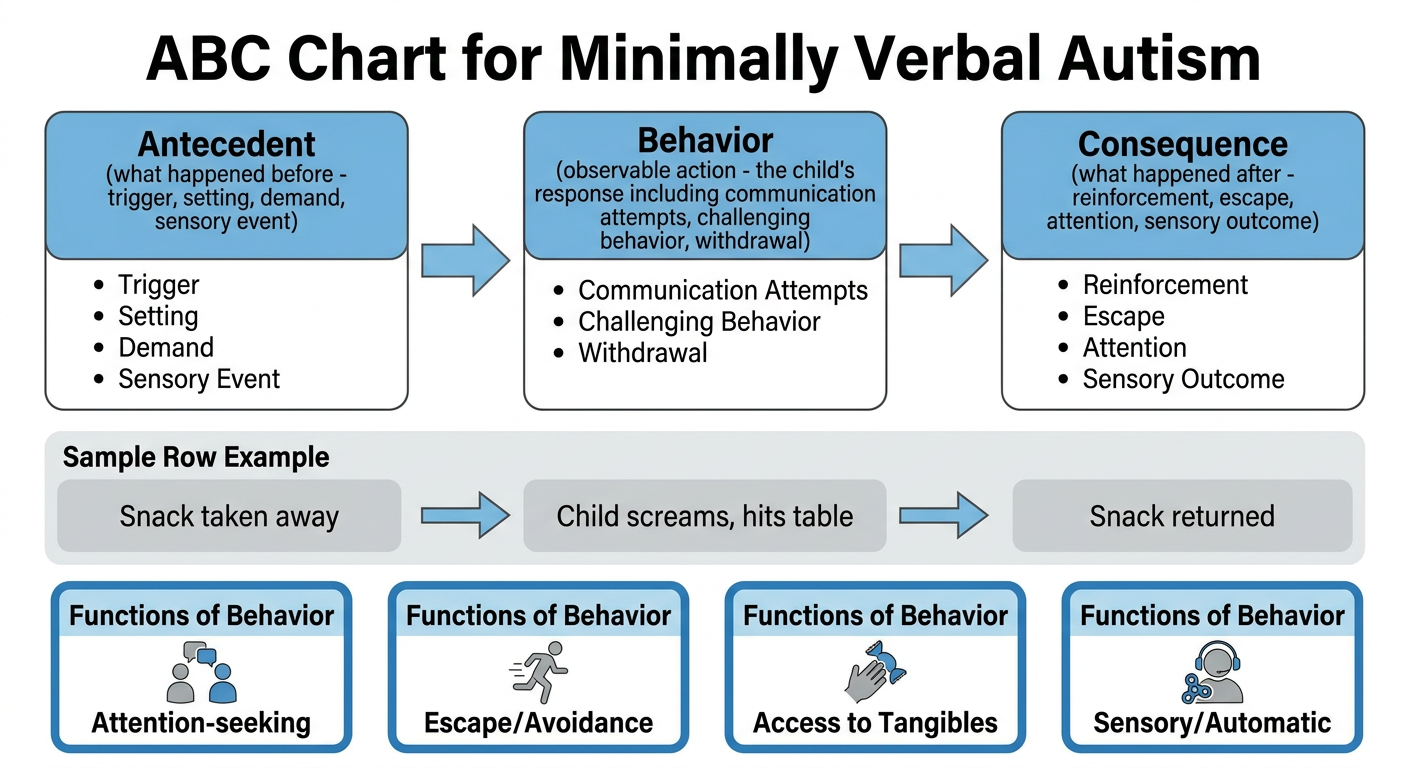
A - Antecedent
| Antecedent Type | MVA-Specific Examples |
|---|---|
| Instructional/demand | "Sit down," "Do this," transition from preferred activity |
| Environmental | Loud noise, unexpected person, change in routine, new setting |
| Sensory | Certain textures, fluorescent lights, crowded space, specific sounds |
| Biological/internal | Hunger, pain, fatigue, GI discomfort (cannot be reported verbally) |
| Social | Peer approaching, parent leaving room, attention withdrawn |
| Removal of preferred item | Snack taken away, iPad turned off, favorite toy taken |
| Task difficulty | Demand above current skill level |
| Waiting | Inability to tolerate delay without communication |
B - Behavior
| Communication Behaviors (TARGET to increase) | Challenging Behaviors (TARGET to reduce/replace) |
|---|---|
| Eye contact + vocalization | Hitting, biting, scratching |
| Reaching toward desired item | Self-injurious behavior (SIB) |
| Gesture (point, reach, show) | Throwing objects |
| Approximation of a word | Screaming / prolonged crying |
| Touching picture/symbol | Running/elopement |
| Use of AAC device | Destruction of property |
| Turn-taking behavior | Dropping to floor / refusal |
C - Consequence
| Consequence Type | Effect on Behavior | MVA Example |
|---|---|---|
| Positive reinforcement | Behavior increases (something added that the child wants) | Child hits → snack is given → hitting increases |
| Negative reinforcement | Behavior increases (something aversive is removed) | Child screams → demand is removed → screaming increases |
| Positive punishment | Behavior decreases (something aversive added) | Generally avoided; ethical concerns in MVA |
| Extinction | Behavior decreases (reinforcement withheld) | Must be combined with teaching replacement behavior |
2.3 The Four Functions of Behavior (FEAT / SEAT)
          ┌─────────────────────────────────────────────────┐
          │         FUNCTIONS OF BEHAVIOR IN MVA            │
          ├─────────────┬───────────────────────────────────┤
          │  FUNCTION   │  THE BEHAVIOR IS SAYING...        │
          ├─────────────┼───────────────────────────────────┤
          │  ATTENTION  │  "Look at me / Be with me"        │
          │  ESCAPE     │  "I don't want this / Stop"       │
          │  TANGIBLE   │  "I want that item/activity"      │
          │  SENSORY    │  "This feels good / I need this"  │
          └─────────────┴───────────────────────────────────┘
2.4 The ABC Chart: Completed Template for MVA
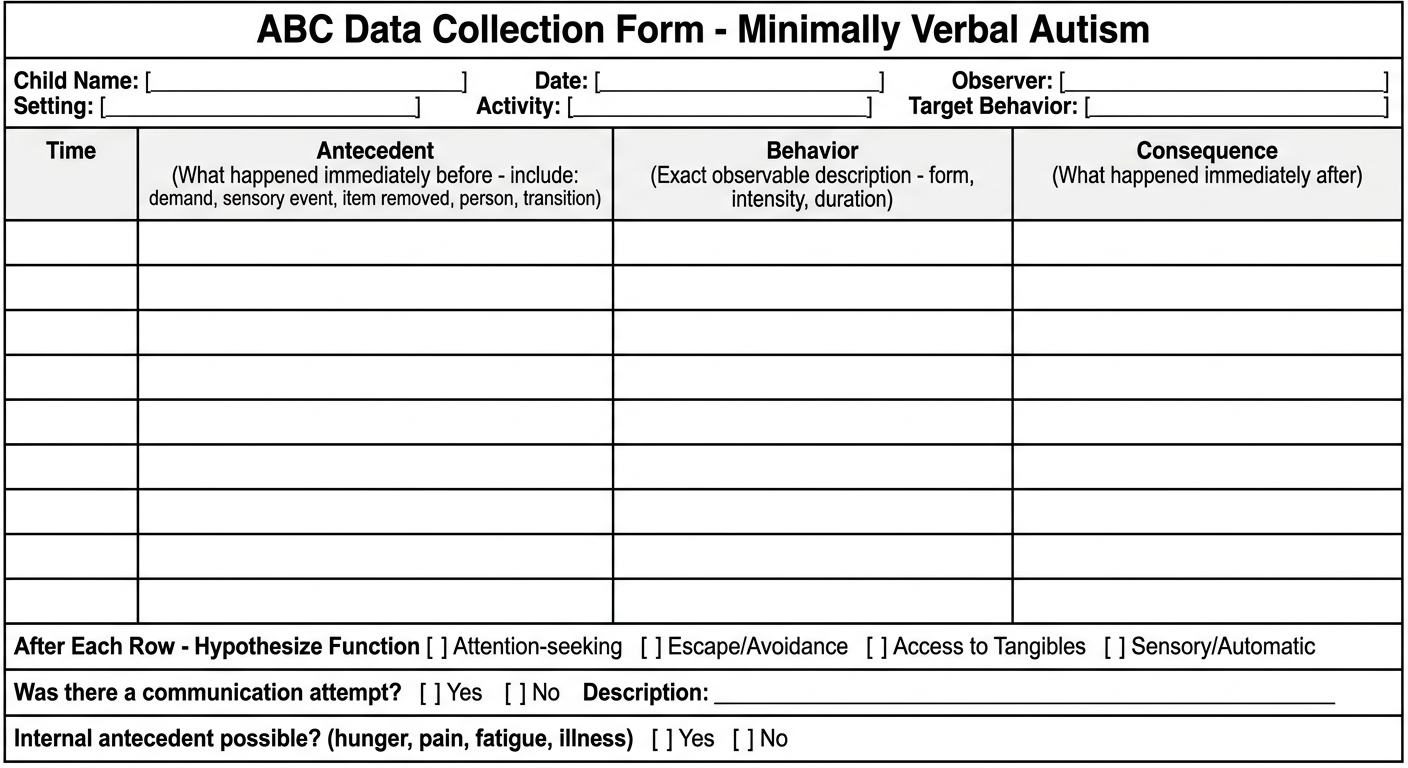
ABC DATA COLLECTION FORM - MINIMALLY VERBAL AUTISM
══════════════════════════════════════════════════════════════════════
Child Name: ______________ Observer: ____________ Date: ___________
Setting: _________________ Activity at time: _____________________
Target Behavior being tracked: ___________________________________

┌──────────────┬──────────────────────────┬──────────────────────────┐
│   TIME       │  ANTECEDENT              │  BEHAVIOR                │
│              │  (What happened before)  │  (Exact description)     │
├──────────────┼──────────────────────────┼──────────────────────────┤
│              │                          │                          │
│              │                          │                          │
├──────────────┴──────────────────────────┴──────────────────────────┤
│  CONSEQUENCE (What happened immediately after):                    │
│                                                                    │
├────────────────────────────────────────────────────────────────────┤
│  HYPOTHESIZED FUNCTION:                                            │
│  [ ] Attention  [ ] Escape  [ ] Tangible  [ ] Sensory/Automatic   │
├────────────────────────────────────────────────────────────────────┤
│  COMMUNICATION ATTEMPT PRESENT? [ ] Yes [ ] No                     │
│  If yes, describe: _____________________________________________   │
├────────────────────────────────────────────────────────────────────┤
│  INTERNAL ANTECEDENT POSSIBLE? (hunger/pain/fatigue)               │
│  [ ] Possible  [ ] Unlikely  Notes: __________________________    │
└────────────────────────────────────────────────────────────────────┘
2.5 MVA-Specific ABC Examples
| Detail | |
|---|---|
| Antecedent | Therapist places worksheet on table and says "Time to work" |
| Behavior | Child pushes worksheet to the floor, covers ears, drops to the ground |
| Consequence | Therapist removes worksheet and moves to a sensory break |
| Function | Escape from non-preferred demand |
| Communication message | "I don't want to do this / This is too hard / I need a break" |
| Intervention | Teach "break" card or break gesture; modify task difficulty; use First-Then visual |
| Detail | |
|---|---|
| Antecedent | Parent turns off the child's preferred iPad video |
| Behavior | Child screams, grabs at parent's hands, bites own hand |
| Consequence | Parent turns iPad back on to stop self-injury |
| Function | Access to tangible (iPad/video) |
| Communication message | "I want that back / More please" |
| Intervention | Teach "more" or "iPad" using gesture, PECS, or device; use visual timer to prepare for transitions; honor appropriate requests immediately |
| Detail | |
|---|---|
| Antecedent | Parent is on phone; child has been playing alone for 10+ minutes |
| Behavior | Child approaches parent and hits the parent's leg repeatedly |
| Consequence | Parent puts phone down and attends to child |
| Function | Attention/social connection |
| Communication message | "Play with me / I need you" |
| Intervention | Teach tap-and-wait or approach gesture; pre-schedule brief "my time" periods to prevent deprivation; respond to appropriate bids for attention immediately |
| Detail | |
|---|---|
| Antecedent | Child sitting at table during group activity; fluorescent lights on; background noise |
| Behavior | Child begins rocking, humming loudly, covers ears |
| Consequence | No external response (behavior is self-sustaining) |
| Function | Sensory/automatic - self-regulation |
| Communication message | "I am overwhelmed / I am regulating myself" |
| Intervention | Modify environment (noise-canceling headphones, dimmer lighting); DO NOT eliminate rocking/humming - provide alternative regulated outlet; teach "too loud" sign |
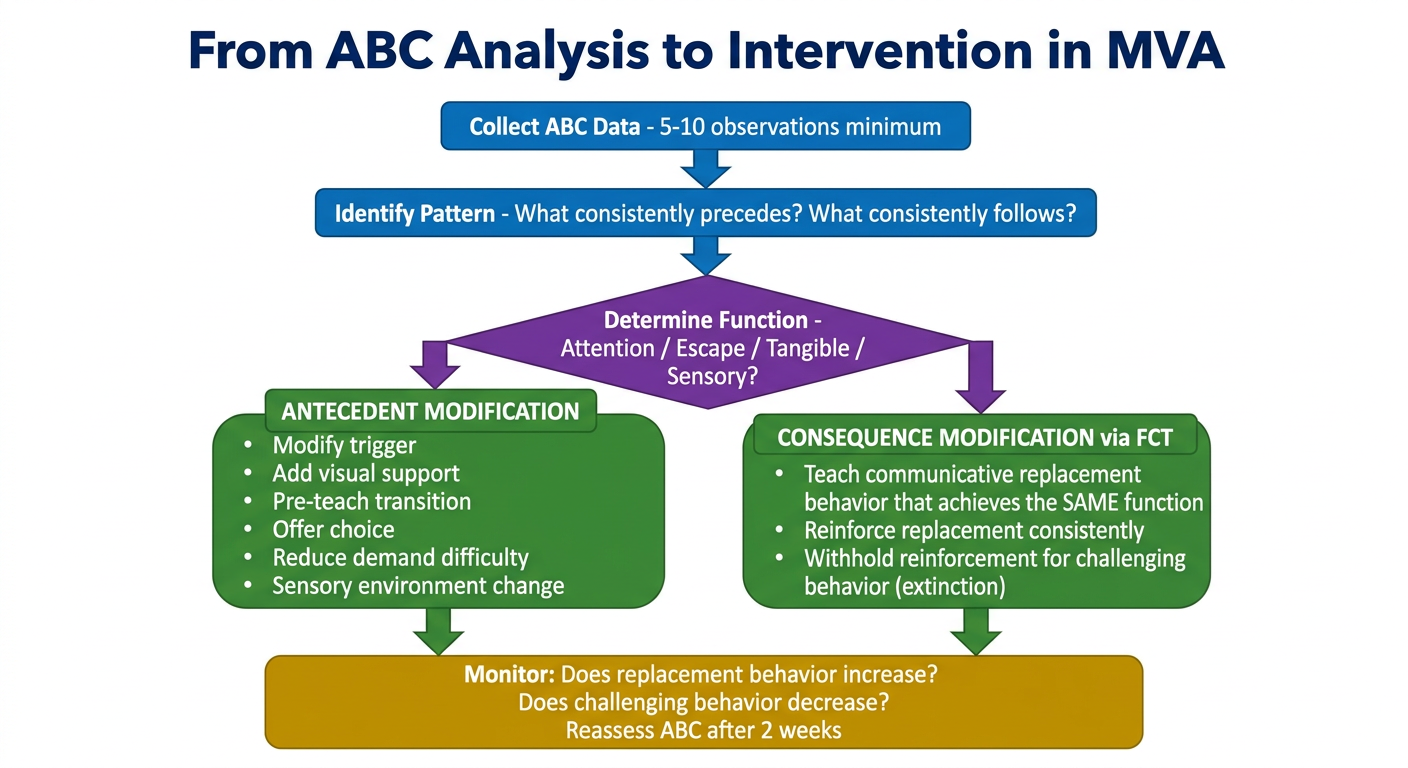
2.6 From ABC to Intervention: The Function-Based Pathway
      IDENTIFY FUNCTION (via ABC)
              │
              ▼
    ┌─────────────────────┐
    │  What is the child  │
    │  trying to GET or   │
    │  AVOID?             │
    └──────────┬──────────┘
               │
       ┌───────┴────────┐
       ▼                ▼
  ANTECEDENT        CONSEQUENCE
  MODIFICATION      MODIFICATION
  ─────────────     ─────────────
  • Change the      • Teach a
    trigger          replacement
  • Modify task      behavior (FCT)
  • Visual support  • Reinforce
  • Pre-teach        replacement
  • Choice          • Extinguish
                     challenging
                     behavior
2.7 Functional Communication Training (FCT): Closing the Loop
- Large effects for reducing challenging behavior (Tau-BC = 0.97)
- Moderate-to-large effects for increasing replacement behavior (Tau-BC = 0.78)
- Most effective in school settings; parent training is a critical implementation gap
- Functionally equivalent - achieves exactly the same outcome as the challenging behavior
- Response efficient - easier to produce than the challenging behavior (or it won't replace it)
- Within the child's motor capacity - accounts for motor speech or motor planning difficulties
- Honored consistently - replacement communication must ALWAYS be reinforced, initially
| Function | Challenging Behavior | FCT Replacement (MVA-appropriate) |
|---|---|---|
| Escape | Screaming, dropping to floor | "Break" card / gesture / device output / "no" symbol |
| Attention | Hitting, persistent touching | Tap-and-wait gesture; point to person; "play" symbol |
| Tangible | Grabbing, biting | Point + vocalization; PECS exchange; device request |
| Sensory | SIB, stereotypy | Socially acceptable sensory alternative; "I need ___" |
PART 3 - Motivation Assessment Framework (Visual)
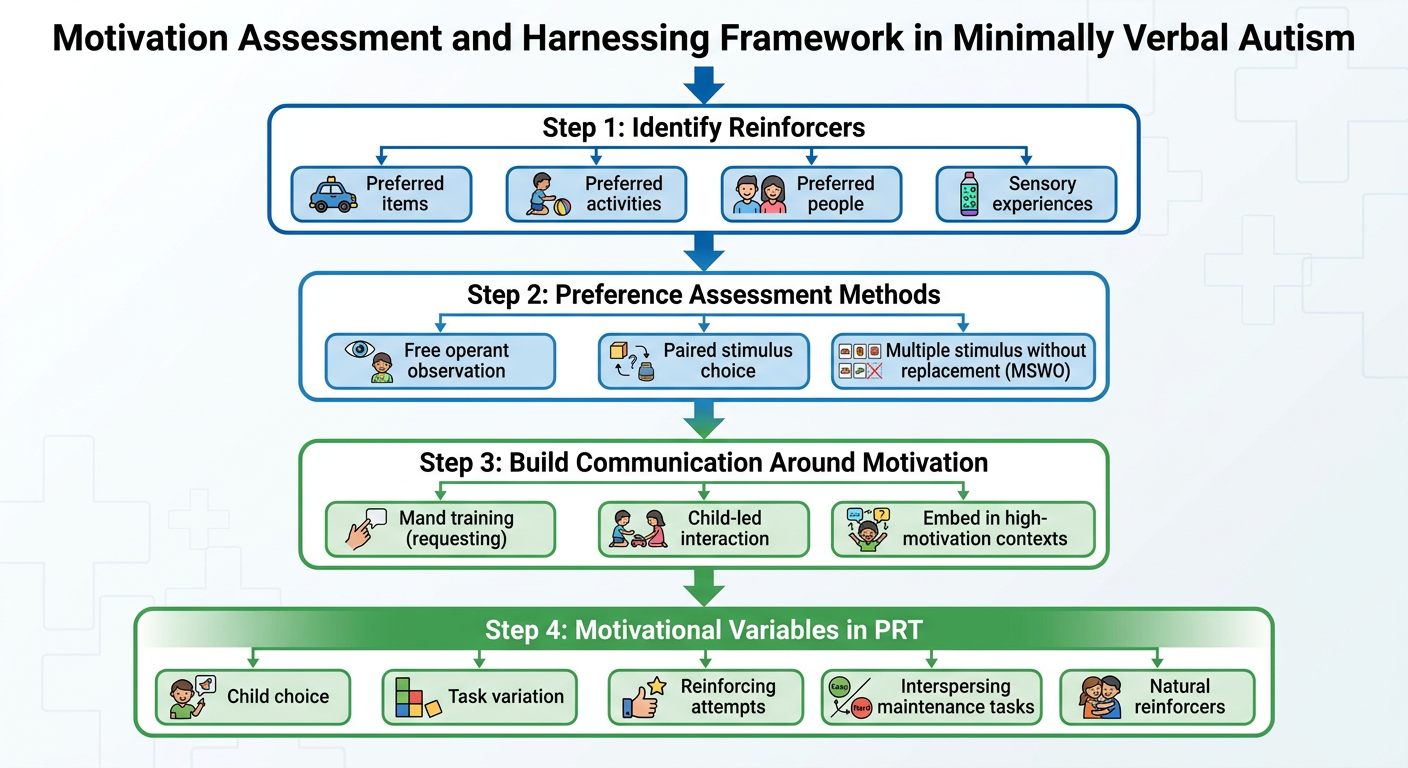
PART 4 - Motivation + ABC: Integration in Clinical Practice
The MVA Session Design Principle
1. PREFERENCE CHECK
   Offer choice of 2-3 preferred items/activities
   Observe what the child gravitates toward
           │
           ▼
2. CREATE MOTIVATIONAL CONTEXT
   Use the preferred item/activity as the session context
   Do NOT impose unrelated tasks onto unmotivated child
           │
           ▼
3. ENGINEER COMMUNICATION OPPORTUNITIES
   Withhold briefly, offer partial access,
   pause routine, create a "communication trap"
           │
           ▼
4. PROMPT AND HONOR ATTEMPTS
   At lowest effective prompt level
   Reinforce ANY approximation immediately
           │
           ▼
5. TRACK VIA ABC
   Document what preceded communication attempts
   Note what followed and whether it increased attempts
   Identify any challenging behaviors and their function
           │
           ▼
6. REVIEW AND ADAPT
   Preference may shift (satiation)
   Function may change with context
   Adjust accordingly
The Motivational Trap: What Goes Wrong
| Common Error | Why It Happens | Effect in MVA |
|---|---|---|
| Using non-preferred reinforcers | Clinician assumes what child should want | Low engagement, behavior escalates |
| Ignoring the function of challenging behavior | Focus only on reducing the behavior | Behavior persists or transforms into new form |
| Removing preferred activities as punishment | Punitive tradition | Destroys trust, eliminates the motivational foundation |
| Reinforcing communication only sometimes | Inconsistency | Puts communication on extinction; child stops trying |
| Ignoring internal antecedents | Can't see pain/hunger | Missing the real trigger; misidentifying function |
| Assuming sensory behavior is problematic | Neurotypical lens | Suppresses self-regulation; increases distress |
- Blair et al. (2025) FCT meta-analysis [PMID 41464031] - FCT effect sizes in ASD
- Durand & Crimmins (1988) - Motivation Assessment Scale
- Koegel & Koegel - PRT motivation components (foundational text)
- Sam & AFIRM Team (2024 update) - Antecedent-Based Interventions brief packet (AFIRM/UNC)
- Cooper, Heron & Heward - Applied Behavior Analysis (standard ABA text)
motivation of the child in MVA - how to assess and harness it for intervention, and (2) the ABC (Antecedent-Behavior-Consequence) chart/draw as a tool in MVA
Child Motivation in MVA: Assessment, Harnessing, and the ABC Framework
PART 1 - Why Motivation Is the Central Mechanism in MVA
Find what the child is motivated by. Deliver it ONLY through communication. Then communication becomes worth trying.
PART 2 - Assessing Motivation: Preference Assessment
A professional clinical educational diagram titled "Preference Assessment Methods in Minimally Verbal Autism". Show five methods in clearly labeled boxes arranged vertically with brief descriptions: 1. Free Operant Observation - scatter items freely, observe approach and time spent, no demands; 2. Single Stimulus Presentation - present one item at a time, record approach or avoidance; 3. Paired Stimulus/Forced Choice - present two items simultaneously, child selects one, repeat all pairs; 4. Multiple Stimulus Without Replacement (MSWO) - array of 5-7 items, remove chosen item each round, generates ranked hierarchy; 5. Multiple Stimulus With Replacement (MSW) - same array, item replaced after each choice, tests preference stability. On the right side show a "Reinforcer Hierarchy Output" box with an ordered list showing High, Medium, Low preference tiers. Clean medical/clinical education style, blue and green color scheme, clear typography
A clean professional clinical ABC data collection chart template titled "ABC Data Collection Form - Minimally Verbal Autism" suitable for printing. The chart has a header section with fields for Child Name, Date, Observer, Setting, Activity, and Target Behavior. Below is a table with columns: Time | Antecedent (What happened immediately before - include: demand, sensory event, item removed, person, transition) | Behavior (Exact observable description - form, intensity, duration) | Consequence (What happened immediately after). Below the table is a section titled "After Each Row - Hypothesize Function" with four checkboxes: Attention-seeking, Escape/Avoidance, Access to Tangibles, Sensory/Automatic. Then a section: "Was there a communication attempt?" Yes/No with description line. Then "Internal antecedent possible?" (hunger, pain, fatigue, illness) Yes/No. Clean white background, black grid lines, professional typography, printable format
A professional clinical diagram titled "The Four Functions of Behavior in MVA - Behavior as Communication" showing four large colored quadrants in a 2x2 grid. Top-left (blue): ATTENTION - icon of two people - "I want you / Be with me / Look at me" - Antecedent: attention withdrawn, alone time - Replacement: tap-wait gesture, point to person. Top-right (red): ESCAPE/AVOIDANCE - icon of exit door - "Stop / Too hard / I need a break" - Antecedent: demand presented, transition, non-preferred task - Replacement: break card, "no" sign, "help" gesture. Bottom-left (green): TANGIBLE - icon of toy/item - "I want that / Give me / More" - Antecedent: preferred item removed, denied - Replacement: point+vocalize, PECS, device request. Bottom-right (orange): SENSORY/AUTOMATIC - icon of person rocking - "This feels right / I'm regulating / Overstimulated" - Antecedent: often none or internal - Replacement: sensory alternative, not elimination. Center circle: "All behavior in MVA is communication". Clean educational style, bold labels
A clean professional clinical flowchart titled "From ABC Analysis to Intervention in MVA" showing a top-to-bottom clinical decision pathway. Step 1 (blue box): "Collect ABC Data - 5-10 observations minimum". Arrow down. Step 2 (blue box): "Identify Pattern - What consistently precedes? What consistently follows?". Arrow down. Step 3 (purple diamond): "Determine Function - Attention / Escape / Tangible / Sensory?". Arrow down. Step 4 splits into two parallel paths: Left path (green boxes): "ANTECEDENT MODIFICATION - Modify trigger, Add visual support, Pre-teach transition, Offer choice, Reduce demand difficulty, Sensory environment change". Right path (green boxes): "CONSEQUENCE MODIFICATION via FCT - Teach communicative replacement behavior that achieves the SAME function, Reinforce replacement consistently, Withhold reinforcement for challenging behavior (extinction)". Both paths merge into Step 5 (gold box): "Monitor: Does replacement behavior increase? Does challenging behavior decrease? Reassess ABC after 2 weeks". Clean flowchart style, colored boxes, professional typography
Preference Assessment Methods
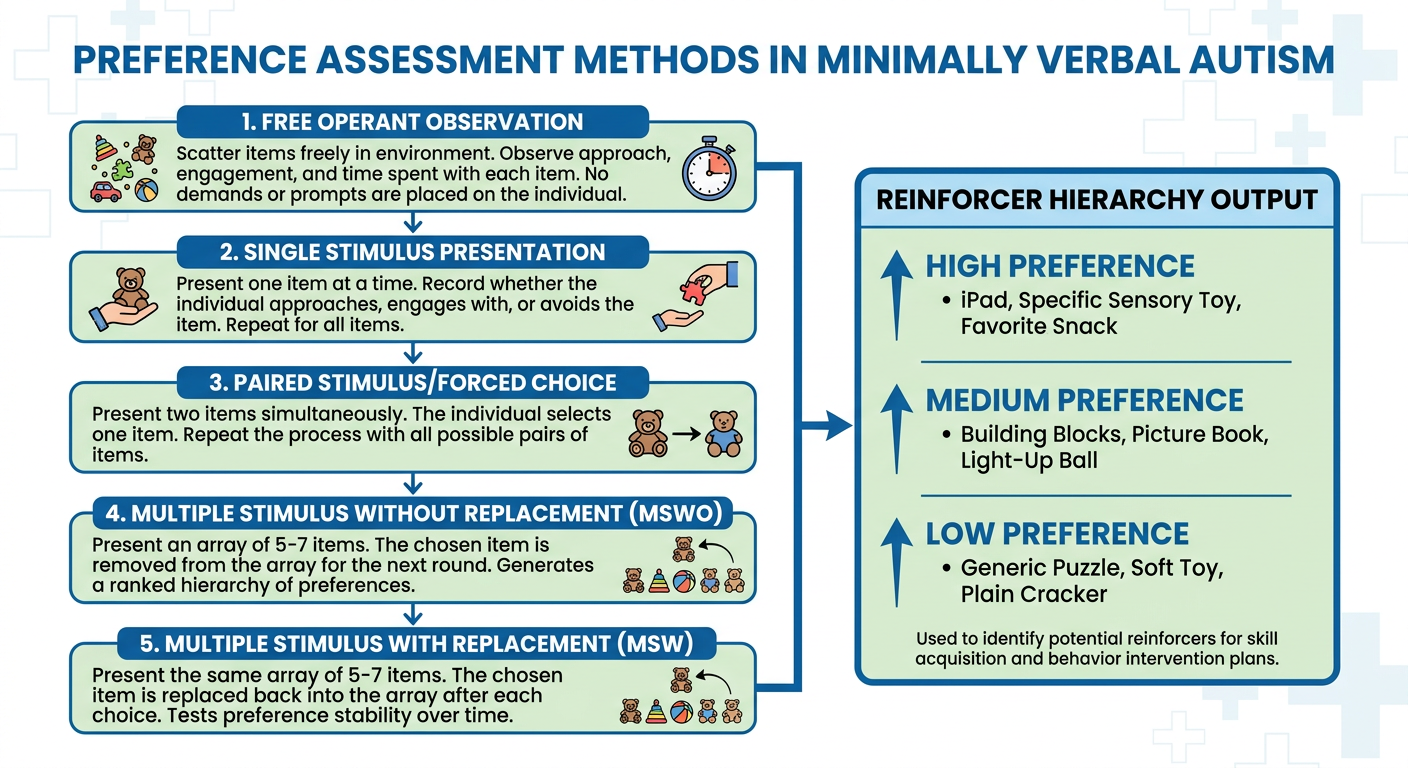
What You Are Looking For
| Category | Examples in MVA | Clinical Note |
|---|---|---|
| Edible | Specific snacks, juice, ice chips | Most immediately reinforcing; risk of satiation; use small quantities |
| Sensory-vestibular | Swinging, spinning, bouncing, deep pressure | Often the highest-value category in MVA; use as direct natural reinforcer |
| Auditory-sensory | Specific songs, sounds, music, videos | Short clips as reinforcers; also reveals special interests |
| Object/toy | Trains, cars, fidgets, kinetic sand, light toys | Brief access contingent on communication attempt |
| Activity | Trampoline, water play, iPad game, bubbles | Timed access; natural reinforcer for requests |
| Social | Tickles, chase, peek-a-boo, physical proximity | Highly variable; do not assume; must be confirmed by preference assessment |
| Special interests | Characters, numbers, a specific color, letters | The most potent motivators; build entire sessions around them |
Satiation and Deprivation: Managing Motivational State
- Satiation - the child has had so much of something they no longer want it. Never begin a session with unlimited access to the planned reinforcer.
- Deprivation - withholding the preferred item briefly before the session so the child is motivated to request it. This is the standard condition before mand training.
- Preference shifts - what motivates today may not motivate next week. Reassess regularly, especially after extended breaks, illness, or developmental changes.
PART 3 - Harnessing Motivation for Intervention
3.1 The Mand: First Communication, Built on Motivation
1. Identify high-preference item via preference assessment
        ↓
2. Establish motivation (brief deprivation - 3-5 minutes)
        ↓
3. Present item visibly but hold it back (create the want)
        ↓
4. Wait for any communication attempt (2-5 second pause)
        ↓
5. Prompt at the lowest effective level:
   Gestural → Model → Physical (most-to-least or least-to-most)
        ↓
6. Immediately deliver the item upon ANY communicative attempt
   (approximation, vocalization, gesture, point, device press)
        ↓
7. Allow brief enjoyment (5-10 seconds)
        ↓
8. Gently remove item to re-establish motivation
        ↓
9. Repeat, fading prompts systematically
3.2 PRT: Motivation as a "Pivotal Area"
| PRT Motivational Component | What It Means in Practice |
|---|---|
| Child choice | Offer 2-3 preferred options and let the child direct activity selection |
| Task variation | Mix new acquisition tasks with easy mastered tasks to maintain success experience |
| Reinforcing attempts | ANY reasonable communicative attempt is honored - not just perfect responses |
| Interspersing maintenance | Include already-learned tasks to keep child in "win" state |
| Direct / natural reinforcers | The reward is the natural outcome of the communication - child says "swing" → goes on swing |
| Shared control | Child and adult alternate turns controlling the interaction |
3.3 JASPER: Motivation Through Following the Child's Lead
- Observe what the child is doing and what holds their attention
- Join - sit near, imitate the child's actions, mirror their engagement
- Expand - add one small variation to the play once engaged
- Comment and model language - at the child's current level, within the motivating activity
- Never redirect away from the preferred activity; the activity IS the therapy
3.4 The Motivational Trap: What Goes Wrong
| Common Error | Effect in MVA |
|---|---|
| Using non-preferred reinforcers ("good job!" praise for a child who is not socially motivated) | Low engagement, rapid extinction of communication attempts |
| Delivering the reinforcer regardless of communication | Teaches nothing; child has no reason to communicate |
| Over-using one reinforcer until satiated | Motivation disappears mid-session; challenging behavior increases |
| Withholding preferred items punitively | Destroys trust; eliminates the motivational foundation of therapy |
| Failing to honor approximations | Child learns that imperfect communication is not worth attempting |
| Ignoring sensory preferences as "not real" reinforcers | Missing the most powerful motivators for many MVA children |
PART 4 - The ABC Chart in MVA
4.1 Why ABC Analysis Is Critical in MVA Specifically
- A child who bites when a demand is made is saying: "Stop. I can't do this. I need a break."
- A child who screams when the iPad is turned off is saying: "I want that back."
- A child who bangs their head when in a loud room is saying: "This is overwhelming my sensory system."
4.2 The ABC Chart (Printable Template)
4.3 Breaking Down Each Component for MVA
A - Antecedent: Everything Before the Behavior
| Antecedent Type | MVA-Specific Examples |
|---|---|
| Instructional demand | "Sit down," "Do your work," any verbal directive |
| Transition | Moving from preferred to non-preferred activity |
| Removal of item | iPad off, snack finished, toy taken |
| Sensory trigger | Loud noise, certain texture, fluorescent lighting, crowd |
| Social | Peer approaches, parent leaves the room, stranger enters |
| Waiting | Delay before receiving preferred item |
| Task difficulty | Demand exceeds current skill |
| Change in routine | Unexpected schedule change, new person, different room |
| Internal State | Behavioral Signs | How to Check |
|---|---|---|
| Hunger | Increased aggression near meal times, seeking food areas | Track against meal schedule |
| Pain (headache, GI, ear infection) | Sudden behavior escalation without clear external trigger, head-holding, stomach-pressing | Medical review if acute onset |
| Fatigue | Yawning, eye-rubbing, increased stereotypy, lower engagement | Sleep diary; track against sleep quality |
| Illness (early) | Behavior deterioration before other symptoms manifest | Temperature check; recent illness contact |
| Anxiety | Increased rigidity, repetitive questioning, clinging | Note schedule disruptions, novel contexts |
B - Behavior: Defining It Precisely
- Topography - what it looks like (hits flat-handed against table vs. pinches skin)
- Frequency - how many times in the observation period
- Duration - how long each episode lasts
- Intensity - mild/moderate/severe rating
- Latency - how quickly after the antecedent
"Drops to the floor on knees, crosses arms over chest, and produces continuous high-pitched vocalizations lasting 20-120 seconds. Does not respond to name or touch during episode."
"Has a tantrum"
C - Consequence: What Actually Reinforces Behavior
| Scenario | Behavior | Consequence | Actual Effect |
|---|---|---|---|
| Demand causes screaming | Screaming | Demand removed | Negative reinforcement → screaming will increase when demands are made |
| Biting when iPad removed | Biting | iPad returned to stop biting | Positive reinforcement → biting will increase when iPad is removed |
| Rocking in loud room | Rocking | No external response | Automatic/sensory reinforcement → self-sustaining, no external control possible |
| Child approaches adult and taps | Tapping | Adult ignores (busy) | Extinction → tapping may escalate to hitting before being noticed |
When you give in to challenging behavior to stop it, you have just made that behavior more likely to occur next time. Consistency in consequence delivery is the most critical variable in behavior change.
4.4 The Four Functions of Behavior in MVA
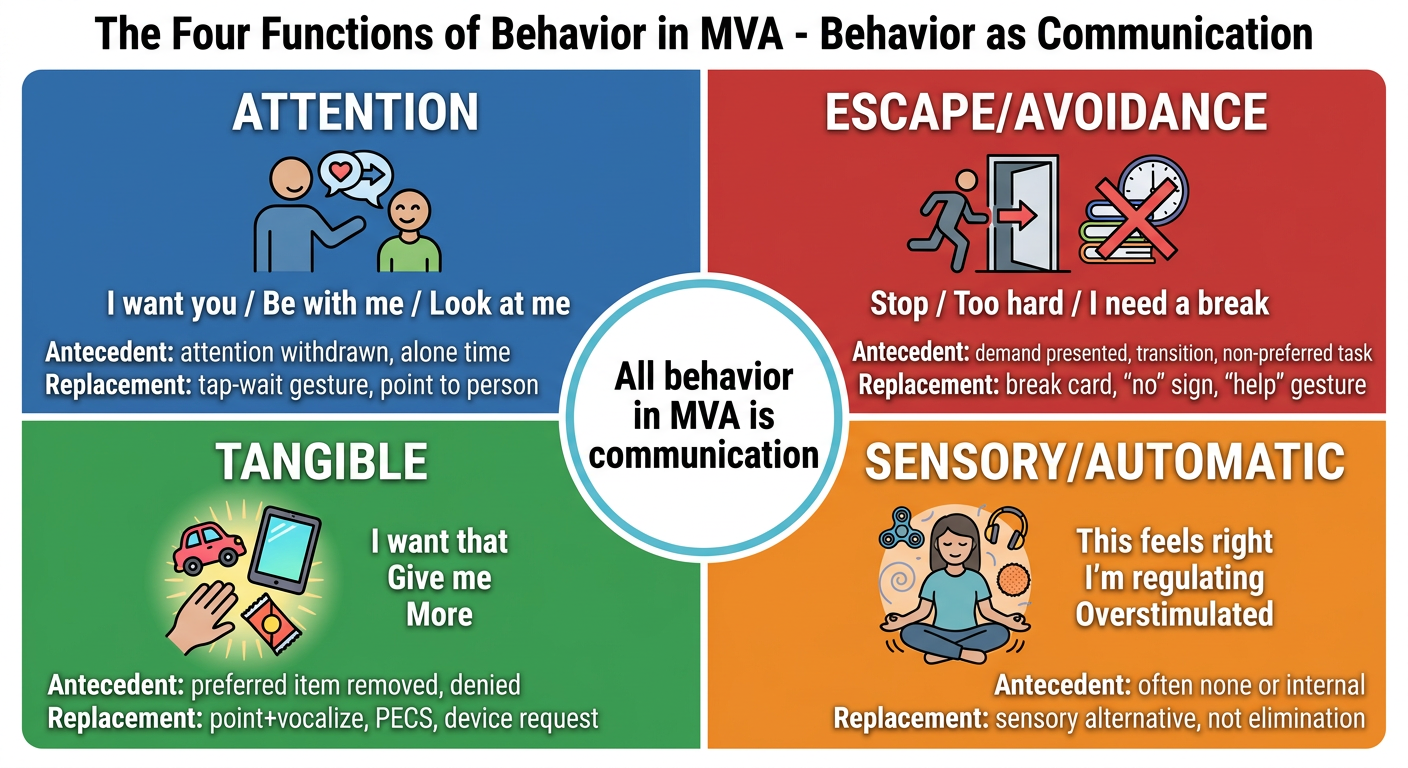
Function Identification Guide
- Increases when the child has been alone or ignored for a period
- Occurs specifically when adults are talking to others, on the phone, or occupied
- Is immediately resolved when adult gives attention (even negative attention counts)
- In MVA: The child has no verbal way to say "play with me" - behavior is the only tool
- Increases specifically when demands are presented
- Immediately stops when the demand is removed
- Child may engage fine before demand, then rapidly escalate after instruction
- In MVA: Cannot say "this is too hard," "I need a break," "I don't understand" - behavior removes the demand instead
- Occurs when a preferred item is visible but inaccessible, or has just been removed
- Resolves when preferred item is returned
- In MVA: Cannot request "more," "again," "give it back" - behavior retrieves the item
- Occurs regardless of social context - can happen when alone
- Is NOT resolved by attention, removal of demands, or giving items
- The behavior itself produces the reinforcement (proprioceptive, vestibular, auditory input)
- Critical in MVA: Rocking, hand-flapping, humming, repetitive finger movements are frequently regulatory - they should not be eliminated but understood and accommodated
4.5 Complete MVA ABC Examples with Intervention
| Component | Detail |
|---|---|
| Setting event | Poor sleep; school day |
| Antecedent | Teacher presents 3-step worksheet activity, says "Time to work" |
| Behavior | Sweeps worksheet off table, drops to floor, covers ears (45 seconds) |
| Consequence | Teacher says "okay, let's take a break" and removes worksheet |
| Function | Escape from non-preferred demand |
| Child's message | "I can't do this / Too much / Stop" |
| Antecedent modification | Visual First-Then board ("First 1 question, then trampoline"); reduce to 1-step task; pre-teach transition |
| FCT replacement | Teach "break" card (PECS) or break symbol on device; honor it IMMEDIATELY |
| Consequence modification | Only remove demand after appropriate "break" communication, not after challenging behavior |
| Component | Detail |
|---|---|
| Setting event | Child has been watching preferred video for 30 minutes |
| Antecedent | Parent turns iPad off; says "all done" |
| Behavior | Screams, bites own forearm, grabs at parent |
| Consequence | Parent turns iPad back on to stop self-injurious behavior |
| Function | Access to tangible (video/iPad) |
| Child's message | "I want that / More / Not done yet" |
| Antecedent modification | Visual timer (5-minute warning before off); "2 more minutes" visual support; use preferred video as earned reinforcer after communication |
| FCT replacement | Teach "more" or "iPad" using point + vocalization or device; honor FIRST successful request |
| Consequence modification | Do not return iPad for biting; return it immediately for any appropriate communication attempt |
| Component | Detail |
|---|---|
| Setting event | Parent has been on a phone call for 20 minutes |
| Antecedent | Child approaches; parent waves them away |
| Behavior | Child hits parent repeatedly on the arm |
| Consequence | Parent ends call, attends to child |
| Function | Attention / social connection |
| Child's message | "Play with me / I need you / Be with me" |
| Antecedent modification | Pre-schedule "my time" interaction periods (10 min every hour); child activity kit for when parent is unavailable; predictable visual schedule |
| FCT replacement | Teach tap-and-wait protocol; "play" symbol; tapping shoulder once = honored immediately |
| Consequence modification | Respond to appropriate bids immediately; do not respond to hitting; pre-empt by checking in before hitting begins |
| Component | Detail |
|---|---|
| Setting event | Morning transition; bright lights, noisy environment |
| Antecedent | Child enters group room (multiple children, fluorescent lights on) |
| Behavior | Child begins rocking back and forth, humming loudly, covers ears |
| Consequence | No external consequence; behavior continues for duration of session |
| Function | Sensory/automatic - self-regulation of auditory/vestibular system |
| Child's message | "I am overwhelmed / I am coping / This is too much" |
| Intervention | Do NOT attempt to stop rocking/humming - these are regulatory. Modify environment: noise-canceling headphones, dimmer lighting, reduce child density. Provide pre-scheduled sensory input before entering group |
| What NOT to do | Never apply extinction to sensory/automatic behavior - it has no external reinforcement to withhold, and suppressing it increases distress |
4.6 From ABC to Intervention: The Clinical Pathway
4.7 Functional Communication Training (FCT): Closing the Loop
- Challenging behavior reduction: Tau-BC = 0.97 (large effect)
- Replacement behavior increase: Tau-BC = 0.78 (moderate-to-large effect)
- School settings showed larger effects than home (parent training is the critical implementation gap)
| Rule | Explanation |
|---|---|
| Functionally equivalent | Must achieve the SAME outcome as the challenging behavior |
| Response efficient | Must be easier to produce than the challenging behavior |
| Within motor capacity | Must account for motor speech or motor planning difficulties |
| Honored consistently | Must be reinforced EVERY time initially - no exceptions |
| Gradually thinned | Over time, delay reinforcement slightly to build tolerance |
| Function | Challenging Behavior | FCT Replacement (MVA-appropriate) |
|---|---|---|
| Escape | Screaming, dropping to floor | Break card (PECS), "no" sign, "stop" gesture, device output |
| Attention | Hitting, persistent touching | Tap-and-wait, approach + touch gesture, "play" symbol |
| Tangible | Grabbing, biting, screaming | Point + vocalization, PECS exchange, device request, reach |
| Sensory | SIB, stereotypy (if causing harm) | Functionally similar sensory alternative; "I need ___" communication |
PART 5 - Integrating Motivation and ABC: The Session Architecture
 PRE-SESSION
 ───────────
 • Check setting events (sleep, health, mood)
 • Confirm top 3 preferred reinforcers from assessment
 • Prepare FCT replacement items (break card, device charged)

 SESSION OPENING
 ───────────────
 • Offer 2-3 choices; child communicates preference
 • Enter child's chosen activity; follow their lead
 • No demands for first 2-3 minutes; build engagement

 COMMUNICATION ENGINEERING
 ──────────────────────────
 • Create motivated communication traps
   (withhold, pause routine, offer partial access)
 • Wait 3-5 seconds for spontaneous attempt
 • Prompt at lowest effective level
 • Honor and deliver IMMEDIATELY

 BEHAVIOR TRACKING (concurrent)
 ────────────────────────────────
 • Note any challenging behaviors with A-B-C
 • Record communication attempts and their context
 • Track reinforcer effectiveness

 SESSION CLOSE
 ─────────────
 • Gradual transition (not abrupt removal of preferred activity)
 • Review ABC data collected
 • Identify any functions; plan FCT if new behavior appeared
 • Update reinforcer hierarchy if satiation observed

 AFTER SESSION
 ─────────────
 • Complete full ABC form
 • Share with caregivers: what worked, what the behaviors meant
 • Update intervention plan if needed
Summary: The Two Frameworks in One Sentence Each
- "Why is this child communicating?" - Motivation answers this.
- "Why is this child behaving this way?" - ABC answers this.
- Blair et al. (2025) FCT meta-analysis, Behavioral Sciences [PMID 41464031]
- Sam & AFIRM Team (2024 update) - Antecedent-Based Interventions, UNC/AFIRM
- Cooper, Heron & Heward - Applied Behavior Analysis (foundational text)
- Koegel & Koegel - Pivotal Response Treatment
- Durand & Crimmins (1988) - Motivation Assessment Scale
- Miltenberger (2016) - Behavior Modification: Principles and Procedures