
Various techniques for pinna reconstruction. Ms ent University exam pattern for 20 marks.
Reading File
Finding Sources
Finding Sources
Searching the Web
pinna auricle reconstruction techniques microtia ENT surgery comprehensive
Finding Sources
Finding Sources
Reading Web Page
pinna auricle reconstruction techniques stages
Reading File
Finding Sources
Reading File
Reading File
Finding Sources
Finding Sources
Reading File
Reading File
Reading File
Reading File
I now have comprehensive information to write a thorough university exam answer. Let me compile the complete answer:
Techniques for Pinna Reconstruction
MS ENT University Exam - 20 Marks
INTRODUCTION
Pinna (auricle) reconstruction is one of the most technically demanding procedures in otolaryngology and facial plastic surgery. It requires an intricate combination of framework fabrication, skin cover, and projection to recreate a three-dimensional structure with complex topography. The main indications are:
- Microtia (congenital underdevelopment) - most common indication
- Traumatic avulsion or amputation
- Post-oncologic resection (e.g., squamous cell carcinoma of the pinna)
- Burns
- Congenital anotia
CLASSIFICATION OF MICROTIA (BASIS FOR SURGICAL PLANNING)
Marx/Weerda Classification:
| Grade | Description | Surgical Implication |
|---|---|---|
| Grade 1 (1st degree dysplasia) | Smaller pinna; all features recognizable | No additional skin/cartilage needed |
| Grade 2 (2nd degree dysplasia) | Some features recognizable | Partial reconstruction; some additional skin + cartilage required |
| Grade 3 (3rd degree dysplasia) | "Peanut" - no normal features | Total reconstruction; large amounts of skin + cartilage needed |
| Grade 4 / Anotia | Absent pinna | Complete reconstruction |
OPTIONS FOR PINNA RECONSTRUCTION
Three broad categories exist:
- Autologous reconstruction (rib cartilage framework)
- Alloplastic reconstruction (porous polyethylene implant)
- Prosthetic reconstruction (bone-anchored auricular prosthesis - BAAP)
1. AUTOLOGOUS RIB CARTILAGE RECONSTRUCTION
This is the gold standard and most widely accepted technique. The fundamental principles are:
- Construction of a cartilaginous framework
- Soft-tissue coverage
- Projection of the reconstructed pinna
Cartilage harvest: Ribs 6, 7, 8 (and sometimes 9) are harvested from the bony-cartilaginous junction. The synchondrosis of ribs 6/7 forms the base plate (conchal bowl, scaphoid fossa, triangular fossa), and rib 8 (the "floating rib") forms the helix.
Timing: Age 8-10 years (chest circumference at xiphoid must be ≥60 cm for Nagata; Brent technique requires less cartilage and can be done at 6-7 years).
A. TANZER TECHNIQUE (Historical - First Systematic Approach, 1959)
Radford Tanzer first introduced systematic multistage autologous auricular reconstruction. His original approach had 4 stages:
- Lobule transposition
- Cartilage framework creation and insertion into a subcutaneous pocket
- Framework elevation (creation of retroauricular sulcus)
- Tragal construction and conchal deepening
Tanzer's work established the foundation for all subsequent techniques.
B. BRENT TECHNIQUE (4-Stage)
Brent refined and built upon Tanzer's technique with over 1000 reported reconstructions. The four stages are:
| Stage | Procedure |
|---|---|
| Stage 1 | Autogenous rib cartilage framework creation and subcutaneous implantation |
| Stage 2 | Lobular transposition |
| Stage 3 | Framework elevation (retroauricular sulcus creation) |
| Stage 4 | Tragal reconstruction and conchal deepening |
Key features of Brent's technique:
- Baseplate from synchondrosis of ribs 6/7; helix from rib 8
- Less three-dimensional detail (no antihelical feature carved separately)
- Atypical appearance persists until lobule transposition at Stage 2
- Requires less cartilage than Nagata - can be done at age 6-7 years
- Can be combined into 3 stages with modifications
C. NAGATA TECHNIQUE (2-Stage) - Most Widely Used
Developed by Satoru Nagata - simplified to 2 stages and produces superior three-dimensional detail.
Stage 1 - Framework construction and insertion:
- Performed at age ≥10 years (chest circumference ≥60 cm)
- Lobule split and transposition performed at same time
- Framework carved with overall thickness of 10-14 mm using scalpel, punch biopsies, and gauges
- Components:
- Base plate (from ribs 6/7 synchondrosis): conchal bowl, scaphoid fossa, triangular fossa carved in
- Helix (rib 8) - contoured around the base plate
- Antihelical element (rib 9 may accentuate antihelix)
- Intertragal complex (from remainder of 6/7 synchondrosis)
- Framework inserted into subcutaneous pocket
- Residual cartilage banked over muscle for use in Stage 2
- Drain placed for tight soft-tissue adherence onto framework
Stage 2 - Ear projection (6 months later):
- Posterior auricular incision peripheral to the neohelix
- Ear framework elevated, creating retroauricular sulcus
- Banked cartilage harvested, carved into crescentic shape for projection block placed posterior to conchal bowl
- Posterior scalp flap (widely elevated) advanced anteriorly and sutured to periosteum
- Anteriorly-based postauricular fascial flap covers the projecting cartilage block
- Full-thickness skin graft (from inguinal region or chest) covers posterior surface of neoauricle
Advantages over Brent: Normal ear appearance after Stage 1, superior framework definition, 2 stages instead of 4.
Firmin's modifications: Hemitransfixion incision for lobule transposition; posterior cartilage foundation for improved root-of-helix and tragal definition.
D. PARK TECHNIQUE (Expanded Two-Flap Method, 3-Stage)
Stage 1: Tissue expander inserted in a pocket under the fascial layer in the mastoid area. Gradual saline inflation begins 3 weeks later, continuing for 5 months to reach ~80-90 mL. Both fascia and overlying skin are expanded.
Stage 2: Contralateral rib cartilage harvested to fabricate framework. Expander is explanted; expanded fascial and skin flaps are separated. Skin is undermined anterior to vestigial cartilage for the tragal element. Framework is inserted:
- Upper portion placed between skin and fascial flaps
- Lower portion inserted in the earlobe envelope
- Anterior surface covered by skin flap
- Fascial flap drapes the posterior portion
- Skin graft (from groin or scalp) covers exposed fascial flap
Stage 3: Refinements.
Advantages: Thin, expanded mastoid skin for anterior surface coverage; deeper concha floor and EAM can be reconstructed; donor site scar confined to mastoid region; no baldness.
Disadvantage: Temporal depression during expansion phase due to high internal pressure of inflated expander.
2. ALLOPLASTIC RECONSTRUCTION (MedPor/SuPor - Porous Polyethylene)
Material: High-density porous polyethylene (HDPE) - allows tissue ingrowth and vascularization.
Procedure (typically single-stage):
- Postauricular incision; excision of remnant cartilage
- Temporoparietal fascial (TPF) flap raised for coverage (vascular supply from anterior and posterior superficial temporal vessels)
- TPF may be harvested endoscopically through the postauricular incision (avoids alopecia and scar)
- Alloplastic implant positioned
- TPF flap draped over implant
- Full-thickness skin graft placed over the fascial flap
Advantages:
- Single-stage procedure
- No rib donor site morbidity
- Can be performed at younger age (does not depend on rib cartilage volume; possible from age 3)
- Less dependence on framework carving skill
- Excellent aesthetic outcomes possible
Disadvantages:
- Higher rates of fracture, extrusion, infection
- Needs significant postoperative maintenance
- Less resilient than autologous cartilage
- Exposed implant rates are well-documented
3. BONE-ANCHORED AURICULAR PROSTHESIS (BAAP)
Indications:
- Lack of autogenous tissue
- Irradiated area (poor wound healing)
- Failed autologous reconstruction
- Cancer resection
- Absence of lower half of pinna
- Patient preference
- Significant comorbidities
- Craniofacial anomaly
Procedure:
- Requires removal of vestigial ear including lobule - precludes subsequent autologous reconstruction
- Two osseointegrating fixtures are placed (position agreed by surgeon and prosthetist)
- Single- or two-stage surgery (similar to BAHA insertion)
- After osseointegration, a gold retention bar attached to abutments
- Prosthetic ear clips onto this bar
Advantages: Realistic cosmetic result when done by experienced prosthetist; fine contouring; skin color matching.
Disadvantages:
- Prosthesis lasts only 6 months to 2 years before wear becomes apparent
- Seasonal skin tone changes make prosthesis distinction apparent
- Recurrent soft-tissue inflammation around percutaneous abutments
- Traumatic fixture loss
- Patients may not feel it is "part of themselves"
- Significant cost and maintenance
4. RECONSTRUCTION FOR TRAUMATIC DEFECTS
Partial defects:
- Small partial defects: primary closure or local flaps
- Helical defects: Antia-Buch chondrocutaneous advancement flap (for upper/middle third) - based on subcutaneous pedicle
- Composite grafts from contralateral ear for small defects
- For larger peripheral defects: 3-step rib cartilage reconstruction
Complete avulsion/amputation:
| Scenario | Management |
|---|---|
| Avulsed pinna available, fresh | Microvascular re-anastomosis (best option but technically challenging due to small vessel size) |
| Avulsed pinna available, not fresh | Dermal banking - deepithelialized cartilage banked under temporalis fascia for later reconstruction |
| Pinna not available | Local skin flaps or free skin grafts; delayed reconstruction with rib cartilage after 3-6 months |
Post-oncologic resection:
- Prosthesis is the most common offering following parotidectomy/pinna excision and radiotherapy
- Autologous reconstruction less frequently performed due to irradiated bed
5. FLAP OPTIONS FOR COVERAGE
| Flap Type | Use |
|---|---|
| Temporoparietal fascia (TPF) flap | Coverage of alloplastic implants; second-stage elevation coverage |
| Retroauricular fascial flap | Anteriorly based; used in Nagata Stage 2 |
| Posterior scalp flap | Advanced anteriorly in Stage 2 elevation |
| Preauricular flaps | Reconstruction of pinna using preauricular skin |
| Free radial forearm flap | Total auricular reconstruction in complex cases |
| Free lateral arm flap | Alternative free flap |
| Pedicled myocutaneous / scalp transposition fasciocutaneous flaps | For patients not suitable for free tissue transfer |
COMPLICATIONS
| Type | Examples |
|---|---|
| Skin flap | Necrosis (most common - often from excessively thin flap), wound dehiscence, delayed healing |
| Framework | Framework extrusion, absorption/resorption, warping |
| Chest donor site | Chest wall deformity, pneumothorax (perichondrium must be preserved), scar |
| Alloplastic-specific | Fracture, infection, high extrusion rates |
| Prosthetic-specific | Soft-tissue inflammation around abutments, fixture loss |
COMPARISON TABLE: AUTOLOGOUS vs ALLOPLASTIC vs PROSTHETIC
| Feature | Autologous (Rib) | Alloplastic (MedPor) | Prosthesis (BAAP) |
|---|---|---|---|
| Age at surgery | 6-10 years | 3+ years | Any |
| Stages | 2-4 | 1 | 1-2 |
| Donor site morbidity | Yes (chest) | No | No |
| Framework extrusion | Low | High | N/A |
| Longevity | Lifetime | Variable | 6 months - 2 years |
| "Natural" feel | Yes | Moderate | No |
| If fails | Revisable | Difficult | - |
CONCLUSION
Autologous rib cartilage reconstruction (Nagata 2-stage or Brent 4-stage) remains the gold standard for pinna reconstruction due to its durability, natural integration, and low extrusion rates. The Nagata technique is favored for superior aesthetics in 2 stages. Alloplastic reconstruction with MedPor/TPF flap is an acceptable alternative, especially in younger children or when cartilage is inadequate. Prosthetic reconstruction is best for complex cases with irradiated tissue, post-oncologic defects, or patient preference. A multidisciplinary team including the ENT surgeon, plastic surgeon, and prosthetist is essential for optimal outcomes.
Key textbook references: Cummings Otolaryngology Head and Neck Surgery (Chapter 195); Scott-Brown's Otorhinolaryngology Head & Neck Surgery Vol. 2 (Chapter 16); Shambaugh Surgery of the Ear.
Perforators of pinna for reconstruction.
Finding Sources
Finding Sources
Searching the Web
perforators of pinna auricle vascular anatomy reconstruction ENT surgery
Reading Web Page
perforators pinna auricle blood supply vascular anatomy posterior auricular superficial temporal artery
Finding Sources
Finding Sources
Reading File
Finding Sources
Searching the Web
posterior auricular artery perforators triangular fossa cymba conchae helical root anatomy pinna flap design
Reading Web Page
helical rim blood supply perforators posterior auricular artery superficial temporal artery surgical anatomy
Finding Sources
Loading Image
I now have all the information needed for a comprehensive, well-illustrated answer. Here it is:
Perforators of the Pinna for Reconstruction
Understanding the vascular perforators of the pinna is fundamental to designing reliable local flaps, avoiding necrosis, and planning staged reconstructions. The pinna has a remarkably rich dual blood supply, which explains why flap survival rates are high in this region.
ARTERIAL SUPPLY - OVERVIEW
The pinna receives its entire arterial supply from two branches of the external carotid artery (ECA):
- Superficial Temporal Artery (STA) - anterior supply
- Posterior Auricular Artery (PAA) - posterior supply
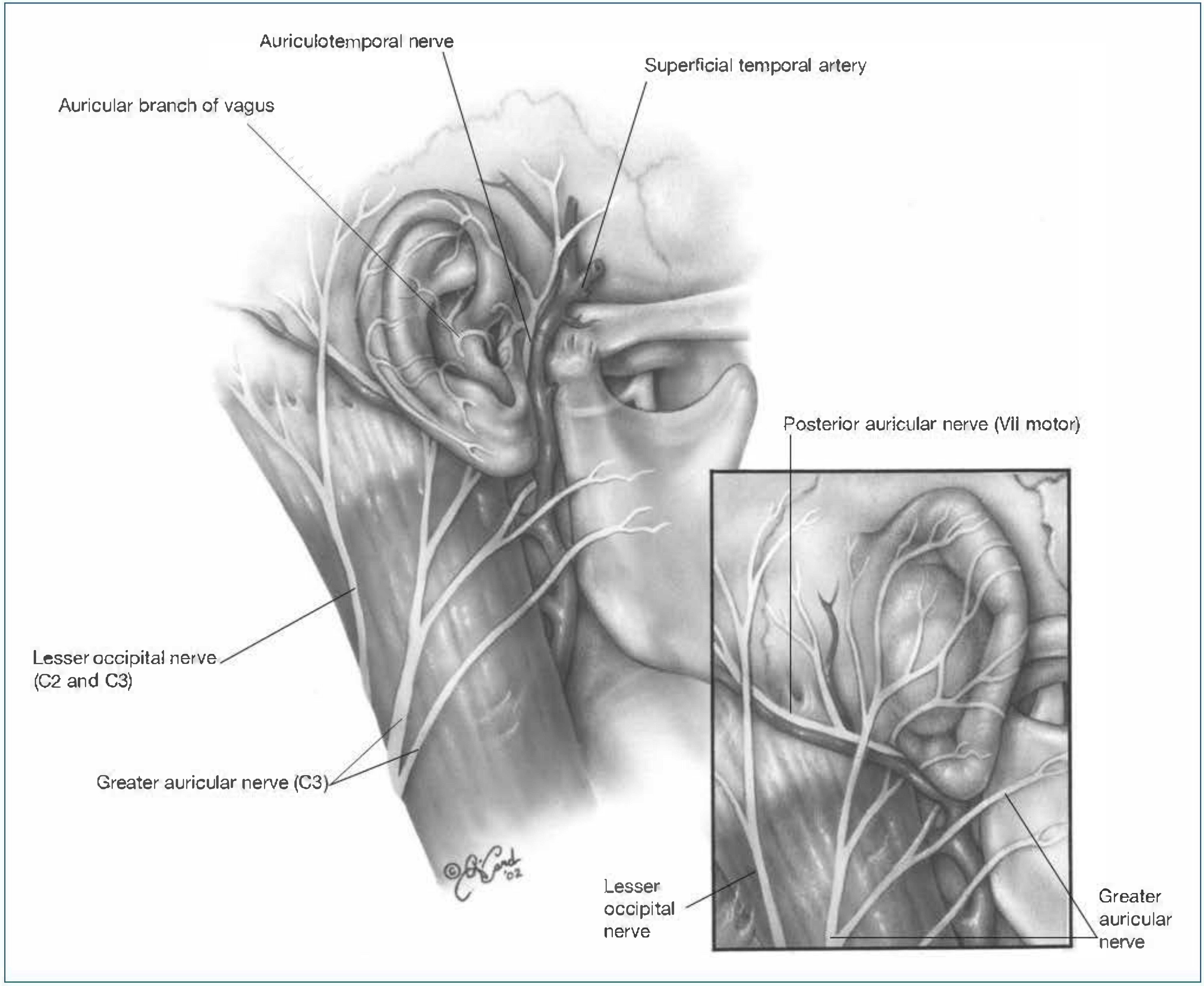
Innervation and vascular anatomy of the pinna - Shambaugh Surgery of the Ear
The veins accompanying these arteries drain into the external jugular vein and ultimately the internal jugular vein via the facial or external jugular pathways.
1. SUPERFICIAL TEMPORAL ARTERY (STA) - ANTERIOR AURICULAR BRANCHES
The STA gives off three anterior auricular branches that supply the lateral (anterior) face of the pinna:
| Branch | Course | Territory Supplied |
|---|---|---|
| Superior branch | Emerges from STA cranial to the tragus; runs along helical rim posteroinferiorly | Ascending helix, upper pole |
| Middle branch | Emerges from STA caudal to the tragus | Tragus, upper earlobe |
| Inferior branch | Emerges caudal to the tragus; runs into earlobe capillary system | Earlobe (lower lobule), lower helix |
Key anatomical point: From the earlobe, small arteries run along the helical rim posterosuperiorly, forming a continuous vascular arcade along the rim. This is the anatomical basis for the earlobe-based advancement flap (ELBAF).
A dorsal vascular arch is formed along the helical rim, fed by anastomoses between the inferior and superior anterior auricular branches - this arch is the key to helical rim flap survival.
2. POSTERIOR AURICULAR ARTERY (PAA) - PERFORATORS
The PAA courses superiorly along the mastoid portion of the temporal bone. It is the primary source of the posteromedial skin and sends perforating branches that pierce through the cartilage to supply the lateral surface of the pinna.
Specific Perforating Points (PAA perforators through cartilage):
| Perforator Location | Clinical Significance |
|---|---|
| Triangular fossa | Perforator through cartilage at the triangular fossa |
| Cymba conchae | Perforator through cartilage in the cymba region |
| Helical root | Perforator at the root/crus of the helix |
| Concha | Perforator through the conchal cartilage |
These trans-cartilaginous perforators are the reason why thinning the skin flap too aggressively during auricular reconstruction risks skin necrosis - the subdermal plexus must be preserved.
Additional PAA branches:
- Supplies skin of the mastoid/retroauricular region (basis of postauricular flaps)
- Stylomastoid branch enters the fallopian canal and supplies the inferior segment of the facial nerve (clinically important in parotid/mastoid surgery)
3. ANASTOMOTIC NETWORK - SURGICAL IMPORTANCE
A rich anastomotic network exists between STA branches and PAA perforators at multiple levels:
- In the concha
- Along the helix
- Along the antihelix
- Alongside the tragus
- Superior STA branch ↔ PAA anastomosis at the superior helix
This explains why:
- Composite grafts survive well (rely on peripheral revascularization)
- Postauricular flaps are robust with minimal necrosis risk
- The pinna tolerates replantation and staged elevation better than many body parts
4. SURGICAL RELEVANCE - FLAP DESIGN BASED ON PERFORATORS
A. Postauricular Island Flap (Masson 1972)
- Based on auricular branch of PAA + STA
- Axial flap design based on one of the major divisions of PAA
- Covers defects of helix, scaphoid fossa, concha, EAC
- Single-stage; rich vascular supply; minimal flap necrosis risk
- Donor site closed primarily (well-hidden scar in retroauricular sulcus)
- Designs: superiorly pedicled (superior pole defects), inferiorly pedicled (lower pole/lobule defects), subcutaneous pedicle propeller island flap
B. Antia-Buch Chondrocutaneous Advancement Flap (1967)
- Used for helical rim defects (middle and upper third)
- Relies on posterior auricular skin left intact to provide blood supply via PAA perforators
- Helical rim incisions through anterior skin and cartilage only; posterior auricular skin remains attached
- Posterior auricular skin is freed from conchal cartilage to allow advancement
- The uncut posterior auricular skin = the vascular pedicle
C. Temporoparietal Fascial (TPF) Flap
- Based on the superficial temporal artery (parietal branch)
- Used to cover alloplastic (MedPor) frameworks in microtia reconstruction
- Thin, well-vascularized; allows skin graft adherence
- Can be endoscopically harvested to reduce alopecia risk
D. Earlobe-Based Advancement Flap (ELBAF)
- Newer technique based on the inferior and middle STA branches converging at the earlobe
- Arteries from earlobe run superiorly along helical rim
- Simpler alternative to Antia-Buch for helical defects
E. Preauricular Flaps
- Based on STA anterior auricular branches
- Used for anterior surface defects of pinna
5. VENOUS DRAINAGE
| Region | Vein | Drains Into |
|---|---|---|
| Lateral (anterior) surface | Superficial temporal vein | External jugular vein |
| Medial (posterior) surface | Posterior auricular veins | External jugular vein |
6. LYMPHATIC DRAINAGE (Clinically Important for Malignancy)
| Auricular Region | Draining Lymph Nodes |
|---|---|
| Anterosuperior lateral face | Pretragal nodes, parotid subfascial nodes |
| Lower lateral surface | Lower parotid lymph nodes |
| Posterior lateral surface + medial surface | Mastoid (postauricular) nodes, inferior parotid nodes |
7. PRACTICAL SURGICAL PRINCIPLES FROM PERFORATOR ANATOMY
- Never thin the skin over the framework excessively - PAA perforators enter through specific cartilage windows; an overly thin flap sacrifices the subdermal plexus
- Posterior auricular skin is the workhorse - rich PAA supply makes it the most reliable donor tissue
- Leave posterior skin intact in Antia-Buch - it is the sole blood supply to the advanced chondrocutaneous flap
- STA-PAA anastomoses protect composite grafts - peripheral revascularization allows composite graft survival up to ~1.5 cm
- Skin necrosis in embolic occlusion - the pinna is particularly susceptible to cutaneous branch emboli from the ECA (important in embolization procedures)
- TPF flap elevation must preserve the superficial temporal vessels (run just under the temporoparietal fascia, superficial to deep temporal fascia)
SUMMARY DIAGRAM
External Carotid Artery
├── Superficial Temporal Artery (STA) [ANTERIOR supply]
│   ├── Superior anterior auricular branch → ascending helix, upper pole
│   ├── Middle anterior auricular branch → tragus, upper lobule
│   └── Inferior anterior auricular branch → lobule, lower helix
│                ↕ anastomoses (concha, helix, antihelix, tragus)
└── Posterior Auricular Artery (PAA) [POSTERIOR supply]
    ├── Retroauricular skin branches → postauricular skin (flap basis)
    ├── Perforators through cartilage:
    │   ├── Triangular fossa
    │   ├── Cymba conchae
    │   ├── Helical root
    │   └── Concha
    └── Stylomastoid branch → facial nerve (inferior segment)
References: Shambaugh Surgery of the Ear (Ch. 2); Partial Ear Reconstruction - Napoli/Schonauer; "The arterial blood supply of the helical rim and the earlobe-based advancement flap" (ELBAF study, Mohs College); ENT & Audiology News - Malignant lesions and reconstruction of the pinna.
This is a shared conversation. Sign in to Orris to start your own chat.