
Methotretate
Reading File
Finding Sources
Finding Sources
The query is broad ("Methotrexate" with no further context). Let me gather comprehensive content from the best pharmacology/clinical sources in the library.
Finding Sources
Finding Sources
Excellent. I have the key sources. Now let me read from the best pharmacology sources: Lippincott (mechanism), Harrison's (clinical), and Fitzpatrick's (dermatology use), Henry's Lab Methods (monitoring), and Tietz (TDM) in parallel.
Reading File
Reading File
Reading File
Reading File
I have strong content. Let me now fetch the mechanism-of-action diagram and get more detail on toxicity/adverse effects and monitoring from Lippincott and the Fitzpatrick's psoriasis section.
Loading Image
Reading File
Reading File
Now let me get the adverse effects and monitoring details from Fitzpatrick's and Henry's:
Reading File
Reading File
I now have comprehensive information to write a thorough response on methotrexate. Let me compile this into a well-organized answer.
Methotrexate (MTX)
Classification & Overview
Methotrexate is an antifolate antimetabolite — a synthetic analog of folic acid. Discovered in 1948, it was initially developed as a chemotherapeutic agent for hematologic malignancies and has since become a cornerstone drug in oncology, rheumatology, and dermatology.
Mechanism of Action
MTX enters cells via an active transport process and competitively and irreversibly inhibits dihydrofolate reductase (DHFR) — the enzyme that converts dihydrofolate (FH₂) → tetrahydrofolate (FH₄). This blocks the folate cycle and starves rapidly dividing cells of:
- Thymidylate (via blockade of thymidylate synthase)
- Purines (adenine, guanine) — by inhibiting glycinamide ribonucleotide transformylase (GART) and aminoimidazole carboxamide transformylase (AICA-T)
The net result is blockade of DNA and RNA synthesis, making MTX S-phase specific.
Additionally, MTX accumulates intracellularly as polyglutamate derivatives, which prolong its inhibitory activity on multiple folate-dependent enzymes and also inhibit DNA methylation via reduction of S-adenosylmethionine levels.
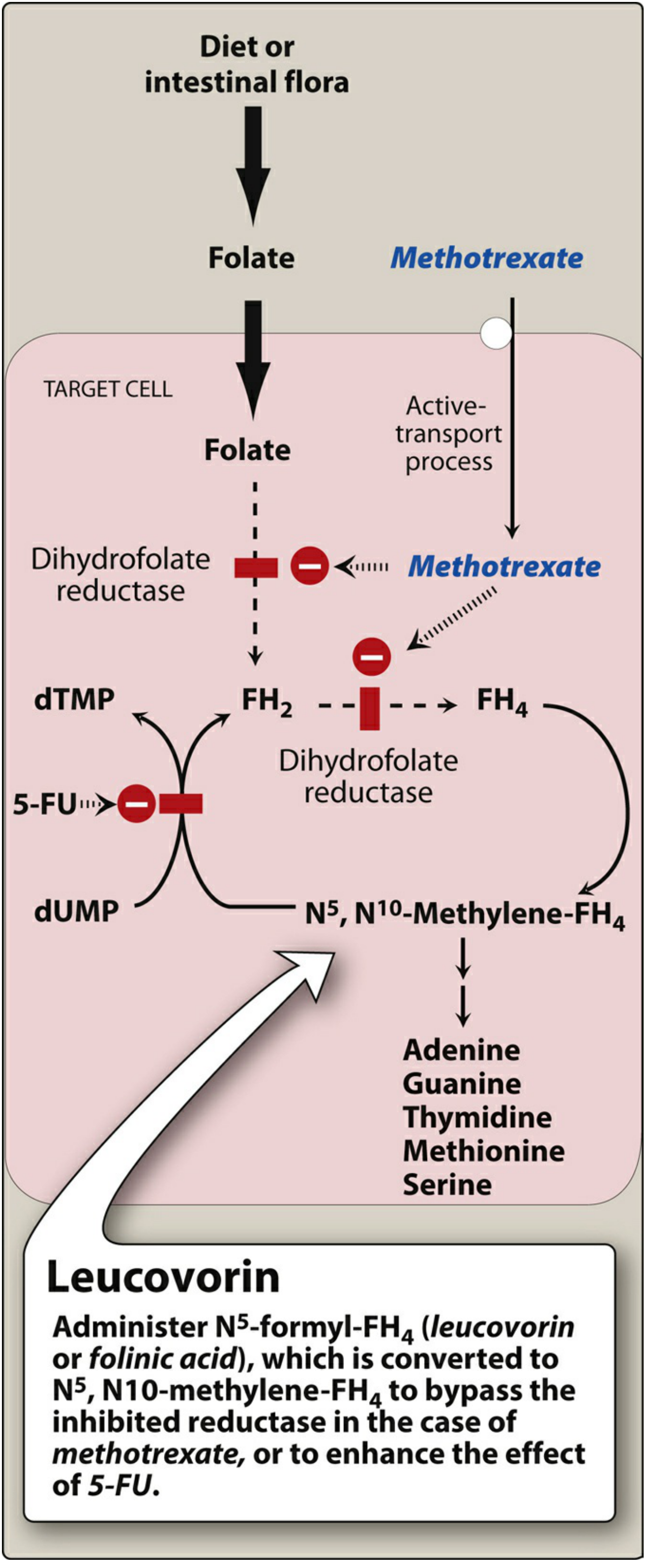
Inhibition can be reversed only by a 1000-fold excess of the natural substrate (FH₂) or by administration of leucovorin (folinic acid, N⁵-formyl-FH₄), which bypasses DHFR entirely.
Pharmacokinetics
| Parameter | Detail |
|---|---|
| Absorption | Oral bioavailability ~67%; variable at low doses; SC preferred for doses >20 mg/week (14–40% higher bioavailability vs. oral) |
| Distribution | High concentrations in intestinal epithelium, liver, kidney; distributes into skin, ascites, pleural effusions; does not readily cross blood-brain barrier |
| Protein binding | ~50% plasma protein bound |
| Metabolism | Minor: 7-hydroxylation → 7-OH-MTX (less water-soluble; risk of crystalluria) |
| Excretion | 60–95% excreted unchanged in urine (renal tubular secretion + GFR); triphasic kinetics — rapid distribution, then renal clearance t½ 2–3 h, then slow t½ 8–10 h |
| Routes | Oral, IM, IV, SC, intrathecal (for CNS sanctuary disease) |
Renal impairment significantly slows elimination and markedly increases toxicity risk. Alkalinizing the urine and ensuring adequate hydration are essential when using high doses to prevent MTX/7-OH-MTX precipitation in tubules.
Therapeutic Uses
Oncology
- Acute lymphocytic (lymphoblastic) leukemia (ALL) — including intrathecal for CNS prophylaxis/treatment
- Burkitt lymphoma (children)
- Choriocarcinoma (highly curative as single agent)
- Breast cancer, head and neck carcinomas
- Mycosis fungoides (FDA-approved)
- Non-Hodgkin lymphoma, osteosarcoma (high-dose regimens with leucovorin rescue)
Inflammatory / Non-oncologic
- Psoriasis (severe, recalcitrant) — FDA-approved 1972; considered the "gold standard" DMARD; ~45% of patients reach PASI-75 response; effective across all subtypes (plaque, guttate, pustular, erythrodermic)
- Psoriatic arthritis — first-line DMARD
- Rheumatoid arthritis — anchor DMARD; may be combined with biologics
- Crohn disease — effective SC for induction and maintenance (NOT effective in ulcerative colitis)
- Ectopic pregnancy (single/multi-dose IM protocol)
- Sarcoidosis (10–25 mg/week as steroid-sparing agent)
- Off-label: dermatomyositis, cutaneous lupus, pemphigus, lichen planus, atopic dermatitis, scleroderma, pyoderma gangrenosum
Dosing Summary
| Indication | Typical Dose |
|---|---|
| Psoriasis / PsA | 7.5–25 mg/week PO, IM, SC |
| Rheumatoid arthritis | 7.5–15 mg/week PO; up to 25 mg/week SC/IM |
| Malignancy (standard) | 25 mg/m² IV/IM 1–2×/week |
| High-dose oncology | 1–12 g/m² IV with leucovorin rescue |
| Ectopic pregnancy | 50 mg/m² IM (single-dose protocol) |
Adverse Effects
| System | Effect |
|---|---|
| Hematologic | Leukopenia, thrombocytopenia, anemia (bone marrow suppression) — most serious acute toxicity |
| GI | Nausea, vomiting, stomatitis, glossitis, mucositis, GI ulceration |
| Hepatic | Hepatotoxicity, hepatic fibrosis, cirrhosis (risk rises with cumulative dose >1.5–2 g; also with alcohol, preexisting liver disease) |
| Pulmonary | Methotrexate pneumonitis (hypersensitivity reaction); pulmonary fibrosis (rarer) |
| Renal | Tubular necrosis from MTX/7-OH-MTX precipitation in acidic urine; especially with high-dose IV |
| CNS | Intrathecal use: arachnoiditis, leukoencephalopathy, ↑ CSF pressure |
| Dermatologic | Urticaria, vasculitis, photosensitivity; can cause "radiation recall" |
| Teratogenicity | Category X — causes methotrexate embryopathy (multiple congenital anomalies if exposure during organogenesis at 6–8 weeks) |
Folate co-administration (1 mg/day folic acid) reduces GI and hematologic side effects without significantly reducing efficacy.
Monitoring
Baseline: CBC with differential, LFTs (AST, ALT, alkaline phosphatase), serum creatinine/BUN, urinalysis, chest X-ray, hepatitis B/C serology.
Ongoing:
- CBC and LFTs every 4–8 weeks during therapy
- Renal function monitoring (dose-adjust or hold if GFR falls)
- Liver biopsy consideration after cumulative dose >1.5 g (or procollagen-III peptide testing as alternative)
- Serum MTX levels mandatory with high-dose regimens; leucovorin doses adjusted to keep levels <50 nM post-rescue
| Condition | Target serum level |
|---|---|
| Psoriasis | <10 nM |
| High-dose oncology | Monitored with leucovorin rescue titrated to <50 nM |
Drug Interactions
| Drug | Interaction |
|---|---|
| NSAIDs / Aspirin | Displace MTX from albumin; reduce renal clearance → ↑ toxicity |
| Trimethoprim-sulfamethoxazole | Additive DHFR inhibition → severe pancytopenia |
| Probenecid | Blocks renal tubular secretion of MTX → ↑ levels |
| Penicillins | Reduce renal clearance |
| Alcohol | Potentiates hepatotoxicity |
| Folate antagonists (pyrimethamine, etc.) | Potentiate toxicity |
| Biologics (adalimumab, infliximab) | Combination used intentionally to reduce antidrug antibody formation |
Contraindications
- Pregnancy (absolute) — teratogenic/embryotoxic
- Breastfeeding
- Significant hepatic disease / alcoholism
- Severe renal impairment (GFR <30–40 mL/min)
- Pre-existing bone marrow suppression
- Active serious infections
- Immunodeficiency syndromes
Leucovorin Rescue
High-dose MTX protocols require leucovorin (folinic acid) rescue given 18–36 hours after MTX:
- Leucovorin is N⁵-formyl-FH₄ — it replenishes the tetrahydrofolate pool by bypassing the blocked DHFR enzyme
- Dose is titrated to serum MTX levels (target <50 nM)
- In suspected low-dose overdose, leucovorin should be given immediately
Sources: Lippincott Illustrated Reviews: Pharmacology, p. 1224–1228 | Henry's Clinical Diagnosis & Management by Laboratory Methods, Table 24.7 | Fitzpatrick's Dermatology, Vol. 1–2, p. 3493 | Harrison's Principles of Internal Medicine 22E
This is a shared conversation. Sign in to Orris to start your own chat.