
Hormonal control of menstrual cycle
Hormonal Control of the Menstrual Cycle
The HPO Axis: Overview
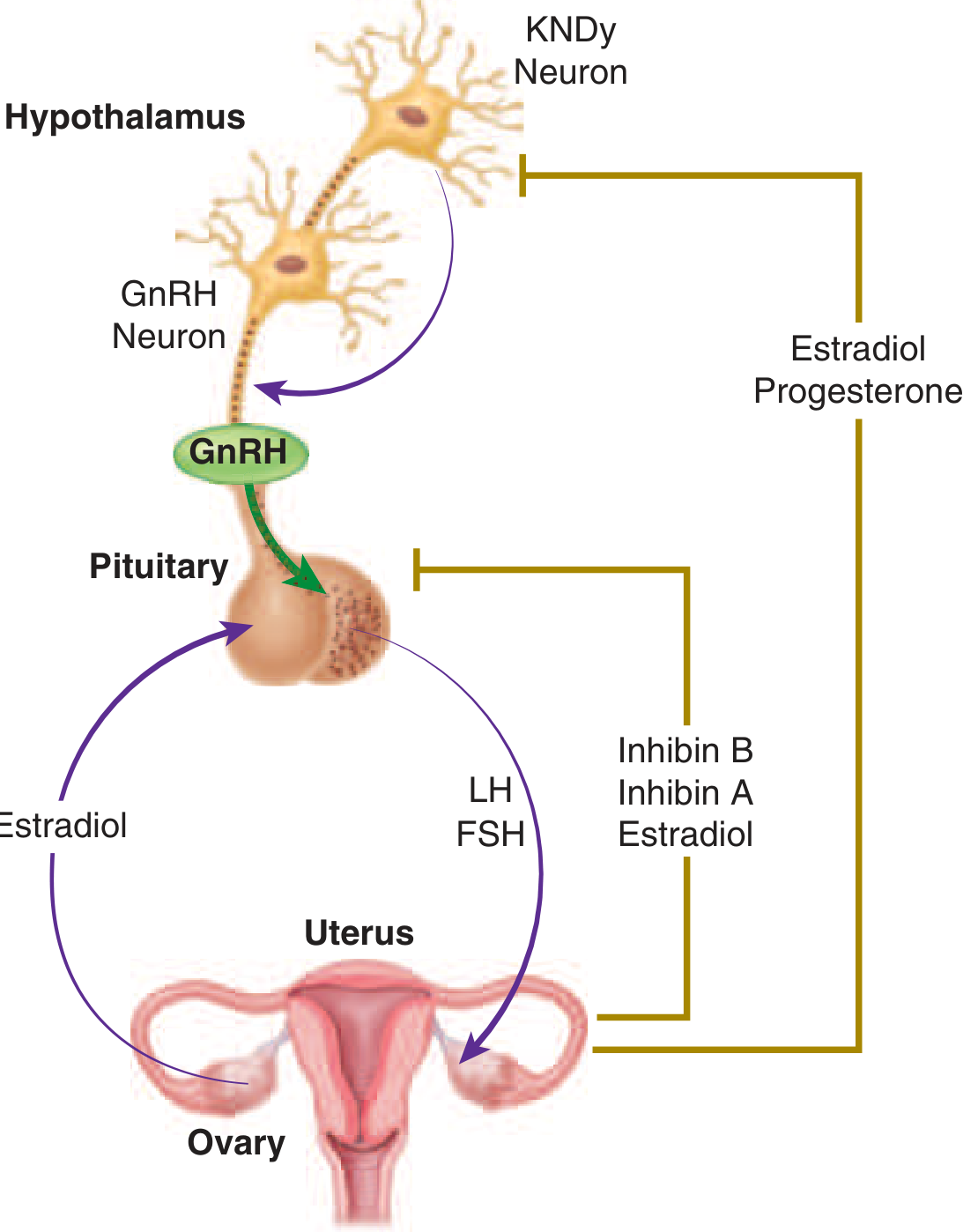
- Pulsatile GnRH secretion from the hypothalamic arcuate nucleus
- Pituitary response to GnRH (synthesis and release of LH and FSH)
- Relative secretion of LH vs. FSH
Hormone Dynamics Across the Cycle
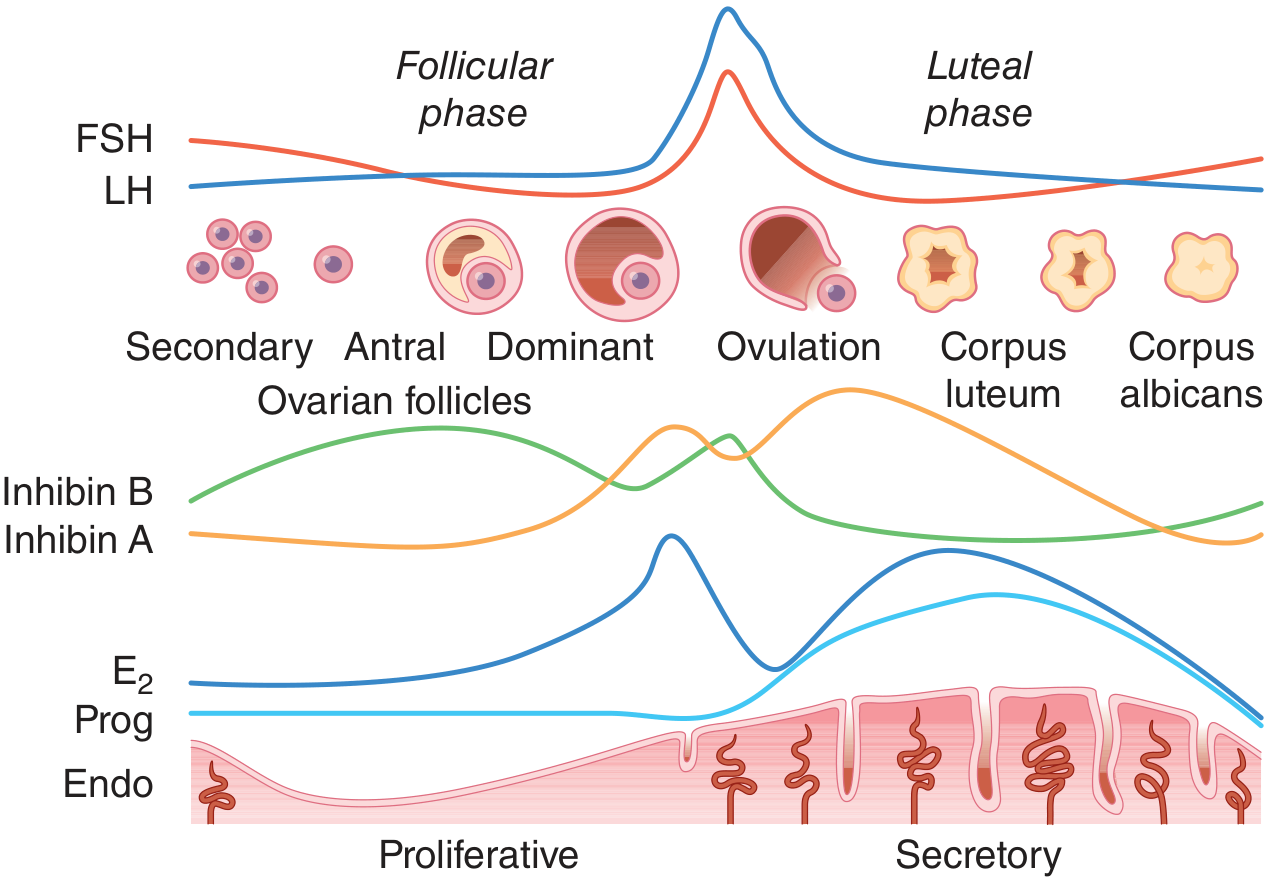
Phase 1: Follicular Phase (Days 1-14)
Initiation - the FSH Rise
The Two-Cell, Two-Gonadotropin Model
- LH acts on theca cells to stimulate androgen (androstenedione, testosterone) production
- FSH acts on granulosa cells to induce aromatase, converting androgens to estradiol (E2)
Dominant Follicle Selection
Late Follicular Phase
- Continued negative feedback suppression of FSH (and initially LH)
- At a threshold of sustained high estradiol, a switch to positive feedback at the pituitary, upregulating GnRH receptors and gonadotrope responsiveness
Phase 2: Ovulation (Day ~14)
- The LH surge precedes follicle rupture by 24-36 hours
- During this window: the oocyte uncouples from granulosa cells, genes for inflammation and tissue remodeling are induced, and final oocyte maturation (completion of meiosis I) occurs
Phase 3: Luteal Phase (Days 14-28)
Corpus Luteum Formation
- Progesterone (dominant hormone)
- 17-hydroxyprogesterone
- Inhibin A
- Estradiol (via continued aromatization of theca-derived androgens by luteinized granulosa cells)
- Relaxin
Endometrial Effects
- Glands become tortuous and glycogen-filled
- Stroma becomes edematous
- Spiral arteries elongate and coil further
- Cervical mucus becomes thick, non-elastic, and non-ferning (hostile to sperm)
- Basal body temperature rises (~0.2-0.5°C) due to progesterone's thermogenic effect on the hypothalamic temperature set point
Negative Feedback and Corpus Luteum Regression
Menstruation
If Pregnancy Occurs
Key Feedback Summary
| Hormone | Source | Feedback at Hypothalamus | Feedback at Pituitary |
|---|---|---|---|
| Estradiol (low-moderate) | Granulosa cells | Negative (via KNDy neurons) | Negative (more for FSH than LH) |
| Estradiol (high, sustained) | Dominant follicle | Permissive/positive | Positive - triggers LH surge |
| Progesterone | Corpus luteum | Negative (via KNDy/dynorphin) | Negative |
| Inhibin B | Early-mid follicular granulosa | - | Suppresses FSH selectively |
| Inhibin A | Dominant follicle, corpus luteum | - | Suppresses FSH selectively |
| Activin | Pituitary (autocrine) | - | Stimulates FSH synthesis |
Menstrual Cycle at a Glance
| Feature | Follicular Phase | Ovulation | Luteal Phase |
|---|---|---|---|
| Duration | 10-14 days (variable) | Day 14 | 14 days (constant) |
| Dominant hormone | Estradiol | LH/FSH surge | Progesterone |
| Endometrium | Proliferative | - | Secretory |
| Cervical mucus | Watery, ferning, sperm-friendly | Peak | Thick, non-ferning |
| BBT | Normal | - | Elevated |
| Key gonadal event | Follicle growth, dominant selection | Ovulation | Corpus luteum function |
- Harrison's Principles of Internal Medicine 22E (2025), pp. 3172-3175 - primary source for HPO axis and feedback mechanisms
- Berek & Novak's Gynecology - two-cell/two-gonadotropin model, phase summary
- Costanzo Physiology 7th Edition, pp. 478-480 - phase-by-phase hormone events
- Medical Physiology (Boron & Boulpaep) - HPO axis driving the cycle
In flowchart
A detailed medical flowchart showing the hormonal control of the menstrual cycle. The flowchart should be vertical and clearly organized with labeled boxes and arrows. Include the following flow: TOP SECTION - "HYPOTHALAMUS" box: GnRH (pulsatile) → arrow down to "ANTERIOR PITUITARY" box ANTERIOR PITUITARY releases: FSH and LH → arrows down FOLLICULAR PHASE box (Days 1-14, blue theme): - FSH stimulates follicle recruitment (cohort of secondary follicles) - Two-cell two-gonadotropin model: LH → Theca cells → Androgens → (aromatase, FSH) → Granulosa cells → Estradiol - Rising Estradiol → Endometrial proliferation - Rising Inhibin B + Estradiol → NEGATIVE FEEDBACK arrow back up to pituitary (FSH suppressed) - Dominant follicle selected (most FSH receptors, survives FSH fall) - Late follicular: sustained high Estradiol → POSITIVE FEEDBACK → LH Surge trigger OVULATION box (Day 14, red/orange highlight): - LH Surge (+ smaller FSH surge) - Follicle rupture 24-36 hours after surge - Oocyte released LUTEAL PHASE box (Days 14-28, yellow/green theme): - Corpus luteum forms from ruptured follicle - Secretes: Progesterone + Estradiol + Inhibin A - Progesterone → Secretory endometrium, thick cervical mucus, raised BBT - Progesterone + Estradiol + Inhibin A → NEGATIVE FEEDBACK → suppresses GnRH, FSH, LH Two outcome branches at bottom: LEFT branch - "NO PREGNANCY": Corpus luteum regresses → Progesterone/Estradiol fall → Endometrial shedding (MENSTRUATION) → FSH rises again → New cycle RIGHT branch - "PREGNANCY": hCG from embryo → Rescues corpus luteum → Sustained progesterone → Maintains endometrium Use color coding: blue for follicular phase, orange/red for ovulation, green for luteal phase, pink for endometrial effects, red dashed arrows for negative feedback, green dashed arrows for positive feedback. Clean professional medical textbook style, white background, clear typography.
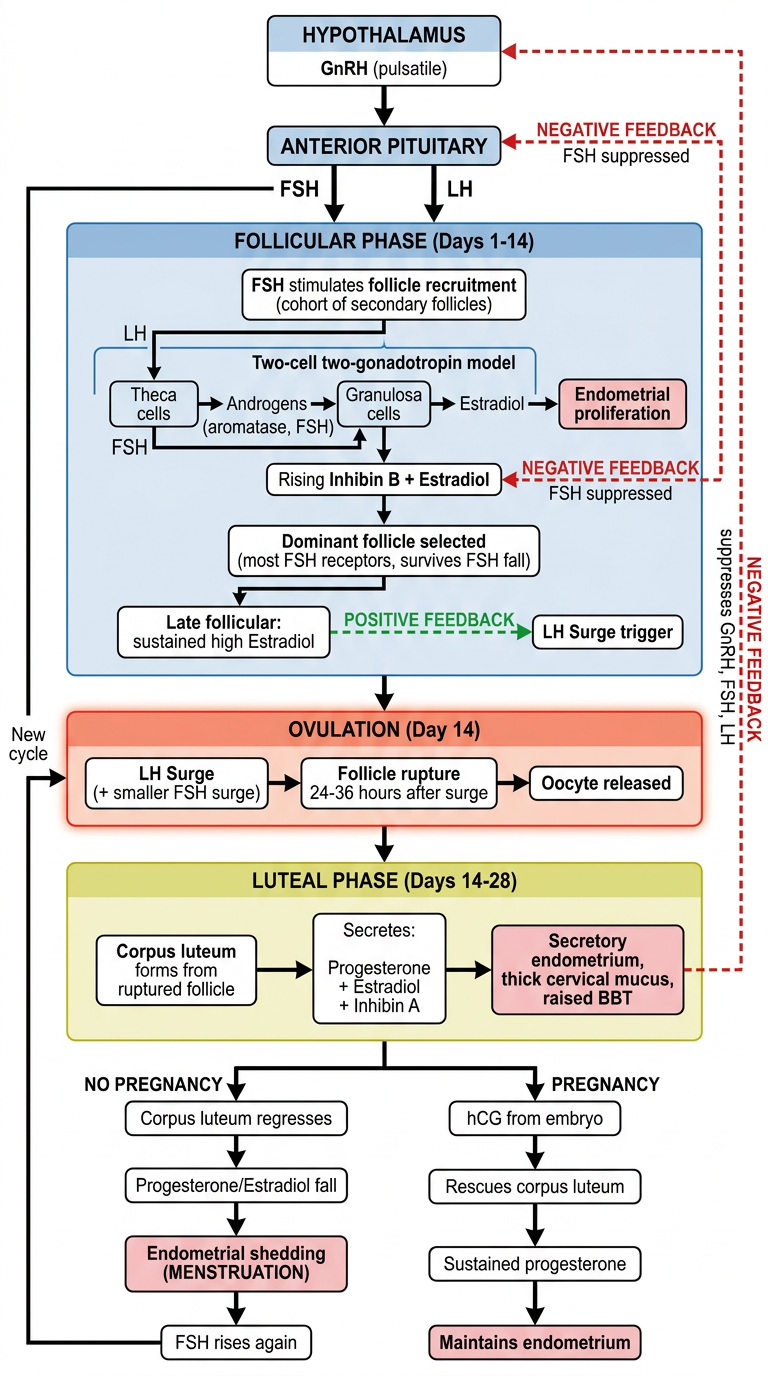
- HPO Axis at the top (Hypothalamus → GnRH → Pituitary → FSH/LH)
- Follicular Phase (Days 1-14): follicle recruitment, the two-cell/two-gonadotropin model, dominant follicle selection, and the negative→positive feedback switch of estradiol
- Ovulation (Day 14): the LH surge triggering follicle rupture 24-36 hours later
- Luteal Phase (Days 14-28): corpus luteum forming and secreting progesterone + estradiol, with negative feedback suppressing FSH/LH
- Two outcome branches: menstruation (if no pregnancy) vs. hCG rescue of corpus luteum (if pregnancy occurs)