
Wht shld be done in cardiogenic shock
"cardiogenic shock" AND management
cardiogenic shock management algorithm hemodynamic support
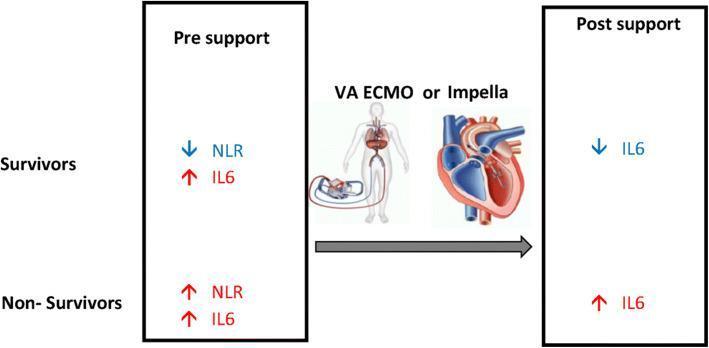
This medical infographic illustrates the prognostic value of inflammatory markers in cardiogenic shock patients undergoing percutaneous mechanical circulatory support (MCS). The diagram is divided into 'Pre support' and 'Post support' phases, centered around an illustration of VA ECMO and Impella devices. In the 'Pre support' phase, survivors are characterized by lower Neutrophil-to-Lymphocyte Ratio (NLR) levels (blue downward arrow) but elevated Interleukin-6 (IL6) levels (red upward arrow), whereas non-survivors exhibit elevations in both NLR and IL6. Following the transition to mechanical support ('Post support'), the infographic highlights a critical divergence in cytokine response: survivors demonstrate a significant reduction in IL6 levels (blue downward arrow), while non-survivors show a continued rise in IL6 (red upward arrow). The visual emphasizes the educational concept that successful hemodynamic stabilization via MCS is associated with a resolution of systemic inflammation (IL6 reduction), while persistent or increasing inflammation despite support correlates with poor clinical outcomes and mortality.
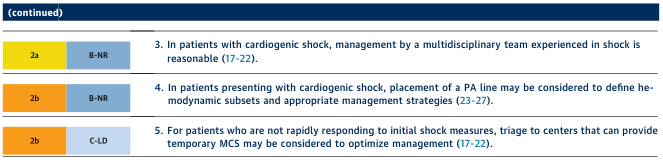
(continued) <table><tr><td>2a</td><td>B-NR</td><td>3. In patients with cardiogenic shock, management by a multidisciplinary team experienced in shock is reasonable (17-22).</td></tr><tr><td>2b</td><td>B-NR</td><td>4. In patients presenting with cardiogenic shock, placement of a PA line may be considered to define hemodynamic subsets and appropriate management strategies (23-27).</td></tr><tr><td>2b</td><td>C-LD</td><td>5. For patients who are not rapidly responding to initial shock measures, triage to centers that can provide temporary MCS may be considered to optimize management (17-22).</td></tr></table>
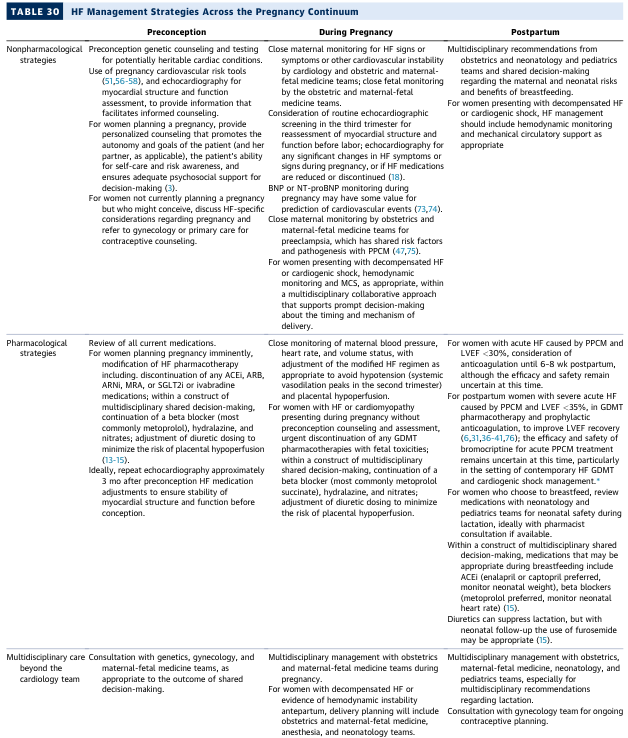
TABLE 30 HF Management Strategies Across the Pregnancy Continuum <table><thead><tr><th></th><th>Preconception</th><th>During Pregnancy</th><th>Postpartum</th></tr></thead><tbody><tr><td>Nonpharmacological strategies</td><td>Preconception genetic counseling and testing for potentially heritable cardiac conditions. Use of pregnancy cardiovascular risk tools (5,36-50), and echocardiography for myocardial structure and function assessment, to provide information that facilitates informed counseling. For women planning a pregnancy, provide personalized counseling that promotes the autonomy and goals of the patient (and her partner, as applicable), the patient's ability to address and risk awareness, and ensures adequate psychosocial support for decision-making (3). For women not currently planning a pregnancy but who might conceive, discuss HF-specific considerations regarding pregnancy and refer to gynecology or primary care for contraceptive counseling.</td><td>Close maternal monitoring for HF signs or symptoms or other cardiovascular changes by cardiology and obstetric and maternal-fetal medicine teams; close fetal monitoring by the obstetric and maternal-fetal medicine teams. Consideration of routine echocardiographic screening in the third trimester for reassessment of myocardial structure and function before labor and echocardiography for any significant changes in HF symptoms or signs during pregnancy, or if HF medications are reduced or discontinued (18). BNP or NT-proBNP monitoring during pregnancy may have some value for prediction of cardiovascular events (73,74). Close maternal monitoring by obstetrics and maternal-fetal medicine teams for preeclampsia, which has shared risk factors and pathogenesis with PPCM (47,75). For women presenting with decompensated HF or cardiogenic shock, hemodynamic monitoring and MCS, as appropriate, within a multidisciplinary collaborative approach that supports prompt decision-making about the timing and mechanism of delivery.</td><td>Multidisciplinary recommendations from obstetrics and neonatology and pediatrics teams and shared decision-making regarding the maternal and neonatal risks and benefits of breastfeeding. For women presenting with decompensated HF or cardiogenic shock, HF management should include hemodynamic monitoring and mechanical circulatory support as appropriate.</td></tr><tr><td>Pharmacological strategies</td><td>Review of all current medications. For women planning pregnancy imminently, initiation of HF pharmacotherapies including discontinuation of ACEi, ARB, ARNI, MRA, or SGLT2i or ivabradine medications, within a construct of multidisciplinary shared decision-making, continuation of a beta blocker (most commonly metoprolol), hydralazine, and nitrates, adjustment of diuretic dosing to minimize the risk of placental hypoperfusion (13-15). Ideally, repeat echocardiography approximately 3 mo after preconception HF medication adjustments to ensure stability of myocardial structure and function before conception.</td><td>Close monitoring of maternal blood pressure, heart rate, and volume status, with adjustment of HF pharmacotherapy regimen as appropriate to avoid hypotension (systemic vasodilator peaks in the second trimester) and maternal hypervolemia. For women with HF or cardiomyopathy presenting during pregnancy without preconception counseling and assessment, urgent discontinuation of any GDMT pharmacotherapies with fetal toxicities; within a construct of multidisciplinary shared decision-making, continuation of a beta blocker (most commonly metoprolol succinate), hydralazine, and nitrates, adjustment of diuretic dosing to minimize the risk of placental hypoperfusion.</td><td>For women with acute HF caused by PPCM and LVEF <30%, consideration of anticoagulation until 6-8 wk postpartum, although the efficacy and safety remain uncertain at this time. For postpartum women with severe acute HF caused by PPCM and LVEF <35%, in GDMT pharmacotherapy and prophylactic anticoagulation, to improve LVEF recovery (6,13,36-41,76); the efficacy and safety of bromocriptine for acute PPCM treatment remains uncertain at this time, particularly in the setting of contemporary HF GDMT and cardiogenic shock management.* For women who choose to breastfeed, review medications with neonatology and pediatrics teams for neonatal safety during lactation, ideally with pharmacist consultation if available. Within a construct of multidisciplinary shared decision-making, medications that may be appropriate during breastfeeding include ACEi (enalapril or captopril preferred, monitor neonatal weight), beta blockers (metoprolol preferred, monitor neonatal heart rate) (15). Diuretics can suppress lactation, but with neonatal follow-up the use of furosemide may be appropriate (15).</td></tr><tr><td>Multidisciplinary care beyond the cardiology team</td><td>Consultation with genetics, gynecology, and maternal-fetal medicine teams, as appropriate to the outcome of shared decision-making.</td><td>Multidisciplinary management with obstetrics and maternal-fetal medicine teams during pregnancy. For women with decompensated HF or evidence of hemodynamic instability antepartum, delivery planning will include obstetrics and maternal-fetal medicine, anesthesia, and neonatology teams.</td><td>Multidisciplinary management with obstetrics, maternal-fetal medicine, neonatology, and pediatrics teams, especially for multidisciplinary recommendations regarding lactation. Consultation with gynecology team for ongoing contraceptive planning.</td></tr></tbody></table>
Management of Cardiogenic Shock
Definition & Diagnostic Criteria
- Systolic BP < 90 mm Hg (sustained)
- Pulmonary capillary wedge pressure (PCWP) > 18 mm Hg
- Cardiac index (CI) < 2.2 L/min/m²
Note: 75% of cardiogenic shock complicating MI develops after hospital admission - early recognition and intervention are key.
- Goldman-Cecil Medicine, p. 2621
Step 1 - Initial Stabilization
| Action | Details |
|---|---|
| IV access | Large-bore, ideally central line |
| Supplemental O2 / intubation | Intubate if hypoxemic or increased work of breathing; reduces O2 demand and allows sedation |
| Continuous ECG monitoring | Detect/treat arrhythmias promptly |
| Arterial line | For accurate BP monitoring (non-invasive BP is unreliable in severe shock) |
| Correct electrolytes | Hypokalemia and hypomagnesemia worsen arrhythmias |
| Pain/anxiety relief | Opiates reduce sympathetic activity, preload, and afterload |
| Echocardiography (STAT) | Confirm cardiac dysfunction; rule out tamponade, VSD, papillary muscle rupture, RV infarction |
- Goldman-Cecil Medicine, p. 2990-2991
Step 2 - Vasopressors & Inotropes
First-Line: Norepinephrine
- Preferred vasopressor to raise systolic BP to target > 90 mm Hg
- Better survival than dopamine in cardiogenic shock (fewer arrhythmias)
- Start at 0.1-0.2 mcg/kg/min, titrate to MAP ≥ 65 mm Hg
Add Inotrope: Dobutamine
- Start 2-5 mcg/kg/min when cardiac output is severely reduced
- Increases contractility and reduces afterload
- Use with norepinephrine when BP is very low
Dopamine
- Alternative if norepinephrine unavailable
- Higher risk of tachyarrhythmias
Vasodilators (later, with caution)
- Sodium nitroprusside or nitroglycerin - only when BP has been stabilized
- Reduce afterload and improve forward flow
The key vasopressor/inotrope principle: do not use vasopressors as the sole therapy - treat the underlying cause simultaneously.
- Goldman-Cecil Medicine, p. 2991-2993
Step 3 - Identify and Treat the Underlying Cause
Most Common Cause: Acute MI / STEMI
- PCI (Percutaneous Coronary Intervention): Preferred over fibrinolysis in cardiogenic shock due to MI; reduces 1-year mortality significantly
- CABG: For patients with unsuitable anatomy for PCI or left main/3-vessel disease
- Fibrinolysis: Only if PCI is unavailable within a reasonable timeframe
"The SHOCK trial demonstrated that early revascularization was the only therapy shown to reduce mortality in cardiogenic shock." - Goldman-Cecil Medicine, p. 2994
Other Causes to Treat:
| Cause | Specific Treatment |
|---|---|
| Acute MR (papillary rupture) | Emergency surgical repair |
| Ventricular septal defect | Emergency surgical repair |
| Cardiac tamponade | Pericardiocentesis |
| RV infarction | Volume loading + avoid nitrates/diuretics; improve LV function |
| Fulminant myocarditis | Immunosuppression in select cases; MCS bridge |
| Massive PE | Thrombolysis or catheter-directed therapy |
| Arrhythmia | Cardioversion / pacing |
Step 4 - Mechanical Circulatory Support (MCS)
| Device | Mechanism | Notes |
|---|---|---|
| IABP (Intra-aortic balloon pump) | Diastolic augmentation + systolic unloading | Historically first-line; IABP-SHOCK II trial showed no mortality benefit in routine use - now selective |
| Impella (2.5, CP, 5.0) | Axial pump - pulls blood from LV into aorta | Most widely used active MCS; provides up to 5 L/min |
| VA-ECMO (Veno-arterial extracorporeal membrane oxygenation) | Full cardiopulmonary bypass support | Used in refractory shock; can increase LV afterload - often "vented" with Impella |
| TandemHeart | Left atrial-to-aorta bypass | Less commonly used |
-
Multidisciplinary "shock team" management is associated with better outcomes
-
Transfer to a center capable of MCS should be considered early if not responding
-
PA catheter (Swan-Ganz) is useful to guide therapy in complex/refractory cases
-
Goldman-Cecil Medicine, p. 2984-2995; AHA/ACC guidelines recommendation Class 2a
Step 5 - Monitoring & Targets
| Parameter | Target |
|---|---|
| MAP | ≥ 65 mm Hg |
| Urine output | > 0.5 mL/kg/h |
| Lactate | Trending downward |
| SvO2 (mixed venous O2 sat) | > 65% |
| PCWP | 15-18 mm Hg |
| Cardiac index | > 2.2 L/min/m² |
What NOT to Do
- Avoid aggressive fluid loading - may worsen pulmonary edema; fluids are NOT first-line (unlike distributive shock)
- Do not delay revascularization for hemodynamic stabilization alone - early PCI saves lives
- Avoid dopamine as first choice over norepinephrine (more arrhythmias, worse outcomes)
- Do not use beta-blockers, ACE inhibitors, or aggressive diuresis in acute phase
Summary Algorithm
Suspected Cardiogenic Shock
        ↓
O2 + IV access + ECG monitoring + Arterial line
        ↓
Stat Echo → confirm diagnosis, identify cause
        ↓
Norepinephrine (vasopressor) + Dobutamine (inotrope)
        ↓
Identify & treat cause:
  - ACS → Urgent PCI/CABG
  - Mechanical complication → Surgery
  - Tamponade → Pericardiocentesis
  - RV infarction → Volume + treat LV
        ↓
Not responding? → Add MCS (Impella / ECMO)
        ↓
Shock Team + PA catheter-guided optimization
- Goldman-Cecil Medicine (26th ed.), Chapter 93 - Cardiogenic Shock (Hollenberg & Yancy), pp. 2621-2995
- Rosen's Emergency Medicine (9th ed.), Chapter 3 - Shock, p. 1483
- Harrison's Principles of Internal Medicine 22E (2025), p. 1407
- Recent meta-analysis: Cangrelor in cardiogenic shock undergoing PCI (Crit Care, 2025, PMID 41457245) - supports antiplatelet strategies in ischemic cardiogenic shock