
/handwrittennotes alpha and beta receptors function and adrenaline,noradrenaline,dopamine actions on these receptors
/handwrittennotes
"adrenergic receptors"[MeSH Terms] AND "catecholamines"[MeSH Terms]
adrenergic receptor subtypes alpha1 alpha2 beta1 beta2 tissue distribution effects of epinephrine norepinephrine dopamine
/handwrittennotes. The path doesn't exist in my workspace, so I haven't seen your notes. If you re-upload them, I'll check this against what you wrote. The summary below comes from the library textbooks and standard pharmacology.1. Receptor functions
| Receptor | G protein / signal | Main locations | Effects when stimulated |
|---|---|---|---|
| α1 | Gq: PLC → IP3/DAG → ↑Ca²⁺ | Vascular smooth muscle (skin, splanchnic, coronary), pupillary dilator, bladder trigone and sphincter, prostate, vas deferens, liver | Vasoconstriction (↑ SVR and BP), mydriasis, sphincter contraction (urinary retention), ejaculation, glycogenolysis. Relaxes gut smooth muscle. Has a positive inotropic effect on the heart. |
| α2 | Gi: ↓cAMP | Presynaptic nerve terminals, platelets, pancreatic β cells, CNS (brainstem), some vessels | Presynaptic inhibition of NE release (negative feedback), ↓ central sympathetic outflow (↓ BP and HR), platelet aggregation, ↓ insulin release, ↓ gut motility, vasoconstriction of some vessels |
| β1 | Gs: ↑cAMP → PKA | Heart (SA node, AV node, myocardium), juxtaglomerular cells | ↑ HR, ↑ contractility, ↑ AV conduction, ↑ renin release |
| β2 | Gs: ↑cAMP | Bronchial and vascular smooth muscle (skeletal muscle, coronary), uterus, liver, skeletal muscle, ciliary body | Bronchodilation, vasodilation (↓ SVR), uterine relaxation, glycogenolysis and gluconeogenesis, K⁺ uptake into cells, tremor, ↑ aqueous humor |
| β3 | Gs: ↑cAMP | Adipose tissue, bladder detrusor | Lipolysis, detrusor relaxation |
| D1 | Gs: ↑cAMP | Renal, mesenteric and coronary vessels | Vasodilation, ↑ renal blood flow, natriuresis |
| D2 | Gi: ↓cAMP | Presynaptic nerve terminals, CNS | ↓ NE release, central effects (CTZ, pituitary) |
- Ahlquist proposed α and β receptors in 1948, and they were later subdivided into α1, α2, β1, β2 and β3 (- Barash, Cullen, and Stoelting's Clinical Anesthesia, 9e, p. 1049-1050).
- α1 receptors are postsynaptic only. α2 receptors sit on both pre- and postsynaptic membranes (- Barash, Cullen, and Stoelting's Clinical Anesthesia, 9e, p. 1052-1053).
- All three β subtypes couple to Gs and raise cAMP. This activates PKA, which phosphorylates target proteins. Repeated exposure causes desensitization through GRK phosphorylation and arrestin binding (- Goodman & Gilman's The Pharmacological Basis of Therapeutics, p. 218-219).
- DA1 and DA2 receptors are found in renal, mesenteric and coronary vessels and in the CNS (- Barash, Cullen, and Stoelting's Clinical Anesthesia, 9e, p. 1050).
2. Actions of the three catecholamines
| Drug | α1 | α2 | β1 | β2 | D1 | Net effect |
|---|---|---|---|---|---|---|
| Adrenaline (epinephrine) | +++ | +++ | +++ | +++ | 0 | Dose-dependent (see below) |
| Noradrenaline (norepinephrine) | +++ | +++ | ++ | +/0 (weak) | 0 | Strong vasoconstriction, ↑ BP, reflex bradycardia |
| Dopamine | + (high dose) | + | ++ (medium dose) | + | +++ (low dose) | Dose-dependent (see below) |
- Low dose or infusion: β effects dominate. Heart rate and contractility rise (β1). Skeletal muscle vessels dilate (β2), so diastolic BP falls and pulse pressure widens. The bronchi dilate.
- High dose: α1 vasoconstriction takes over, so SVR and BP rise.
- Other effects: Raises blood glucose through glycogenolysis and lipolysis. Causes mydriasis. Stabilises mast cells.
- Clinical use: First-line for anaphylaxis, cardiac arrest, and severe bronchospasm. Also added to local anaesthetics to prolong their action.
- It acts mainly on α1, with some α2 and β1 activity, and little β2 activity.
- It causes intense peripheral vasoconstriction, so systolic, diastolic and mean BP all rise.
- The rise in BP triggers a baroreceptor-mediated vagal reflex that slows the heart. This offsets its direct β1 effect, so heart rate usually stays unchanged or falls.
- Clinical use: First-line vasopressor in septic shock.
- Low dose (about 0.5-2 mcg/kg/min): D1 stimulation dilates renal, mesenteric and coronary beds. This raises renal blood flow, GFR and sodium excretion. Routine "renal-dose" use for kidney protection is not supported by evidence.
- Medium dose (about 2-10 mcg/kg/min): β1 stimulation raises contractility and cardiac output, with a smaller effect on heart rate.
- High dose (above about 10 mcg/kg/min): α1 stimulation causes vasoconstriction and a rise in SVR and BP. The renal vasodilation is lost.
- Clinical use: Shock with bradycardia or low cardiac output. It is also arrhythmogenic.
3. Quick memory points
- The order of potency at α receptors is NE ≥ EPI ≫ isoproterenol.
- The order of potency at β receptors is isoproterenol > EPI ≥ NE.
- At β2, EPI is much more potent than NE. This is why adrenaline lowers diastolic BP at low dose and noradrenaline does not.
- Mnemonic: α1 = Gq = constrict. α2 = Gi = brake. β1 = heart. β2 = lungs and vessel dilation.
- The synthesis pathway is tyrosine → DOPA → dopamine → noradrenaline → adrenaline. The last step is catalysed by PNMT, which is expressed in the adrenal medulla. The medulla secretes about 80% adrenaline and 20% noradrenaline (- Bailey and Love's Short Practice of Surgery, 28th Ed).
/handwrittennotes alpha and beta receptors function and adrenaline,noradrenaline,dopamine actions on these receptors Create an image
A clear educational study-notes infographic on adrenergic receptors. Title: "Alpha and Beta Receptors and Actions of Adrenaline, Noradrenaline, Dopamine". Left section: receptor table with α1 (Gq, vasoconstriction, mydriasis, sphincter contraction), α2 (Gi, presynaptic inhibition of NE release, platelet aggregation, decreased insulin), β1 (Gs, heart: increased heart rate, contractility, AV conduction, renin release), β2 (Gs, bronchodilation, vasodilation in skeletal muscle, uterine relaxation, glycogenolysis), β3 (Gs, lipolysis), D1 (Gs, renal and mesenteric vasodilation), D2 (Gi). Right section: drug-versus-receptor grid: Adrenaline = α1 +++, α2 +++, β1 +++, β2 +++ (low dose β effects, high dose α effects); Noradrenaline = α1 +++, α2 +++, β1 ++, β2 weak (raises BP, reflex bradycardia); Dopamine = low dose D1 (renal vasodilation), medium dose β1 (increased cardiac output), high dose α1 (vasoconstriction). Bottom: synthesis pathway Tyrosine, DOPA, Dopamine, Noradrenaline, Adrenaline (PNMT), and mnemonic "α1 = Gq = constrict; α2 = Gi = brake; β1 = heart; β2 = lungs and vasodilation". Handwritten-notes style on lined paper with colored headings and simple icons of heart, lungs, blood vessel, kidney.
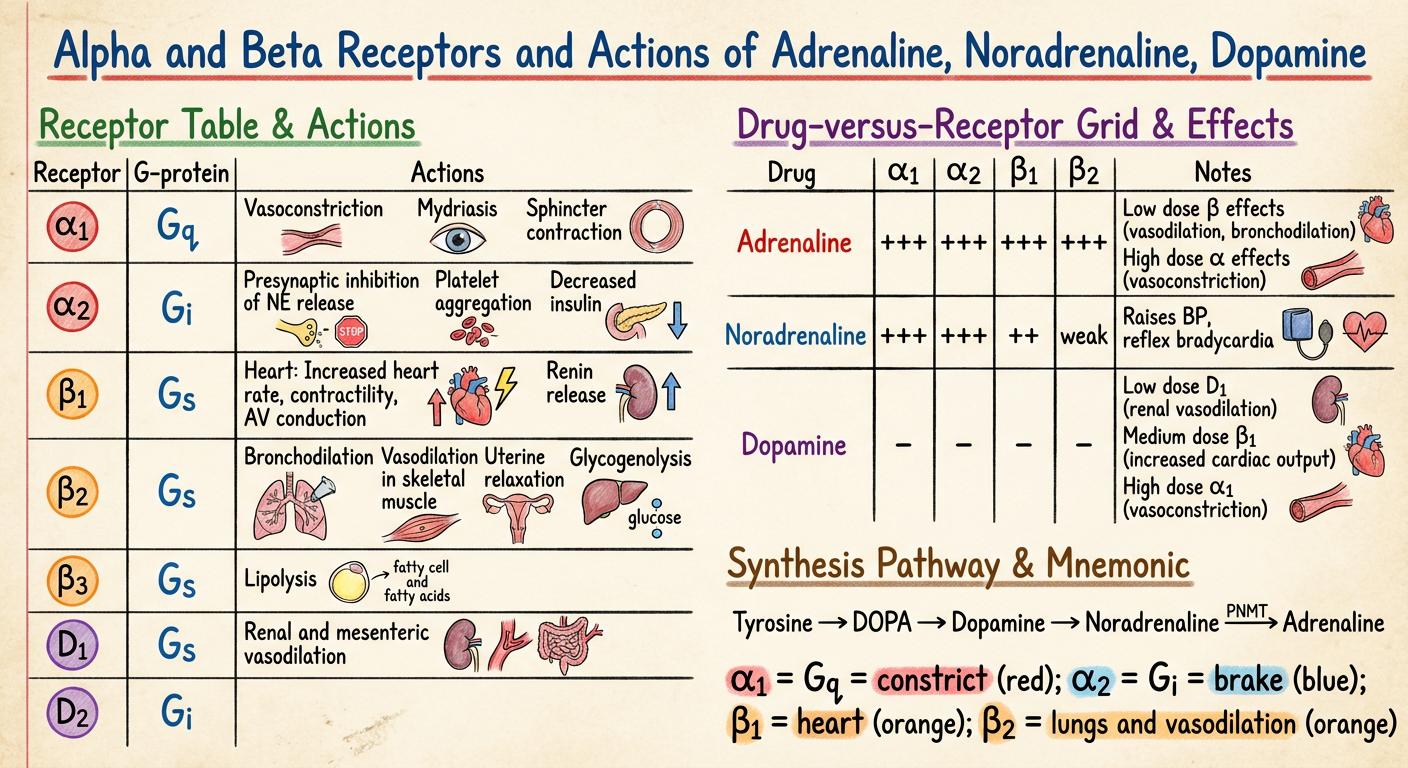
- Receptors: α1, α2, β1, β2, β3, D1 and D2, each with its G protein and main effects.
- Drugs: a grid of adrenaline, noradrenaline and dopamine against each receptor, including the dose-dependent effects.
- Extras: the synthesis pathway (tyrosine → DOPA → dopamine → noradrenaline → adrenaline) and the mnemonic.
/handwrittennotes, so this follows the textbook content, not your notes.