
Ameloblastoma in detail and explain in creative ways
Reading File
Now let me search the medical library and web in parallel for comprehensive ameloblastoma content.
Finding Sources
Searching the Web
ameloblastoma pathology classification treatment 2024
Searching PubMed
ameloblastoma[MeSH Terms] AND treatment
Now let me read the most comprehensive textbook sections in parallel with image searches:
Reading File
Reading File
Searching Images
ameloblastoma histology microscopy follicular plexiform
Now let me get more detailed content on histological variants, molecular biology, and clinical management:
Reading File
Reading File
Searching Images
ameloblastoma CT scan jaw radiolucent soap bubble multilocular
I now have rich content from textbooks, images, and recent literature. Let me compile the comprehensive, creative response.
🦷 Ameloblastoma — The Jaw's Most Notorious Trickster
"The tumor that looks harmless but acts like a squatter — it'll move in slowly, refuse to leave, and keep coming back."
🌱 Origin Story: What IS an Ameloblastoma?
Ameloblastoma is the most aggressive benign odontogenic tumor of the jaws. The name comes from the Old French amel (enamel) + Greek blastos (germ) — it arises from the epithelial remnants of the enamel organ, the same tissue that builds your teeth during development. When that tissue goes rogue, it doesn't make enamel — instead, it forms an expanding, infiltrative mass that slowly devours bone.
- Incidence: ~1 in 1 million per year — rare but not negligible
- Most common location: Mandible (~85%), especially the molar-ramus region
- Peak age: Conventional type after age 20; unicystic type in the 2nd–3rd decade
- No sex predilection (affects males and females equally)
🎭 The Four Characters: WHO 2017 Classification
Think of ameloblastoma as a family of four siblings, each with a distinct personality:
| Type | Personality | Key Feature |
|---|---|---|
| Conventional (Solid/Multicystic) | The Classic Bully | Intraosseous, locally aggressive, highest recurrence |
| Unicystic | The Undercover Agent | Mimics a dentigerous cyst radiographically |
| Peripheral (Extraosseous) | The Soft-Tissue Squatter | Lives on the gingiva, no bone invasion |
| Metastasizing | The Surprise Traveller | Benign histology but metastasizes — most often to lung |
The 2017 WHO classification removed "solid/multicystic" from the conventional type name and reclassified metastasizing ameloblastoma OUT of the malignant category — because its histology is benign; it's the behavior that's surprising.
🔬 Microscopy: The Enamel Organ Reborn
Under the microscope, ameloblastoma is a masterpiece of developmental mimicry — it recreates the architecture of a developing tooth germ.
The Hallmark Architecture
Reverse polarity (a.k.a. the "piano key sign"):
- Peripheral columnar cells line the epithelial islands
- Their nuclei are pushed away from the basement membrane (toward the center of the cell) — this is the reverse of normal epithelium
- Central cells are loosely arranged, resembling stellate reticulum of the tooth bud
🎸 Histological Variants — The Band Members
| Variant | Visual Metaphor | Description |
|---|---|---|
| Follicular | 🥚 Nests of eggs | Discrete islands with peripheral palisading and stellate center |
| Plexiform | 🕸️ Spider web | Anastomosing cords and sheets in vascular stroma |
| Acanthomatous | 🧀 Swiss cheese | Squamous metaplasia with keratin pearls in the center |
| Granular cell | 🫙 Jar of marbles | Central cells packed with eosinophilic granules (lysosomes) |
| Desmoplastic | 🪨 Rocky landscape | Dense fibrous (desmoplastic) stroma; mixed lucent-opaque on X-ray |
| Basal cell | 🧱 Brick wall | Basaloid nests with minimal stellate reticulum; classic in peripheral type |
Note: Histological variant does not affect prognosis — it's the tumor type (conventional vs. unicystic vs. peripheral) and surgical margins that matter.
Histology Images:
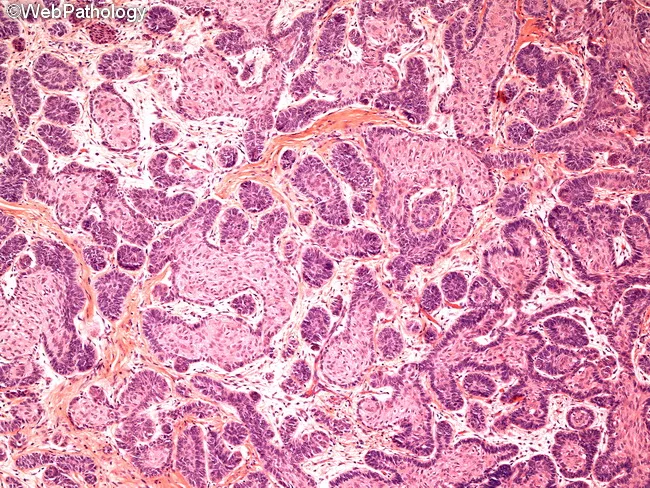
Classic ameloblastoma: follicular pattern with peripheral palisading, reverse nuclear polarity, and stellate reticulum-like center.
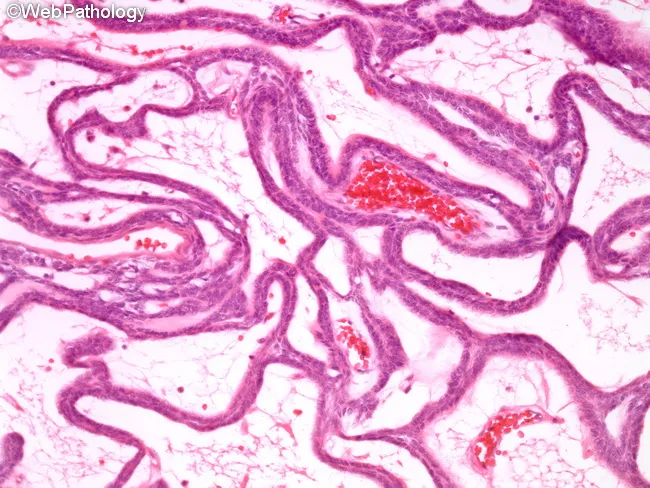
Plexiform variant: interconnected epithelial cords in a loose vascular stroma — the "spider web" pattern.
📡 Radiology: The Soap Bubble Sign
Ameloblastoma has a classic but not pathognomonic radiographic appearance:
- Multilocular radiolucency — the iconic "soap bubble" or "honeycomb" pattern
- May also appear unilocular (especially unicystic type, nearly indistinguishable from a dentigerous cyst)
- Well-demarcated borders with a sclerotic rim
- Root resorption of adjacent teeth
- Cortical expansion — buccal and lingual cortices balloon outward like a blister
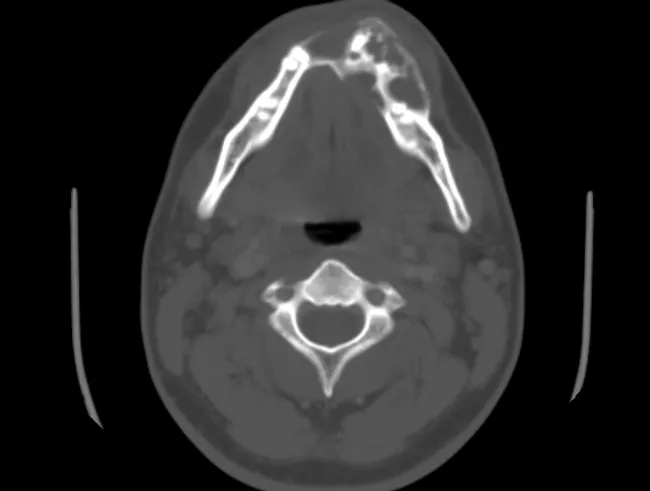
CT showing classic multilocular ameloblastoma of the mandible with cortical expansion — the "soap bubble" at its finest.
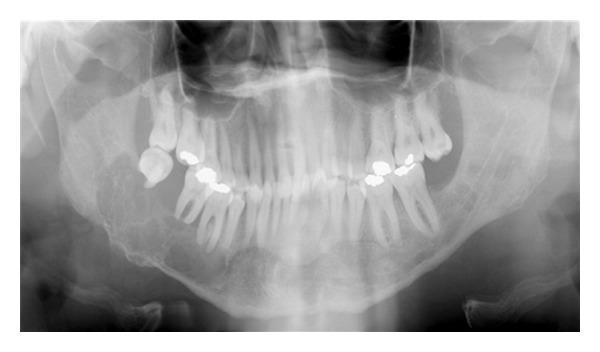
Panoramic X-ray: multilocular ameloblastoma with classic scalloped borders and "floating" displaced teeth.
🧬 Molecular Biology: The MAPK Pathway Gone Wild
In approximately 90% of all ameloblastomas, mutations in the MAPK signaling pathway have been identified — making this one of the best-understood molecular signatures in odontogenic tumors.
Key Mutations
| Gene | Frequency | Significance |
|---|---|---|
| BRAF V600E | ~63% of conventional | Most common; targetable with BRAF inhibitors |
| SMO | ~10% | Hedgehog pathway; seen in BRAF-wild type |
| RAS (KRAS/NRAS/HRAS) | ~15% | Alternative MAPK activation |
| FGFR2 | Rare | Receptor tyrosine kinase mutation |
🔑 BRAF V600E is the master key — it keeps the MAPK "gas pedal" permanently pressed, driving uncontrolled cell proliferation. The same mutation drives melanoma, papillary thyroid cancer, and hairy cell leukemia — meaning vemurafenib (a BRAF inhibitor) is now being explored for refractory/recurrent ameloblastoma.
🩺 Clinical Presentation: The Quiet Invader
Ameloblastoma earns its reputation as "the silent tumor":
- Painless jaw swelling — slow, progressive (patients may ignore it for years)
- Facial asymmetry as the tumor expands
- Loose teeth or displaced teeth (from bone destruction)
- Trismus if involving pterygoid muscles
- No paresthesia (unlike odontogenic carcinoma)
The maxillary location (~15% of cases) is particularly dangerous because the tumor can spread into the pterygoid plates, orbital floor, and pterygopalatine fissure — areas where complete surgical access is limited, so persistence there is more a problem of anatomy than tumor aggression.
🏥 Diagnosis: The Triple Approach
Panoramic X-ray  ──►  CT scan  ──►  Biopsy (histopathology)
     ↓                   ↓                  ↓
 First look         3D extent          Definitive Dx
Differential diagnosis (what it mimics):
- Odontogenic keratocyst (KCOT) — very similar!
- Dentigerous cyst (especially unicystic type)
- Giant cell tumor
- Ossifying fibroma
- Myxoma
- Central mucoepidermoid carcinoma (for desmoplastic type)
⚔️ Treatment: The Great Debate
Ameloblastoma has no single perfect treatment — it has been debated for decades. Here's the battlefield:
Conservative vs. Radical Surgery
| Approach | Method | Recurrence Rate | Use When |
|---|---|---|---|
| Enucleation/Curettage | Scoop it out | ⚠️ 60–80% | Almost never recommended for conventional type |
| Marginal Resection | Remove tumor + 1 cm clear margin | 10–20% | Small conventional lesions; all unicystic mural |
| Segmental Resection | Remove jaw segment entirely | <5% | Large conventional lesions |
| Hemimandibulectomy | Half the mandible | <5% | Extensive disease |
The 1 cm rule: Most surgeons favor resection extending 1 cm past the radiographic edge of the tumor — because ameloblastoma microscopically infiltrates beyond its visible borders.
Reconstruction After Surgery
After segmental jaw resection, reconstruction is essential:
- Free fibula flap — most common choice; provides vascularized bone
- Iliac crest graft
- Titanium plate + secondary bone graft
- Dental implants can be placed later
Targeted Therapy: The New Frontier
For recurrent/unresectable disease with confirmed BRAF V600E:
- Vemurafenib / Dabrafenib (BRAF inhibitors) — evidence accumulating for jaw preservation before surgery
- Trametinib (MEK inhibitor) — used in combination for melanoma; being explored for ameloblastoma
- Response is slow (weeks to months) due to the tumor's inherent slow growth and bone metabolism — but this allows a jaw-preservation strategy in selected cases
📊 Prognosis: The Long Game
| Type | Recurrence Rate | Notes |
|---|---|---|
| Conventional (after resection) | <5% | With adequate margins |
| Conventional (after curettage) | 60–80% | High — why resection is preferred |
| Unicystic luminal/intraluminal | 10–20% | Conservative treatment acceptable |
| Unicystic mural | ~25% | Behaves like conventional — needs resection |
| Peripheral | 15–20% | After excision |
| Metastasizing | Variable | Slow — may not need aggressive treatment |
Lifelong surveillance is mandatory — recurrences can appear 5, 10, even 20 years after initial surgery. Minimum follow-up: 5 years with annual imaging.
☠️ When It Turns Bad: Malignant Forms
Two distinct malignant entities:
1. Malignant Ameloblastoma
- Benign histology (no cytological atypia) but metastasizes — classically to the lung and cervical lymph nodes
- Often delayed metastases — decades after the primary
- Treatment: surgical resection (1–2 cm margins); no chemo/radiotherapy generally needed
- Recent WHO 2017 reclassified this into the benign spectrum since histology is benign
2. Ameloblastic Carcinoma
- Malignant histology (high mitoses, nuclear pleomorphism, necrosis, perineural invasion) + aggressive behavior
- SOX2 overexpression — a potential marker for malignant transformation
- Treatment: resection with 2–3 cm margins + concurrent chemoradiotherapy for positive margins
- Worse prognosis — lymph node and distant metastases possible
🔍 Unicystic Ameloblastoma: The Undercover Case
"It comes disguised as a dentigerous cyst. Your radiograph says cyst. Your biopsy says something far more interesting."
Unicystic ameloblastoma accounts for ~15% of all ameloblastomas and is the great mimicker:
Three Subtypes (Vickers and Gorlin criteria):
- Luminal — ameloblastomatous lining on the cyst wall's luminal surface only → conservative treatment
- Intraluminal — nodule projects INTO the cyst lumen → conservative treatment
- Mural — tumor infiltrates the fibrous wall → treat like conventional ameloblastoma (resection!)
Histological hallmarks (Vickers-Gorlin):
- Columnar basal cells
- Palisading of basilar cells
- Reverse nuclear polarity
- Hyperchromatic basal nuclei
- Sub-nuclear vacuolization
- Loosely arranged stellate cells above the basal layer
💡 Creative Memory Tricks
🎯 "SPRAM" — The Ameloblastoma Checklist
- Slow-growing but locally aggressive
- Painless jaw swelling
- Radiolucent (soap bubble/honeycomb)
- Ameloblastic pattern (reverse polarity, stellate reticulum)
- MAPKK pathway mutations (BRAF V600E most common)
🏗️ Visualizing the Histology
Think of a follicular ameloblastoma island as a deviled egg:
- The outer ring = peripheral columnar cells (the egg white border) with nuclei pointing INWARD
- The center = loosely arranged stellate cells (the yolk)
- Multiple deviled eggs embedded in dense fibrous tissue = the classic picture
📚 Textbook Sources
- K.J. Lee's Essential Otolaryngology, p. 758
- Cummings Otolaryngology Head and Neck Surgery, Ch. 88
🔬 Recent Literature
Three recent systematic reviews (2023–2024) highlight emerging areas:
- Adenoid ameloblastoma is a newly recognized entity (PMID: 37540485) — systematic review confirming distinct clinicopathologic features
- Papilliferous keratoameloblastoma — ultra-rare variant reviewed (PMID: 37655071)
- Ameloblastic carcinoma — a 2024 systematic review (PMID: 38368851) confirms its aggressive behavior and need for wide margins
⚡ Quick-Fire Summary
| Feature | Key Point |
|---|---|
| Type | Benign but locally aggressive odontogenic tumor |
| Origin | Enamel organ epithelial remnants |
| Location | 85% mandible, molar-ramus region |
| Radiology | Soap bubble / honeycomb multilocular radiolucency |
| Histology | Peripheral palisading + reverse polarity + stellate reticulum |
| Molecular | BRAF V600E in ~63%, SMO, RAS mutations |
| Treatment | Surgical resection with 1 cm margins (gold standard) |
| Recurrence | 60–80% with curettage; <5% with resection |
| Malignant forms | Malignant ameloblastoma (benign histo + mets) vs. ameloblastic carcinoma (malignant histo) |
| Follow-up | Lifelong — recurrences possible decades later |
This is a shared conversation. Sign in to Orris to start your own chat.