
Eye boll
Reading File
Finding Sources
Searching Images
eyeball anatomy cross section diagram
Searching the Web
eyeball anatomy overview
Finding Sources
Loading Image
Finding Sources
Reading File
Reading File
Loading Image
Here's a comprehensive overview of the eyeball (ocular globe) anatomy.
The Eyeball — Anatomy Overview
The eyeball is a bilateral, roughly spherical organ housed within the bony orbit of the skull. Its wall is organized into three concentric layers:
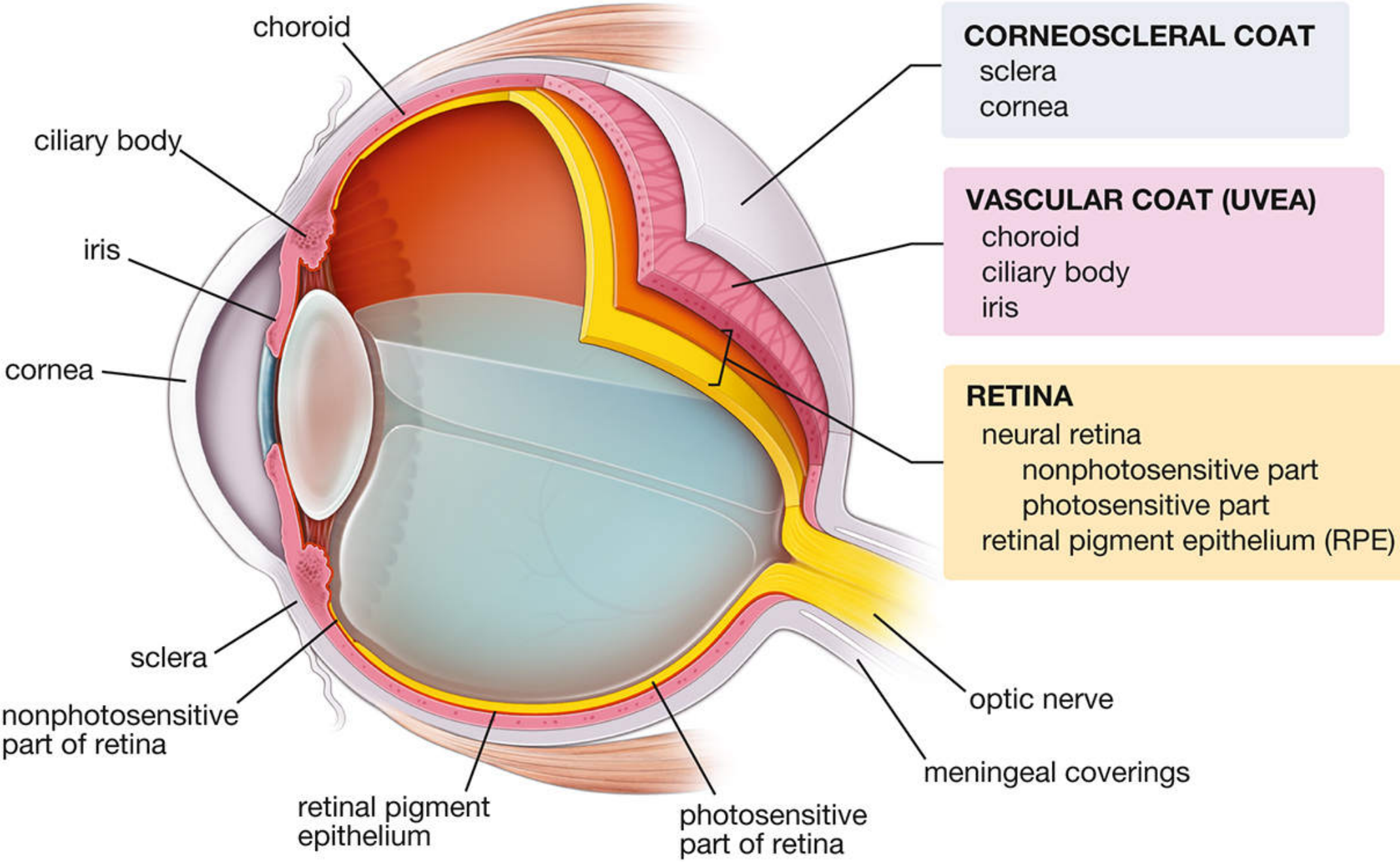
Layer 1 — Corneoscleral Coat (Outer Fibrous Layer)
| Structure | Description |
|---|---|
| Sclera | The white, opaque, dense fibrous connective tissue forming the posterior 5/6 of the outer wall. Provides structural support and attachment points for the extraocular muscles. Appears slightly blue in children (thin) and yellowish in the elderly (lipofuscin accumulation). Turns yellow in jaundice (scleral icterus). |
| Cornea | Covers the anterior 1/6. Transparent and avascular, allowing light to enter. Continuous with the sclera at the limbus. Responsible for most of the eye's refractive power. |
Layer 2 — Vascular Coat / Uvea (Middle Layer)
| Structure | Description |
|---|---|
| Choroid | Highly vascular layer between sclera and retina. Provides nutrition to the outer retina. Rich in melanin pigment to absorb scattered light and minimize glare. |
| Ciliary body | Ring-like thickening anterior to the choroid. Contains the ciliary muscle (smooth muscle controlling lens accommodation) and the ciliary processes (produce aqueous humor). |
| Iris | Pigmented, contractile diaphragm in front of the lens. Contains sphincter muscle (parasympathetic → miosis/constriction) and dilator muscle (sympathetic → mydriasis/dilation). The central opening is the pupil. Pupil diameter changes can produce up to a 16-fold change in light reaching the retina. |
Layer 3 — Retina (Inner Neural Layer)
| Structure | Description |
|---|---|
| Neural retina | Contains the photoreceptors (rods and cones), bipolar cells, and ganglion cells. The photosensitive portion occupies the posterior 2/3, terminating anteriorly at the ora serrata. |
| Retinal pigment epithelium (RPE) | Single layer of pigmented cells supporting the photoreceptors. |
| Fovea centralis | Area of highest visual acuity, rich in cones. |
| Optic disc | Where ganglion cell axons converge to form the optic nerve; no photoreceptors here → the "blind spot." |
Internal Compartments and Contents
| Structure | Description |
|---|---|
| Aqueous humor | Clear, protein-free fluid filling the anterior and posterior chambers (between cornea and lens). Produced by the ciliary body; drains via the trabecular meshwork into the canal of Schlemm. Obstruction → raised intraocular pressure (IOP) → risk factor for glaucoma. |
| Lens | Transparent, biconvex, held by zonule fibers (suspensory ligaments) attached to the ciliary body. Provides variable focus (accommodation). |
| Vitreous humor | Clear gelatinous material filling the vitreous chamber (between lens and retina). Maintains the globe's shape. |
Developmental Origins (Embryology)
- Retina → neuroectoderm
- Lens + corneal epithelium → surface ectoderm
- Sclera, corneal stroma, vascular coat → mesoderm
How Light Travels Through the Eye
Cornea → Aqueous humor → Pupil → Lens → Vitreous humor → Retina → Optic nerve → Brain
The cornea and lens bend (refract) incoming light to focus it precisely onto the retina, where photoreceptors convert it into electrical signals transmitted to the visual cortex.
Sources: Histology: A Text and Atlas (Ross & Pawlina), Ganong's Review of Medical Physiology 26th ed., Gray's Anatomy for Students
This is a shared conversation. Sign in to Orris to start your own chat.