
Iceberg phenomenon
iceberg phenomenon epidemiology medicine concept explained
Iceberg Phenomenon of Disease
The Concept
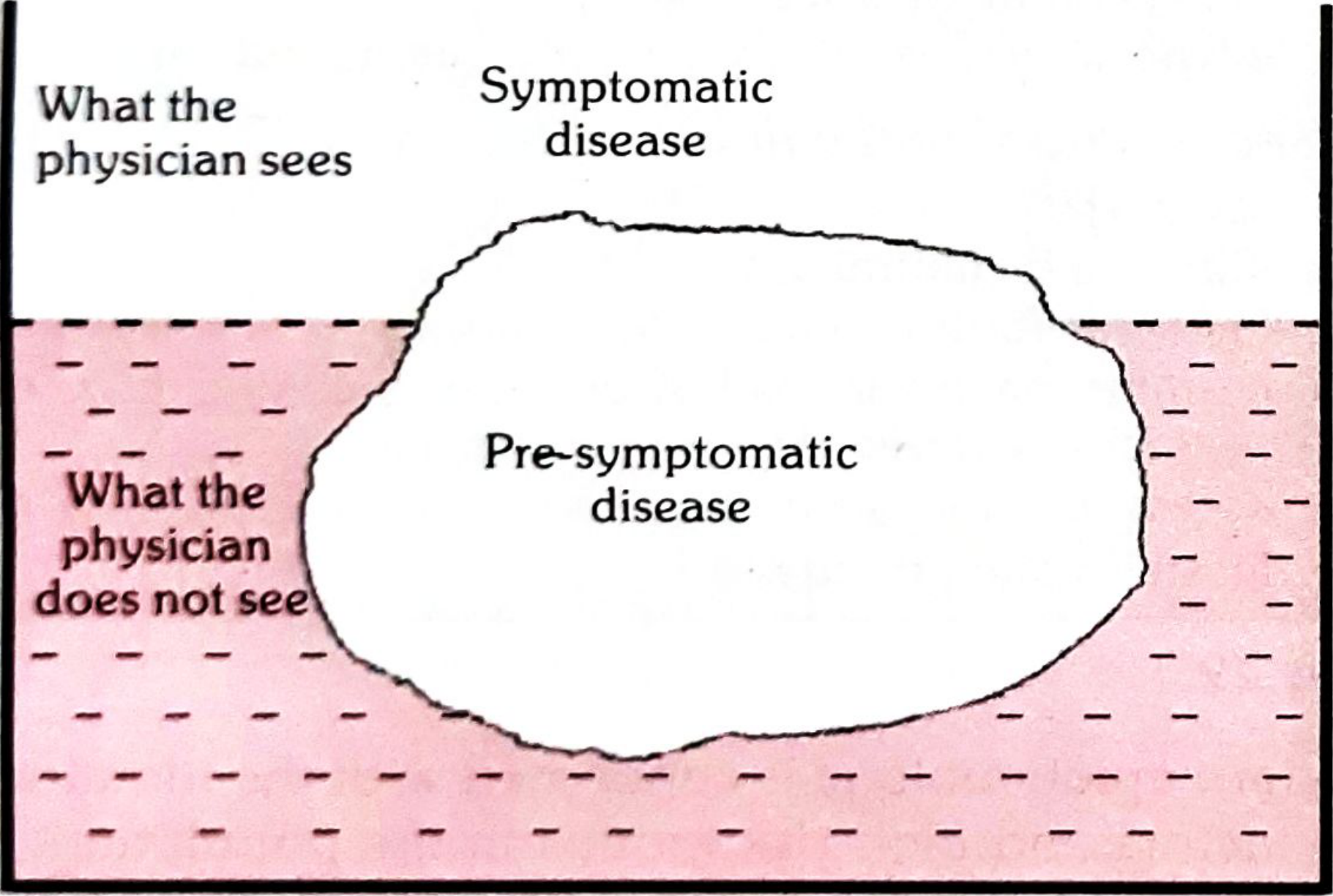
The Three Zones
| Zone | What it represents |
|---|---|
| Tip (above waterline) | Symptomatic, diagnosed, clinically apparent cases - "what the physician sees" |
| Waterline | The threshold between apparent and inapparent disease |
| Submerged bulk (below waterline) | Pre-symptomatic, subclinical, undiagnosed cases, carriers, latent infections - "what the physician does not see" |
Key Points
-
Pattern in hospitals vs. community differs sharply. The pattern of disease seen in hospitals is quite different from that in the community. A far larger proportion of disease (e.g., diabetes, hypertension) is hidden from view in the community than is evident to physicians or the general public.
-
It is closely related to the spectrum of disease. The iceberg concept gives a better idea of the progression of disease from its subclinical stages to overt (apparent) disease than the familiar spectrum concept alone.
-
Hidden disease = unrecognized community reservoir. The submerged part of the iceberg constitutes an important, undiagnosed reservoir of infection or disease in the community. In infectious diseases, this reservoir sustains transmission even when clinical cases appear controlled.
-
Detection is a challenge in preventive medicine. One of the major deterrents in studying chronic diseases of unknown aetiology is the absence of methods to detect the subclinical state - the bottom of the iceberg.
Diseases Showing a Prominent Iceberg
- Hypertension
- Diabetes mellitus
- Anaemia
- Malnutrition
- Mental illness
- HIV/AIDS (reported AIDS cases represent only the tip of all HIV infections)
- Tuberculosis (many subclinical/latent cases)
- Poliomyelitis (most infections are inapparent; clinical paralysis is rare)
Diseases That Do NOT Show the Iceberg Phenomenon
Public Health Significance
- Disease surveillance: Reported case counts severely underestimate true disease burden. Surveillance systems capture only the tip.
- Screening programmes: Screening is the principal tool to uncover the submerged portion. It is defined as "the search for unrecognized disease or defect by means of rapidly applied tests, examinations, or other procedures in apparently healthy individuals." By detecting presymptomatic cases early, screening allows intervention before overt disease develops.
- Epidemiological studies: Community-based surveys (not just hospital data) are needed to measure the true iceberg - hence the use of prevalence surveys.
- Resource planning: Health systems that plan based only on diagnosed cases will consistently underestimate need.
- Infection control: In communicable diseases, the hidden reservoir (subclinical carriers) may be the dominant source of transmission. Eradication efforts must address the whole iceberg, not just clinical cases.
Relationship to the Spectrum of Disease
Susceptible host → Subclinical infection → Clinical disease (mild → moderate → severe) → Death
Uses of screening
Uses of Screening
a. Case Detection (Prescriptive Screening)
- Defined as the presumptive identification of unrecognized disease, which does not arise from a patient's own request (e.g., neonatal screening).
- People are screened primarily for their own benefit.
- Diseases commonly sought by this method:
- Bacteriuria in pregnancy
- Breast cancer
- Cervical cancer
- Deafness in children
- Diabetes mellitus
- Iron deficiency anaemia
- Phenylketonuria (PKU)
- Pulmonary tuberculosis
- Haemolytic disease of the newborn
- Since disease detection is initiated by medical and public health personnel, they carry a special obligation to ensure appropriate early treatment is started.
b. Control of Disease (Prospective Screening)
- People are examined for the benefit of others (i.e., to protect the wider community).
- Examples:
- Screening of immigrants for infectious diseases such as tuberculosis and syphilis - to protect the home population.
- Screening for streptococcal infection to prevent rheumatic fever.
- The programme may lead to early diagnosis, permit more effective treatment, and reduce the spread of infectious disease and/or mortality from the disease.
c. Research Purposes
- Screening is sometimes performed to generate basic knowledge about diseases whose natural history is not fully known (e.g., cancer, hypertension).
- Initial screening provides a prevalence estimate; subsequent screening provides an incidence figure.
- Where screening is done purely for research, the investigator must inform participants that no follow-up therapy will be available.
d. Educational Opportunities
- Screening programmes (e.g., for diabetes) provide opportunities for:
- Creating public awareness about a disease.
- Educating health professionals about disease burden and early detection.
- Benefits extend beyond the individual to public health relevance at a community level.
What are the limitations and harms of screening?
Limitations and Harms of Screening
1. False Negatives
- The patient may ignore developing signs and symptoms and postpone treatment.
- This can be detrimental if the disease is serious and the test is not repeated soon.
- The lower the sensitivity of the test, the larger the number of false negatives.
2. False Positives
- Normal, healthy individuals are subjected to further diagnostic tests, causing:
- Inconvenience
- Discomfort
- Anxiety
- Unnecessary expense
- False positives burden diagnostic facilities.
- They also bring discredit to screening programmes if the public loses trust.
- A test with high specificity will have fewer false positives.
No screening test is perfect - none can achieve 100% sensitivity AND 100% specificity simultaneously. There is always a trade-off.
3. The Cut-Off Point Problem
- There is no absolute biological threshold that perfectly separates diseased from non-diseased individuals (e.g., no single blood glucose level cleanly separates diabetics from non-diabetics).
- Lowering the cut-off point increases sensitivity but reduces specificity (more false positives).
- Raising the cut-off point increases specificity but reduces sensitivity (more false negatives).
- This trade-off must be decided in advance, based on:
- Disease prevalence in the community
- Lethality of the disease (e.g., cervical cancer - sensitivity prioritized; diabetes - specificity prioritized to avoid overburdening health services)
4. Self-Selection Bias (Participation Problem)
- People who volunteer to participate in a screening programme may not be those who have the most to gain.
- Example: women at greatest risk of cervical cancer are least likely to attend for cervical cytology.
- This means screening may benefit the already health-conscious rather than the high-risk population, reducing its true impact.
5. Low Yield in Low-Prevalence Populations
- The predictive value of a positive test falls sharply when disease prevalence is low.
- Example from Park's (Gram-stained cervical smear for gonorrhoea):
- At 5% prevalence → only 21% of positive results are true positives; 79% are false positives.
- At 25% prevalence → 63% of positives are true positives.
- Screening a low-risk, low-prevalence population generates more harm (false positives, unnecessary investigations) than benefit.
6. Complications of the Examination Procedure
- Some screening tests carry physical risks from the procedure itself (e.g., colonoscopy carries perforation risk; radiation exposure from CT/mammography; biopsy complications).
- These risks must be explained to participants before screening - informed consent is required.
7. Incomplete Follow-Up
- Screening without proper follow-up leaves patients "high and dry."
- Detecting a case but failing to provide diagnosis, treatment, and monitoring negates any benefit and may cause psychological harm from unresolved anxiety.
- Effective screening must be integrated into existing health services, not run in isolation.
8. Tests with Greater Accuracy Are Expensive and Time-Consuming
- More accurate tests often cost more and take longer.
- The choice of test is frequently a compromise between accuracy, cost, and feasibility for large-scale application.
9. Evaluation Often Overlooked
- Many historical screening tests were introduced without rigorous evaluation - introduced simply because early detection was assumed to be beneficial.
- The modern view is that screening programmes should only be introduced after proper evaluation (ideally via randomised controlled trials) to confirm that early detection genuinely improves outcomes and does not cause net harm.
Summary Table
| Limitation / Harm | Consequence |
|---|---|
| False negatives | False reassurance, delayed treatment |
| False positives | Anxiety, unnecessary investigations, cost |
| Cut-off point trade-off | No perfect threshold exists |
| Self-selection bias | High-risk groups may not participate |
| Low yield at low prevalence | Majority of positives are false positives |
| Procedural complications | Physical harm from the screening test itself |
| No follow-up | Benefit lost; psychological harm persists |
| Cost vs. accuracy compromise | Less accurate tests used at population scale |
| Lack of prior evaluation | Harm may outweigh benefit if not properly studied |
According to nagar textbook
- K. Park's (you may have meant to continue with Park's but a different section/edition)
- Nagaur - a specific author or regional textbook not in this library
- Another textbook - e.g., a specific PSM or community medicine book you have in mind
Nagar community physiotherapy textbook
| Category | Available Books |
|---|---|
| Community Medicine | Park's Textbook of Preventive and Social Medicine |
| Physiology | Guyton & Hall, Ganong's, Costanzo, Medical Physiology |
| Surgery, Medicine, etc. | Harrison's, Bailey & Love's, Braunwald's, and many others |
- Answer your question on limitations and harms of screening from Park's (which is the standard reference for this topic in community medicine/PSM)
- If you have access to the Nagar physiotherapy textbook physically, you could share the relevant passage and I can help you understand or summarize it
Limitation according to physiotherapy pov
limitations of screening in community physiotherapy perspective
Limitations of Screening - Physiotherapy Perspective
1. Lack of Standardised Screening Tools
- There is no single universally accepted screening tool for all physiotherapy-relevant conditions (e.g., fall risk, frailty, musculoskeletal dysfunction).
- Different settings use different tools (Timed Up and Go, Berg Balance Scale, FRAX, etc.), making comparisons across populations difficult.
- Choosing the wrong tool for a given population reduces validity and yield.
2. False Negatives - Missed at-Risk Individuals
- Screening tools have limited sensitivity for detecting subclinical or early functional decline.
- Individuals who screen negative may be falsely reassured and not referred for physiotherapy assessment, even if they are at genuine risk.
- Example: a person may pass a simple fall risk screen yet have underlying gait abnormalities that will lead to falls.
3. False Positives - Unnecessary Referrals
- Overly sensitive tools may flag individuals who do not actually need physiotherapy intervention.
- This leads to unnecessary assessments, wasted resources, and patient anxiety.
- Example: classifying a healthy older adult as "high fall risk" based on age alone.
4. Functional Assessment Is Subjective and Context-Dependent
- Many physiotherapy screening tools rely on observed performance (e.g., gait analysis, posture assessment) which can vary by:
- Time of day
- Patient fatigue or pain levels
- Environmental conditions (type of floor, footwear)
- Assessor experience
- This reduces inter-rater and test-retest reliability.
5. Self-Selection Bias
- Individuals who attend community physiotherapy screening camps or health fairs tend to be already health-conscious.
- Those at greatest risk (sedentary, elderly, low-income, disabled) are least likely to attend, meaning the people most likely to benefit are systematically missed.
6. Poor Follow-Up and Referral Pathways
- Screening without an adequate referral and treatment system is harmful.
- If a patient is identified as at-risk but there is no physiotherapist available for follow-up, screening creates anxiety without benefit.
- In resource-limited community settings, this is a major practical barrier.
7. Patient Non-Compliance and Cooperation
- Screening requires patient effort (e.g., performing walking tests, answering questionnaires).
- Elderly, cognitively impaired, or poorly motivated individuals may not cooperate adequately, leading to inaccurate results.
- Language barriers and low health literacy further reduce reliability in community settings.
8. Single Time-Point Assessment
- Physiotherapy screening captures function at one moment in time.
- Functional ability fluctuates (e.g., pain, fatigue, mood), so a single screen may not reflect a person's true capacity or risk.
- Repeat screening is needed but resource-intensive.
9. Does Not Establish a Diagnosis
- Screening is not diagnostic - it only identifies people who need further assessment.
- A positive screen for fall risk or musculoskeletal dysfunction must be followed by full physiotherapy assessment before any intervention is planned.
- This two-step process is often not completed in community settings.
10. Resource and Cost Constraints
- Community physiotherapy screening requires trained staff, equipment (e.g., dynamometers, balance platforms), and time.
- In low-resource settings, screening may not be sustainable or cost-effective, especially if the yield (true positives who benefit from treatment) is low.
Summary
| Limitation | Physiotherapy Relevance |
|---|---|
| No universal tool | Many conditions, many tools, no consensus |
| False negatives | At-risk patients missed, no intervention |
| False positives | Unnecessary referrals, wasted resources |
| Subjectivity of functional tests | Reliability and reproducibility problems |
| Self-selection bias | High-risk groups don't attend |
| Poor follow-up pathways | Screening without treatment = harm |
| Patient non-compliance | Incomplete or inaccurate data |
| Single time-point limitation | Doesn't reflect dynamic functional status |
| Screening ≠ diagnosis | Requires further full assessment |
| Resource constraints | Not always feasible in community settings |
Note: The specific "Nagar Community Physiotherapy" textbook is not available in this library. The above is synthesised from established community medicine principles (Park's), physiotherapy practice guidelines (APTA), and available medical library content. If you can share the relevant pages from that textbook, I can map the content precisely.
Create a comparison table of screening tools used in community physiotherapy
community physiotherapy screening tools comparison TUG Berg Balance Scale FRAX functional assessment
Screening Tools Used in Community Physiotherapy - Comparison Table
A. Fall Risk & Balance Screening
| Tool | Full Name | What It Measures | Method | Cut-off / Scoring | Time | Best Used For | Limitations |
|---|---|---|---|---|---|---|---|
| TUG | Timed Up and Go | Gait, mobility, fall risk | Patient stands from chair, walks 3m, turns, sits | >12 sec = fall risk; >20 sec = dependent | 2-3 min | Elderly, neurological patients | Single task only; not reflective of dual-task ability |
| BBS | Berg Balance Scale | Static and dynamic balance | 14 functional balance tasks scored 0-4 each | <45/56 = fall risk | 15-20 min | Community elderly, stroke, PD | Time-consuming; ceiling effect in high-functioning adults |
| Tinetti POMA | Performance-Oriented Mobility Assessment | Gait + balance combined | Observational gait and balance tasks | <19 = high fall risk; 19-24 = moderate | 10-15 min | Frail elderly | Requires trained observer; subjective scoring |
| FAB Scale | Fullerton Advanced Balance Scale | Dynamic balance in active adults | 10 challenging balance tasks | <25/40 = fall risk | 10-15 min | Active community-dwelling adults | Not suitable for very frail; limited normative data |
| FSST | Four Square Step Test | Dynamic stepping, fall risk | Step over canes in 4 squares in sequence | >15 sec = fall risk | 5 min | Community elderly | Requires floor space and 4 canes |
B. Functional Mobility & Gait Screening
| Tool | Full Name | What It Measures | Method | Cut-off / Scoring | Time | Best Used For | Limitations |
|---|---|---|---|---|---|---|---|
| 10MWT | 10-Metre Walk Test | Gait speed | Timed walk over 10 metres | <0.8 m/s = community ambulation risk | 5 min | Stroke, elderly, orthopaedic | Requires 14m corridor space |
| 6MWT | 6-Minute Walk Test | Walking endurance, cardiorespiratory fitness | Distance walked in 6 minutes | Age/sex normative values | 6 min | COPD, cardiac rehab, elderly | Requires large space; not suitable for very frail |
| DGI | Dynamic Gait Index | Gait adaptability under varied conditions | 8 tasks including head turns, stepping over obstacles | <19/24 = fall risk | 10-15 min | Vestibular disorders, elderly | Requires equipment; subjective scoring |
| FGA | Functional Gait Assessment | Gait stability, vestibular function | 10-item gait task scoring | <22/30 = fall risk | 10 min | Vestibular, neurological patients | Requires trained observer |
C. Musculoskeletal Screening
| Tool | Full Name | What It Measures | Method | Cut-off / Scoring | Time | Best Used For | Limitations |
|---|---|---|---|---|---|---|---|
| MSKT | Musculoskeletal Screening Tool | Joint ROM, pain, function | Interview + brief physical exam | Positive = needs detailed assessment | 10 min | Community OA, back pain | Not highly standardised |
| ODHA | Oswestry Disability Index | Low back pain disability | 10-question self-report | 0-20% = minimal; >60% = crippling | 5 min | Low back pain | Self-report only; not objective |
| NDI | Neck Disability Index | Cervical spine disability | 10-question self-report | 0-8% = no disability; >50% = complete | 5 min | Neck pain, cervicogenic headache | Self-report bias |
| FRAX | Fracture Risk Assessment Tool | 10-year osteoporotic fracture risk | Age, BMD, clinical risk factors via questionnaire | Country-specific thresholds | 5 min | Osteoporosis screening >50 yrs | Requires BMD data ideally; underestimates in some populations |
D. Functional Independence / ADL Screening
| Tool | Full Name | What It Measures | Method | Cut-off / Scoring | Time | Best Used For | Limitations |
|---|---|---|---|---|---|---|---|
| Barthel Index | Barthel Index | ADL independence (10 activities) | Observer-rated 10 ADL tasks | 100 = fully independent; <60 = needs help | 5 min | Stroke, elderly, rehabilitation | Ceiling effect; does not capture instrumental ADLs |
| FIM | Functional Independence Measure | Motor + cognitive function (18 items) | Trained rater observation | 18 = total dependence; 126 = full independence | 30 min | Inpatient rehab, complex disability | Requires certified training; time-consuming |
| KATZ ADL | Katz Index of ADL | Basic self-care independence | 6 ADL items, yes/no | 6 = independent; 0 = dependent | 5 min | Elderly community | Only basic ADLs; misses complex function |
E. Frailty Screening
| Tool | Full Name | What It Measures | Method | Cut-off / Scoring | Time | Best Used For | Limitations |
|---|---|---|---|---|---|---|---|
| FRAIL Scale | Fatigue, Resistance, Ambulation, Illness, Loss of weight | Frailty in community elderly | 5-item self-report questionnaire | 0 = robust; 1-2 = pre-frail; 3-5 = frail | 2 min | Rapid community frailty screen | Self-report; no physical performance item |
| Fried Frailty Phenotype | Fried Criteria | Physical frailty (5 criteria) | Weight loss, exhaustion, grip strength, gait speed, activity level | ≥3 = frail; 1-2 = pre-frail | 10-15 min | Research; detailed frailty assessment | Time-consuming; needs dynamometer |
| SPPB | Short Physical Performance Battery | Lower limb function, gait speed, balance | Balance tests + 4m gait speed + 5x chair stand | 0-12; ≤8 = mobility limitation | 10 min | Community elderly | Requires training; not suitable for non-ambulatory |
F. Pain Screening
| Tool | Full Name | What It Measures | Method | Cut-off / Scoring | Time | Best Used For | Limitations |
|---|---|---|---|---|---|---|---|
| VAS | Visual Analogue Scale | Pain intensity | 100mm line marked by patient | 0 = no pain; 100 = worst pain | 1 min | All musculoskeletal conditions | Cannot be used with cognitive impairment |
| NRS | Numeric Rating Scale | Pain intensity | 0-10 verbal/written rating | 0 = none; 1-3 = mild; 4-6 = moderate; 7-10 = severe | 1 min | Bedside, community, all ages | Subjective; culturally variable |
| LANSS | Leeds Assessment of Neuropathic Symptoms and Signs | Neuropathic vs nociceptive pain | 5 symptom + 2 examination items | ≥12/24 = likely neuropathic | 5 min | Diabetic neuropathy, post-stroke pain | Requires brief sensory examination |
Quick Reference: Choosing the Right Tool
| Clinical Goal | Recommended Tool |
|---|---|
| Quick fall risk screen | TUG |
| Detailed balance assessment | Berg Balance Scale |
| Gait speed measurement | 10MWT |
| Walking endurance | 6MWT |
| Frailty (rapid) | FRAIL Scale |
| Frailty (detailed) | SPPB or Fried Criteria |
| Low back disability | Oswestry Disability Index |
| ADL independence (basic) | Barthel Index |
| ADL independence (detailed) | FIM |
| Osteoporotic fracture risk | FRAX |
| Pain intensity | NRS (simplest) / VAS |
All tools listed are validated for community use. Selection should be based on the target population, available resources, time constraints, and the specific clinical question being asked.
Create a clinical decision flowchart for selecting screening tools
ls -la /tmp/workspace/ 2>/dev/null || mkdir -p /tmp/workspace && echo "created"
mkdir -p /tmp/workspace/flowchart && python3 << 'EOF' import matplotlib matplotlib.use('Agg') import matplotlib.pyplot as plt import matplotlib.patches as mpatches from matplotlib.patches import FancyBboxPatch, FancyArrowPatch fig, ax = plt.subplots(1, 1, figsize=(22, 28)) ax.set_xlim(0, 22) ax.set_ylim(0, 28) ax.axis('off') fig.patch.set_facecolor('#F7F9FC') # ── colour palette ────────────────────────────────────────────────────────── C_START = '#2C3E7A' # dark navy – start/end C_Q = '#1A6B9A' # teal-blue – decision diamonds C_TOOL = '#1A7A4A' # forest green – recommended tool boxes C_SUB = '#B35C00' # amber – sub-question C_ARROW = '#444444' C_TXT = 'white' C_BG = '#F7F9FC' def box(ax, x, y, w, h, text, color, fontsize=9, text_color='white', style='round,pad=0.1'): rx, ry = x - w/2, y - h/2 bp = FancyBboxPatch((rx, ry), w, h, boxstyle=style, linewidth=1.5, edgecolor='white', facecolor=color, zorder=3) ax.add_patch(bp) ax.text(x, y, text, ha='center', va='center', fontsize=fontsize, color=text_color, fontweight='bold', zorder=4, wrap=True, multialignment='center') def diamond(ax, x, y, w, h, text, color, fontsize=8.5): dx, dy = w/2, h/2 pts = [(x, y+dy), (x+dx, y), (x, y-dy), (x-dx, y)] poly = plt.Polygon(pts, closed=True, facecolor=color, edgecolor='white', linewidth=1.5, zorder=3) ax.add_patch(poly) ax.text(x, y, text, ha='center', va='center', fontsize=fontsize, color='white', fontweight='bold', zorder=4, multialignment='center') def arrow(ax, x1, y1, x2, y2, label='', color=C_ARROW): ax.annotate('', xy=(x2, y2), xytext=(x1, y1), arrowprops=dict(arrowstyle='->', color=color, lw=1.8), zorder=2) if label: mx, my = (x1+x2)/2, (y1+y2)/2 ax.text(mx+0.15, my, label, fontsize=7.5, color=color, fontstyle='italic', zorder=5) def tool_box(ax, x, y, title, tools, color=C_TOOL): """Tall box listing tool name + score threshold.""" lines = [title] + tools text = '\n'.join(lines) n = len(lines) h = 0.38 * n + 0.3 w = 4.0 box(ax, x, y, w, h, text, color, fontsize=7.8, style='round,pad=0.15') return h # ════════════════════════════════════════════════════════════════════════════ # TITLE # ════════════════════════════════════════════════════════════════════════════ ax.text(11, 27.4, 'Clinical Decision Flowchart', ha='center', va='center', fontsize=17, fontweight='bold', color=C_START) ax.text(11, 27.0, 'Selecting Screening Tools in Community Physiotherapy', ha='center', va='center', fontsize=11, color='#555555') # ════════════════════════════════════════════════════════════════════════════ # STEP 1 – START # ════════════════════════════════════════════════════════════════════════════ box(ax, 11, 26.3, 5, 0.7, 'PATIENT PRESENTS TO COMMUNITY PHYSIOTHERAPY', C_START, fontsize=9) arrow(ax, 11, 25.95, 11, 25.35) # ════════════════════════════════════════════════════════════════════════════ # Q1 – Primary clinical concern # ════════════════════════════════════════════════════════════════════════════ diamond(ax, 11, 24.85, 6.5, 1.0, 'What is the PRIMARY clinical concern?', C_Q, fontsize=9) # Five branches from Q1 branches = [ (2.2, 22.8, 'FALL\nRISK'), (5.5, 22.8, 'MUSCULO-\nSKELETAL'), (11, 22.8, 'FUNCTIONAL\nINDEPENDENCE\n/ ADL'), (16.5, 22.8, 'FRAILTY'), (19.8, 22.8, 'PAIN'), ] for bx, by, label in branches: arrow(ax, bx if abs(bx-11)<0.5 else 11, 24.35, bx, by+0.5) box(ax, bx, by, 2.8, 0.9, label, C_SUB, fontsize=8) # ════════════════════════════════════════════════════════════════════════════ # BRANCH 1 – FALL RISK # ════════════════════════════════════════════════════════════════════════════ arrow(ax, 2.2, 22.35, 2.2, 21.7) diamond(ax, 2.2, 21.2, 3.8, 0.9, 'Time\navailable?', C_Q, fontsize=8) # Quick (<5 min) → TUG arrow(ax, 0.9, 21.2, 0.9, 20.1); ax.text(0.55, 20.65, 'Quick\n(<5 min)', fontsize=7, color=C_ARROW, ha='center') box(ax, 0.9, 19.65, 2.9, 0.8, 'TUG Test\n>12 s = fall risk', C_TOOL, fontsize=7.8) # Detailed → BBS or Tinetti arrow(ax, 3.5, 21.2, 3.5, 20.1); ax.text(3.85, 20.65, 'Detailed\n(>10 min)', fontsize=7, color=C_ARROW, ha='center') # Active vs frail diamond(ax, 3.5, 19.55, 3.4, 0.8, 'Patient\nactive?', C_Q, fontsize=7.5) arrow(ax, 2.2, 19.55, 1.5, 18.5); ax.text(1.3, 19.1, 'No\n(Frail)', fontsize=7, color=C_ARROW, ha='center') box(ax, 1.5, 18.1, 2.8, 0.7, 'Tinetti POMA\n<19 = high risk', C_TOOL, fontsize=7.5) arrow(ax, 4.8, 19.55, 5.2, 18.5); ax.text(5.3, 19.1, 'Yes\n(Active)', fontsize=7, color=C_ARROW, ha='center') box(ax, 5.2, 18.1, 2.8, 0.7, 'Berg Balance Scale\n<45/56 = risk', C_TOOL, fontsize=7.5) # Advanced balance arrow(ax, 2.2, 22.35, 2.2, 21.7) # Add gait speed note arrow(ax, 0.9, 19.25, 0.9, 18.5) box(ax, 0.9, 18.1, 2.8, 0.65, 'Add: 10MWT\n(gait speed)', '#5B7FA6', fontsize=7.5) # ════════════════════════════════════════════════════════════════════════════ # BRANCH 2 – MUSCULOSKELETAL # ════════════════════════════════════════════════════════════════════════════ arrow(ax, 5.5, 22.35, 5.5, 21.4) diamond(ax, 5.5, 20.9, 3.6, 0.9, 'Body region\naffected?', C_Q, fontsize=8) arrow(ax, 4.2, 20.9, 4.2, 19.9); ax.text(3.7, 20.4, 'Low\nBack', fontsize=7, color=C_ARROW, ha='center') box(ax, 4.2, 19.55, 2.8, 0.6, 'Oswestry\nDisability Index', C_TOOL, fontsize=7.5) arrow(ax, 5.5, 20.45, 5.5, 19.9); ax.text(5.7, 20.2, 'Neck', fontsize=7, color=C_ARROW, ha='center') box(ax, 5.5, 19.55, 2.8, 0.6, 'Neck Disability\nIndex (NDI)', C_TOOL, fontsize=7.5) arrow(ax, 6.8, 20.9, 6.8, 19.9); ax.text(7.1, 20.4, 'Osteo-\nporosis\nrisk', fontsize=7, color=C_ARROW, ha='center') box(ax, 6.8, 19.55, 2.8, 0.6, 'FRAX Score\n(10-yr fracture risk)', C_TOOL, fontsize=7.5) # Add neuropathic pain branch arrow(ax, 5.5, 19.25, 5.5, 18.5) diamond(ax, 5.5, 18.0, 3.2, 0.8, 'Neuropathic\npain suspected?', C_Q, fontsize=7.5) arrow(ax, 4.2, 18.0, 4.2, 17.2); ax.text(3.7, 17.6, 'Yes', fontsize=7, color=C_ARROW) box(ax, 4.2, 16.85, 2.8, 0.6, 'LANSS Scale\n≥12 = neuropathic', C_TOOL, fontsize=7.5) arrow(ax, 6.8, 18.0, 6.8, 17.2); ax.text(6.9, 17.6, 'No', fontsize=7, color=C_ARROW) box(ax, 6.8, 16.85, 2.8, 0.6, 'NRS / VAS\nPain intensity', C_TOOL, fontsize=7.5) # ════════════════════════════════════════════════════════════════════════════ # BRANCH 3 – FUNCTIONAL INDEPENDENCE / ADL # ════════════════════════════════════════════════════════════════════════════ arrow(ax, 11, 22.35, 11, 21.4) diamond(ax, 11, 20.9, 3.8, 0.9, 'Level of\ncomplexity needed?', C_Q, fontsize=8) arrow(ax, 9.5, 20.9, 9.5, 19.9); ax.text(8.9, 20.4, 'Basic\nADL', fontsize=7, color=C_ARROW, ha='center') box(ax, 9.5, 19.55, 2.9, 0.7, 'Barthel Index\n100 = independent', C_TOOL, fontsize=7.5) arrow(ax, 11, 20.45, 11, 19.9); ax.text(11.15, 20.2, 'IADL', fontsize=7, color=C_ARROW) box(ax, 11, 19.55, 2.9, 0.7, 'Lawton IADL\nScale (0–8)', C_TOOL, fontsize=7.5) arrow(ax, 12.5, 20.9, 12.5, 19.9); ax.text(12.7, 20.4, 'Rehab /\nComplex', fontsize=7, color=C_ARROW, ha='center') box(ax, 12.5, 19.55, 2.9, 0.7, 'FIM\n(18–126)', C_TOOL, fontsize=7.5) # Endurance sub-branch arrow(ax, 11, 19.2, 11, 18.5) diamond(ax, 11, 18.0, 3.4, 0.8, 'Endurance\nconcern?', C_Q, fontsize=7.5) arrow(ax, 9.8, 18.0, 9.8, 17.2); ax.text(9.3, 17.6, 'Yes', fontsize=7, color=C_ARROW) box(ax, 9.8, 16.85, 2.9, 0.6, '6-Minute\nWalk Test', C_TOOL, fontsize=7.5) arrow(ax, 12.2, 18.0, 12.2, 17.2); ax.text(12.3, 17.6, 'No', fontsize=7, color=C_ARROW) box(ax, 12.2, 16.85, 2.9, 0.6, 'SPPB\n(0–12)', C_TOOL, fontsize=7.5) # ════════════════════════════════════════════════════════════════════════════ # BRANCH 4 – FRAILTY # ════════════════════════════════════════════════════════════════════════════ arrow(ax, 16.5, 22.35, 16.5, 21.4) diamond(ax, 16.5, 20.9, 3.8, 0.9, 'Purpose of\nassessment?', C_Q, fontsize=8) arrow(ax, 15.0, 20.9, 15.0, 19.9); ax.text(14.3, 20.4, 'Rapid\nScreen', fontsize=7, color=C_ARROW, ha='center') box(ax, 15.0, 19.55, 2.9, 0.7, 'FRAIL Scale\n≥3 = frail', C_TOOL, fontsize=7.5) arrow(ax, 16.5, 20.45, 16.5, 19.9); ax.text(16.7, 20.2, 'Detailed', fontsize=7, color=C_ARROW) box(ax, 16.5, 19.55, 2.9, 0.7, 'Fried Frailty\nPhenotype ≥3', C_TOOL, fontsize=7.5) arrow(ax, 18.0, 20.9, 18.0, 19.9); ax.text(18.2, 20.4, 'Physical\nPerform.', fontsize=7, color=C_ARROW, ha='center') box(ax, 18.0, 19.55, 2.9, 0.7, 'SPPB\n≤8 = limitation', C_TOOL, fontsize=7.5) # Cognitive flag arrow(ax, 16.5, 19.2, 16.5, 18.5) diamond(ax, 16.5, 18.0, 3.2, 0.8, 'Cognitive\nimpairment?', C_Q, fontsize=7.5) arrow(ax, 15.2, 18.0, 15.2, 17.2); ax.text(14.7, 17.6, 'Yes', fontsize=7, color=C_ARROW) box(ax, 15.2, 16.85, 2.9, 0.6, 'Mini-Cog /\nMMSE (refer)', C_TOOL, fontsize=7.5) arrow(ax, 17.8, 18.0, 17.8, 17.2); ax.text(17.9, 17.6, 'No', fontsize=7, color=C_ARROW) box(ax, 17.8, 16.85, 2.9, 0.6, 'Proceed with\nphysical tools', '#5B7FA6', fontsize=7.5) # ════════════════════════════════════════════════════════════════════════════ # BRANCH 5 – PAIN # ════════════════════════════════════════════════════════════════════════════ arrow(ax, 19.8, 22.35, 19.8, 21.4) diamond(ax, 19.8, 20.9, 2.8, 0.9, 'Patient\ncooperation?', C_Q, fontsize=7.5) arrow(ax, 19.8, 20.45, 19.8, 19.9); ax.text(20.0, 20.2, 'Good', fontsize=7, color=C_ARROW) box(ax, 19.8, 19.55, 2.9, 0.7, 'NRS (0–10)\nor VAS', C_TOOL, fontsize=7.5) arrow(ax, 19.8, 19.2, 19.8, 18.5) diamond(ax, 19.8, 18.0, 2.8, 0.8, 'Neuro-\npathic?', C_Q, fontsize=7.5) arrow(ax, 18.6, 18.0, 18.6, 17.2); ax.text(18.1, 17.6, 'Yes', fontsize=7, color=C_ARROW) box(ax, 18.6, 16.85, 2.6, 0.6, 'LANSS\n≥12 = neuro', C_TOOL, fontsize=7.5) arrow(ax, 21.0, 18.0, 21.0, 17.2); ax.text(21.1, 17.6, 'No', fontsize=7, color=C_ARROW) box(ax, 21.0, 16.85, 2.6, 0.6, 'BPI (Brief\nPain Inv.)', C_TOOL, fontsize=7.5) # ════════════════════════════════════════════════════════════════════════════ # COMMON FINAL STEPS (bottom) # ════════════════════════════════════════════════════════════════════════════ # Horizontal connector line ax.plot([0.5, 21.5], [15.9, 15.9], color='#AAAAAA', lw=1.2, ls='--', zorder=1) ax.text(11, 15.65, '▼ ALL BRANCHES CONVERGE ▼', ha='center', fontsize=8, color='#777777', style='italic') arrow(ax, 11, 15.55, 11, 14.9) diamond(ax, 11, 14.4, 5.0, 0.9, 'Is the screen POSITIVE\nor borderline?', C_Q, fontsize=9) # YES → Detailed assessment arrow(ax, 8.7, 14.4, 7.5, 13.3); ax.text(7.5, 13.9, 'YES', fontsize=8, color='#B03030', fontweight='bold') box(ax, 7.5, 12.95, 4.8, 0.6, 'Perform Full Physiotherapy Assessment\n+ Set measurable goals', C_TOOL, fontsize=8) # NO → Reassure + reassess arrow(ax, 13.3, 14.4, 14.5, 13.3); ax.text(14.0, 13.9, 'NO', fontsize=8, color='#1A7A4A', fontweight='bold') box(ax, 14.5, 12.95, 4.0, 0.6, 'Reassure + Health Education\n+ Schedule re-screen', '#5B7FA6', fontsize=8) # Detailed assessment → intervention arrow(ax, 7.5, 12.65, 7.5, 11.9) diamond(ax, 7.5, 11.4, 4.8, 0.9, 'Are treatment goals\nclear?', C_Q, fontsize=8.5) arrow(ax, 5.2, 11.4, 4.0, 10.4); ax.text(3.8, 10.95, 'YES', fontsize=8, color='#1A7A4A', fontweight='bold') box(ax, 4.0, 10.0, 4.0, 0.7, 'Initiate Physiotherapy\nIntervention Plan', C_TOOL, fontsize=8) arrow(ax, 9.8, 11.4, 11.0, 10.4); ax.text(10.6, 10.95, 'NO', fontsize=8, color='#B03030', fontweight='bold') box(ax, 11.0, 10.0, 4.0, 0.7, 'Refer to Specialist /\nMultidisciplinary Team', '#8B3A8B', fontsize=8) # Both → Monitor & re-screen arrow(ax, 4.0, 9.65, 4.0, 9.0) arrow(ax, 11.0, 9.65, 11.0, 9.0) ax.plot([4.0, 11.0], [9.0, 9.0], color=C_ARROW, lw=1.5, zorder=2) arrow(ax, 7.5, 9.0, 7.5, 8.4) box(ax, 7.5, 8.1, 4.5, 0.55, 'Monitor Progress + Re-screen at 4–6 weeks', C_START, fontsize=8) # ════════════════════════════════════════════════════════════════════════════ # LEGEND # ════════════════════════════════════════════════════════════════════════════ legend_items = [ (C_START, 'Start / End / Monitor'), (C_Q, 'Decision Point'), (C_TOOL, 'Recommended Screening Tool'), (C_SUB, 'Clinical Concern Category'), ('#5B7FA6', 'Supplementary / Next step'), ('#8B3A8B', 'Referral'), ] lx, ly = 14.5, 8.8 ax.text(lx, ly, 'LEGEND', fontsize=9, fontweight='bold', color='#333333') for i, (col, lbl) in enumerate(legend_items): ry = ly - 0.55 * (i + 1) rect = FancyBboxPatch((lx, ry - 0.18), 0.55, 0.36, boxstyle='round,pad=0.05', facecolor=col, edgecolor='white', lw=1, zorder=3) ax.add_patch(rect) ax.text(lx + 0.7, ry, lbl, fontsize=8, va='center', color='#333333') # ── watermark / source ─────────────────────────────────────────────────────── ax.text(11, 0.3, 'Community Physiotherapy • Clinical Screening Decision Flowchart', ha='center', fontsize=7.5, color='#AAAAAA', style='italic') plt.tight_layout(pad=0.3) plt.savefig('/tmp/workspace/flowchart/screening_flowchart.png', dpi=180, bbox_inches='tight', facecolor=C_BG) print("Saved OK") EOF

screening flowchart
Image · PNG
- Start at the top - patient presents to community physiotherapy
- Identify the primary clinical concern - choose one of 5 branches:
- Fall Risk → TUG (quick) or Berg Balance Scale / Tinetti (detailed)
- Musculoskeletal → ODI (back), NDI (neck), FRAX (fracture risk), LANSS/NRS (pain)
- Functional Independence / ADL → Barthel (basic), Lawton (IADL), FIM (complex), 6MWT (endurance)
- Frailty → FRAIL Scale (rapid), Fried Phenotype (detailed), SPPB (physical performance)
- Pain → NRS/VAS (nociceptive), LANSS (neuropathic), BPI (comprehensive)
- All branches converge - if screen is positive → full assessment → intervention or referral
- Monitor and re-screen at 4-6 weeks regardless of outcome
30 sec chair stand test
30 second chair stand test procedure scoring normative values physiotherapy
https://med-fom-clone-pt.sites.olt.ubc.ca/files/2024/01/30-s…
30-Second Chair Stand Test (30sCST)
Overview
| Feature | Detail |
|---|---|
| Also called | 30-Second Sit-to-Stand Test (30s STS) |
| Purpose | Measure lower extremity muscle strength, endurance, and functional performance |
| ICF Domain | Activity limitation |
| Time to administer | ~2 minutes |
| Setting | Clinical, community, home-based, can be administered virtually |
| Developed to overcome | Floor effect of the 5-rep and 10-rep sit-to-stand tests in older adults |
Purpose / What It Measures
- Lower limb (LE) muscle strength and endurance - primarily quadriceps and hip extensors
- Dynamic balance during transitional movement
- Functional status - ability to perform daily activities like rising from a chair, getting in/out of a vehicle, climbing stairs
- Fall risk in community-dwelling older adults
- Frailty and physical performance in elderly populations
Equipment Required
- Straight-backed chair without armrests, seat height 43-46 cm (17 inches)
- Stopwatch / timer
- Same chair must be used for re-testing
Procedure (Step-by-Step)
- Patient sits in the middle of the chair
- Feet flat on the floor, shoulder-width apart
- Back straight, arms crossed at chest (not using armrests or legs to push up)
- On "Go" - rise to a full standing position, then sit back down
- Repeat as many times as possible for 30 seconds
- Stand next to the patient for safety
- Count the total number of full stands in 30 seconds
- If the patient is more than halfway to standing when time expires, count it as a full stand
- Stands using arms to push off or incomplete stands do not count
- Record best of 2 trials; note chair height and any adaptations used
Normative Values (Age-Based)
Older Adults (CDC STEADI / Jones & Rikli norms)
| Age Group | Men (avg stands) | Women (avg stands) | Below Average |
|---|---|---|---|
| 60-64 | 14-19 | 12-17 | <14 (M) / <12 (F) |
| 65-69 | 12-18 | 11-16 | <12 (M) / <11 (F) |
| 70-74 | 12-17 | 10-15 | <12 (M) / <10 (F) |
| 75-79 | 11-17 | 10-15 | <11 (M) / <10 (F) |
| 80-84 | 10-15 | 9-14 | <10 (M) / <9 (F) |
| 85-89 | 8-14 | 8-13 | <8 (M) / <8 (F) |
| 90-94 | 7-12 | 4-11 | <7 (M) / <4 (F) |
A value of less than 9 is below average for an 80-year-old female - indicates fall risk (Rockwood & Green's Fractures in Adults, 10th ed.)
Young Adults (19-35 years)
- Higher repetition counts expected; normative values vary by sex and physical activity level
- Used for pre-season screening and return-to-sport assessment in younger populations
Interpretation
| Score | Interpretation |
|---|---|
| Above average for age/sex | Good lower limb strength; low fall risk |
| Average for age/sex | Adequate functional strength |
| Below average for age/sex | Reduced lower limb strength; INCREASED fall risk → refer for full assessment |
- Higher number of repetitions = better function
- A below-average score indicates risk for falls (CDC STEADI)
Psychometric Properties
| Property | Value |
|---|---|
| Test-retest reliability (ICC) | Knee OA: ICC = 0.92-0.94; Hip/Knee OA: ICC = 0.95 - excellent |
| Inter-rater reliability (ICC) | THA/TKA awaiting: ICC = 0.93-0.98; Hip OA: ICC = 0.81 |
| SEM | ~0.7-1.3 reps (advanced OA populations) |
| MDC (Minimal Detectable Change) | Knee OA: 2.27 reps (baseline); TKA/THA: 1.64 reps |
| MCID (Minimal Clinically Important Diff.) | Hip OA: 2.0-2.6 reps = major improvement |
| Validity | Moderately high correlation with fast-paced walk (r = -0.64), WOMAC function (r = -0.62) |
| Convergent validity | Strong correlation with gait speed (r=0.52), endurance (r=0.56), dynamic balance (r=-0.50) |
Clinical Applications in Physiotherapy
| Condition / Setting | Role of 30sCST |
|---|---|
| Elderly / Community | Fall risk screening, frailty assessment |
| Hip/Knee OA | Baseline function, treatment response monitoring |
| Pre/Post TKA or THA | Pre-operative functional status, post-operative recovery |
| Stroke rehabilitation | Lower limb strength recovery |
| Cardiac/pulmonary rehab | Functional endurance proxy |
| Sports/young adults | Pre-season LE strength screen, return-to-sport |
| Parkinson's disease | Functional mobility and balance monitoring |
Advantages
- Minimal equipment and space required
- Quick (~2 minutes)
- No floor/ceiling effects in most populations (only 1.1-10.8% cannot complete in OA populations)
- Can be administered virtually
- More responsive to change than TUG or 40m walk test after physiotherapy programmes
- Excellent reliability (ICC >0.90)
Limitations
- Requires a standardised chair - results vary with seat height
- Cannot be used in patients who cannot stand independently (severe weakness, non-weight-bearing)
- Does not isolate individual muscle groups - a composite lower limb measure only
- Pain during the test may affect performance (counts as reduced function, not true strength deficit)
- Does not capture upper limb or trunk contribution to standing
- Cognitive impairment may affect task understanding and compliance
- Seat height relative to leg length is not always standardised, which can affect scores
Ages and stages questionneri
Ages and Stages Questionnaire ASQ developmental screening tool domains scoring interpretation
https://agesandstages.com/about-asq
Ages and Stages Questionnaire (ASQ)
Overview
| Feature | Detail |
|---|---|
| Full name | Ages and Stages Questionnaires® |
| Developed by | Diane Bricker & Jane Squires (1999); University of Oregon |
| Publisher | Paul H. Brookes Publishing Co. |
| Current edition | ASQ-3 (3rd edition) + ASQ:SE-2 (Social-Emotional) |
| Type | Parent-completed developmental screening tool |
| Age range | Birth (1 month) to 66 months (5.5 years) |
| Time to complete | ~10-15 minutes (parent); ~2-3 min to score |
| Setting | Paediatric clinics, community health, early childhood education, home visits |
Versions of ASQ
| Version | Full Name | What It Screens | Age Range |
|---|---|---|---|
| ASQ-3 | Ages & Stages Questionnaire, 3rd Edition | Overall developmental milestones (5 domains) | 1-66 months |
| ASQ:SE-2 | Ages & Stages Questionnaire: Social-Emotional, 2nd Edition | Social-emotional and behavioural development | 1-72 months |
How It Works
- Completed by parents/caregivers - based on their direct observation of the child
- Available in 21 age-specific questionnaires (e.g., 2-month, 4-month, 6-month... up to 60-month)
- Each questionnaire has 30 items across 5 domains
- Each item is answered: Yes / Sometimes / Not Yet
- Scoring: Yes = 10 points, Sometimes = 5 points, Not Yet = 0 points
- Maximum score per domain = 60 points
The 5 Developmental Domains (ASQ-3)
| Domain | What It Assesses | Example Items |
|---|---|---|
| 1. Communication | Language, speech, listening, understanding | Does baby turn to voice? Use 2-word phrases? Follow simple directions? |
| 2. Gross Motor | Large muscle movement, balance, coordination | Sit independently? Walk? Jump? Climb stairs? |
| 3. Fine Motor | Small muscle control, hand-eye coordination | Reach and grasp? Stack blocks? Draw a circle? |
| 4. Problem Solving | Learning, reasoning, hand-eye coordination with objects | Uncover hidden object? Match shapes? Simple puzzles? |
| 5. Personal-Social | Self-help, interaction with others, independence | Feed self? Play with others? Dress self? |
Scoring and Interpretation
| Zone | Meaning | Action |
|---|---|---|
| Above cutoff (green zone) | Development on track | Continue routine monitoring; provide age-appropriate activities |
| Monitoring zone (yellow zone) | Score close to cutoff; mild concern | Provide learning activities; re-screen in 2-3 months |
| Below cutoff (red zone) | Significant developmental concern | Refer for full developmental evaluation |
Cutoff scores are set at -2 standard deviations (SD) below the mean for each age group and domain.
ASQ:SE-2 (Social-Emotional Version)
- Screens for social-emotional and behavioural problems
- Covers: self-regulation, compliance, communication, adaptive functioning, autonomy, affect, interaction with people
- Higher score = more concern (opposite to ASQ-3)
- Has its own age-specific cutoff scores
- Useful for identifying children who may need mental health or behavioural referral
Questionnaire Age Intervals
| Age Interval | Questionnaire Used |
|---|---|
| 1-2 months | 2-month questionnaire |
| 4 months | 4-month questionnaire |
| 6 months | 6-month questionnaire |
| 8, 10, 12, 14, 16, 18, 20, 22, 24 months | Monthly intervals |
| 27, 30, 33, 36 months | 3-monthly intervals |
| 42, 48, 54, 60 months | 6-monthly intervals |
The correct questionnaire is selected based on the child's adjusted age (for premature infants, subtract weeks of prematurity from chronological age)
Psychometric Properties
| Property | Value |
|---|---|
| Sensitivity | 70-90% (varies by domain and age) |
| Specificity | ~80-86% |
| Test-retest reliability | High (r = 0.75-0.94) |
| Inter-rater reliability | Good (ICC > 0.70) |
| Validity | Validated against Bayley Scales of Infant Development |
Advantages
- Parent-completed - captures everyday observations not seen in a clinical setting
- Increases time efficiency - can be filled out in the waiting room
- Documents milestones that are difficult to assess in the office
- Widely validated across diverse cultural and linguistic groups
- Available in multiple languages
- Can be completed online (ASQ Online system)
- Cost-effective and easy to administer
- Suitable for community-based screening programmes
Limitations
- Relies on parent report - may be affected by parental education, literacy, or expectations
- Does not provide a diagnosis - only screens; positive screen requires referral for full evaluation
- May underidentify children from low-literacy households
- Items are language and culture-dependent in some questionnaires
- Needs correct age-questionnaire matching - using wrong age form reduces accuracy
- Does not cover all developmental domains (e.g., vision, hearing not directly assessed)
Clinical Use in Community Physiotherapy
- Early intervention programmes - identifying infants with motor delays for early PT referral
- Gross motor domain - directly maps to physiotherapy targets (e.g., head control, sitting, walking)
- Fine motor domain - relevant to occupational and physiotherapy co-management
- Neonatal follow-up clinics - monitoring premature or at-risk infants
- Community child health programmes - integrated developmental surveillance
Comparison with Other Developmental Screening Tools
| Tool | Age Range | Completed by | Focus | Time |
|---|---|---|---|---|
| ASQ-3 | 1-66 months | Parent | 5 developmental domains | ~10-15 min |
| Denver II (DDST-II) | 0-6 years | Clinician | Motor, language, social, adaptive | 20-30 min |
| PEDS | 0-8 years | Parent | Developmental & behavioural concerns | ~5 min |
| M-CHAT-R/F | 16-30 months | Parent | Autism spectrum disorder | ~5 min |
| Capute Scales | 3-36 months | Clinician | Language and problem-solving (DQ) | 15-20 min |
Fms
What does FMS refer to in your context?
Functional Movement Screen FMS 7 tests scoring interpretation injury risk physiotherapy
https://www.bodyspec.com/blog/post/functional_movement_scree…
Functional Movement Screen (FMS)
Overview
| Feature | Detail |
|---|---|
| Developed by | Gray Cook & Lee Burton (1995, refined 1997) |
| Type | Standardised movement screening tool |
| Purpose | Identify movement limitations, asymmetries, and compensation patterns before they cause injury |
| Population | Active individuals, athletes, military, occupational workers, general community |
| Number of tests | 7 movement patterns + 3 clearing tests |
| Scoring range | 0-21 (3 points per test × 7 tests) |
| Time | 10-15 minutes |
| Equipment | FMS kit: dowel rod, measuring board, hurdle, resistance band |
The FMS is a screen, not a diagnosis. It identifies movement quality deficits - not the cause. Individuals with active pain should be assessed with the SFMA (Selective Functional Movement Assessment) instead.
The Scoring System
| Score | Meaning |
|---|---|
| 3 | Performs the movement correctly with no compensations; full pattern achieved |
| 2 | Completes the movement but with compensation or altered mechanics |
| 1 | Cannot perform the movement even with compensations |
| 0 | Pain during any part of the movement (automatically = 0 regardless of completion) |
- For bilateral tests (Hurdle Step, In-Line Lunge, Shoulder Mobility, ASLR, Rotary Stability), the lowest score of both sides is recorded
- Maximum total score = 21
- Any test scoring 0 must be followed up immediately - pain during movement is a red flag
The 7 FMS Tests
1. Deep Squat
- What it assesses: Bilateral symmetrical mobility of hips, knees, ankles; thoracic spine extension; shoulder flexion
- Position: Feet shoulder-width, toes forward; hold dowel overhead with arms extended
- Task: Descend to deepest squat with heels on floor
- Score 3: Hips below knees, heels down, knees track toes, torso upright, dowel over feet
- Score 2: As above but heels elevated on board
- Score 1: Cannot reach depth or maintain alignment even with heel lift
- Common compensations: Heel rise (limited ankle dorsiflexion), forward trunk lean (limited thoracic mobility), knee valgus
2. Hurdle Step
- What it assesses: Bilateral mobility and stability of hips, knees, ankles; single-leg stance stability; step mechanics
- Position: Stand behind hurdle set at tibial tuberosity height; hold dowel across shoulders
- Task: Step over hurdle and touch heel to floor, return without touching hurdle
- Score 3: Hips/ankles/knees aligned, minimal lumbar movement, dowel stays parallel to hurdle
- Score 2: Foot touches hurdle or body sways
- Score 1: Loss of balance or cannot complete
- Note: Scored on both sides; lower score recorded
3. In-Line Lunge
- What it assesses: Hip mobility and stability, ankle/knee stability, trunk stability in split stance
- Position: Feet on board in tandem stance; hold dowel vertically along spine
- Task: Lunge forward until back knee touches board behind front foot, return
- Score 3: Dowel stays in contact with head/thoracic spine/sacrum; no trunk shift; knee touches board behind heel
- Score 2: Some trunk deviation or dowel loses contact
- Score 1: Loss of balance or inability to maintain position
4. Shoulder Mobility
- What it assesses: Bilateral shoulder range - flexion/internal rotation (top arm) and extension/external rotation (bottom arm)
- Position: Stand; one arm reaches overhead/down back, other arm reaches up the back
- Task: Bring fists as close together as possible behind back
- Score 3: Fists within one hand-length of each other
- Score 2: Fists within one-and-a-half hand-lengths
- Score 1: Fists more than one-and-a-half hand-lengths apart
- Clearing test: Yocum test (hand on opposite shoulder, elbow points up to touch forehead) - if painful = score 0
5. Active Straight Leg Raise (ASLR)
- What it assesses: Active hamstring and calf flexibility; core stability; opposite hip extension mobility
- Position: Supine; board placed at midpoint between ASIS and knee
- Task: Raise one leg as high as possible while keeping the other leg flat on the floor
- Score 3: Ankle clears the board (malleolus at or beyond ASIS of opposite leg)
- Score 2: Ankle between board and knee
- Score 1: Ankle below knee
- Note: Opposite leg must remain in contact with floor throughout
6. Trunk Stability Push-Up
- What it assesses: Reflexive core stabilisation during upper extremity movement; spine and pelvis stability
- Position: Prone; men start with thumbs at forehead, women at chin
- Task: Push up as one rigid unit - no lumbar sag or hip hike
- Score 3 (men): Push-up with thumbs at forehead; body as rigid unit
- Score 3 (women): Push-up with thumbs at chin
- Score 2: Men achieve score 3 position but need to drop to women's hand position; women need to drop lower
- Score 1: Unable to perform a push-up maintaining a rigid body
- Clearing test: Prone press-up (passive lumbar extension) - if painful = score 0
7. Rotary Stability
- What it assesses: Multi-plane pelvis and core stability; shoulder girdle stability during combined upper and lower extremity movement
- Position: Quadruped (hands under shoulders, knees under hips, band between knees and feet)
- Task: Extend one arm and ipsilateral leg simultaneously (unilateral), then touch elbow to knee
- Score 3: Unilateral movement with flat spine; elbow and knee touch without rotation
- Score 2: Contralateral arm and leg (diagonal) pattern used instead
- Score 1: Cannot perform diagonal pattern without losing balance
- Clearing test: Quadruped diagonal reaching - if painful = score 0
Scoring Interpretation
| Total Score | Interpretation |
|---|---|
| 17-21, no pain, no asymmetry | Broadly competent movement patterns; low injury risk |
| 15-16 | Minor deficiencies; targeted corrective exercise recommended |
| ≤14 | Higher injury risk - associated with 1.86× increased odds of injury (BMJ Open Sport & Exercise Med, 2019) |
| Any 0 | Pain present - immediate clinical assessment required; do not begin training |
| Asymmetry (L ≠ R) | Even with good total score, asymmetry independently predicts injury risk |
The ≤14 cutoff is the most cited threshold but evidence is mixed across populations - collegiate dancers, for example, show no predictive value at this cutoff. Lowest-scoring patterns and asymmetries are often more clinically useful than the composite score alone.
Clearing Tests (3 tests embedded within FMS)
| Clearing Test | Associated With | Positive = |
|---|---|---|
| Spinal extension press-up | Trunk Stability Push-Up | Score = 0 |
| Posterior rocking (quadruped) | Rotary Stability | Score = 0 |
| Yocum test | Shoulder Mobility | Score = 0 |
Clinical Applications in Physiotherapy
| Setting | Use of FMS |
|---|---|
| Sports physiotherapy | Pre-season injury risk screening; return-to-sport clearance |
| Community physiotherapy | Movement baseline assessment; corrective exercise planning |
| Occupational health | Pre-employment movement screening for physical jobs |
| Military | Combat readiness and injury prevention screening |
| Rehabilitation | Establishing movement quality baseline before and after treatment |
| Personal training / S&C | Guiding exercise prescription and identifying "weak links" |
Psychometric Properties
| Property | Evidence |
|---|---|
| Inter-rater reliability | ICC = 0.74-0.98 (good to excellent when trained raters used) |
| Intra-rater reliability | ICC = 0.81-0.99 |
| Injury prediction | Pooled OR ≈ 1.86 for score ≤14 (meta-analysis, BMJ Open SJSEM 2019) |
| Validity | Moderate; correlates with dynamic balance and movement quality measures |
Limitations
- Not diagnostic - does not identify the cause of movement dysfunction
- ≤14 cutoff is inconsistent across sports and populations
- Requires trained assessor for reliable scoring
- Pain = 0 rule can mask true movement capability
- Does not account for fatigue, pain inhibition, or fear-avoidance
- Ceiling effect in highly trained athletes - many score 17-21 but still get injured
- Does not assess sport-specific or task-specific movement demands
- Asymmetry scoring only captures directional difference, not degree of dysfunction
FMS vs. SFMA
| Feature | FMS | SFMA |
|---|---|---|
| Used when | No current pain; healthy/active individuals | Patient has pain/injury |
| Goal | Identify movement risk before injury | Break down dysfunctional movement patterns in injured patients |
| Administered by | Physio, S&C coach, athletic trainer | Clinician (physiotherapist, sports physician) |
| Outcome | Movement quality score + corrective exercise | Movement diagnosis + treatment direction |