
Define bio transformation. explain the various mechanism of drug metabolism with examples from KDT using buzz words for university exam final LAQ i should have to score without losing a mark. make a pictoral diagram
Katzung drug metabolism phase I phase II mechanisms examples cytochrome P450
"Drug Metabolism"[MeSH Terms] AND mechanisms
pharmacology drug metabolism phase I phase II biotransformation diagram cytochrome P450 conjugation
A clear educational pharmacology flowchart diagram of drug biotransformation for a university exam: lipophilic drug in center, Phase I functionalization with oxidation reduction hydrolysis and cytochrome P450, Phase II conjugation with glucuronide sulfate acetyl methyl glutathione, resulting water-soluble metabolite and renal or biliary excretion. Include a side branch showing direct Phase II and a warning that Phase I can form active or toxic metabolites.
Drug Biotransformation / Drug Metabolism
Definition
Enzymatic conversion - lipophilic to hydrophilic - functionalization - conjugation - detoxification - bioinactivation - active/toxic metabolite - renal/biliary excretion.
It does not always mean inactivation. Metabolism may produce:
- Inactive metabolite: chloramphenicol
- Active metabolite: diazepam → desmethyldiazepam
- Toxic metabolite: paracetamol → NAPQI
- Active drug from prodrug: enalapril → enalaprilat; codeine → morphine
Pictorial Diagram: Overall Pathway
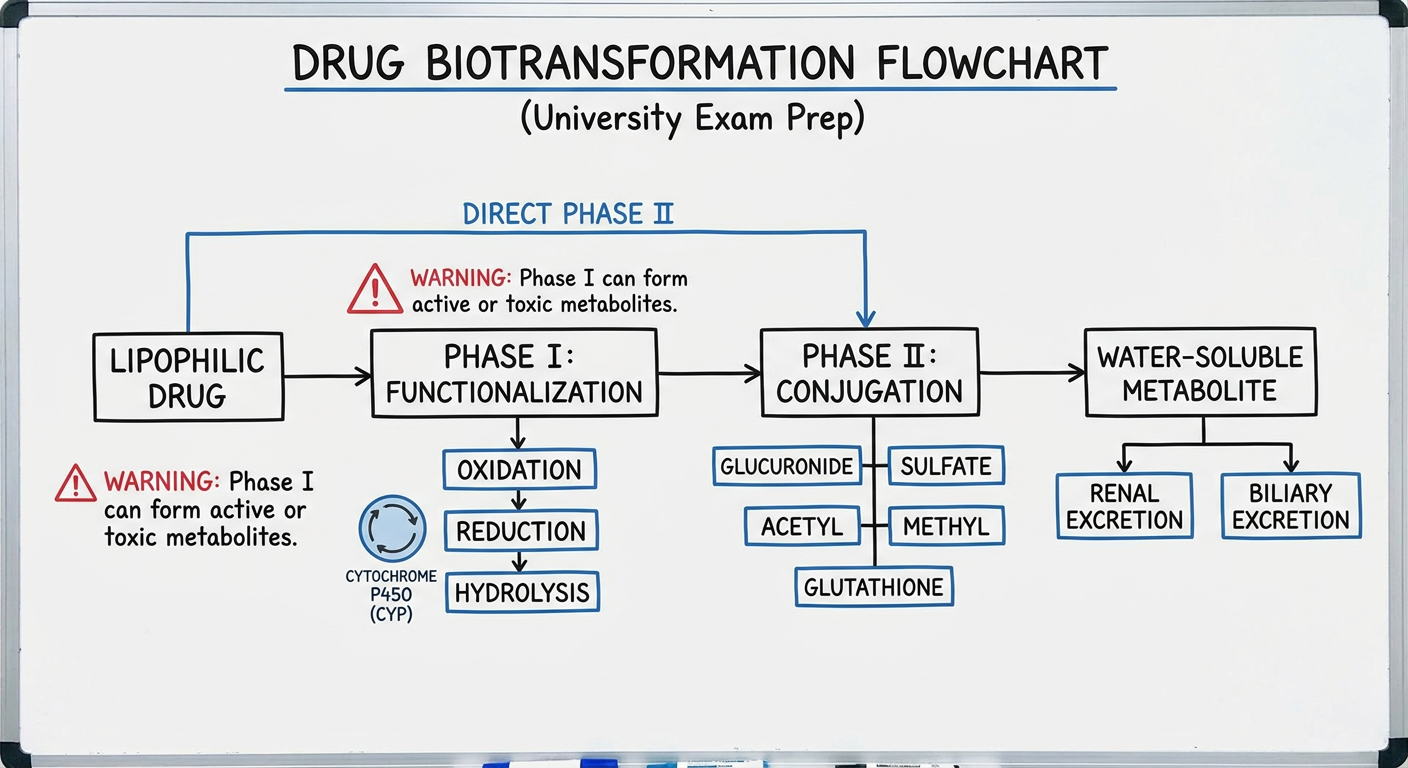
Write this flowchart in the exam
                     LIPID-SOLUBLE DRUG
                           │
                           │  (may be directly excreted if already polar)
                           ▼
         ┌───────────────────────────────────────────┐
         │ PHASE I: FUNCTIONALIZATION REACTIONS       │
         │ Oxidation / Reduction / Hydrolysis         │
         │ Introduces or unmasks: -OH, -NH2, -SH, -COOH│
         └───────────────────────────────────────────┘
                           │
          ┌────────────────┼───────────────────┐
          │                │                   │
          ▼                ▼                   ▼
   Inactive metabolite  Active metabolite   Reactive/toxic
          │              e.g., codeine      metabolite
          │              → morphine          e.g., NAPQI
          ▼
  Excretion if sufficiently polar
          │
          ▼
         OR
          │
          ▼
         ┌───────────────────────────────────────────┐
         │ PHASE II: CONJUGATION / SYNTHETIC REACTIONS│
         │ Glucuronidation, sulfation, acetylation,   │
         │ methylation, glutathione, amino-acid       │
         └───────────────────────────────────────────┘
                           │
                           ▼
       HIGHLY POLAR, WATER-SOLUBLE CONJUGATE
                           │
                           ▼
                  URINE / BILE / FECES
Mechanisms of Drug Metabolism
Classification at a Glance
| Type | Reactions | Main site / enzymes | Main result |
|---|---|---|---|
| Phase I | Oxidation, reduction, hydrolysis | Mainly microsomal CYP450 system | Functional group introduced/unmasked |
| Phase II | Conjugation / synthetic reactions | Microsomal or cytosolic transferases | Highly polar conjugate formed |
| Microsomal metabolism | Mostly oxidation, glucuronidation | Smooth ER of liver | Inducible; inhibited; subject to genetic polymorphism |
| Non-microsomal metabolism | Hydrolysis, acetylation, sulfation, methylation etc. | Cytoplasm, mitochondria, plasma, tissues | Usually not induced by drugs |
I. Phase I Reactions: Functionalization Reactions
Definition
-OH -NH2 -SH -COOH
Main reactions
PHASE I = OXIDATION + REDUCTION + HYDROLYSIS
A. Oxidation
1. Cytochrome P450-dependent microsomal oxidation
Components of CYP450 mixed-function oxidase system
NADPH
  │
  ▼
NADPH-CYP450 reductase
  │
  ▼
Cytochrome P450 (haemoprotein)
  │
  ▼
O2 + Drug (RH)
  │
  ▼
Oxidized drug (ROH) + H2O
General reaction
RH + O2 + NADPH + H+
          CYP450
────────────────────→ ROH + H2O + NADP+
One atom of oxygen is incorporated into the drug, while the other atom is reduced to water.
Important CYP450 isoenzymes
| Isoenzyme | High-yield examples of drugs metabolized |
|---|---|
| CYP3A4/5 | Midazolam, cyclosporine, statins, erythromycin, many drugs |
| CYP2D6 | Codeine, metoprolol, tricyclic antidepressants |
| CYP2C9 | Warfarin, phenytoin, NSAIDs |
| CYP2C19 | Diazepam, omeprazole, clopidogrel |
| CYP1A2 | Theophylline, caffeine |
| CYP2E1 | Ethanol, paracetamol bioactivation |
Types of oxidative reactions with examples
| Oxidative reaction | Example |
|---|---|
| Aromatic hydroxylation | Phenytoin, warfarin, propranolol |
| Aliphatic hydroxylation | Pentobarbital, ibuprofen |
| N-dealkylation | Diazepam, imipramine, morphine derivatives |
| O-dealkylation | Codeine → morphine |
| S-dealkylation | Methitural |
| N-oxidation | Nicotine, imipramine |
| S-oxidation | Chlorpromazine, cimetidine |
| Oxidative deamination | Amphetamine |
| Desulfuration | Thiopental; parathion → paraoxon |
| Epoxidation | Carbamazepine; aromatic hydrocarbons |
High-scoring examples
Codeine ──CYP2D6 O-dealkylation──► Morphine (active metabolite)

Diazepam ──CYP3A4 N-dealkylation / hydroxylation──► Active metabolites
         ──glucuronidation──► Excretion

Paracetamol ──CYP2E1──► NAPQI (toxic reactive metabolite)
            ──Glutathione──► Non-toxic conjugate
2. Non-microsomal oxidation
- Alcohol dehydrogenase
- Aldehyde dehydrogenase
- Monoamine oxidase
- Xanthine oxidase
| Enzyme | Example |
|---|---|
| Alcohol dehydrogenase | Ethanol → acetaldehyde |
| Aldehyde dehydrogenase | Acetaldehyde → acetate |
| Monoamine oxidase | Catecholamines, tyramine |
| Xanthine oxidase | 6-mercaptopurine metabolism |
B. Reduction
Types and examples
| Reaction | Example |
|---|---|
| Azo reduction | Prontosil → sulfanilamide |
| Nitro reduction | Chloramphenicol; nitrazepam |
| Carbonyl reduction | Chloral hydrate → trichloroethanol |
| Disulfide reduction | Disulfiram metabolites |
| Reductive dehalogenation | Halothane metabolism |
C. Hydrolysis
Definition
Sites
- Liver
- Plasma
- Intestinal mucosa
- Kidney
- Other tissues
Examples
| Drug / compound | Hydrolytic product / enzyme |
|---|---|
| Procaine | Hydrolysed by plasma pseudocholinesterase |
| Succinylcholine | Hydrolysed by plasma pseudocholinesterase |
| Aspirin | Hydrolysed to salicylic acid |
| Atropine | Ester hydrolysis |
| Lidocaine | Amide hydrolysis, mainly hepatic |
| Enalapril | Hydrolysed to active enalaprilat |
| Heroin | Hydrolysed to morphine |
Ester drugs are rapidly hydrolysed by esterases, whereas amide-linked drugs are comparatively stable and mainly undergo hepatic metabolism.
II. Phase II Reactions: Conjugation / Synthetic Reactions
Definition
Result
Drug / Phase I metabolite
          +
Endogenous conjugating moiety
          │
          ▼
Highly polar conjugate
          │
          ▼
Urinary or biliary excretion
Major Phase II Reactions
| Reaction | Donor / cofactor | Enzyme | Important examples |
|---|---|---|---|
| Glucuronidation | UDP-glucuronic acid | UDP-glucuronosyl transferase | Morphine, paracetamol, chloramphenicol, lorazepam |
| Sulfation | PAPS | Sulfotransferase | Paracetamol, methyldopa, steroid hormones |
| Acetylation | Acetyl-CoA | N-acetyltransferase | Isoniazid, hydralazine, procainamide, sulfonamides |
| Methylation | S-adenosyl methionine | Methyltransferase | Adrenaline, noradrenaline, histamine, 6-mercaptopurine |
| Glutathione conjugation | Glutathione | Glutathione-S-transferase | NAPQI from paracetamol |
| Amino acid conjugation | Glycine / glutamine etc. | Acyl transferase | Salicylic acid + glycine → salicyluric acid |
A. Glucuronidation
Key facts
- Most common Phase II reaction
- Donor: UDP-glucuronic acid (UDPGA)
- Enzyme: UDP-glucuronosyl transferase (UGT)
- Mainly occurs in hepatic microsomes
- Forms water-soluble glucuronides, excreted in urine or bile.
Examples
Morphine ──► Morphine glucuronide
Paracetamol ──► Paracetamol glucuronide
Chloramphenicol ──► Chloramphenicol glucuronide
Lorazepam ──► Lorazepam glucuronide
Neonates have deficient glucuronidation. Chloramphenicol may accumulate and cause gray baby syndrome.
B. Acetylation
Key facts
- Donor: Acetyl-CoA
- Enzyme: N-acetyltransferase
- Site: Mainly cytoplasm of liver
- Includes genetic polymorphism, producing slow acetylators and fast acetylators.
Examples
Isoniazid
Hydralazine
Procainamide
Sulfonamides
Dapsone
Clinical importance of slow acetylators
| Drug | Consequence in slow acetylator |
|---|---|
| Isoniazid | Peripheral neuropathy, hepatotoxicity |
| Hydralazine | Drug-induced lupus erythematosus |
| Procainamide | Lupus-like syndrome |
NAT2 polymorphism - fast acetylator - slow acetylator - pharmacogenetic variation.
C. Sulfation
- Donor: PAPS: 3′-phosphoadenosine-5′-phosphosulfate
- Enzyme: Sulfotransferase
- Usually occurs in the cytosol.
Examples
- Paracetamol
- Methyldopa
- Steroid hormones
- Phenolic drugs
D. Methylation
- Donor: S-adenosyl methionine (SAM)
- Enzyme: Methyltransferase
- In contrast to most conjugations, methylation may not markedly increase water solubility.
Examples
Noradrenaline / adrenaline ──COMT──► methylated metabolites
Histamine ──► methylhistamine
6-mercaptopurine ──TPMT──► methylated metabolite
E. Glutathione Conjugation
- Endogenous substrate: Reduced glutathione (GSH)
- Enzyme: Glutathione-S-transferase
- Role: Detoxifies electrophilic reactive metabolites.
Classic example: Paracetamol
Paracetamol
   ├── Glucuronidation / sulfation ──► non-toxic metabolites
   │
   └── CYP2E1 ──► NAPQI (toxic electrophilic metabolite)
                      │
                      ├── GSH conjugation ──► non-toxic excretion
                      │
                      └── In overdose: GSH depleted
                                │
                                ▼
                         Hepatic necrosis
F. Amino Acid Conjugation
Salicylic acid + glycine ──► Salicyluric acid
Benzoic acid + glycine ──► Hippuric acid
Microsomal Versus Non-microsomal Drug Metabolism
| Feature | Microsomal metabolism | Non-microsomal metabolism |
|---|---|---|
| Location | Smooth ER, mainly liver | Cytoplasm, mitochondria, plasma, tissues |
| Major enzymes | CYP450, UGT | Esterases, amidases, MAO, alcohol dehydrogenase, NAT |
| Main reactions | Oxidation, some reduction, glucuronidation | Hydrolysis, acetylation, sulfation, methylation, oxidation |
| Drug induction | Present | Usually absent |
| Drug inhibition | Present | Usually absent/minimal |
| Genetic polymorphism | Important | Important for some enzymes, e.g., NAT2, TPMT |
| Examples | Warfarin, diazepam, phenytoin | Procaine, succinylcholine, isoniazid, ethanol |
Final Exam Conclusion
PHASE I = Oxidation + Reduction + Hydrolysis
PHASE II = Conjugation / Synthetic reactions
Bioinactivation     → chloramphenicol
Bioactivation       → enalapril to enalaprilat
Active metabolite   → codeine to morphine
Toxic metabolite    → paracetamol to NAPQI
- “Phase I reactions introduce or unmask a functional group, whereas Phase II reactions conjugate the drug with an endogenous polar moiety.”
- “Drug metabolism usually detoxifies and facilitates excretion, but may also activate prodrugs or generate active and toxic metabolites.”