
Anti arrhythmics drugs in a simplified manner for md emergency medicine exam
Reading File
Now let me search the medical library for antiarrhythmic drugs content in parallel.
Finding Sources
Finding Sources
Excellent - found Tintinalli's Emergency Medicine and Lippincott. Let me read from multiple sources in parallel.
Reading File
Reading File
Reading File
Great content. Now let me read more of the Tintinalli chapter and fetch the key images in parallel.
Reading File
Reading File
Loading Image
Excellent content. Let me now read more of the Tintinalli chapter for the rest of the classes and the action potential image.
Reading File
Loading Image
I now have comprehensive content from Tintinalli's Emergency Medicine and Lippincott. I have enough to write a thorough, well-organized answer. Let me now compose the complete guide.
Antiarrhythmic Drugs - Simplified for MD Emergency Medicine Exam
The Cardiac Action Potential - Foundation You Must Know
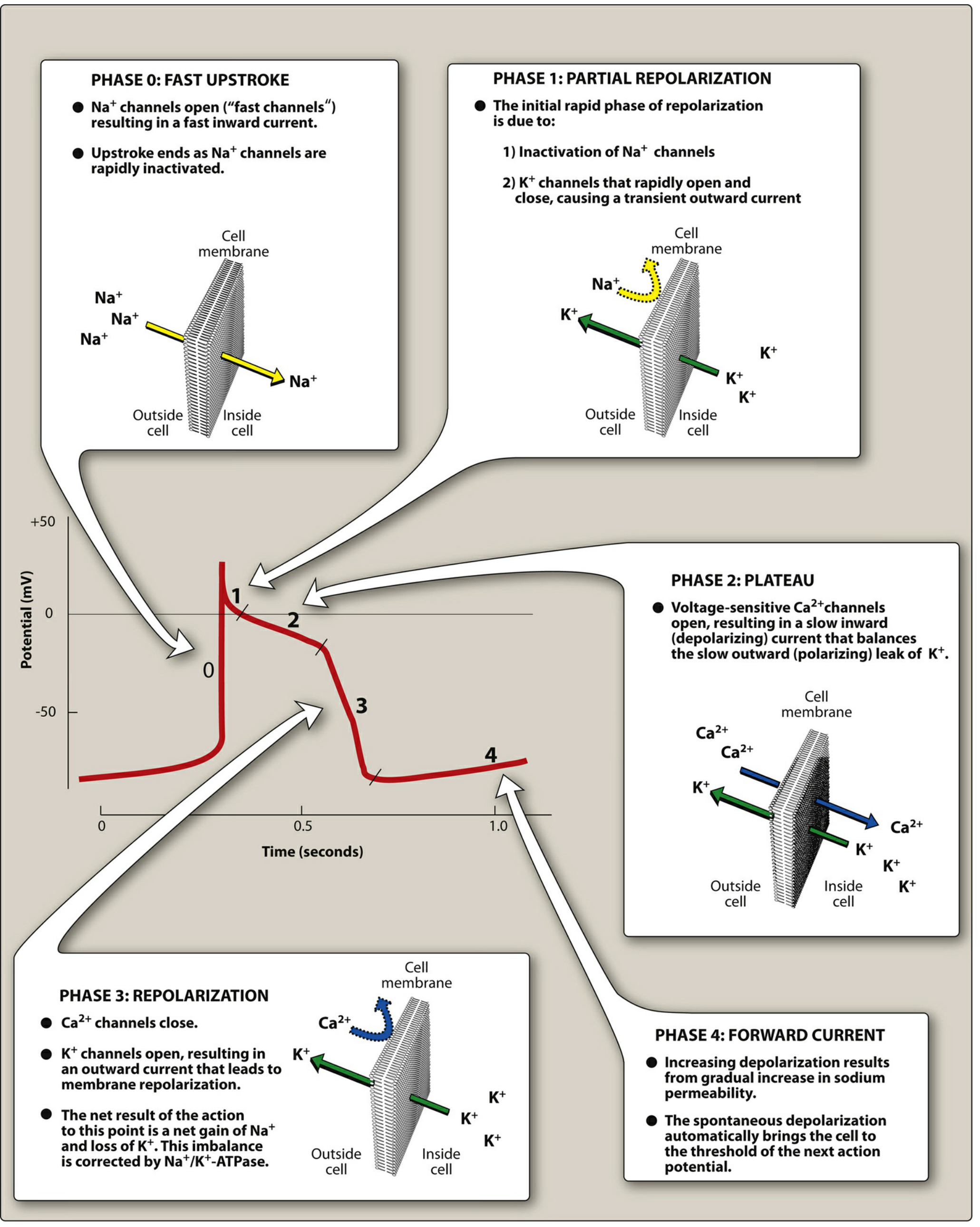
| Phase | What Happens | Ion Movement |
|---|---|---|
| Phase 0 | Fast upstroke (depolarization) | Na+ rushes IN |
| Phase 1 | Partial repolarization | Na+ channels close; K+ briefly out |
| Phase 2 | Plateau | Ca2+ in slowly, K+ out slowly |
| Phase 3 | Repolarization | Ca2+ closes; K+ floods out |
| Phase 4 | Slow diastolic depolarization (pacemaker cells) | Gradual Na+ permeability increase |
Key principle: Arrhythmias arise from either abnormal automaticity or abnormal conduction (re-entry). Antiarrhythmics work by blocking ion channels to suppress one or both.
Vaughan-Williams Classification - The Big Picture
| Class | Mechanism | Channel Blocked | Memory Hook |
|---|---|---|---|
| Ia | Na+ channel block (moderate) | Na+ (+ K+) | "Slow and widen" - slows Phase 0, widens QRS + QT |
| Ib | Na+ channel block (weak) | Na+ | "Short phase 3" - only shortens repolarization |
| Ic | Na+ channel block (strong) | Na+ | "Slam" - most potent Na+ block, biggest QRS widening |
| II | Beta-blockers | β-adrenergic | "Block the sympathetics" |
| III | K+ channel block | K+ | "Prolong the QT" |
| IV | Ca2+ channel block | Ca2+ | "Slow the AV node" |
CLASS I - Sodium Channel Blockers
General rule: All class I agents block fast Na+ channels → increase excitability threshold → slow conduction velocity → can break re-entry circuits.
Class Ia - "Moderate Blockers" (Procainamide, Quinidine, Disopyramide)
Memory: "PQD" - Procainamide, Quinidine, Disopyramide
| Feature | Detail |
|---|---|
| Mechanism | Block Na+ channels (moderate) + K+ channels → slow Phase 0 + prolong QT |
| ECG effect | Widens QRS + prolongs QT interval |
| Big risk | Torsades de pointes (TdP) from QT prolongation |
Procainamide (Most EM-relevant Class Ia)
- Actions: Intermediate Na+ channel block + K+ channel block; active metabolite NAPA (blocks only K+)
- EM Indications:
- Hemodynamically stable VT - drug of choice in stable monomorphic VT (PROCAMIO trial: 68% conversion vs amiodarone 48%, fewer adverse events)
- WPW with AF (pre-excited AF) - PREFERRED over adenosine/verapamil
- AF of <48 hours duration
- Dose: 10 mg/kg IV; or 1g in 250 mL D5W over 60-120 minutes. Stop if BP <100 mmHg, HR <60, or QRS widens >50%
- Avoid in: Prolonged QT, symptomatic CHF, lupus
- Adverse effects: Hypotension, QT prolongation, TdP, lupus-like syndrome (chronic use), agranulocytosis
Quinidine
- Historically important; now mostly oral/chronic use
- Side effects: Cinchonism (tinnitus, headache, visual disturbances), hemolytic anemia, thrombocytopenia, TdP
Disopyramide
- Strong anticholinergic effects (urinary retention, constipation, dry mouth)
- Negative inotrope - avoid in heart failure
Class Ib - "Weak Blockers" (Lidocaine, Mexiletine)
Memory: "LM" - Lidocaine, Mexiletine
| Feature | Detail |
|---|---|
| Mechanism | Weak Na+ block; preferentially acts on ischemic, depolarized tissue |
| ECG effect | No significant QRS/QT change |
| Unique | Shortens Phase 3 repolarization |
Lidocaine (The EM Workhorse)
- Actions: Preferentially suppresses ischemic myocardial tissue; local anesthetic properties
- EM Indications: Ventricular arrhythmias - VT/VF (especially in acute MI setting); alternative when amiodarone unavailable
- Dose: 1-1.5 mg/kg IV bolus; repeat 0.5-0.75 mg/kg every 5-10 min; infusion 1-4 mg/min
- Adverse effects (CNS dose-dependent): Tremor → paresthesias → confusion → seizures → respiratory arrest
- Hepatic metabolism - reduce dose in liver disease/low cardiac output states
Mexiletine
- Oral lidocaine analog; used for chronic VT suppression
- Side effects: nausea, vomiting, dyspepsia
Class Ic - "Strong Blockers" (Flecainide, Propafenone)
Memory: "FP" - Flecainide, Propafenone
| Feature | Detail |
|---|---|
| Mechanism | Strongest Na+ channel block; marked slowing of Phase 0 |
| ECG effect | Marked QRS widening (even at therapeutic doses) |
| Big rule | AVOID in structural heart disease or post-MI |
Flecainide
- EM Use: "Pill-in-pocket" for paroxysmal AF (lone AF, no structural heart disease)
- CAST trial warning: Increased mortality in post-MI patients with PVCs - never use in ischemic heart disease
- Adverse effects: Proarrhythmia, visual disturbances
Propafenone
- Also has mild beta-blocking properties
- Similar indications and contraindications to flecainide
EM Pearl on Class I overall: Class Ic drugs are "use-dependent" - they bind more to open channels during tachycardia, so they're better at rate-related arrhythmia suppression.
CLASS II - Beta-Blockers
Key agents in EM: Metoprolol, Esmolol, Labetalol, Propranolol
| Feature | Detail |
|---|---|
| Mechanism | Block β-adrenergic receptors → decrease SA node automaticity + slow AV conduction |
| ECG effect | Slows HR; prolongs PR interval |
| Phase affected | Reduces Phase 4 slope (slows pacemaker cells) |
| Drug | Key Property | EM Use |
|---|---|---|
| Metoprolol | β1-selective, IV available | Rate control in AF/flutter; SVT |
| Esmolol | Ultra-short acting (T½ ~9 min), titratable | Acute rate control; perioperative arrhythmias |
| Labetalol | α + β blockade | Hypertensive emergency + arrhythmia |
| Propranolol | Non-selective (β1+β2) | Thyroid storm, non-selective situations |
- EM Indications: Rate control in AF/atrial flutter; AVNRT; post-MI arrhythmia suppression; thyrotoxicosis-induced arrhythmias
- Contraindications: Decompensated HF, cardiogenic shock, severe bradycardia, 2nd/3rd degree AV block, reactive airway disease (propranolol)
- Adverse effects: Bradycardia, AV block, bronchospasm, hypotension
CLASS III - Potassium Channel Blockers
Key agents: Amiodarone, Sotalol, Dofetilide, Ibutilide, Dronedarone
| Feature | Detail |
|---|---|
| Mechanism | Block K+ channels → delay Phase 3 repolarization → prolong action potential duration + QT interval |
| ECG effect | Prolonged QT; risk of TdP |
Amiodarone - "The King of Class III" (and the most EM-critical drug)
Multi-channel drug: Blocks K+ (III) + Na+ (I) + Ca2+ (IV) + α + β receptors. Truly a drug of all classes.
Pharmacokinetics: Highly lipophilic; huge volume of distribution; terminal half-life 40-55 days. IV gives rapid effect but redistributes quickly → need large loading doses.
| Setting | Dose | Notes |
|---|---|---|
| VF/Pulseless VT (ACLS) | 300 mg IV push; repeat 150 mg | First-line after epinephrine |
| Stable VT | 150 mg IV over 10 min, then 1 mg/min x 6h, then 0.5 mg/min x 18h | |
| AF rate/rhythm control | 150 mg IV over 10 min, then drip | |
| Oral loading | 400-600 mg TID x 1 week → taper |
Adverse effects (multi-organ toxicity for chronic use):
- Pulmonary toxicity - most serious (pneumonitis → fibrosis)
- Thyroid - hypo or hyperthyroidism (contains iodine)
- Hepatotoxicity
- Corneal microdeposits (most patients on chronic therapy)
- Photosensitivity, blue-grey skin discoloration
- Bradycardia, AV block (acute IV)
- Hypotension (IV formulation contains polysorbate 80)
Indications: AF (rate + rhythm control), VT, VF, post-resuscitation arrhythmia suppression. Preferred in structural heart disease + HF.
Sotalol
- Has BOTH Class II (beta-blocker) and Class III (K+ channel block) effects
- EM Use: AF/flutter; monomorphic VT
- Risk: TdP (must monitor QT); avoid if QTc >500 ms or CrCl <40 mL/min
- Requires inpatient initiation (QT monitoring)
Ibutilide
- IV only; acute cardioversion of AF/flutter
- Big risk: TdP in 3-8% of patients - monitor for at least 4 hours post-infusion
- Dose: 1 mg IV over 10 min; repeat once if needed; correct electrolytes first
Dofetilide
- Oral only; AF/flutter conversion and maintenance of sinus rhythm
- Renally cleared - dose adjust for renal impairment
- Requires inpatient initiation (QT monitoring x 3 days)
Dronedarone
- Amiodarone analog without iodine (less thyroid/pulmonary toxicity)
- Only for paroxysmal/persistent AF that has converted to sinus rhythm
- Contraindicated in: Permanent AF, HF with NYHA III-IV, severe liver disease
- Increases digoxin levels and doubles serum creatinine (not true renal impairment)
CLASS IV - Calcium Channel Blockers
Key agents: Diltiazem, Verapamil
| Feature | Detail |
|---|---|
| Mechanism | Block L-type Ca2+ channels → slow AV node conduction + slow SA node automaticity |
| ECG effect | Prolonged PR interval; rate slowing |
| Selectivity | Work primarily on AV node and SA node (not ventricular myocardium at therapeutic doses) |
| Drug | Key Property | EM Use |
|---|---|---|
| Diltiazem | IV bolus + infusion available | Rate control in AF/flutter; AVNRT termination |
| Verapamil | More negative inotrope | AVNRT; rate control; LVOT obstruction (HCM) |
EM Indications: Rate control in AF/atrial flutter; termination of AVNRT (if adenosine fails or SVT recurs)
Contraindications (critical for exam):
- WPW with AF/flutter - NEVER use (can accelerate conduction down accessory pathway → VF)
- Hypotension, cardiogenic shock
- Decompensated HF with systolic dysfunction
- Wide-complex tachycardia of unknown origin (may be VT)
Diltiazem dose: 0.25 mg/kg IV over 2 min; repeat 0.35 mg/kg if needed; infusion 5-15 mg/hr
OTHER ANTIARRHYTHMICS (Non-Vaughan-Williams)
Adenosine - "The Reset Button"
| Feature | Detail |
|---|---|
| Mechanism | Activates K+ channels in AV node (hyperpolarization) + inhibits cAMP → transient complete AV block |
| Half-life | <10 seconds (metabolized by red blood cells and endothelium) |
| ECG effect | Momentary flat line (complete AV block) |
- EM Indication: Drug of choice for acute SVT (AVNRT, AVRT) - terminates re-entry through AV node
- Dose: 6 mg rapid IV push + flush; repeat 12 mg x2 if no response
- Use central line or antecubital vein (distal veins give unreliable delivery)
- Higher doses needed if patient on theophylline/caffeine (adenosine antagonists)
- Halve the dose if on dipyridamole/carbamazepine (potentiate adenosine) or after heart transplant
- Adverse effects (transient, last seconds): Flushing, chest tightness, dyspnea, "sense of impending doom" - warn the patient!
- Contraindicated in: WPW with pre-excited AF, 2nd/3rd degree AV block, sick sinus syndrome (without pacemaker), severe reactive airway disease
Digoxin
- Mechanism: Inhibits Na+/K+-ATPase → intracellular Na+ rises → Ca2+ accumulates → increased contractility; also increases vagal tone → slows AV conduction
- EM Use: Rate control in AF (especially in HF with reduced EF); not for acute AF cardioversion
- Limitation: Sympathetic activation overcomes digoxin's AV-slowing effect (unreliable rate control in high-adrenergic states)
- Toxicity: Nausea, vomiting, yellow-green visual halos, bradycardia, any arrhythmia (PVCs, junctional tachycardia, AF with slow ventricular response are classic)
- Risk factors: Hypokalemia (most important), hypomagnesemia, renal impairment
- Toxic levels: >2.0 ng/mL (but toxicity can occur at lower levels)
- Treatment: Digoxin-specific antibody fragments (Digibind/DigiFab)
- Therapeutic range for AF: 1.0-2.0 ng/mL; for HFrEF: 0.5-0.9 ng/mL
Magnesium Sulfate
- Mechanism: Blocks Ca2+ channels; inhibits early afterdepolarizations
- EM Indications:
- Torsades de Pointes (drug of choice) - 1-2 g IV over 1-2 min (even if Mg level is normal)
- Digoxin toxicity arrhythmias
- Arrhythmias associated with hypomagnesemia
- Dose for TdP: 1-2 g IV bolus over 1-2 min, then infusion if recurrent
Atropine
- Mechanism: Muscarinic antagonist → blocks vagal tone → increases SA and AV node rate/conduction
- EM Use: Symptomatic bradycardia (sinus bradycardia, AV block)
- Dose: 0.5 mg IV; repeat every 3-5 min; max 3 mg
- Avoid in: High degree (Mobitz II, complete) AV block - may worsen infranodal block
Isoproterenol
- Mechanism: Non-selective β-agonist → increases HR and conduction
- EM Use: Pharmacologic pacing for symptomatic bradycardia refractory to atropine; TdP with bradycardia
- Contraindicated in: Ischemic heart disease (worsens ischemia)
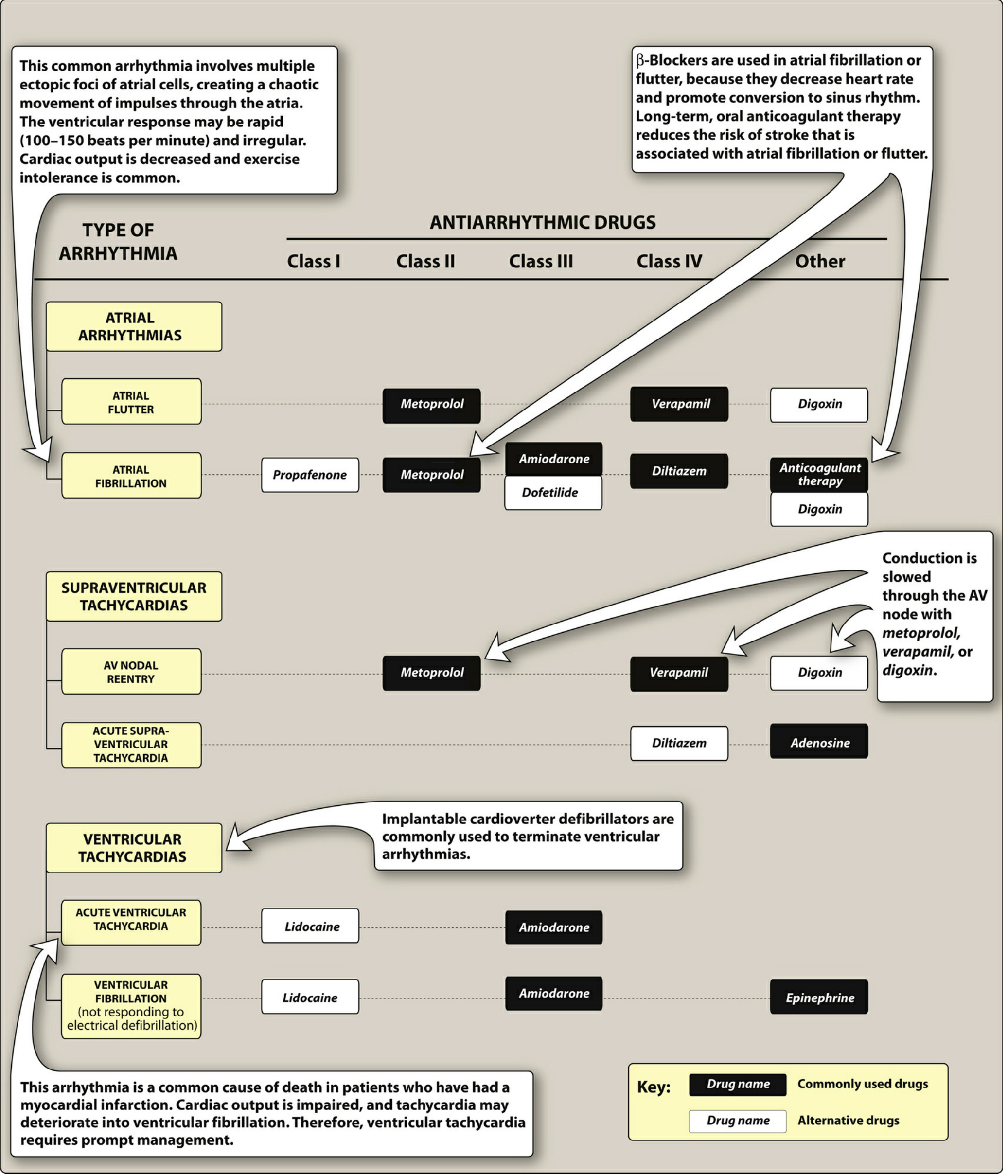
Drug-Arrhythmia Quick Reference Map
High-Yield EM Exam Summary Table
| Arrhythmia | First Choice | Alternative | AVOID |
|---|---|---|---|
| AVNRT (SVT) | Adenosine 6 mg IV | Diltiazem, Metoprolol | Verapamil in WPW |
| AF rate control | Diltiazem IV | Metoprolol IV | Ca2+/beta-blocker in WPW-AF |
| AF rhythm control (no struct. disease) | Flecainide, Propafenone | Amiodarone, Sotalol | Class Ic in structural disease |
| AF rhythm control (HF/struct. disease) | Amiodarone | Dofetilide | Flecainide, Propafenone, Sotalol |
| AF acute cardioversion (IV) | Ibutilide | Procainamide, Amiodarone | - |
| WPW + pre-excited AF | Procainamide | DC cardioversion | Adenosine, CCB, Beta-blockers, Digoxin |
| Stable monomorphic VT | Procainamide | Amiodarone | Verapamil |
| VF/Pulseless VT | Amiodarone 300 mg | Lidocaine 1.5 mg/kg | - |
| Torsades de Pointes | Magnesium 2g IV | Isoproterenol; overdrive pacing | All QT-prolonging drugs |
| Symptomatic Bradycardia | Atropine 0.5 mg | Dopamine, Isoproterenol, Pacing | - |
| Digoxin toxicity arrhythmia | Digibind/DigiFab | Magnesium, Lidocaine | Calcium (if hyperK), DC cardioversion |
Critical "NEVER DO" Pearls for the EM Exam
- Never give adenosine, verapamil, diltiazem, beta-blockers, or digoxin in WPW + AF - can precipitate VF
- Never give Class Ic drugs (flecainide, propafenone) post-MI or with structural heart disease - CAST trial
- Never give verapamil/diltiazem for wide-complex tachycardia unless you are 100% sure it is SVT with aberrancy (assume VT first)
- Never use procainamide/quinidine when QT is already prolonged - TdP risk
- Correct K+ and Mg2+ before giving any QT-prolonging antiarrhythmic
- Sotalol + dofetilide must be started inpatient with QT monitoring
Proarrhythmia Risk Summary
| QT Prolongers (TdP risk) | Biggest proarrhythmic risk |
|---|---|
| Class Ia: quinidine, procainamide, disopyramide | Class Ia > Class Ic (VT/VF) > Class III |
| Class III: amiodarone, sotalol, ibutilide, dofetilide | Amiodarone: lowest TdP risk among Class III despite QT prolongation |
| Many others: macrolides, antipsychotics, antihistamines | Sotalol + ibutilide: highest TdP risk |
Why amiodarone has low TdP risk despite prolonging QT: It also blocks Ca2+ and Na+ channels, which offset the proarrhythmic effects of K+ channel block. This is why amiodarone is preferred in structural heart disease.
Sources: Tintinalli's Emergency Medicine, Chapter 19 (Pharmacology of Antiarrhythmics); Lippincott Illustrated Reviews: Pharmacology, Chapter 11
This is a shared conversation. Sign in to Orris to start your own chat.