
Micro albminuria
Microalbuminuria refers to the presence of small but abnormal amounts of albumin in the urine (30-300 mg/day), below the threshold detectable by standard dipstick tests. It is an early marker of kidney damage and cardiovascular risk, commonly seen in diabetes and hypertension.
Searching sources...
Reading File
Now let me search the medical library and PubMed in parallel for comprehensive content on microalbuminuria.
Finding Sources
Finding Sources
Searching PubMed
microalbuminuria cardiovascular risk diabetes
Good results. Now let me read the most relevant textbook sections in parallel for detailed content.
Reading File
Reading File
Reading File
Now let me fetch the mortality graph image and get treatment/management content:
Loading Image
Reading File
Finding Sources
Excellent - I now have comprehensive information. Let me compile a thorough answer.
Microalbuminuria
Definition and Classification
Microalbuminuria (now more precisely termed "moderately increased albuminuria" per KDIGO guidelines) refers to urinary albumin excretion in the range that is too small for standard dipstick detection but above normal:
| Category | Albumin-to-Creatinine Ratio (ACR) | 24-hour Urine |
|---|---|---|
| Normal | < 30 µg/mg (mg/g) | < 30 mg/day |
| Microalbuminuria | 30-299 µg/mg | 30-300 mg/day |
| Macroalbuminuria | ≥ 300 µg/mg | > 300 mg/day |
From Creasy & Resnik's Maternal-Fetal Medicine, Table 59.3 (modified from ADA Standards of Care 2021)
Diagnosis requires: 2 out of 3 collections showing abnormal values within a 3-6 month period, to exclude transient causes (exercise, fever, UTI, heart failure).
Pathophysiology
Microalbuminuria results from glomerular endothelial dysfunction that increases permeability of the glomerular basement membrane (GBM) to albumin. Key mechanisms include:
- Metabolic injury: Hyperglycemia leads to GBM thickening (up to 3x normal: 270-359 nm range), mesangial matrix expansion, and diffuse glomerulosclerosis
- Hemodynamic injury: Intraglomerular hypertension (from RAAS activation) increases filtration pressure, driving albumin across the GBM
- Endothelial dysfunction: Microalbuminuria reflects systemic endothelial injury - it correlates with increased platelet aggregation, elevated CRP, dyslipidemia, and accelerated atherosclerosis
- Genetic susceptibility: Diabetic siblings of probands with microalbuminuria have a significantly increased risk themselves, indicating hereditary factors
(Comprehensive Clinical Nephrology, 7th Ed.; Brenner and Rector's The Kidney)
Natural History in Diabetic Nephropathy
Diabetic nephropathy progresses through four stages (Goldman-Cecil Medicine):
| Stage | Features |
|---|---|
| Stage I | Hyperfiltration (GFR ↑ up to 50%), transient microalbuminuria with stress/illness |
| Stage II | Fixed microalbuminuria (30-300 mg/day); ~30% of T1DM after ~10 years; GBM thickening and mesangial expansion on biopsy |
| Stage III | Overt proteinuria (>500 mg/day, dipstick-positive); GFR begins to fall |
| Stage IV | Advanced nephropathy; nephrotic-range proteinuria; progressive decline to ESRD |
The majority of patients with fixed microalbuminuria progress to overt nephropathy within 5-7 years if untreated.
- Microalbuminuria is a more specific sign of diabetic nephropathy in Type 1 DM than in Type 2 DM (because hypertension itself can cause microalbuminuria in T2DM).
- It is more likely in patients with concurrent proliferative retinopathy.
Prognostic Significance
Microalbuminuria is a powerful independent predictor of both renal and cardiovascular outcomes:
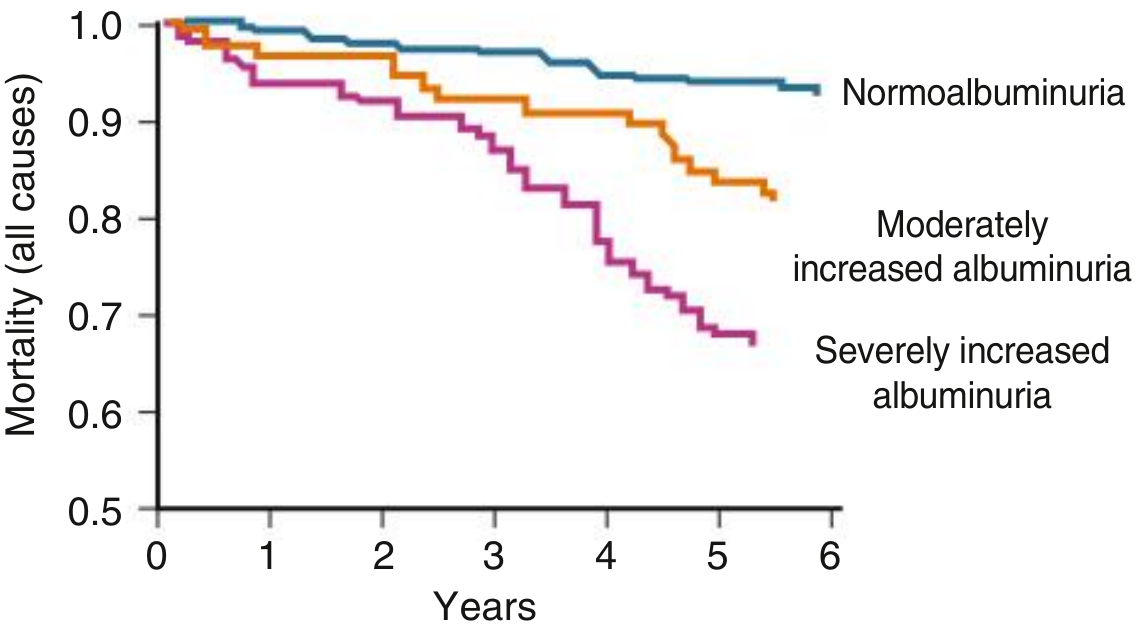
Influence of albuminuria on 5-year all-cause mortality in 328 NIDDM patients. Even moderately increased albuminuria (microalbuminuria) significantly increases total mortality versus normoalbuminuria. - Comprehensive Clinical Nephrology, 7th Ed.
- Cardiovascular risk: Albuminuria at any level indicates endothelial dysfunction and predicts atherosclerosis, coronary events, and cardiovascular death
- CKD marker: Microalbuminuria at any eGFR level indicates CKD (per KDIGO) - it signals metabolic syndrome, DM, or hypertensive glomerular damage (Braunwald's Heart Disease)
- The increase in risk begins even in the upper normal range of albuminuria, not only once the microalbuminuria threshold is crossed
Screening Methods
Three equivalent screening methods (Creasy & Resnik's Maternal-Fetal Medicine):
- Albumin-to-creatinine ratio (ACR) on a random spot urine - easiest and most practical in outpatient settings
- 24-hour urine collection with simultaneous creatinine clearance
- Timed collection (4-hour or overnight)
Conditions that cause false-positive (transient) microalbuminuria:
- Vigorous exercise
- Febrile illness
- Urinary tract infection
- Poor glycemic control
- Congestive heart failure
- Hypertensive crisis
Treatment and Management
1. RAAS Blockade (First-line)
Both ACE inhibitors and ARBs reduce microalbuminuria and slow progression to macroalbuminuria:
- ARBs (e.g., irbesartan 300 mg/day): In T2DM with hypertension and microalbuminuria, irbesartan reduced the incidence of overt proteinuria from 14.9% (placebo) to 5.2% (HR 0.30; 95% CI 0.14-0.61) - a dose-dependent effect (Brenner and Rector's The Kidney)
- A meta-analysis confirmed ARBs significantly reduce: ESKD (RR 0.78), doubling of creatinine (RR 0.79), and progression from microalbuminuria to macroalbuminuria (RR 0.49; 95% CI 0.32-0.75)
- Dose should be titrated to the maximum antihypertensive dose for renoprotective effect
A 2024 Cochrane systematic review (PMID 38682786) confirmed ACEi/ARBs prevent progression of diabetic kidney disease.
2. Glycemic Control
- Tight glycemic control (HbA1c target) reduces hyperfiltration and slows progression from normoalbuminuria to microalbuminuria and beyond
- SGLT2 inhibitors and GLP-1 receptor agonists have demonstrated additional renoprotective effects beyond glucose-lowering. A 2026 meta-analysis (PMID 40982219) confirmed GLP-1 receptor agonists reduce renal outcomes.
3. Blood Pressure Control
- Target BP <130/80 mmHg in diabetic patients with albuminuria
- RAAS inhibitors are preferred antihypertensives in this context
4. Finerenone (Novel MRA)
The non-steroidal selective mineralocorticoid receptor antagonist finerenone attenuates albuminuria in T2DM with DKD when added to conventional ACEi/ARB therapy, with a favorable safety profile (National Kidney Foundation Primer on Kidney Diseases, 8th Ed.)
5. Lifestyle Modifications
- 30-60 minutes of aerobic exercise at least 5 times per week
- Dietary sodium restriction
- Smoking cessation
- Weight reduction
Summary Table
| Feature | Details |
|---|---|
| Definition | ACR 30-299 mg/g; urine albumin 30-300 mg/day |
| Detection | Not detectable by standard urine dipstick |
| Significance | Early marker of nephropathy; cardiovascular risk predictor |
| Most common cause | Diabetic nephropathy, hypertension |
| Confirm diagnosis | 2/3 positive samples over 3-6 months |
| First-line treatment | ACEi or ARB (dose-titrated) |
| Prognosis | Reversal possible with early aggressive treatment |
Key teaching point: Microalbuminuria is not merely a renal finding - it is a window into systemic endothelial dysfunction and independently predicts cardiovascular mortality. Early detection and RAAS blockade can reverse or delay progression to overt nephropathy.
This is a shared conversation. Sign in to Orris to start your own chat.