
Free fatty acid undergo Beta oxidation in mitochondria means
Beta oxidation is the process by which fatty acids are broken down in the mitochondrial matrix to generate acetyl-CoA, NADH, and FADH2, which feed into the TCA cycle and electron transport chain to produce ATP. Free fatty acids must first be activated to fatty acyl-CoA in the cytoplasm, then transported into the mitochondria via the carnitine shuttle before oxidation begins.
Searching sources...
Reading File
Finding Sources
Finding Sources
Reading File
Reading File
Loading Image
Reading File
Reading File
Finding Sources
Reading File
Searching Images
carnitine shuttle fatty acid transport inner mitochondrial membrane CPT1 CPT2
Loading Image
Reading File
Loading Image
Reading File
Now I have a thorough picture from the textbooks. Let me compose the complete, well-structured answer.
Beta Oxidation of Free Fatty Acids in Mitochondria
Beta oxidation is the principal catabolic pathway by which free fatty acids (FFAs) are broken down to generate energy. The name "beta" refers to the fact that oxidation occurs at the beta-carbon (carbon 3) of the fatty acyl chain. The entire process takes place in the mitochondrial matrix.
Step 1: Activation of Free Fatty Acid in the Cytosol
Before entering the mitochondria, the free fatty acid must be activated to its CoA derivative:
Fatty acid + CoA + ATP → Fatty acyl-CoA + AMP + PPi (Enzyme: Acyl CoA synthetase / Thiokinase, located on the outer mitochondrial membrane)
This step consumes the equivalent of 2 ATP (ATP is cleaved to AMP + pyrophosphate).
- Biochemistry, 8th ed, Lippincott Illustrated Reviews, p. 542
Step 2: Entry into Mitochondria - The Carnitine Shuttle
The inner mitochondrial membrane is impermeable to CoA and fatty acyl-CoA. Long-chain fatty acids (>12 carbons) must use the carnitine shuttle to cross.
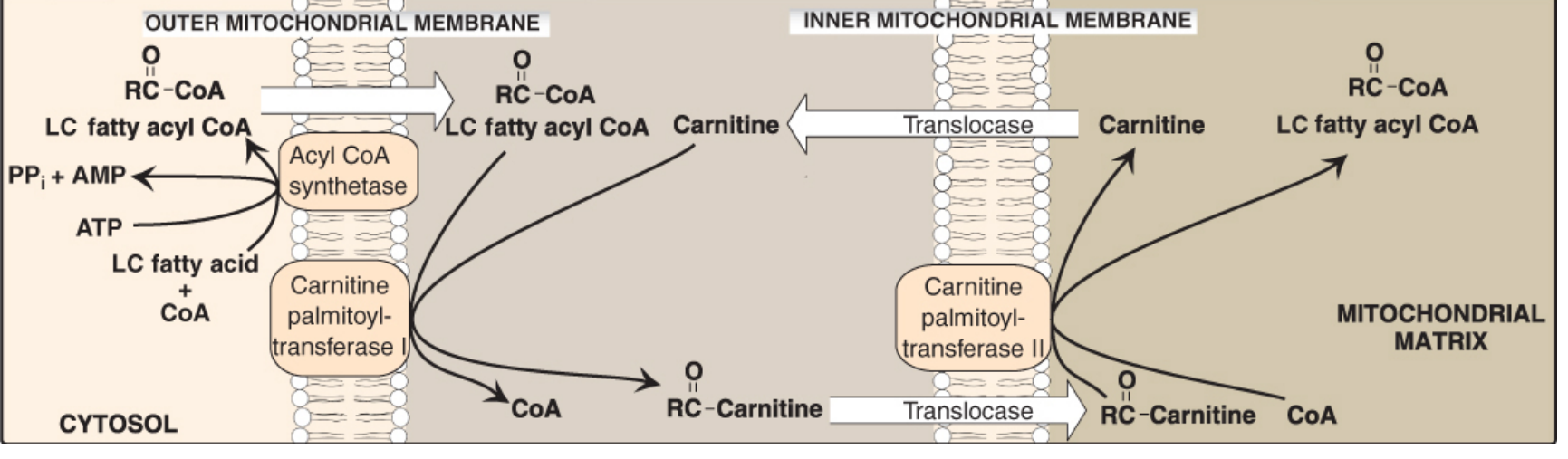
Three steps of the carnitine shuttle:
- CPT-I (outer mitochondrial membrane): Acyl group transferred from CoA to carnitine → forms acylcarnitine
- Carnitine-acylcarnitine translocase: Acylcarnitine moves into the matrix; free carnitine returns to cytosol
- CPT-II (inner mitochondrial membrane): Acyl group transferred back to CoA in the matrix → regenerates fatty acyl-CoA
Key regulation: Malonyl CoA (the first intermediate of fatty acid synthesis) inhibits CPT-I, preventing fatty acid degradation when synthesis is active - ensuring these opposing pathways do not run simultaneously.
- Short- and medium-chain fatty acids (≤12 carbons) can cross the inner membrane without carnitine.
- Biochemistry, 8th ed, Lippincott Illustrated Reviews, p. 541-543
Step 3: The Four Reactions of Beta Oxidation (Spiral)
Once inside the mitochondrial matrix, the fatty acyl-CoA undergoes a repeating cycle of four reactions, each removing a 2-carbon unit as acetyl-CoA:
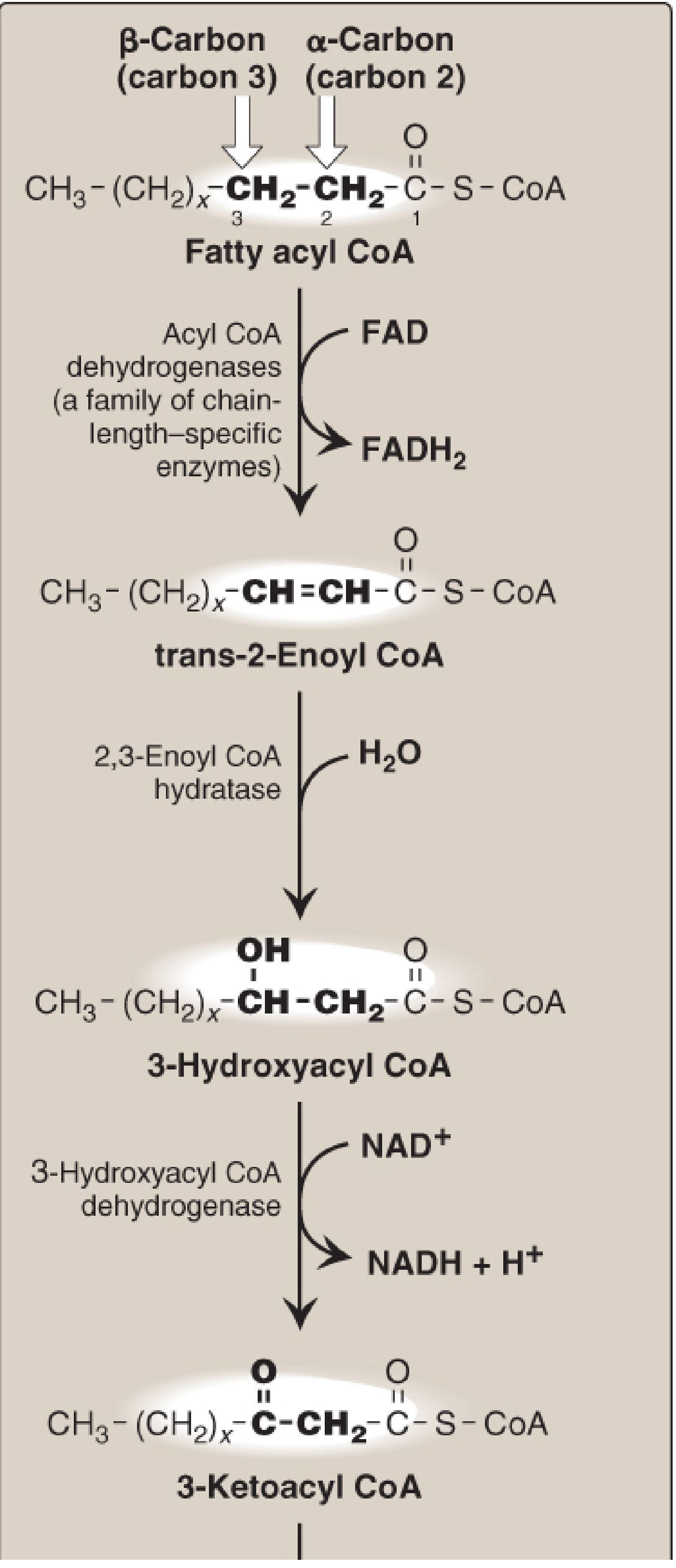
| Step | Reaction | Enzyme | Product |
|---|---|---|---|
| 1. Oxidation | Fatty acyl-CoA → trans-2-Enoyl CoA | Acyl CoA dehydrogenase (FAD-dependent) | FADH₂ |
| 2. Hydration | trans-2-Enoyl CoA + H₂O → 3-Hydroxyacyl CoA | 2,3-Enoyl CoA hydratase | 3-Hydroxyacyl CoA |
| 3. Oxidation | 3-Hydroxyacyl CoA → 3-Ketoacyl CoA | 3-Hydroxyacyl CoA dehydrogenase (NAD⁺-dependent) | NADH |
| 4. Thiolysis | 3-Ketoacyl CoA + CoA → Fatty acyl-CoA (2C shorter) + Acetyl CoA | Thiolase | Acetyl-CoA |
The shortened fatty acyl-CoA re-enters the cycle. This spiral repeats until the entire chain is broken into acetyl-CoA units.
- Guyton & Hall Textbook of Medical Physiology, p. 845
Step 4: Products and Energy Yield
Each round of the spiral produces:
- 1 FADH₂ → enters ETC at Complex II / CoQ → ~1.5 ATP
- 1 NADH → enters ETC at Complex I → ~2.5 ATP
- 1 Acetyl-CoA → enters TCA cycle → ~10 ATP
For palmitate (16C): 7 cycles of beta oxidation yield:
-
7 FADH₂ + 7 NADH + 8 Acetyl-CoA
-
Gross yield: ~131 ATP
-
Net yield: 129 ATP (subtracting 2 ATP for activation)
-
Biochemistry, 8th ed, Lippincott Illustrated Reviews, p. 547
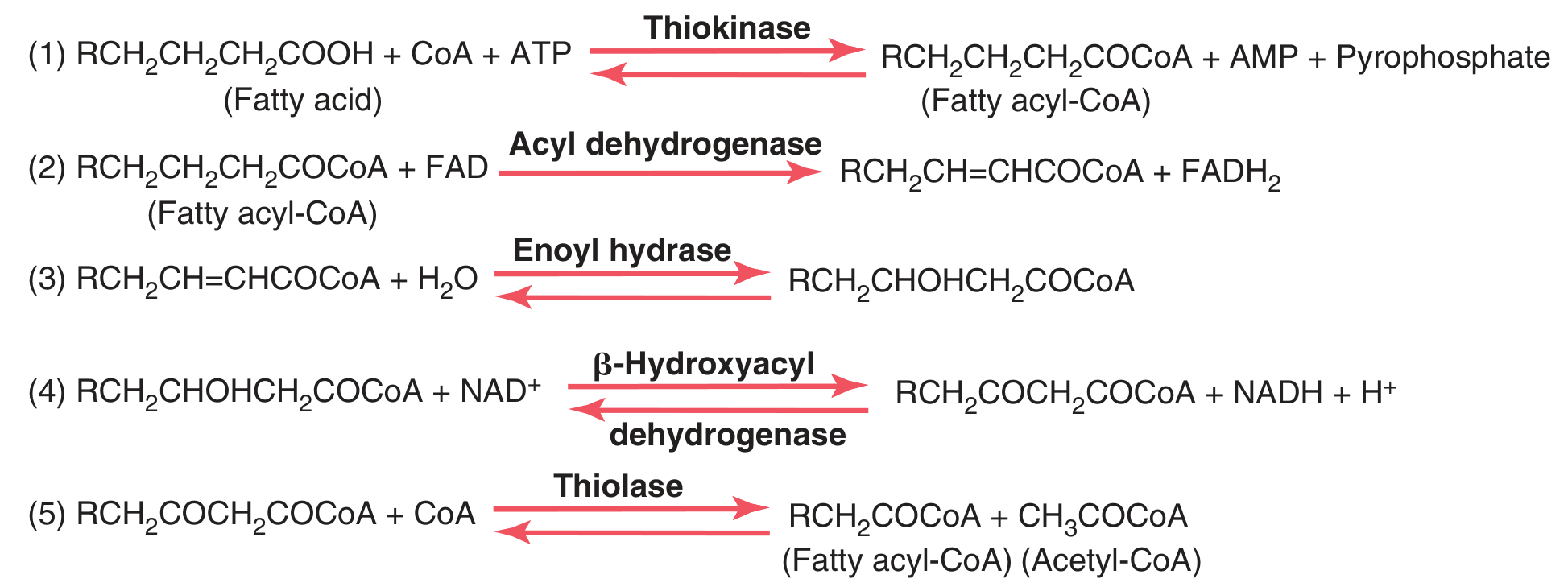
Summary Diagram of Reactions
What Happens to Acetyl-CoA?
The acetyl-CoA generated has two main fates:
- TCA cycle - combines with oxaloacetate to form citrate → complete oxidation to CO₂ + H₂O + ATP
- Ketogenesis (in liver) - when oxaloacetate is limited (e.g., fasting/starvation), two acetyl-CoA molecules condense to form acetoacetate, which is exported to other tissues as a fuel (ketone body)
Key Clinical Points
| Condition | Mechanism |
|---|---|
| Primary carnitine deficiency | Defect in OCTN2 transporter → carnitine lost in urine → cannot oxidize LCFA → hypoglycemia, muscle weakness |
| CPT-I deficiency | Liver cannot use LCFA → severe hypoglycemia during fasting |
| CPT-II deficiency | Most common form affects skeletal muscle → weakness + myoglobinemia after prolonged exercise |
| Valproic acid toxicity | Decreases renal reabsorption of carnitine → secondary carnitine deficiency |
- Biochemistry, 8th ed, Lippincott Illustrated Reviews, p. 543-544
Beta Oxidation vs. Peroxisomal Oxidation
Beta oxidation also occurs in peroxisomes, but with key differences:
-
Peroxisomes handle very-long-chain fatty acids (24-26C), which mitochondria cannot process directly
-
The first peroxisomal enzyme is an oxidase (not dehydrogenase) → electrons go to O₂ → produces H₂O₂ (not FADH₂), so less ATP is generated
-
Peroxisomal oxidation stops at 4-6C; the shortened chain is then transferred to mitochondria via carnitine
-
Basic Medical Biochemistry - A Clinical Approach, 6e, p. 1092-1093
This is a shared conversation. Sign in to Orris to start your own chat.