
Anatomy of facial nerve. MS ent University exam pattern for 20 marks as per standard ENT textbooks.
Reading File
Finding Sources
Finding Sources
Reading File
Reading File
Reading File
Reading File
Reading File
Finding Sources
Reading File
Finding Sources
Finding Sources
Reading File
Reading File
Loading Image
Reading File
I now have comprehensive material from multiple standard ENT textbooks. Let me compile the complete 20-mark MS ENT university exam answer on the anatomy of the facial nerve.
Anatomy of the Facial Nerve (CN VII)
MS ENT University Exam — 20 Marks
(Sources: Cummings Otolaryngology, Scott-Brown's Otorhinolaryngology, Shambaugh's Surgery of the Ear, KJ Lee's Essential Otolaryngology, Gray's Anatomy for Students)
I. Introduction
The facial nerve (CN VII) is the nerve of the second branchial arch (Reichert's cartilage). It is a mixed nerve containing five distinct fiber types and traverses a complex course through the temporal bone before supplying the muscles of facial expression.
II. Fiber Components (5 Types)
| Fiber Type | Origin / Nucleus | Function |
|---|---|---|
| Special Visceral Efferent (SVE) | Motor nucleus, caudal pons | Muscles of facial expression, stapedius, stylohyoid, posterior belly of digastric |
| General Visceral Efferent (GVE) (Parasympathetic) | Superior salivatory nucleus, pons | Lacrimal, nasal, palatine glands (via GSPN + pterygopalatine ganglion); submandibular and sublingual glands (via chorda tympani + submandibular ganglion) |
| Special Visceral Afferent (SVA) | Geniculate ganglion → Nucleus of tractus solitarius | Taste from anterior 2/3 of tongue (via chorda tympani); taste from palate and tonsillar fossa (via GSPN) |
| General Somatic Afferent (GSA) | Geniculate ganglion → Spinal nucleus of V | Sensation from concha, EAC skin, auricle (Ramsay Hunt zone) |
| Visceral Afferent | — | Mucosa of nose, pharynx, palate |
Key point: The superior part of the facial motor nucleus (innervating frontalis, orbicularis oculi) receives bilateral supranuclear input; the inferior part receives only contralateral cortical input. This explains why UMN lesions spare the forehead.
III. Course of the Facial Nerve — Six Segments
The nerve traverses the temporal bone within the fallopian canal, which begins at the fundus of the IAC and terminates at the stylomastoid foramen.
1. Intracranial (Cisternal) Segment — 17-24 mm
- Arises from the pontomedullary junction, between the pons and olive
- Traverses the cerebellopontine angle (CPA) alongside CN VIII and the nervus intermedius
- Vulnerable to: acoustic neuromas, meningiomas, CPA tumors
2. Meatal (Intracanalicular) Segment — 8-10 mm
- Enters the internal auditory meatus (IAM) at the porus acusticus
- Lies in the anterosuperior quadrant of the IAC (above the cochlear nerve anteroinferiorly; above the superior vestibular nerve posterosuperiorly - Bill's bar separates it from the superior vestibular nerve)
- Exits the IAC at the meatal foramen (narrowest point of the intratemporal canal)
- Vulnerable to: acoustic neuromas, labyrinthitis
3. Labyrinthine Segment — 4 mm (Shortest and Narrowest Segment)
- Runs from the meatal foramen to the geniculate ganglion
- Passes superior to the cochlea, between the cochlea and vestibule
- The nerve lacks epineurium here; surrounded only by thin arachnoid → most susceptible to compression from edema (Bell's palsy mechanism)
- Ends at the geniculate ganglion (the only sensory ganglion of CN VII; contains cell bodies of taste and somatic sensory neurons)
- First genu occurs at the geniculate ganglion - the nerve makes an acute posterior turn
- First branch given off: Greater (Superficial) Petrosal Nerve (GSPN) - exits via the facial hiatus
4. Tympanic (Horizontal) Segment — 11-13 mm
- From the geniculate ganglion (first genu) to the second genu (at the level of the lateral semicircular canal)
- Runs in the medial wall of the middle ear (tympanic cavity), forming part of the medial wall anterior attic
- Passes superior to the cochleariform process and the oval window niche posteriorly
- This segment is the most common site of congenital bony dehiscence (especially above the oval window; ~66% of dehiscences occur here; 75% are bilateral)
- A dehiscent nerve may prolapse into the middle ear, presenting as a middle ear mass
- Vulnerable to: acute suppurative otitis media, cholesteatoma erosion
5. Mastoid (Vertical) Segment — 13-20 mm
- From the second genu (at the pyramidal eminence/lateral SCC) to the stylomastoid foramen
- Second genu is just anteroinferior to the lateral semicircular canal, anterior to a line through the short process of the incus
- Passes posterior to the external auditory canal
- The space between the mastoid segment and the chorda tympani = facial recess (used in posterior tympanotomy / intact canal wall mastoidectomy)
- Most variable in course; especially abnormal in congenital atresia
- In the newborn, the underdeveloped mastoid tip places this segment superficially - at risk during postauricular incisions and forceps delivery
6. Extratemporal Segment
- Exits at the stylomastoid foramen
- Immediately surrounded by aponeurosis of the posterior belly of digastric (preserving this during rerouting improves post-op nerve function)
- Gives off branches before entering the parotid:
- Posterior auricular nerve: occipital belly of occipitofrontalis + auricular muscles
- Branch to posterior belly of digastric and stylohyoid
- Enters the parotid gland, divides into upper (temporofacial) and lower (cervicofacial) divisions, then fans out into 5 terminal branches
IV. Summary of Surgical Landmarks by Segment
| Segment | Key Surgical Landmark |
|---|---|
| Labyrinthine | Vertical crest (Bill's bar); cochlea |
| Geniculate ganglion | GSPN; supratubal recess; tegmen |
| Tympanic | Cochleariform process; oval window; short process of incus |
| Second genu | Lateral SCC prominence; pyramidal eminence |
| Mastoid | Short process of incus (extrapolate vertical segment superiorly bisects it); digastric ridge at its inferior end |
V. Branches and Their Functions
A. Within the Temporal Bone
| Branch | Level of Origin | Function |
|---|---|---|
| Greater petrosal nerve (GSPN) | Geniculate ganglion (first genu) | Parasympathetic to lacrimal, nasal, palatine glands; taste from palate. Joins deep petrosal nerve (sympathetic) → nerve of pterygoid canal (Vidian nerve) → pterygopalatine ganglion |
| Nerve to stapedius | ~6 mm above stylomastoid foramen (mastoid segment) | Motor to stapedius muscle (hyperacusis when absent) |
| Chorda tympani | Mastoid segment, just before stylomastoid foramen | - Crosses middle ear, lateral to incus, medial to handle of malleus - Exits via petrotympanic (Glaserian) fissure - Joins lingual nerve (CN V3) - Taste from anterior 2/3 of tongue (via submandibular ganglion) - Parasympathetic to submandibular and sublingual glands |
B. Extratemporal Branches (after stylomastoid foramen)
- Posterior auricular nerve - auricular muscles, occipital belly of occipitofrontalis
- Digastric branch - posterior belly of digastric
- Stylohyoid branch - stylohyoid muscle
- Terminal motor branches (5, through parotid substance):
- Temporal (T) - frontalis, corrugator supercilii, orbicularis oculi
- Zygomatic (Z) - orbicularis oculi (lower), zygomaticus
- Buccal (B) - buccinator, muscles of upper lip and nose
- Marginal mandibular (M) - depressor anguli oris, depressor labii, mentalis
- Cervical (C) - platysma
Mnemonic: "To Zanzibar By Motor Car" (Temporal, Zygomatic, Buccal, Marginal mandibular, Cervical)
VI. Nervus Intermedius
- The nerve of Wrisberg; carries all non-motor fibers of CN VII
- Runs as a separate trunk between the main motor root and CN VIII within the IAC (anterosuperiorly)
- Merges with the main facial nerve at the geniculate ganglion
- Carries: parasympathetic (GVE) + taste (SVA) + somatic sensation (GSA)
- The chorda tympani is the peripheral expression of the nervus intermedius at the mastoid segment
VII. Blood Supply
| Segment | Arterial Supply |
|---|---|
| Intracranial + IAC | Anterior inferior cerebellar artery (AICA) |
| Labyrinthine + geniculate | Labyrinthine artery (branch of AICA) |
| Tympanic and mastoid segments | Superficial branch of middle meningeal artery; petrosal branch of middle meningeal artery; superior petrosal artery |
| Near stylomastoid foramen | Stylomastoid branch of posterior auricular artery (or occipital artery) |
The labyrinthine segment is a watershed zone with poor blood supply - contributing to Bell's palsy severity at this level.
VIII. Applied / Clinical Anatomy (Exam-High-Yield)
Localization of Lesions by Testing
| Test | Tests | Nerve Branch Involved |
|---|---|---|
| Lacrimation (Schirmer's test) | GSPN function | Lesion proximal to GSPN origin (geniculate ganglion level or above) |
| Stapedial reflex (impedance audiometry) | Nerve to stapedius | Lesion proximal to nerve to stapedius (above second genu) |
| Taste (electrogustometry) | Chorda tympani | Lesion proximal to chorda tympani origin (mastoid segment) |
| Motor function only | Pure motor | Lesion distal to stylomastoid foramen |
Rule: The more proximal the lesion, the more functions lost.
Forehead Sparing (UMN vs LMN)
- UMN lesion (e.g., stroke): Contralateral lower face palsy; forehead spared (bilateral cortical representation of upper face)
- LMN lesion (e.g., Bell's palsy): Complete ipsilateral hemifacial palsy including forehead
Dehiscence of Fallopian Canal
- Most common at tympanic segment over oval window (~55-66% of cases)
- ~25% dehiscence at geniculate ganglion fossa
- Predisposes to otitis media-related facial palsy; surgical injury
Vulnerability Points Summary
| Segment | Pathology |
|---|---|
| Labyrinthine (no epineurium, watershed supply) | Bell's palsy; temporal bone fracture (geniculate fossa) |
| Geniculate ganglion (thin bone, tethered by GSPN) | Trauma (shearing), fractures, middle fossa surgery |
| Tympanic (dehiscent) | CSOM, cholesteatoma, surgical injury |
| Mastoid (variable, newborn) | Forceps delivery, mastoid surgery, cholesteatoma |
| Extratemporal (parotid) | Parotid neoplasms, parotidectomy, facial lacerations |
Facial Recess
- Triangular space bounded by: facial nerve (medially), chorda tympani (laterally), incudal fossa (superiorly)
- Surgical corridor used in posterior tympanotomy for cochlear implant surgery and intact canal wall mastoidectomy
IX. Diagram
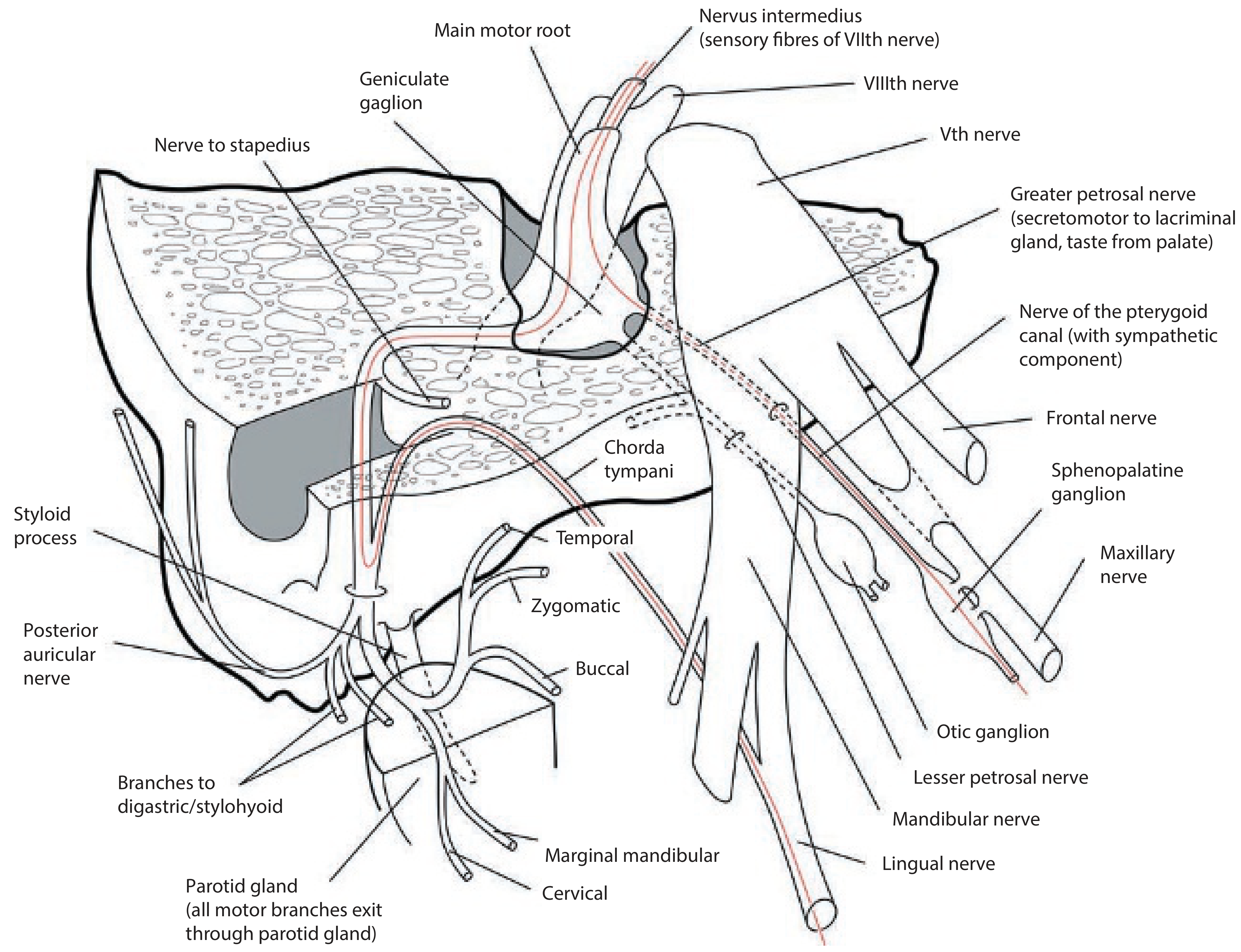
X. Quick Revision Summary
- Nerve of 2nd branchial arch
- 5 fiber types: SVE (motor), GVE (parasympathetic), SVA (taste), GSA (somatic sensation), visceral afferent
- 6 segments: Intracranial → Meatal → Labyrinthine (shortest, 4 mm) → Tympanic (horizontal, 11 mm, most dehiscent) → Mastoid (vertical, 13 mm) → Extratemporal
- Geniculate ganglion: only sensory ganglion; first branch = GSPN; first genu here
- Narrowest point: meatal foramen (between meatal and labyrinthine segments)
- Terminal 5 branches through parotid: T-Z-B-M-C (To Zanzibar By Motor Car)
- Facial recess: between facial nerve and chorda tympani - key surgical landmark
- Forehead sparing in UMN lesions due to bilateral cortical representation
References:
- Cummings Otolaryngology Head and Neck Surgery, Chapter 126
- Scott-Brown's Otorhinolaryngology Head & Neck Surgery, Vol. 2, Chapter 111-112
- Shambaugh's Surgery of the Ear, Chapter 2
- KJ Lee's Essential Otolaryngology, Chapter 21
- Gray's Anatomy for Students, Chapter 8
This is a shared conversation. Sign in to Orris to start your own chat.