
Epidemiological determines of disease causation
Reading File
Now let me search the medical library for content on epidemiological determinants of disease causation.
Finding Sources
Finding Sources
Finding Sources
Finding Sources
Park's Textbook of Preventive and Social Medicine has a dedicated section. Let me read it along with relevant paragraph content.
Reading File
Finding Sources
Excellent - Park's textbook has a "Web of causation" and "Multifactorial causation" sections. Let me read those key sections.
Reading File
Finding Sources
Finding Sources
Reading File
Reading File
Finding Sources
Reading File
Reading File
I now have comprehensive content. Let me also fetch the "web of causation" image and the triangle of epidemiology image for the response.
Loading Image
Reading File
I now have all the material needed to compose a thorough, well-structured answer. Let me compile it.
Epidemiological Determinants of Disease Causation
1. What are "Determinants" in Epidemiology?
A unique feature of epidemiology is the testing of aetiological hypotheses and the identification of underlying causes (or risk factors) of disease. This is the domain of analytical epidemiology. A determinant is any factor - biological, social, chemical, physical, or psychological - whose presence or absence is associated with the occurrence of disease. According to the International Epidemiological Association (IEA), one of epidemiology's core aims is to "identify aetiological factors (risk factors) in the pathogenesis of disease."
Park's Textbook of Preventive and Social Medicine
2. Models of Disease Causation
2a. The Epidemiological Triad (Triangle of Epidemiology)
The classical model identifies three interacting elements:
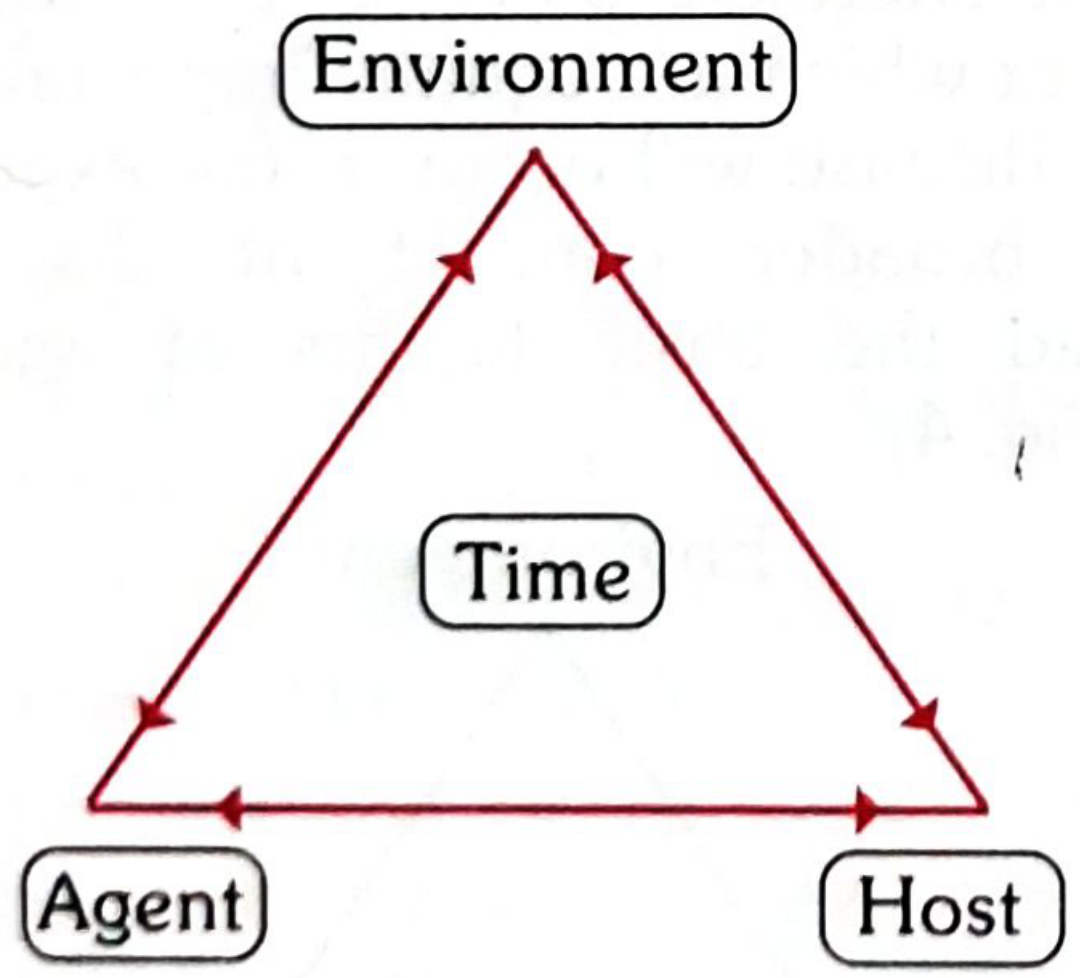
| Element | Description |
|---|---|
| Agent | The cause of disease - biological, chemical, physical, nutritional, or other force |
| Host | The human or animal harboring the disease; immunity, genetics, age, sex, behavior all matter |
| Environment | External surroundings - physical, biological, and psychosocial - that facilitate or inhibit disease transmission |
| Time | Incubation periods, duration of illness, epidemic thresholds, and life expectancy of host/pathogen |
"The primary mission of epidemiology is to provide information that results in breaking one of the legs of the triangle, thereby disrupting the connection among environment, host, and agent, and stopping the outbreak."
Park's Textbook of Preventive and Social Medicine
2b. Multifactorial Causation
The concept of a single cause for every disease (the "germ theory" or one-to-one relationship) was shown to be untenable even for microbial diseases. Diseases like tuberculosis are not merely due to the tubercle bacillus - poverty, overcrowding, and malnutrition also contribute. For non-communicable diseases like coronary heart disease, excess fat intake, smoking, lack of physical exercise, and obesity all interact.
Epidemiology has moved beyond the germ theory into examining the total life situation of the patient and community: social, economic, cultural, genetic, and psychological factors. The purpose of identifying multiple factors is to prioritize them for modification or control - which offers multiple points of intervention.
Park's Textbook of Preventive and Social Medicine
2c. Web of Causation (MacMahon and Pugh)
Proposed by MacMahon and Pugh in Epidemiologic Principles and Methods, the web of causation considers all predisposing factors of any type and their complex interrelationships. It is ideally suited to chronic disease study, where a specific agent is often unknown.
Key points:
- No single factor is the sole cause; disease results from interlocking chains of causation
- Removing even one link from the chain - if that link is sufficiently important - may be enough to prevent disease
- Individual factors within a multifactorial web are not of equal weight; their relative importance is expressed as the relative risk
- The model guides the selection of feasible intervention points
For example, myocardial infarction has a web including smoking, hypertension, obesity, sedentary lifestyle, diet, stress, and genetic predisposition - all connected.
Park's Textbook of Preventive and Social Medicine
3. Categories of Determinants
A. Agent Factors
A disease agent is "a substance, living or non-living, or a force, tangible or intangible, the excessive presence or relative lack of which may initiate or perpetuate a disease process."
1. Biological agents - viruses, bacteria, rickettsiae, fungi, protozoa, metazoa
- Infectivity: ability to invade and multiply in a host
- Pathogenicity: ability to induce clinically apparent illness
- Virulence: proportion of clinical cases resulting in severe manifestations
2. Chemical agents - dietary substances, tobacco smoke, solvents, poisons, pollutants
3. Physical agents - radiation, heat, noise, electromagnetic energy
4. Nutritional agents - deficiencies (e.g., vitamin A, iodine) or excesses (e.g., fat, calories)
5. Genetic/inherited factors - chromosomal abnormalities, single-gene disorders, polygenic traits
B. Host Factors
The host is the organism harboring disease. Host determinants include:
- Immunity (innate and acquired)
- Age and sex
- Genetic makeup - susceptibility varies; some pathogens only thrive under limited ideal conditions within specific host types
- Nutritional status and overall fitness
- Behaviour and lifestyle - smoking, diet, physical activity, substance use
- Prior disease and comorbidities
C. Environmental Factors
Physical environment: sanitation, water supply, air quality, housing, radiation hazards, electromagnetic exposure. Historically, improvements in the physical environment have driven the greatest reductions in infectious disease.
Biological environment: viruses, insects, rodents, plants, and other organisms that serve as disease agents, reservoirs, intermediate hosts, or vectors.
Psychosocial environment: cultural values, customs, habits, beliefs, attitudes, religion, education, lifestyles, community structures, and social organization. Conflict, tension, and socioeconomic inequality all generate disease burden.
Park's Textbook of Preventive and Social Medicine
4. Establishing Causation: The Bradford Hill Criteria
Simply demonstrating an association between a factor and a disease is not the same as establishing causation. Sir Austin Bradford Hill (1965) proposed nine criteria that constitute a framework for inferring causality:
| Criterion | Explanation |
|---|---|
| Strength of association | The stronger the association (e.g., high relative risk or odds ratio), the more likely it is causal |
| Consistency | The association is replicated in different populations, places, and times |
| Specificity | A single putative cause produces a single specific effect |
| Temporality | The exposure must precede the outcome (risk factor predates disease) - this is the only absolute requirement |
| Biological gradient | A dose-response relationship: more exposure = greater risk; less exposure = lower risk |
| Plausibility | The association is consistent with known biological mechanisms |
| Coherence | The association does not conflict with existing theory and knowledge of the disease |
| Experimental evidence | Removing or modifying the factor reduces disease occurrence (e.g., RCT or natural experiment) |
| Analogy | An established cause-effect relationship exists for a similar exposure or disease |
Not all criteria need to be satisfied - in complex multifactorial diseases (e.g., CKD, cardiovascular disease) many risk factors will not fulfil all criteria, but the framework remains a useful tool for weighing evidence.
Brenner and Rector's The Kidney; Park's Textbook of Preventive and Social Medicine
5. The Natural History of Disease: A Framework for Prevention
Causation links directly to understanding the natural history of disease, which unfolds in two phases:
Prepathogenesis phase: Interaction of agent, host, and environment in the environment, before disease starts in the human body. This is the window for primary prevention (e.g., vaccination, health promotion).
Pathogenesis phase: Begins when the disease agent enters the susceptible host. Progresses through incubation, early pathogenesis, and late pathogenesis, ending in recovery, disability, or death. Intervention here constitutes secondary or tertiary prevention.
Summary
| Model | Best Applied To | Key Insight |
|---|---|---|
| Epidemiological Triad | Infectious diseases | Interaction of agent, host, environment, and time |
| Multifactorial causation | All diseases | Multiple causal factors, priority-ranked for intervention |
| Web of causation | Chronic diseases | Complex interrelationships; removing one key link can control disease |
| Bradford Hill Criteria | Any exposure-outcome pair | Framework for moving from association to causation |
The determinants of disease are not simply the agent causing illness but the full interaction of biological, behavioural, social, economic, and environmental forces acting on a susceptible host over time. Analytical epidemiology exists precisely to disentangle these forces and guide targeted, evidence-based interventions.
This is a shared conversation. Sign in to Orris to start your own chat.