
Mention about hostel of malarial parasite
Reading File
The malarial parasite (Plasmodium species) has two hosts - a definitive host (female Anopheles mosquito) and an intermediate/intermediate host (humans). Let me look this up in the medical library for authoritative detail.
Searching sources...
Finding Sources
Finding Sources
Good results found. Let me now read the most relevant sections - the life cycle from Fishman's and the dedicated malaria section from Harrison's and Medical Microbiology.
Reading File
Finding Sources
Reading File
Excellent - I now have very rich content from both Fishman's Pulmonary Diseases and Harrison's Principles of Internal Medicine. Let me read more of the Harrison's section for complete host information.
Reading File
Finding Sources
I found a lifecycle diagram. Let me fetch that image and read more of the Harrison's text about the mosquito (definitive host) stage.
Loading Image
Reading File
I now have comprehensive information. Let me also fetch the lifecycle diagram with the correct full URL.
Loading Image
I now have all the information needed. Here is a comprehensive answer about the hosts of the malarial parasite.
Hosts of the Malarial Parasite (Plasmodium spp.)
The malarial parasite has two hosts - a definitive host where sexual reproduction occurs, and an intermediate/incidental host where asexual reproduction takes place.
1. Definitive Host - Female Anopheles Mosquito
The female Anopheles mosquito is the definitive host because sexual reproduction (sporogony) of Plasmodium takes place within it.
What happens in the mosquito:
- When a female Anopheles mosquito takes a blood meal from an infected human, it ingests gametocytes (the sexual forms of the parasite)
- The male gametocyte exflagellates and rapidly divides into 8 motile male gametes
- Male gametes fuse with female gametocytes - this is the actual sexual union (fertilization)
- Two rounds of meiotic division produce a zygote in the mosquito's midgut
- The zygote matures into an ookinete, which penetrates and encysts in the mosquito's gut wall
- The resulting oocyst expands by asexual division until it bursts, liberating myriad motile sporozoites
- Sporozoites migrate through the hemolymph to the salivary glands of the mosquito
- At the next blood meal, sporozoites are inoculated into a new human host, completing the cycle
Since sexual reproduction (gamete fusion and meiosis) occurs in the mosquito, it is technically the definitive host.
2. Intermediate/Incidental Host - Humans
Humans are the intermediate host because only asexual reproduction (schizogony/merogony) occurs in us. Six species of Plasmodium cause human malaria: P. falciparum, P. vivax, P. ovale (curtisi and wallikeri), P. malariae, and P. knowlesi.
The human host cycle has two major phases:
A. Pre-erythrocytic (Hepatic / Exo-erythrocytic) Stage
| Step | Detail |
|---|---|
| Entry | Sporozoites inoculated from mosquito salivary glands enter the bloodstream |
| Liver invasion | Sporozoites rapidly travel to the liver and invade hepatic parenchymal cells (hepatocytes) |
| Intrahepatic schizogony | Asexual multiplication occurs - one sporozoite produces 10,000 to >30,000 daughter merozoites |
| Schizont rupture | Infected liver cells burst, releasing merozoites into the bloodstream |
| Hypnozoites | In P. vivax and P. ovale, some intrahepatic forms remain dormant (hypnozoites) for weeks to over a year - these cause relapses |
| Duration | ~5.5 days (P. falciparum), ~8 days (P. vivax), ~9 days (P. ovale), ~15 days (P. malariae) |
This stage is clinically silent (asymptomatic).
B. Erythrocytic Stage (Blood Stage)
| Step | Detail |
|---|---|
| RBC invasion | Merozoites invade red blood cells (RBCs) and become trophozoites |
| Ring stage | Early intracellular parasites appear as "ring forms" under microscopy |
| Trophozoite growth | Parasites grow, consuming ~2/3 of the RBC's hemoglobin; hemozoin (malaria pigment) forms |
| Schizogony | Multiple nuclear divisions produce a schizont, which ruptures to release 6-30 new merozoites |
| Erythrocytic cycle | Repeats every 48 h (P. falciparum, P. vivax, P. ovale), 24 h (P. knowlesi), or 72 h (P. malariae) |
| Gametocytogenesis | A small percentage of merozoites develop into gametocytes (sexual forms) - these are picked up by the next feeding mosquito |
Symptoms begin when parasite density reaches ~50/μL blood. The disease is caused by RBC invasion, destruction, and the host's inflammatory reaction.
Lifecycle Summary Diagram
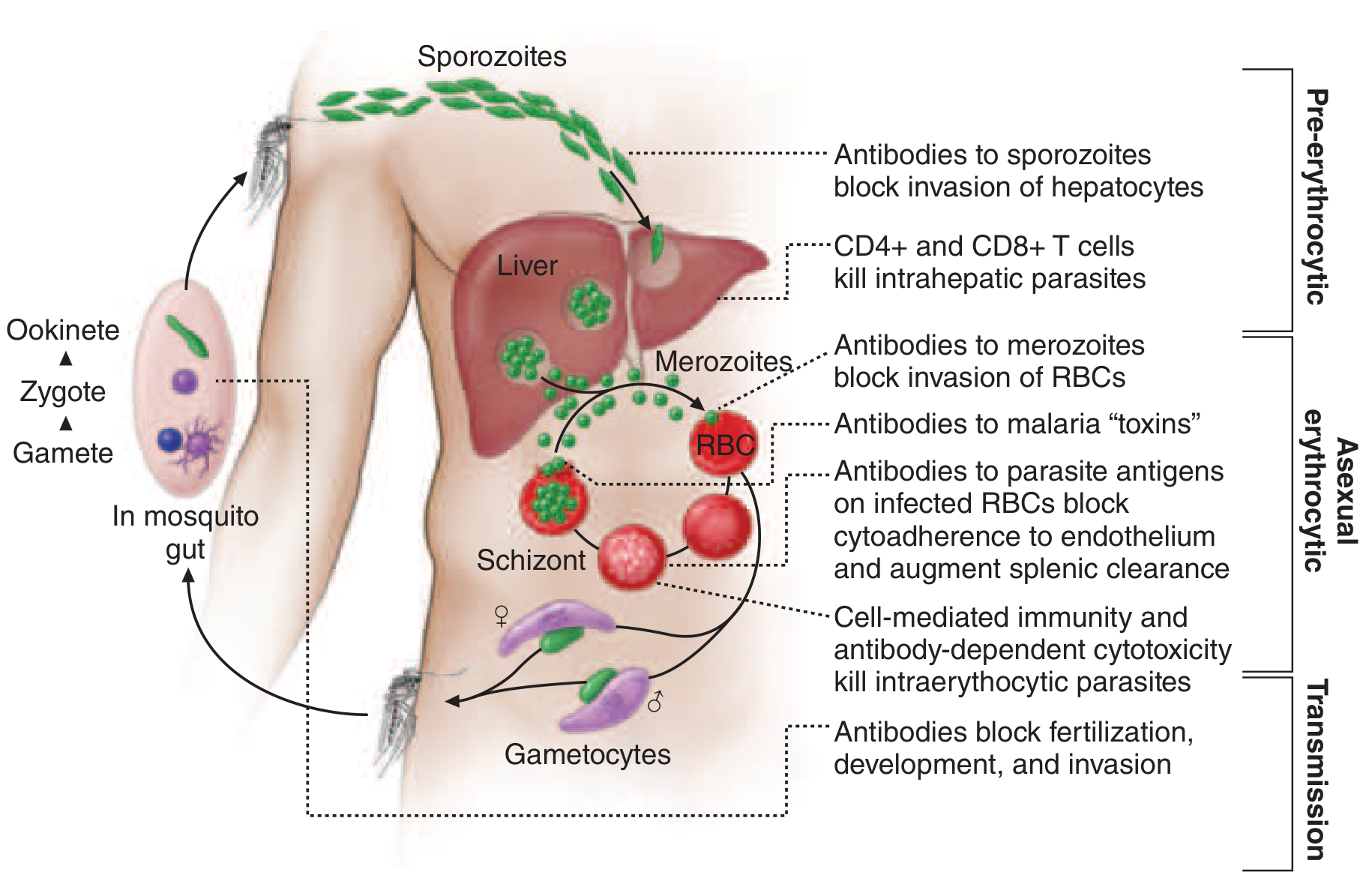
FIGURE: The malaria transmission cycle from mosquito to human, showing pre-erythrocytic and asexual erythrocytic stages, plus immune targets at each phase. (Harrison's Principles of Internal Medicine, 22nd Ed., Fig. 231-1)
Species-Specific Host Characteristics
| Feature | P. falciparum | P. vivax | P. ovale | P. malariae | P. knowlesi |
|---|---|---|---|---|---|
| Intrahepatic phase | 5.5 days | 8 days | 9 days | 15 days | 5.5 days |
| Merozoites/hepatocyte | 30,000 | 10,000 | 15,000 | 15,000 | 20,000 |
| Erythrocytic cycle | 48 h | 48 h | 50 h | 72 h | 24 h |
| RBC preference | All ages | Reticulocytes/young | Reticulocytes | Older cells | Younger cells |
| Relapses (hypnozoites) | No | Yes | Yes | No | No |
| Gametocyte shape | Banana-shaped | Round | Round | Round | Round |
Key Points to Remember
-
Definitive host = female Anopheles mosquito (sexual reproduction / sporogony occurs here)
-
Intermediate host = Humans (asexual reproduction / schizogony occurs here)
-
The parasite is also transmitted (rarely) by contaminated blood products, organ transplantation, and transplacentally (mother to child)
-
P. falciparum accounts for the majority of malaria-related deaths
-
Immunity is species- and strain-specific, requiring both humoral and cellular components
-
Harrison's Principles of Internal Medicine, 22nd Ed. (2025), Ch. 231, pp. 1804-1876
-
Fishman's Pulmonary Diseases and Disorders, 2-Volume Set, "Life Cycle" section, block 28
This is a shared conversation. Sign in to Orris to start your own chat.