
SPONDYLITIS
SPONDYLITIS,SPONDYLOSIS,SPONDYLOLYSISK,SPONDYLOLISTHESIS
SPONDYLITIS,SPONDYLOSIS,SPONDYLOLYSISK,SPONDYLOLISTHESIS diffrence image very easy to understand
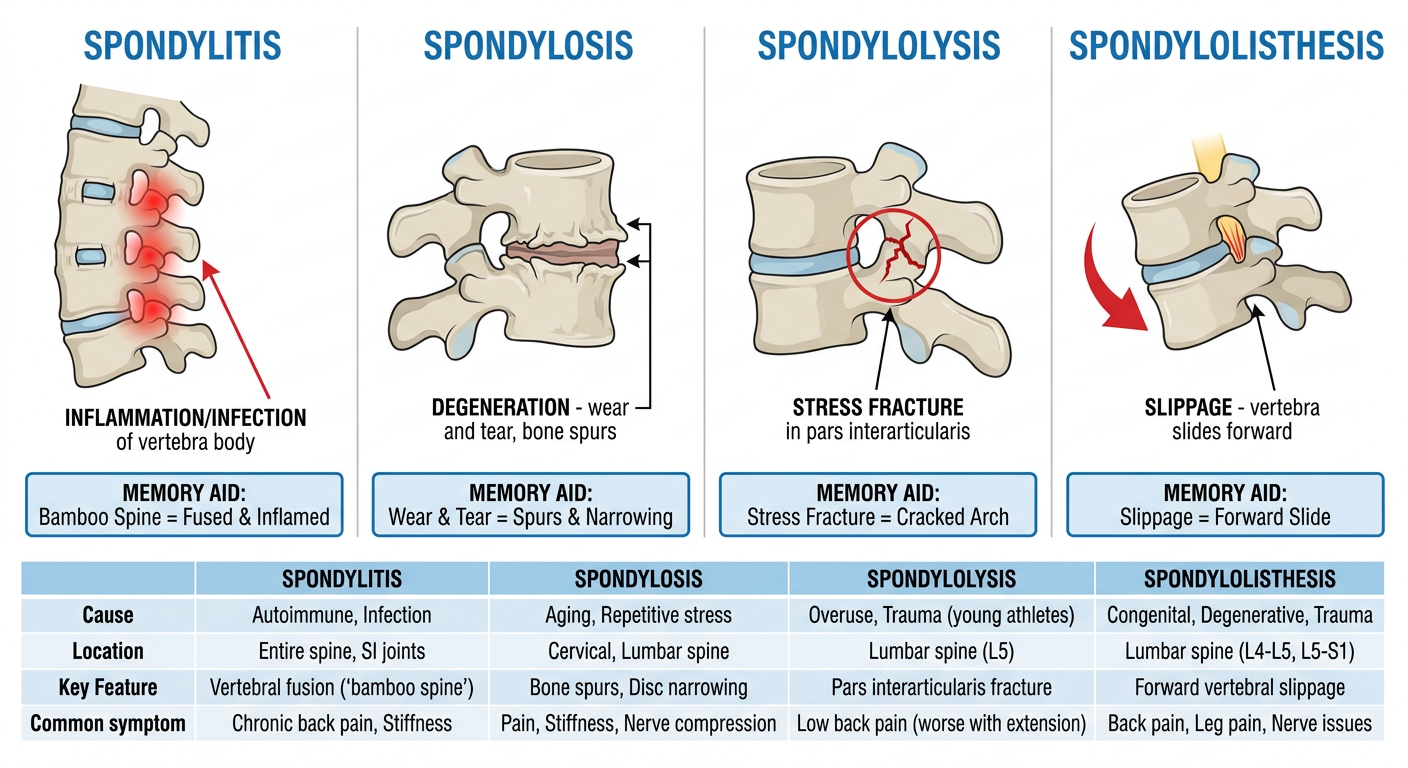
Medical educational diagram comparing 4 spinal conditions side by side on a clean white background. Each condition shown as a simple labeled spine illustration: 1. SPONDYLITIS (left panel): Inflammation and fusion of vertebrae, shown with red inflamed joints and fused "bamboo spine" appearance, label: "INFLAMMATION/INFECTION of vertebra body" 2. SPONDYLOSIS (second panel): Degenerative disc with bone spurs (osteophytes) at disc edges, disc narrowing, label: "DEGENERATION - wear and tear, bone spurs" 3. SPONDYLOLYSIS (third panel): Crack/stress fracture in the pars interarticularis (the bony arch of vertebra), shown with a clear break line, label: "STRESS FRACTURE in pars interarticularis" 4. SPONDYLOLISTHESIS (right panel): One vertebra sliding forward over the one below it, shown with forward slippage arrow, label: "SLIPPAGE - vertebra slides forward" Below each diagram: a simple memory aid. Clean, colorful, educational style with large clear labels. Include a comparison table at the bottom with rows: Cause, Location, Key Feature, Common symptom.
Spondylitis vs Spondylosis vs Spondylolysis vs Spondylolisthesis
Quick Memory Trick
| Term | Root Meaning | One-Word Summary |
|---|---|---|
| Spondyl-ITIS | -itis = inflammation | INFLAME |
| Spondyl-OSIS | -osis = degeneration | DEGENERATE |
| Spondyl-OLYSIS | -lysis = break/crack | CRACK |
| Spondyl-OLISTHESIS | -olisthesis = slip | SLIP |
1. SPONDYLITIS - "Inflammation"
- Cause: Autoimmune (HLA-B27 associated), infection (e.g. TB spondylitis = Pott's disease)
- What happens: Inflammation at vertebral joints and ligaments -> progressive ossification -> "Bamboo Spine" on X-ray (fused vertebrae like a bamboo cane)
- Who gets it: Young men, age 20-40
- Symptoms: Morning stiffness, improves with exercise (unlike mechanical back pain), sacroiliac joint pain
- Key X-ray: Symmetrical marginal bridging syndesmophytes, bamboo spine
2. SPONDYLOSIS - "Degeneration"
- Cause: Aging, chronic mechanical stress (like osteoarthritis of the spine)
- What happens: Disc height loss -> bone spurs (osteophytes) grow at disc edges -> spinal canal narrows (stenosis) -> nerve/cord compression
- Who gets it: Age >60 (most common spinal condition in elderly)
- Symptoms: Neck/back pain, radiculopathy, neurogenic claudication (leg pain walking, relieved by bending forward = "shopping cart sign")
- Key finding: Osteophytes, disc narrowing, foraminal stenosis on MRI/CT
- (Rosen's Emergency Medicine)
3. SPONDYLOLYSIS - "Crack/Fracture"
- Cause: Repetitive hyperextension stress (gymnastics, football linemen, weightlifters)
- What happens: The pars interarticularis develops a hairline crack; the vertebra stays in place
- Who gets it: Young athletes; incidence ~6% by age 14 years, up to 47% in athletic populations
- Level: Almost always L5 (occasionally L4)
- Symptoms: Low back pain worse with extension, may be completely asymptomatic
- Diagnosis: Often missed on plain X-ray; best seen on SPECT scan, reverse gantry CT, or MRI
- Treatment: Rest, NSAIDs, anti-lordotic brace; surgery (Buck's fusion) if conservative care fails
- (Bailey & Love's Surgery)
4. SPONDYLOLISTHESIS - "Slip"
- Cause: Bilateral spondylolysis (most common = isthmic type), degeneration, congenital, trauma
- What happens: The pars fractures bilaterally -> nothing holds the vertebra back -> it slips anteriorly
- Who gets it: Presents in ~4% of adults; also young athletes
- Level: Almost always L5 on S1
- Grading (Meyerding scale):
- Grade I = <25% slip
- Grade II = 25-50%
- Grade III = 50-75%
- Grade IV = 75-100%
- Grade V (Spondyloptosis) = >100% (complete fall-off)
- Symptoms: Low back pain, tight hamstrings, "step deformity" palpable in spine, radiculopathy, neurogenic claudication
- Treatment: Conservative for low-grade; surgical fusion for high-grade or neurological deficits
- (Bailey & Love's Surgery)
Side-by-Side Comparison Table
| Feature | Spondylitis | Spondylosis | Spondylolysis | Spondylolisthesis |
|---|---|---|---|---|
| Core problem | Inflammation | Degeneration | Pars fracture | Vertebral slip |
| Age | Young (20-40) | Elderly (>60) | Young athletes | Young athletes / elderly |
| Cause | Autoimmune / infection | Aging / wear | Repetitive stress | Bilateral pars fracture |
| X-ray key sign | Bamboo spine | Osteophytes, disc space loss | Pars defect ("Scottie dog" collar sign) | Anterior slip of vertebra |
| Pain pattern | Morning stiffness, improves with activity | Worsens with activity, neurogenic claudication | Extension pain | Back + leg pain |
| Vertebra moves? | No (fuses) | No | No | YES - forward |
| Treatment | NSAIDs, biologics (anti-TNF) | Conservative, PT, surgery for stenosis | Rest, brace, Buck's fusion | Fusion surgery if severe |
- -ITIS = fire (inflammation)
- -OSIS = rust (degeneration over time)
- -LYSIS = crack (break in the bone)
- -LISTHESIS = slide (one bone slides on another)