
Biomechanics of shoulder
Reading File
Finding Sources
Finding Sources
Finding Sources
Finding Sources
Finding Sources
Finding Sources
Finding Sources
Reading File
Reading File
Reading File
Reading File
Finding Sources
Reading File
Searching Images
shoulder joint biomechanics scapulohumeral rhythm glenohumeral
Reading File
Searching Images
rotator cuff muscles shoulder stability force couple
I now have comprehensive material. Let me compile the full answer.
Biomechanics of the Shoulder
The shoulder is the most mobile joint in the body, achieving this range of motion through a complex of four articulations that function as a unit. Stability is sacrificed for mobility and is restored by a coordinated system of static and dynamic restraints.
1. Anatomy Overview — The Shoulder Complex
The shoulder is not a single joint but a complex of four articulations:
| Joint | Type | Key Features |
|---|---|---|
| Glenohumeral (GH) | Ball & socket | Greatest ROM in the body; stability via labrum, ligaments, rotator cuff |
| Sternoclavicular (SC) | Double gliding + disc | Only true bony link between upper limb and axial skeleton; rotates ~30° with shoulder motion |
| Acromioclavicular (AC) | Plane/gliding + fibrocartilaginous disc | 5–8° rotation at max elevation; clavicle rotates 40–50° |
| Scapulothoracic | Not a true joint | Allows scapular movement against posterior rib cage; critical for glenoid positioning |
Bony Architecture
- Scapula: Spans ribs 2–7; anteverted ~30° on chest wall; glenoid retroverted ~5° relative to scapular body; attachment for 17 muscles
- Humeral head: Retroverted 30° relative to the transepicondylar axis
- Clavicle: First bone to ossify (5 weeks gestation), last to fuse (medial epiphysis ~25 years)
2. Static Stabilizers
The glenohumeral joint has minimal bony congruence (the glenoid covers only ~25–30% of the humeral head), so static stabilizers are critical:
| Structure | Stabilizing Function |
|---|---|
| Glenoid labrum | Deepens socket by 50%; acts as a bumper to translation; increases surface area |
| Coracohumeral ligament (CHL) | Restrains inferior translation and external rotation of adducted arm |
| Superior GH ligament (SGHL) | Restrains external rotation and inferior translation (arm adducted or slightly abducted) |
| Middle GH ligament (MGHL) | Restrains anterior translation at 45° abduction (absent in up to 30%) |
| Inferior GH ligament, anterior band (IGHL-AB) | Primary restraint — anterior/inferior translation at 90° abduction + external rotation (apprehension position) |
| Inferior GH ligament, posterior band (IGHL-PB) | Restrains posterior/inferior translation at 90° abduction + internal rotation |
| Negative intra-articular pressure | Passive suction contributes to stability in neutral positions |
AC Joint Ligaments
- AC ligaments: Prevent anteroposterior displacement (posterior and superior bands strongest)
- Coracoclavicular ligaments: Resist superior displacement of distal clavicle
- Trapezoid (anterolateral): ~25 mm from AC joint
- Conoid (posteromedial, stronger): ~45 mm from AC joint
- Coracoacromial ligament: Contributes to anterosuperior stability in rotator cuff deficiency — should be preserved in irreparable cuff tears to prevent anterosuperior escape
3. Dynamic Stabilizers — The Rotator Cuff
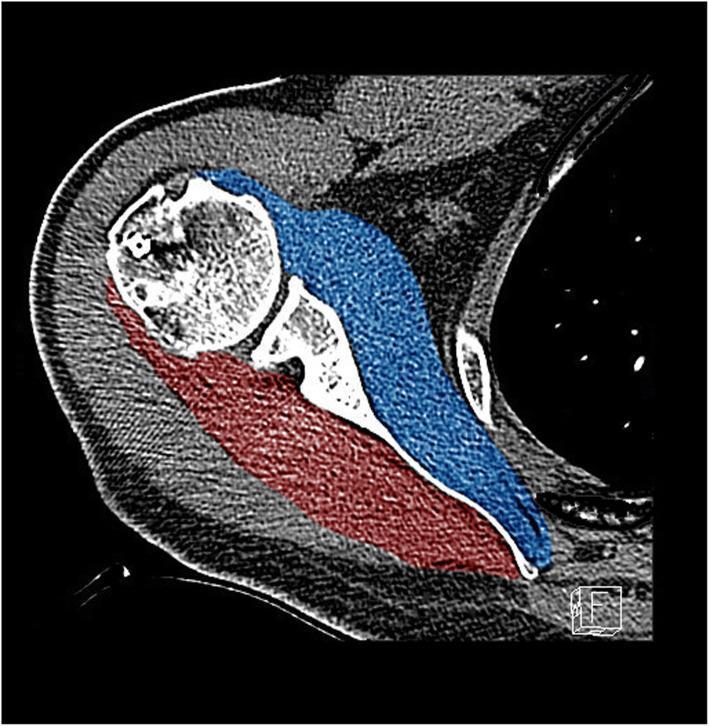
The rotator cuff (SITS) — Supraspinatus, Infraspinatus, Teres minor, Subscapularis — performs two fundamental biomechanical roles:
- Concavity compression: Depress and stabilize the humeral head into the glenoid socket
- Force couple: Balance the deltoid's superior shear force to maintain the humeral head's center of rotation
Force Couple Mechanism
- The deltoid generates a large superiorly directed force during abduction
- Without the rotator cuff, the humeral head would translate superiorly (impingement)
- The inferior cuff (infraspinatus, teres minor, subscapularis inferior fibers) provide a downward counterforce, maintaining the head centered on the glenoid
- In the coronal plane: deltoid vs. inferior cuff
- In the transverse plane: subscapularis (anterior) balanced against infraspinatus + teres minor (posterior) — key for rotational stability
Rotator Cuff Innervation
- Supraspinatus, infraspinatus → suprascapular nerve
- Teres minor → axillary nerve
- Subscapularis → upper and lower subscapular nerves
Clinical note: Shoulder internal rotators (pectoralis major, latissimus dorsi, teres major, subscapularis) are significantly stronger than external rotators. This imbalance explains why posterior dislocations occur with electric shock and seizures — powerful, unopposed internal rotation.
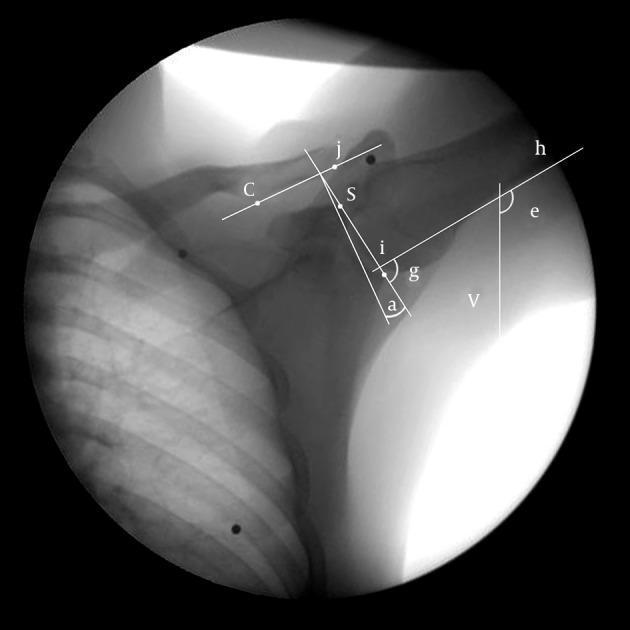
4. Scapulohumeral Rhythm
One of the most important biomechanical concepts of the shoulder:
For every 2° of glenohumeral abduction, there is 1° of scapulothoracic upward rotation → 2:1 ratio
- Total shoulder abduction (~180°) = 120° GH + 60° scapulothoracic
- Scapular upward rotation optimally positions the glenoid to receive the humeral head throughout the arc
- Loss of normal rhythm (e.g., in rotator cuff pathology, frozen shoulder) → impingement, pain, and reduced function
Corresponding clavicular motion at the SC joint: ~30° of rotation with full shoulder elevation; at the AC joint: ~5–8° rotation but the clavicle rotates 40–50° overall.
5. Range of Motion
| Movement | Range |
|---|---|
| Abduction | 0–180° |
| Flexion | 0–180° |
| Extension | 0–60° |
| Internal rotation | 0–90° |
| External rotation | 0–90° |
| Adduction | 0–50° |
The glenohumeral joint alone accounts for ~120° of abduction; the remaining ~60° comes from scapular rotation and clavicular elevation.
6. Neurovascular Spaces
Three important muscle-defined spaces around the posterior shoulder have direct biomechanical and clinical relevance:
| Space | Borders | Contents |
|---|---|---|
| Quadrangular space | Teres minor (sup), teres major (inf), long head of triceps (med), surgical neck of humerus (lat) | Axillary nerve, posterior humeral circumflex vessels |
| Triangular space | Teres minor (sup), teres major (inf), long head of triceps (lat) | Scapular circumflex vessels |
| Triangular interval | Teres major (sup), long head of triceps (med), humerus (lat) | Radial nerve, profunda brachii artery |
7. Biomechanical Implications of Common Pathologies
| Pathology | Biomechanical Consequence |
|---|---|
| Rotator cuff tear | Loss of force couple → superior humeral head migration → impingement |
| Labral tear (Bankart) | Loss of concavity compression → anterior instability |
| Adhesive capsulitis | Loss of normal GH arthrokinematics → scapulohumeral block (humerus and scapula move as unit) |
| AC joint disruption | Loss of clavicular control of scapular rotation → reduced overhead function |
| Os acromiale | Incomplete acromion fusion → contributes to impingement syndrome |
8. Key Biomechanical Principles — Summary
- Mobility at the expense of stability — the GH joint sacrifices bony congruence for ROM
- Four-joint coordination — all four articulations must function in harmony for normal shoulder motion
- 2:1 scapulohumeral rhythm — essential for impingement-free overhead function
- Force couple — rotator cuff and deltoid must balance each other for centered humeral head rotation
- Concavity compression — the rotator cuff maintains joint compression proportional to load
- Position-specific ligament recruitment — different GH ligaments are primary restraints at different arm positions
Sources: Miller's Review of Orthopaedics, 9th Ed.; Gray's Anatomy for Students
This is a shared conversation. Sign in to Orris to start your own chat.