
muscles its types classification, function and classification of skeletal muscles
Reading File
Now let me search the medical library for comprehensive content on muscle types, classification, and skeletal muscle details.
Finding Sources
Finding Sources
muscles its types classification, function and classification of skeletal muscles from general anatomy
Reading File
This is a broad anatomy topic. Let me search the library for relevant anatomy content on muscles simultaneously.
Finding Sources
Finding Sources
Finding Sources
I found anatomy textbooks and relevant sections. Let me search specifically in the anatomy textbooks and also pull skeletal muscle content from histology.
Finding Sources
Finding Sources
Finding Sources
Excellent! I found great sources. Let me now read the key sections from the THIEME General Anatomy textbook and Gray's Anatomy, plus other relevant sections in parallel.
Reading File
Reading File
Reading File
Excellent content. Now let me read more from the THIEME General Anatomy atlas which has the most relevant anatomy classification content, and also the muscle fiber types sections.
Reading File
Reading File
Now let me read the key section on types of muscles and their overview from the THIEME General Anatomy atlas, starting from the right section:
Reading File
Reading File
Let me now read the motor unit, fiber types, and muscle shapes content:
Reading File
Reading File
Now let me fetch the key diagram images and read the muscle fiber types section:
Reading File
Loading Image
Excellent! I now have a comprehensive set of information. Let me also fetch the pennate/nonpennate diagram:
Loading Image
I now have all the content I need. Let me compile a comprehensive, well-structured answer based on the authoritative textbooks.
Muscles: Types, Classification, and Functions
(Sources: Gray's Anatomy for Students; THIEME Atlas of Anatomy - General Anatomy and Musculoskeletal System; Harper's Illustrated Biochemistry)
1. Overview of Muscle Tissue
Muscle is a highly specialized tissue that converts the chemical energy of ATP into mechanical energy. The muscular system is commonly described as consisting of three types of muscle tissue. These types are distinguished by their control (voluntary vs. involuntary), histological appearance (striated vs. non-striated), and anatomical location (somatic vs. visceral).
"The muscular system is generally regarded as consisting of one type of muscle found in the body - skeletal muscle. However, there are two other types of muscle tissue found in the body, smooth muscle and cardiac muscle." - Gray's Anatomy for Students
2. The Three Types of Muscle
A. Skeletal Muscle
| Feature | Detail |
|---|---|
| Control | Voluntary (somatic motor nerves) |
| Appearance | Striated (cross-striped) |
| Location | Attached to bones and other structures |
| Cell structure | Long, multinucleated fibers arranged in parallel bundles |
| Contraction | Powerful but fatigues; contracts in one dimension |
Skeletal muscle forms the majority of muscle tissue in the body. It provides movement, support, and gives form to the body. Individual muscles are commonly named based on:
- Shape - e.g., rhomboid major
- Attachments - e.g., sternohyoid
- Function - e.g., flexor pollicis longus
- Position - e.g., palmar interosseous
- Fiber orientation - e.g., external oblique
B. Cardiac Muscle
| Feature | Detail |
|---|---|
| Control | Involuntary (visceral motor nerves) |
| Appearance | Striated |
| Location | Walls of the heart (myocardium) and proximal large vessels |
| Cell structure | Branching network of individual cells linked electrically and mechanically |
| Contraction | Less powerful than skeletal; highly resistant to fatigue |
Cardiac muscle cells are interconnected mechanically and electrically, allowing them to function as a single coordinated unit (functional syncytium).
C. Smooth Muscle
| Feature | Detail |
|---|---|
| Control | Involuntary (visceral motor nerves) |
| Appearance | Non-striated (no striations = "smooth") |
| Location | Walls of blood vessels, GI tract, respiratory, genitourinary systems; hair follicles; eyeball |
| Cell structure | Elongated or spindle-shaped fibers |
| Contraction | Slow, sustained; shortens in all directions (like inflated balloon skin) |
3. Structural Organization of Skeletal Muscle
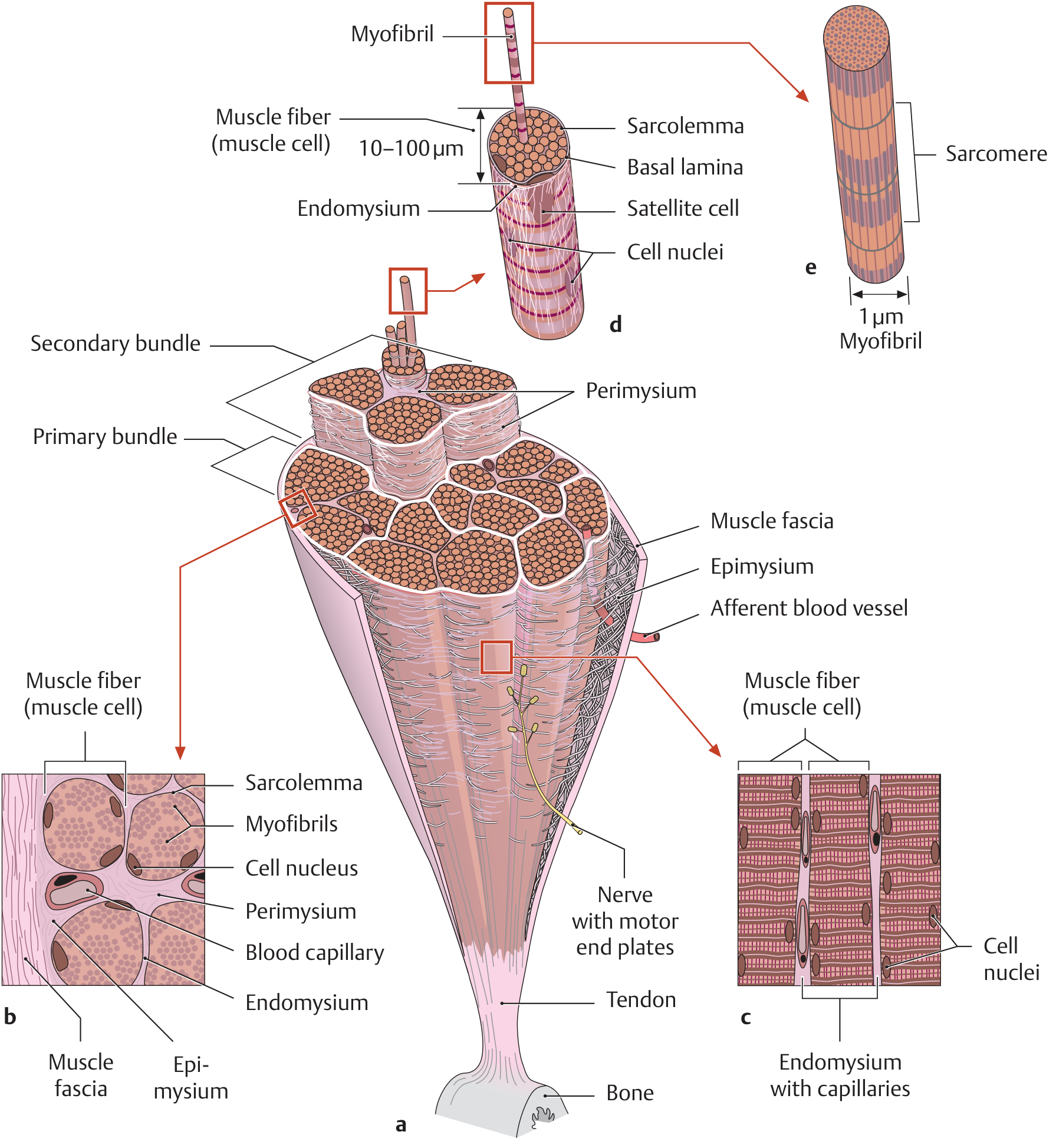
Structure of a skeletal muscle - THIEME General Anatomy Atlas
Skeletal muscle fibers and connective tissue are tightly interwoven, with connective tissue arranged in three sheaths:
| Sheath | Description |
|---|---|
| Endomysium | Innermost sheath; surrounds and condenses 200-250 muscle fibers into primary bundles; contains motor axon end branches and capillaries (300-400/mm²) |
| Perimysium | Surrounds multiple primary bundles into secondary bundles (visible to naked eye); important for transmitting tensile force to tendons |
| Epimysium | Outermost loose connective tissue layer beneath the muscle fascia; connects to the muscle |
Individual skeletal muscle fibers are among the largest cells in the body:
- Average diameter ~60 μm (range 10-100 μm)
- Length up to 20 cm
- Multinucleated (~50 nuclei per mm length), nuclei lie just beneath the sarcolemma
- Contain myofibrils, mitochondria, L-system (sarcoplasmic reticulum) and T-system (transverse tubules)
- Satellite cells (dormant stem cells, ~800/mm³) lie between sarcolemma and basal membrane - the regeneration reserve
4. Classification of Skeletal Muscles
4.1 Classification by Fiber Arrangement (Shape/Architecture)
This is the most important anatomical classification of skeletal muscles.
A. Nonpennate (Parallel-Fibered) Muscles
Fibers run roughly along the longitudinal direction of the tendon (= muscle line of action). Nearly all force is transmitted to the tendon.
- Maximum fiber shortening and actual shortening during activity are almost identical
- Anatomical cross-section ≈ physiological cross-section
- Better suited for range of movement (excursion)
- Example: sartorius, biceps brachii
B. Pennate Muscles
Fibers form a pennation angle (up to 30°) with the longitudinal axis of the tendon - like feathers of a quill (Latin: penna = feather).
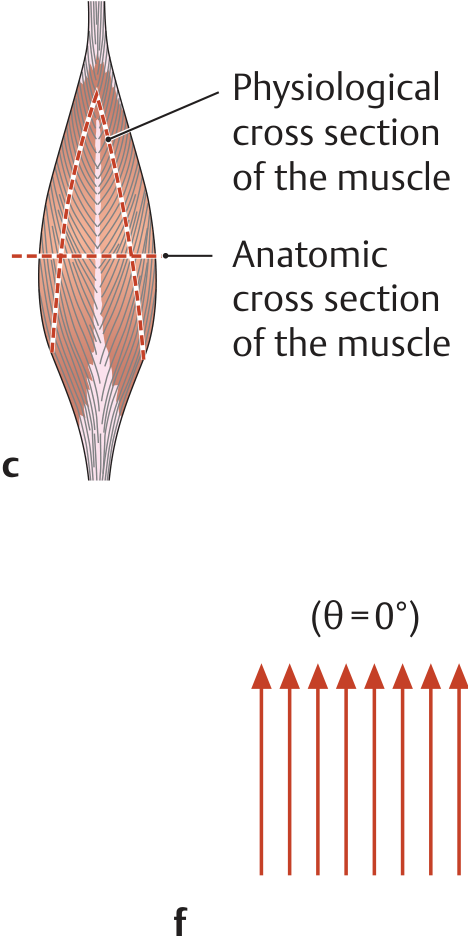
| Type | Description | Example |
|---|---|---|
| Unipennate | Fibers insert from one side of central tendon | Flexor pollicis longus |
| Bipennate | Fibers insert from both sides of central tendon | Rectus femoris |
| Multipennate | Multiple sets of pennate fibers | Deltoid |
Pennate muscles: physiological cross-section > anatomical cross-section - more fibers can insert into the tendon, generating greater force at the cost of range of movement.
"The greater the pennation angle, the greater the physiological cross-sectional area and thus the lifting force." - THIEME General Anatomy Atlas
4.2 Classification by Muscle Fiber Types (Histophysiological)
All striated skeletal muscles contain two main muscle fiber types:
| Property | Type I (Slow-twitch / ST) | Type II (Fast-twitch / FT) |
|---|---|---|
| Color | Red (postural muscles) | White (muscles of movement) |
| Twitch speed | Slow (~100 ms) | Fast (~30 ms) |
| Metabolism | Oxidative (aerobic) | Glycolytic (anaerobic) |
| Fatigue | Slow to fatigue | Rapid fatigue |
| Motor units | Large (thousands of fibers) | Small (<100 fibers) |
| Myoglobin | Rich | Scant |
| Mitochondria | Abundant | Few |
| Glycogen | Little (PAS-negative) | Abundant (PAS-positive) |
| Vascularity | Highly vascularized | Poor capillary supply |
| Primary role | Endurance, posture | Brief, intense, explosive activity |
| Tendency | Prone to shortening (needs stretching) | Prone to atrophy (needs strengthening) |
| Example athletes | Long-distance runners, cyclists, rowers | Sprinters, weight lifters, jumpers |
Type II fibers are further subdivided:
- Type IIA - intermediate; fast-twitch oxidative-glycolytic
- Type IIB - pure fast-twitch glycolytic (most fatigable)
"The basic distribution pattern of type I and type II fibers in individual skeletal muscles is apparently genetically determined... However, as skeletal muscles are highly adaptable, the genetically programmed distribution can be influenced through neuromuscular activity (exercise)." - THIEME General Anatomy Atlas
4.3 Classification by Number of Heads/Bellies
| Name | Heads/Bellies | Example |
|---|---|---|
| Biceps | 2 heads | Biceps brachii, biceps femoris |
| Triceps | 3 heads | Triceps brachii |
| Quadriceps | 4 heads | Quadriceps femoris |
| Digastric | 2 bellies | Digastric muscle |
4.4 Classification by Action/Function
| Type | Function | Example |
|---|---|---|
| Prime mover (agonist) | Produces the primary movement | Biceps brachii in elbow flexion |
| Antagonist | Opposes/controls the agonist | Triceps brachii in elbow flexion |
| Synergist | Assists the prime mover | Brachialis assisting biceps |
| Fixator/Stabilizer | Stabilizes the origin of prime mover | Rotator cuff stabilizing glenohumeral joint |
4.5 Classification by Joints Crossed
| Type | Definition | Example |
|---|---|---|
| Uniarticular | Crosses one joint | Brachialis |
| Biarticular | Crosses two joints | Biceps femoris, rectus femoris |
| Multiarticular | Crosses more than two joints | Finger flexors/extensors |
5. Motor Unit
A motor unit = all muscle fibers innervated by one alpha-motoneuron (motor nerve cell of spinal cord):
- Small motor units (<100 fibers): mostly fast-twitch (type II) fibers; found in muscles requiring precision (eye muscles, finger muscles)
- Large motor units (thousands of fibers): mostly slow-twitch (type I) fibers; found in postural/power muscles (gluteal, back muscles)
The motor end plate (neuromuscular synapse) uses acetylcholine as its neurotransmitter, stored in synaptic vesicles.
6. General Functions of Skeletal Muscle
- Movement - moves bones at joints by contraction
- Posture and support - maintains body position against gravity
- Stabilization of joints - provides dynamic stability to joints (e.g., rotator cuff)
- Body form - gives form and shape to the body
- Protection - protects underlying viscera (e.g., abdominal muscles)
- Heat production - muscle metabolism generates ~85% of body heat
- Pumping venous/lymphatic return - especially in lower limbs (muscle pump)
Summary Table: Three Muscle Types Compared
| Feature | Skeletal | Cardiac | Smooth |
|---|---|---|---|
| Control | Voluntary | Involuntary | Involuntary |
| Striations | Yes | Yes | No |
| Nuclei | Multiple, peripheral | 1-2, central | Single, central |
| Location | Body wall/limbs | Heart wall | Viscera/vessels |
| Speed | Fast or slow | Intermediate | Slow, sustained |
| Fatigue | Yes (type II) | Fatigue-resistant | Slow, minimal |
| Nerve supply | Somatic motor | Visceral motor (ANS) | Visceral motor (ANS) |
References:
- Gray's Anatomy for Students - Muscular System section
- THIEME Atlas of Anatomy: General Anatomy and Musculoskeletal System - Sections 5.2-5.4 (Skeletal muscle fiber types, structure, pennation)
- Harper's Illustrated Biochemistry, 32nd Ed. - Chapter 51 (Three types of muscle)
This is a shared conversation. Sign in to Orris to start your own chat.