
Role of nacetyl cysteine in viral hepatitis
Reading File
N-acetylcysteine (NAC) is a well-established antioxidant and glutathione precursor used in several liver conditions. In viral hepatitis, it works primarily by replenishing intracellular glutathione, reducing oxidative stress, and improving hepatic microcirculation. It is most studied in acute liver failure (ALF) of various etiologies, including viral causes.
Searching sources...
Finding Sources
Finding Sources
Searching PubMed
"N-acetylcysteine" AND "viral hepatitis"
Good results. Let me read the key sections in depth - particularly the Yamada's textbook section on NAC for non-acetaminophen ALF (which includes hepatitis B data) and the Goldman-Cecil section.
Reading File
Reading File
Searching PubMed
"N-acetylcysteine" AND "acute liver failure" AND hepatitis
Excellent - I have very strong textbook data with actual trial results. Let me get the full NAC trial section from Yamada's and also get the Harrison's alcoholic hepatitis section and the PubMed abstract for the systematic review.
Reading File
Reading File
Reading Article
PMID: 35371352
I now have comprehensive, high-quality data to write a thorough answer. Let me fetch the key Kaplan-Meier survival curve image and the NAC trial results bar graph from Yamada's to enhance the response.
Loading Image
Loading Image
I now have all the information needed for a thorough, well-illustrated answer.
N-Acetylcysteine (NAC) in Viral Hepatitis
Mechanism of Action
NAC works through several complementary pathways relevant to hepatic injury:
- Glutathione replenishment - NAC is a precursor of L-cysteine, which is the rate-limiting substrate for intracellular glutathione (GSH) synthesis. It replenishes both mitochondrial and cytosolic GSH stores depleted during hepatic oxidative stress.
- Direct antioxidant - Acts as a free radical scavenger (particularly against hydroxyl and superoxide radicals).
- Improved hepatic microcirculation - Increases nitric oxide bioavailability, improving sinusoidal blood flow and oxygen delivery to hepatocytes.
- Anti-inflammatory effects - Reduces NF-κB activation and pro-inflammatory cytokine production (TNF-α, IL-1β).
- Mitochondrial protection - Prevents mitochondrial permeability transition pore opening, a key step in hepatocyte apoptosis/necrosis.
- Lippincott Illustrated Reviews: Pharmacology, NAC works as a "glutathione precursor and glutathione substitute and assists with sulfation... [and] may also function as an antioxidant to aid in recovery"
1. Acute Viral Hepatitis Causing Acute Liver Failure (ALF)
This is the most clinically important context. Viral hepatitis - particularly hepatitis B (acute or reactivation) - is a leading cause of non-acetaminophen ALF worldwide.
The Landmark RCT (Lee et al., 2009 - Acute Liver Failure Study Group)
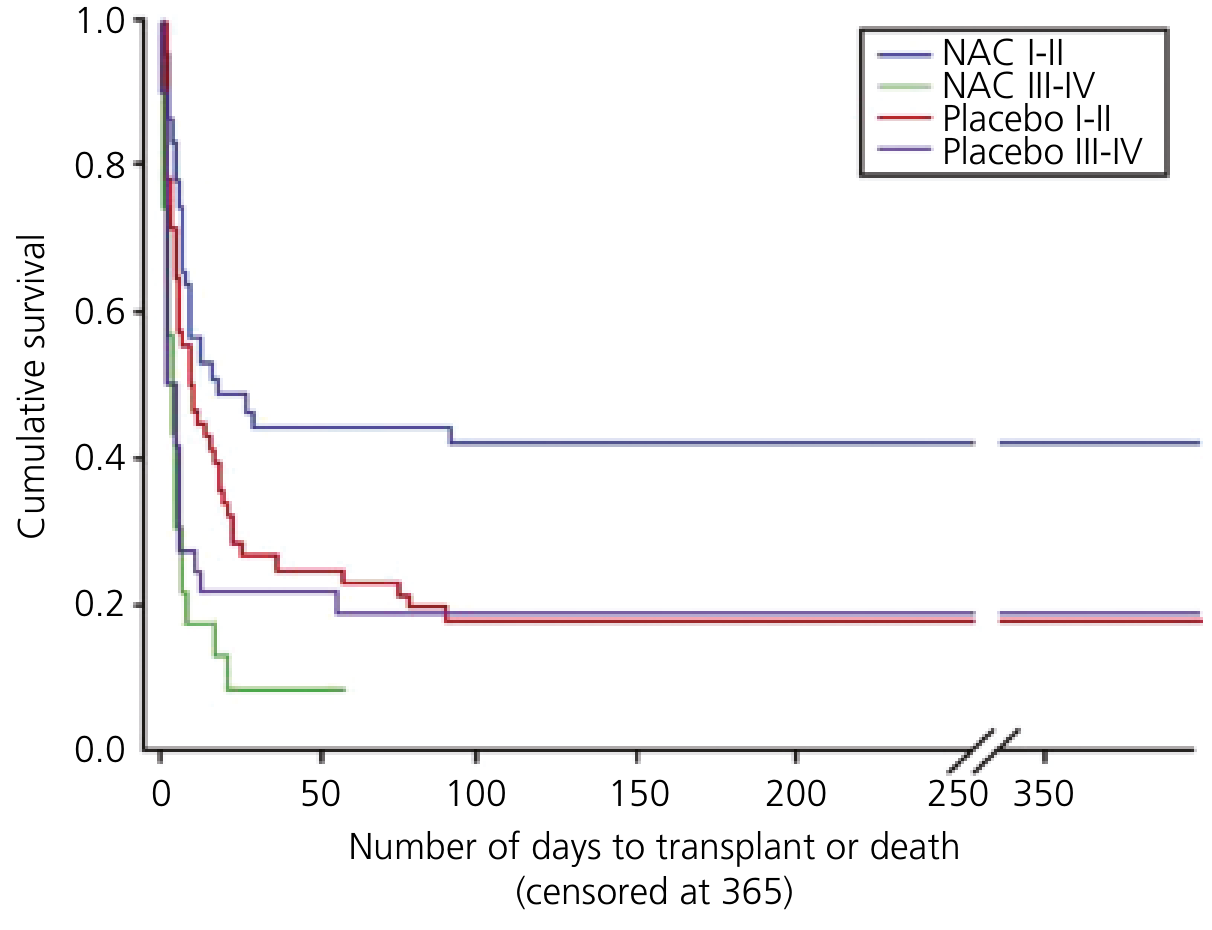
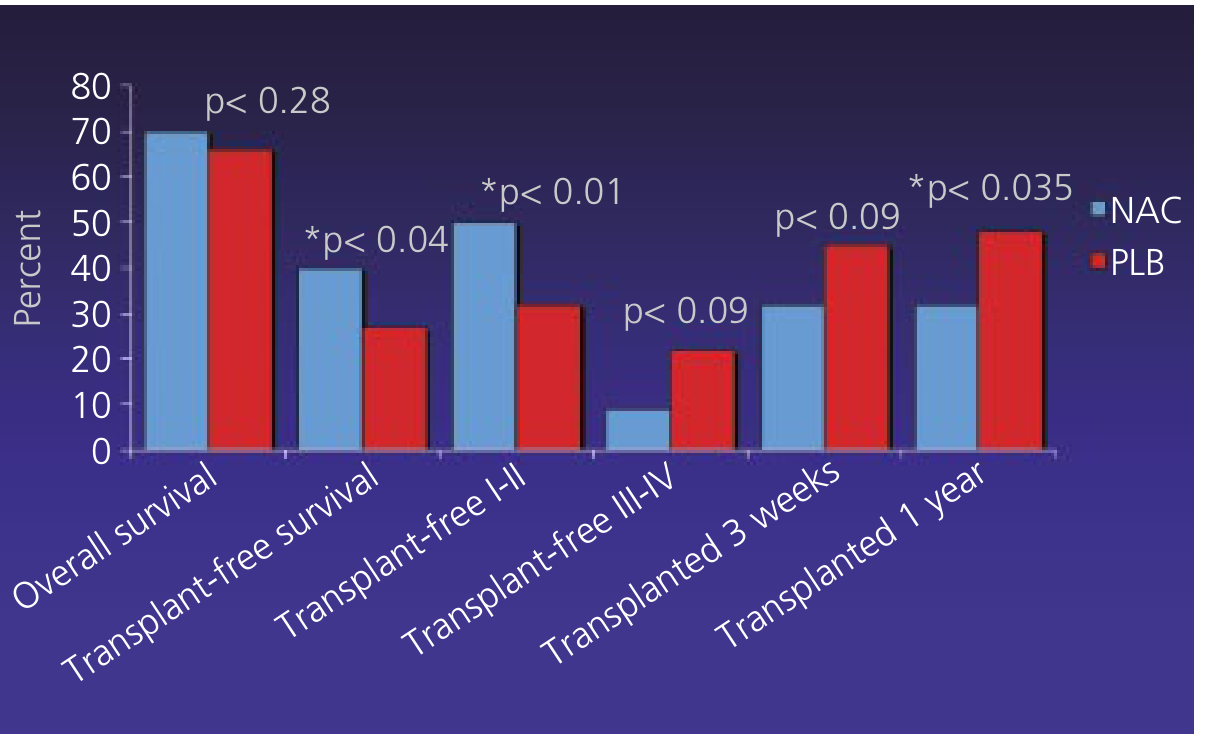
A randomized, placebo-controlled, double-blind trial of IV NAC in non-acetaminophen ALF found:
- Overall survival: 70% (NAC) vs. 66% (placebo) - not statistically significant (p < 0.28)
- Transplant-free survival (overall): 40% (NAC) vs. 27% (placebo) - p < 0.04 (significant)
- Early encephalopathy (grades I-II): Transplant-free survival 52% (NAC) vs. 30% (placebo) - p < 0.01
- Advanced encephalopathy (grades III-IV): No benefit; transplant-free survival actually lower with NAC (8% vs. 22%, p < 0.09 - not significant but trend against NAC)
Hepatitis B Subgroup (Key Data)
The HBV subgroup showed the greatest benefit from NAC:
| Outcome | Placebo (n=12) | NAC (n=25) |
|---|---|---|
| Overall survival | 50% (6/12) | 76% (19/25) |
| Transplant-free survival | 17% (2/12) | 40% (10/25) |
"Drug-induced liver injury and hepatitis B (in bold) demonstrated the greatest differences in rates of spontaneous survival in these small patient subsets." - Yamada's Textbook of Gastroenterology, 7th ed.
Clinical Implication
Based on this, Goldman-Cecil Medicine recommends:
"N-acetylcysteine is also commonly recommended in acute liver failure caused by idiosyncratic drug-induced liver injury, hepatitis B, and autoimmune hepatitis, as well as acute liver failure of indeterminate cause, especially in patients who have grade 1 or 2 encephalopathy."
2. Alcoholic Hepatitis
NAC has been studied as an adjunct to corticosteroids in severe alcoholic hepatitis (discriminant function > 32):
- Harrison's Principles of Internal Medicine (2025) states: "There is modest evidence that intravenous N-acetylcysteine plus glucocorticoids may have a short-term survival benefit in alcoholic hepatitis if the DF is >32."
- It is not recommended as monotherapy, and is considered adjunctive with uncertain long-term benefit.
3. Meta-Analysis Evidence (2022)
A systematic review and meta-analysis by Amjad et al. (2022) pooling 672 patients from 5 prospective studies (viral hepatitis was the most common etiology at ~46% of NAC-treated patients) found:
- Transplant-free survival: 55.1% (NAC) vs. 28.1% (control) - RR = 0.56, 95% CI: 0.33-0.94 (significant)
- Overall survival: 71% vs. 59.8% - RR = 0.73, 95% CI: 0.48-1.09 (not significant)
- Hospital stay: Significantly shorter with NAC (SMD = -1.62, p < 0.001)
Conclusion from meta-analysis: NAC significantly improves transplant-free survival and shortens hospital stay, though it does not significantly reduce overall mortality when transplantation is available.
4. Other Viral Etiologies
- Hepatitis A/E causing ALF: No specific RCT data, but NAC is used empirically given its safety profile and the plausible mechanism.
- Herpes simplex hepatitis: Acyclovir is the specific treatment, but NAC may be co-administered for ALF support.
- Viral hepatitis in at-risk patients: Patients with pre-existing viral hepatitis (chronic HBV/HCV) are at heightened risk of acetaminophen hepatotoxicity due to depleted GSH reserves. NAC is first-line in any suspected acetaminophen overdose in this population. - Lippincott Illustrated Reviews: Pharmacology
Dosing
| Route | Protocol |
|---|---|
| IV (preferred in ALF) | 150 mg/kg over 60 min (loading), then 12.5 mg/kg/hr x 4 hr, then 6.25 mg/kg/hr x 16 hr (standard 21-hr protocol) |
| Oral | 140 mg/kg loading dose, then 70 mg/kg every 4 hours x 17 doses |
IV is preferred in ALF because oral absorption may be impaired in critically ill patients, and IV NAC also directly reduces risk of hypotension, cerebral edema, and death.
Key Takeaways
| Clinical Context | Evidence | Recommendation |
|---|---|---|
| HBV-related ALF (early encephalopathy) | RCT + meta-analysis | Use IV NAC (strongest evidence) |
| Non-acetaminophen ALF (grades I-II) | RCT (Lee 2009) | Use IV NAC |
| Non-acetaminophen ALF (grades III-IV) | No benefit in RCT | Use with caution / bridge to transplant |
| Alcoholic hepatitis (severe, DF >32) | Limited RCT data | NAC + corticosteroids (adjunct) |
| Viral hepatitis + APAP overdose | Strong evidence | NAC is standard of care |
| Chronic viral hepatitis | No direct evidence | Not routinely recommended |
The therapeutic window is narrow - NAC benefits are most pronounced when started early, in patients with mild-to-moderate encephalopathy (grades I-II). Once advanced encephalopathy develops, liver transplantation evaluation takes priority.
This is a shared conversation. Sign in to Orris to start your own chat.