
Medication for headache
I'll give you a quick overview first, then pull from the medical library for detailed information.
Quick answer: Headache medications fall into two main categories - (1) acute/abortive treatments taken when a headache starts (analgesics like paracetamol/ibuprofen, triptans for migraines, etc.) and (2) preventive medications taken daily to reduce frequency. Choice depends on headache type (tension, migraine, cluster) and severity.
Searching sources...
Reading File
Now I'll search the medical library for headache medications in parallel.
Finding Sources
Finding Sources
Good results. Let me read the most relevant sections from Bradley & Daroff's Neurology and Goldman-Cecil Medicine in parallel.
Reading File
Reading File
Excellent - I have detailed tables on both preventive medications and headache types. Let me read the symptomatic/acute treatment section from Bradley & Daroff's more carefully.
Reading File
Reading File
There's a helpful flowchart image in the textbook. Let me fetch it and also read more of the preventive medications table.
Loading Image
Reading File
I now have comprehensive information from authoritative textbooks (Goldman-Cecil Medicine and Bradley & Daroff's Neurology). Here is a thorough, well-organized answer:
Medications for Headache
Headache treatment depends on the type (tension, migraine, cluster) and severity of the attack. There are two main categories: acute (abortive) treatments and preventive treatments.
Approach to Diagnosis First
The flowchart below (from Goldman-Cecil Medicine) guides initial management:
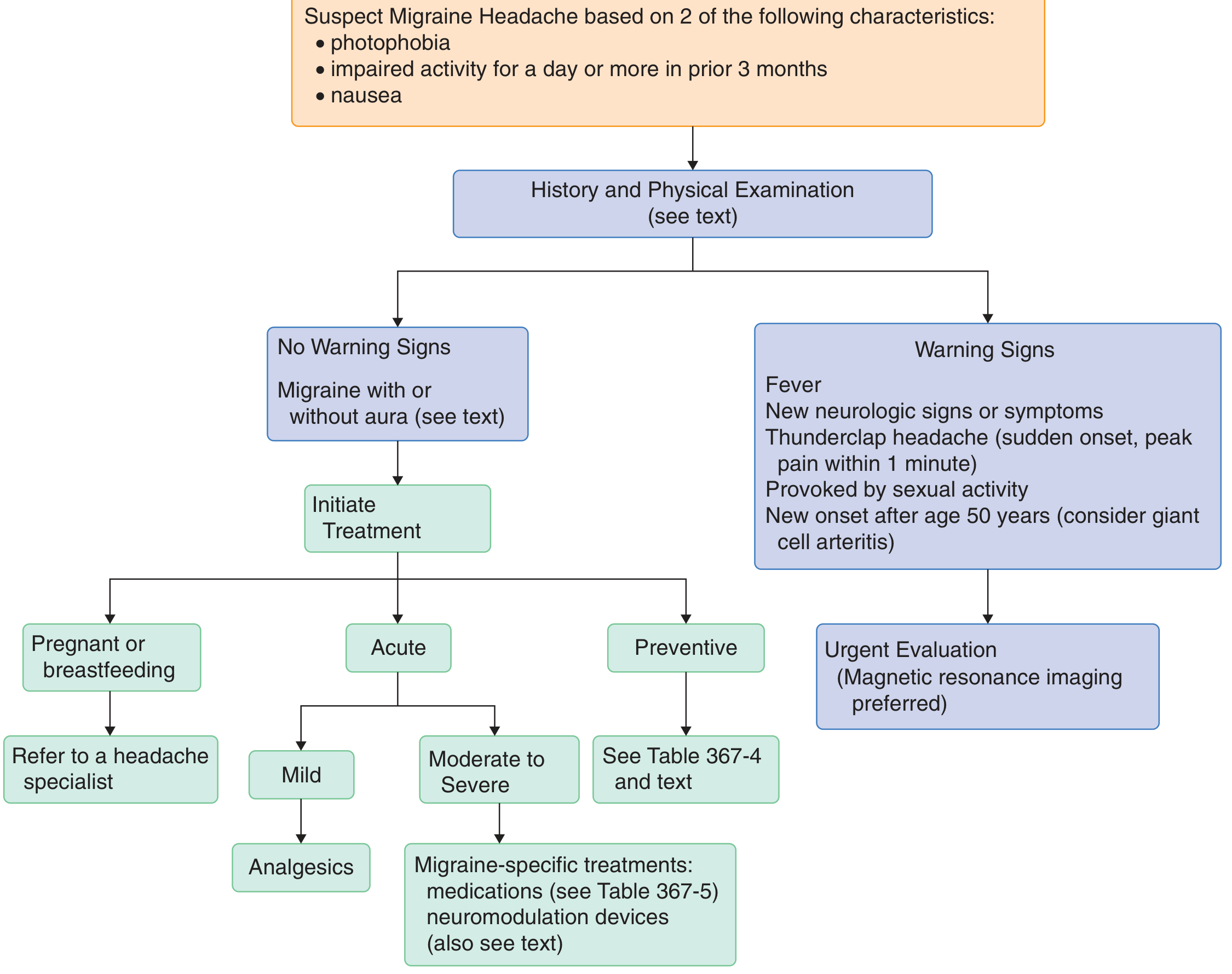
Warning signs requiring urgent evaluation (MRI preferred):
- Fever + headache
- New neurological signs/symptoms
- Thunderclap headache (peak pain within 1 minute)
- Provoked by sexual activity
- New onset after age 50 (consider giant cell arteritis)
1. Acute (Abortive) Treatment
Mild Attacks - Non-Specific Analgesics
| Drug | Dose | Notes |
|---|---|---|
| Acetaminophen (Paracetamol) | 650-1000 mg | First-line OTC |
| Aspirin | 250-1000 mg | Also has anti-inflammatory action |
| Ibuprofen | 400-600 mg | NSAID; effective for tension + migraine |
| Naproxen | 500-825 mg | Longer-acting NSAID |
| Diclofenac | 50 mg | NSAID option |
| Ketoprofen | 75 mg | NSAID option |
Caffeine added to analgesics aids absorption, induces mild vasoconstriction, and enhances efficacy. Combination preparations (e.g., aspirin + acetaminophen + caffeine) are commonly used.
Start treatment as early as possible - once a migraine is fully developed, oral absorption decreases due to reduced GI motility. - Bradley & Daroff's Neurology in Clinical Practice
Moderate to Severe Attacks - Migraine-Specific Drugs
Triptans (5-HT1B/1D agonists) - Grade A Evidence
| Triptan | Routes Available |
|---|---|
| Sumatriptan | Oral, SC injection, intranasal |
| Zolmitriptan | Oral, intranasal |
| Rizatriptan | Oral |
| Naratriptan | Oral |
| Almotriptan | Oral |
| Eletriptan | Oral |
| Frovatriptan | Oral (longest half-life; useful for menstrual migraine) |
Contraindications to triptans: Uncontrolled hypertension, ischemic heart disease, Prinzmetal angina.
Newer Alternatives to Triptans
- Lasmiditan (50-200 mg) - selective 5-HT1F agonist, no vasoconstrictive effects, safe when triptans are contraindicated. Note: sedating - avoid driving for at least 8 hours.
- Rimegepant (75 mg) - CGRP receptor antagonist (gepant); ~10% absolute increase in pain freedom vs placebo at 2 hours. Also approved for prevention (75 mg every other day).
- Ubrogepant (50-100 mg) - another gepant option when triptans fail or are contraindicated.
Ergot Derivatives
- Dihydroergotamine (DHE): 1-2 mg intranasal or SC; 0.5-1 mg IV (requires antiemetic pre-treatment)
- Ergotamine tartrate: 2 mg sublingual or 1-2 mg oral - effective if taken early
Very Severe / Refractory Attacks
| Drug | Dose/Route | Notes |
|---|---|---|
| Ketorolac | 60 mg IM / 30 mg IV | IV NSAID |
| Prochlorperazine | 10-25 mg IM / 10 mg IV | Dopamine D2 antagonist + antiemetic |
| Metoclopramide | 10 mg IV | Antiemetic + prokinetic |
| DHE + antiemetic | IV/SC | Gold standard for refractory attacks |
| Celecoxib solution | 120 mg oral | COX-2 inhibitor |
Opioids should NOT be used except as a last resort, and oral opiates should not be used for chronic recurrent primary headaches. Opioid overuse leads to medication overuse headache (rebound). - Goldman-Cecil Medicine
2. Preventive (Prophylactic) Treatment
Indicated when headaches interfere with activities 3 or more days per month, or are severe/prolonged.
| Drug Class | Examples | Dose | Notes |
|---|---|---|---|
| Beta-blockers | Propranolol, nadolol, timolol | Propranolol 20-80 mg | First-line for migraine; caution in asthma, low BP |
| Calcium-channel blockers | Verapamil, amlodipine | Verapamil 120-480 mg/day | Also used for cluster headache |
| NSAIDs | Naproxen, ibuprofen | Naproxen 200-600 mg/day | Menstrual migraine; GI side effects |
| Indomethacin | 25-50 mg TID | Drug of choice for paroxysmal hemicrania & hemicrania continua | |
| Tricyclic antidepressants | Amitriptyline, nortriptyline | Low doses | Tension-type + migraine prevention |
| Anticonvulsants | Valproate, topiramate | Varies | Valproate: avoid in women of childbearing age |
| CGRP monoclonal antibodies | Erenumab, fremanezumab, eptinezumab, galcanezumab | Monthly SC / quarterly | Modern biologics; highly effective |
| Small-molecule gepants | Atogepant, rimegepant | Daily/alternate-day | Oral CGRP inhibitors for prevention |
| OnabotulinumtoxinA | Botox | Injections every 12 weeks | FDA-approved for chronic migraine only |
3. Adjunct & Special Situations
- Antiemetics (metoclopramide 10 mg, promethazine 25 mg, prochlorperazine 10 mg) - often needed alongside other agents when nausea/vomiting is present
- Cluster headache: High-flow 100% oxygen (gold standard acute), SC sumatriptan, intranasal zolmitriptan; verapamil for prevention
- Pregnancy: Acetaminophen is safest; avoid NSAIDs and triptans if possible; refer to headache specialist
- Tension-type headache: Simple analgesics (paracetamol, ibuprofen); amitriptyline for prevention
- Non-pharmacological: Neuromodulation devices (vagus nerve stimulation, TMS), biofeedback, acupuncture, rest in a dark/quiet room with ice pack
Key Caution: Medication Overuse Headache (MOH)
Using acute medications on >10-15 days/month (especially opioids, triptans, ergotamines, and combination analgesics) can cause chronic daily rebound headache. Patients who smoke are particularly susceptible. Always limit acute medication frequency to prevent this.
Sources: Goldman-Cecil Medicine, 2-Volume Set; Bradley and Daroff's Neurology in Clinical Practice
Disclaimer: This is for educational purposes only. Always consult a healthcare professional for diagnosis and personalized treatment.
This is a shared conversation. Sign in to Orris to start your own chat.