
Tell my pathophysiology of hypothyroid
Reading File
Now let me search the medical library for hypothyroidism pathophysiology content.
Finding Sources
Finding Sources
Finding Sources
Finding Sources
Reading File
Good finds. Now let me read the most authoritative sources - Robbins Pathology, Guyton & Hall, and Goldman-Cecil for comprehensive pathophysiology content.
Reading File
Reading File
Reading File
Reading File
I now have excellent content from Robbins Pathology and Guyton & Hall. Let me also fetch the myxedema image and get the Goldman-Cecil content for a complete picture.
Reading File
Loading Image
I now have comprehensive content from multiple authoritative textbooks. Let me compile a thorough answer.
Pathophysiology of Hypothyroidism
Hypothyroidism is a condition in which the thyroid gland fails to produce or secrete sufficient thyroid hormone (T3 and T4) to meet the metabolic demands of peripheral tissues. - Rosen's Emergency Medicine
1. Classification by Level of Defect
| Type | Level of Defect | TSH | Free T4 |
|---|---|---|---|
| Primary (99% of cases) | Thyroid gland itself | ↑ (elevated) | ↓ (low) |
| Secondary (Central) | Pituitary - deficient TSH secretion | Low/normal | ↓ (low) |
| Tertiary (Central) | Hypothalamus - deficient TRH secretion | Low/normal | ↓ (low) |
In primary hypothyroidism, loss of negative feedback by T3/T4 on the hypothalamus and pituitary leads to elevated TRH and TSH. In secondary/tertiary forms, the axis fails at a higher level, so TSH is not elevated. - Robbins & Kumar Basic Pathology
2. Causes and Their Mechanisms
A. Autoimmune (Most Common in Iodine-Sufficient Regions)
Hashimoto Thyroiditis is the leading cause in developed countries (female:male ratio 10:1 to 20:1, peak 45-65 years). The mechanisms of thyroid destruction include:
- CD8+ cytotoxic T lymphocytes - directly kill thyroid epithelial cells
- CD4+ T helper cells - activate macrophages, which damage follicles through cytokine-mediated inflammation
- Circulating autoantibodies (anti-thyroid peroxidase, anti-thyroglobulin) are present in nearly all patients
- Progressive lymphocytic infiltration leads to follicular atrophy and fibrosis - Robbins & Kumar Basic Pathology
B. Iodine Deficiency (Most Common Worldwide)
Iodine (~50 mg/year) is required for synthesis of T3 and T4. Without it:
- Thyroxine and T3 production falls
- Loss of negative feedback on the pituitary - TSH rises markedly
- TSH drives thyroid cell hyperplasia and colloid accumulation - endemic goiter forms (gland can enlarge 10-20x)
- Despite gland enlargement, hormone production remains insufficient - Guyton & Hall Medical Physiology
C. Enzyme/Synthesis Defects (Dyshormonogenesis)
Several enzymatic failures can block hormone synthesis:
- Deficient iodide-trapping - iodine not adequately pumped into thyroid cells
- Deficient peroxidase system - iodides cannot be oxidized to active iodine (this is also the mechanism of Wolff-Chaikoff effect from excess iodine and drugs like lithium)
- Defective coupling of iodinated tyrosines - MIT and DIT cannot form T3/T4
- Deficiency of deiodinase - iodine not recovered from MIT/DIT for reutilization - Guyton & Hall Medical Physiology
D. Iatrogenic Causes
- Surgical thyroidectomy - direct loss of thyroid tissue
- Radioactive iodine (RAI) therapy - radiation-induced destruction
- Drugs: Lithium (blocks thyroid hormone release), excess iodides (Wolff-Chaikoff effect), amiodarone - Robbins & Kumar Basic Pathology; Sabiston Textbook of Surgery
3. The HPT Axis Feedback Loop in Primary Hypothyroidism
Hypothalamus → TRH ↑↑
        ↓
Anterior Pituitary → TSH ↑↑
        ↓
Thyroid gland (damaged/dysfunctional)
        → T3/T4 ↓↓ (insufficient output)
        → No negative feedback → cycle perpetuates
The hallmark lab finding is elevated TSH + low free T4. TSH is the most sensitive screening test because it rises early, before free T4 falls below normal range (subclinical hypothyroidism: elevated TSH but normal T4). - Rosen's Emergency Medicine; Sabiston Textbook of Surgery
4. Downstream Pathophysiological Effects
Thyroid hormones regulate nearly every organ system. Their deficiency causes a global hypometabolic state:
| System | Mechanism | Effect |
|---|---|---|
| Metabolism | Decreased Na-K ATPase activity, reduced oxygen consumption | Low BMR (reduced 30-50% in myxedema), cold intolerance, weight gain |
| Cardiovascular | Reduced cardiac contractility, HR, and CO; increased cholesterol | Bradycardia, decreased cardiac output, decreased blood volume, dyslipidemia, atherosclerosis |
| Neuromuscular | Slowed nerve conduction, impaired muscle metabolism | Fatigue, somnolence (sleeping 12-14 hrs/day), muscle sluggishness, delayed deep tendon reflexes |
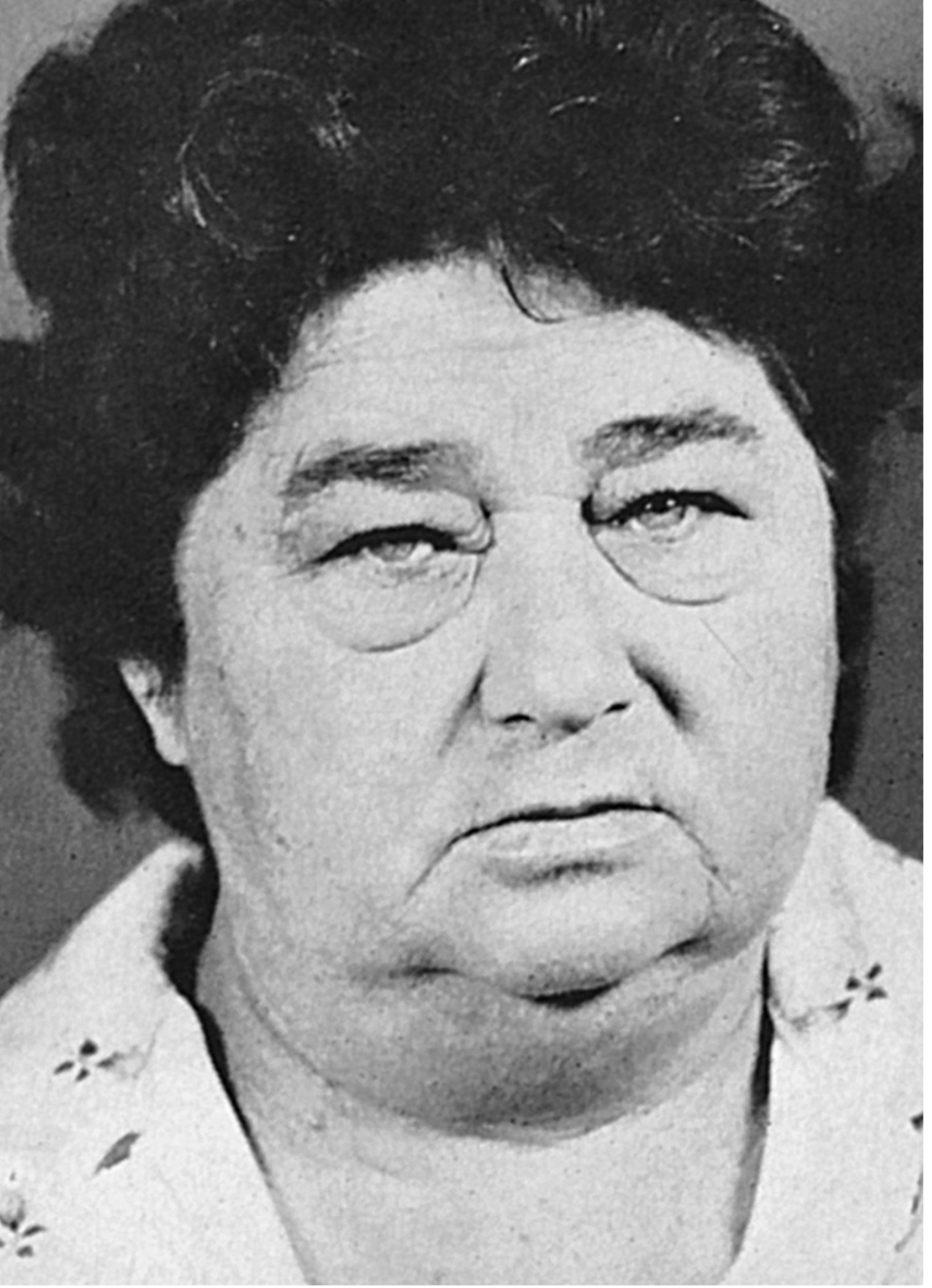
| Skin/connective tissue | Accumulation of hyaluronic acid + chondroitin sulfate in interstitium | Myxedema - non-pitting edema, periorbital puffiness, coarse dry skin, hair loss |
| GI | Decreased gut motility | Constipation |
| Reproductive | Altered steroid hormone metabolism | Menstrual irregularity, anovulation |
| Voice | Myxedematous infiltration of laryngeal tissue | Hoarse, husky, "froglike" voice |
| Mental | Reduced cerebral oxygen use | Mental sluggishness, depression, psychosis ("myxedema madness") |
- Guyton & Hall Medical Physiology
5. Myxedema - The Extreme Presentation
Myxedema is the most severe form of untreated or decompensated hypothyroidism. The hallmark is non-pitting, generalized edema caused by:
"Greatly increased quantities of hyaluronic acid and chondroitin sulfate bound with protein form excessive tissue gel in the interstitial spaces...the edema is the non-pitting type." - Guyton & Hall Medical Physiology
Myxedema crisis (coma) occurs when chronic hypothyroidism is decompensated by an acute stressor (infection, trauma, surgery). Features:
- Altered mental status/coma
- Hypothermia
- Bradycardia
- Hyponatremia
- Cardiomegaly, pericardial effusion
- Hypotension/shock - Sabiston Textbook of Surgery
6. Special Populations
Congenital Hypothyroidism (Cretinism)
- Fetus depends on maternal T3/T4 in early pregnancy (before fetal thyroid develops)
- Maternal hypothyroidism in this window causes severe fetal brain damage
- Clinical features: intellectual disability, growth failure, short stature, protruding tongue, umbilical hernia, coarse facial features
- Later in pregnancy (after fetal thyroid is established), maternal hypothyroidism has less impact on brain development - Robbins & Kumar Basic Pathology
Subclinical Hypothyroidism
- TSH elevated, but free T4 is still within normal range
- Affects 4-10% of the general population, 5-8% in pregnancy
- Represents early/compensated primary hypothyroidism - Rosen's Emergency Medicine
7. Diagnostic Correlation
| Finding | Mechanism |
|---|---|
| TSH ↑ | Loss of T3/T4 negative feedback on pituitary |
| Free T4 ↓ | Insufficient thyroid hormone production |
| Elevated cholesterol | Reduced LDL receptor expression, decreased hepatic cholesterol excretion in bile |
| Hyponatremia | SIADH-like state, increased ADH sensitivity |
| Elevated CK | Muscle involvement in myxedema |
| Macrocytic anemia | Impaired B12 absorption (associated autoimmune gastritis in Hashimoto) |
Sources: Robbins & Kumar Basic Pathology; Guyton and Hall Textbook of Medical Physiology; Sabiston Textbook of Surgery; Rosen's Emergency Medicine
This is a shared conversation. Sign in to Orris to start your own chat.